Miso brun : bienfaits, saveur et comment l’utiliser
⚠️ Avertissement médical : Les informations de cet article sont fournies à titre éducatif uniquement. Elles ne remplacent pas l’avis d’un médecin ou d’un diététicien. Consultez un professionnel de santé avant de modifier votre alimentation, notamment en cas de pathologie rénale, d’hypertension ou d’allergie au soja.
Le miso brun est une pâte fermentée japonaise à longue maturation, reconnue pour sa richesse en probiotiques, en acides aminés essentiels et en composés antioxydants qui soutiennent la santé digestive et immunitaire. Selon une étude publiée dans le Journal of Nutritional Science and Vitaminology () [1], une consommation régulière de miso est associée à une réduction significative du risque de maladies cardiovasculaires dans les populations japonaises. Voici les 5 points clés à retenir :
- Le miso brun est obtenu par fermentation prolongée (6 à 36 mois) de soja avec du sel et du koji (Aspergillus oryzae).
- Sa teneur en probiotiques naturels est supérieure à celle du miso blanc, grâce à une fermentation plus longue.
- Il contient tous les acides aminés essentiels, ce qui en fait une source de protéines complètes pour les régimes végétariens et végétaliens.
- Sa saveur est profonde, umami et légèrement salée — idéale pour les marinades, bouillons et sauces.
- Sa teneur en sodium est élevée (environ 3 500 mg pour 100 g) : une consommation modérée est recommandée.
Qu’est-ce que le miso brun exactement ?
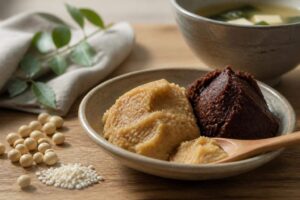
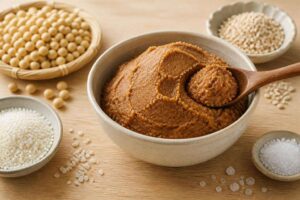
Le miso brun est une pâte fermentée traditionnelle japonaise, obtenue par la transformation lente de graines de soja avec du sel marin et un ferment appelé koji. Sa couleur brun foncé, caractéristique, résulte de la réaction de Maillard prolongée pendant la maturation. Plus la fermentation dure, plus la couleur est sombre et la saveur intense.
On distingue trois grandes familles de miso selon la durée de fermentation :
- Miso blanc (shiro miso) : fermentation courte (2 à 8 semaines), saveur douce et sucrée.
- Miso jaune (shinshu miso) : fermentation intermédiaire (2 à 3 mois), équilibre entre douceur et intensité.
- Miso brun (aka miso) : fermentation longue (6 à 36 mois), saveur profonde, umami prononcé, teneur en sel élevée.
Le miso brun est le plus utilisé dans le nord du Japon, notamment dans la région de Sendai. Il est souvent désigné sous le nom d’aka miso (miso rouge) ou de hatcho miso dans sa version la plus concentrée. Découvrez notre guide complet sur le miso de soja pour approfondir les différences entre les variétés.
Composition nutritionnelle du miso brun pour 100 g
Le miso brun présente un profil nutritionnel dense. Voici ses valeurs moyennes pour 100 g, selon les données de l’ANSES et de la base de données nutritionnelles USDA [2] :
| Nutriment | Quantité pour 100 g | % des AJR* |
|---|---|---|
| Énergie | 199 kcal | 10 % |
| Protéines | 11,7 g | 23 % |
| Glucides | 26,5 g | 10 % |
| Lipides | 6,0 g | 9 % |
| Fibres alimentaires | 5,4 g | 18 % |
| Sodium | 3 500 mg | 175 % |
| Fer | 2,5 mg | 18 % |
| Manganèse | 0,9 mg | 45 % |
| Vitamine K | 29 µg | 39 % |
| Isoflavones de soja | ~40 mg | — |
| *AJR = Apports journaliers de référence pour un adulte (2 000 kcal/jour) | ||
La portion usuelle de miso brun est de 10 à 15 g par préparation (une cuillère à soupe rase). À cette dose, l’apport en sodium reste raisonnable (350 à 525 mg). Consultez notre article sur les ingrédients du miso pour une analyse détaillée de chaque composant.
1. Le miso brun et les probiotiques : un soutien pour votre microbiote
Le miso brun non pasteurisé contient des bactéries lactiques vivantes, notamment des souches de Lactobacillus et de Pediococcus, bénéfiques pour la flore intestinale. Une étude publiée dans le Journal of Applied Microbiology () [3] a identifié plus de 200 espèces microbiennes dans le miso traditionnel à longue fermentation. Ces micro-organismes contribuent à l’équilibre du microbiote intestinal.
Pour bénéficier de ces probiotiques, choisissez un miso brun non pasteurisé et évitez de le faire bouillir : ajoutez-le en fin de cuisson, après avoir retiré la casserole du feu. La chaleur excessive (au-delà de 60 °C) détruit les bactéries vivantes. Apprenez comment soutenir votre flore intestinale avec les probiotiques naturels.
2. Miso brun et santé cardiovasculaire : ce que dit la science
Contrairement à ce que sa teneur en sodium pourrait laisser supposer, le miso brun n’est pas systématiquement associé à une élévation de la pression artérielle. Une étude de cohorte japonaise publiée dans le American Journal of Clinical Nutrition () [4] portant sur 90 000 participants a montré que la consommation quotidienne de soupe miso n’augmentait pas le risque d’hypertension, contrairement à d’autres sources de sodium alimentaire.
Les chercheurs attribuent cet effet protecteur aux isoflavones de soja et aux peptides bioactifs générés lors de la fermentation du miso brun. Ces molécules exercent un effet vasodilatateur et anti-inflammatoire documenté.
- Réduction du LDL-cholestérol dans plusieurs études d’intervention.
- Effet antioxydant supérieur au miso blanc grâce à la fermentation prolongée.
- Peptides inhibiteurs de l’ECA identifiés dans le miso à longue maturation.
3. Digestion : pourquoi le miso brun facilite l’absorption des nutriments
La fermentation prolongée du miso brun prédigère en partie les protéines du soja, les rendant plus facilement assimilables. Les protéases et amylases du koji décomposent les macromolécules en peptides courts et en acides aminés libres. Résultat : le miso brun est mieux toléré que le soja cru ou peu fermenté par les personnes sensibles aux légumineuses.
De nombreux lecteurs nous signalent que l’introduction progressive du miso dans leur alimentation améliore leur confort digestif après quelques semaines. Cette observation est cohérente avec les données sur la modulation du microbiote par les aliments fermentés.
4. Miso brun et prévention du cancer : des données prometteuses
Des études épidémiologiques japonaises suggèrent un lien entre la consommation régulière de miso brun et une réduction du risque de certains cancers, notamment le cancer du sein et du côlon. Une méta-analyse publiée dans le European Journal of Clinical Nutrition () [5] a conclu que les femmes consommant du miso quotidiennement présentaient un risque de cancer du sein réduit de 26 % par rapport aux non-consommatrices.
Ces effets sont attribués aux isoflavones (génistéine, daidzéine) et aux mélanoidines générées lors de la fermentation du miso brun. Ces résultats restent préliminaires et ne permettent pas de conclure à un effet causal direct.
5. La teneur en sodium du miso brun : comment gérer ?
Le miso brun est l’un des condiments les plus salés de la cuisine japonaise. Sa teneur en sodium (environ 3 500 mg/100 g) est comparable à celle de la sauce soja. En pratique, une portion de 10 g apporte 350 mg de sodium, soit environ 15 % de l’apport maximal recommandé par l’OMS (2 000 mg/jour).
Pour intégrer le miso brun sans dépasser vos apports en sodium :
- Limitez les autres sources de sel dans le même repas (sauce soja, fromages salés, charcuteries).
- Utilisez le miso brun comme condiment, non comme base exclusive de sauce.
- Choisissez des versions à teneur réduite en sel, disponibles en épiceries japonaises et biologiques.
- Compensez avec des aliments riches en potassium (banane, avocat, légumes verts) qui contrebalancent l’effet du sodium.
Les personnes souffrant d’hypertension, d’insuffisance rénale ou sous traitement diurétique doivent consulter leur médecin avant d’intégrer le miso brun régulièrement à leur alimentation.
Comment utiliser le miso brun en cuisine ?
Le miso brun est beaucoup plus polyvalent que la simple soupe miso. Sa saveur profonde et umami en fait un exhausteur de goût naturel pour de nombreuses préparations. Voici les usages les plus courants :
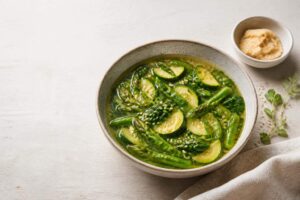
- Soupe miso traditionnelle : dissoudre 1 cuillère à café de miso brun dans un bouillon dashi chaud (sans faire bouillir).
- Marinade pour poissons et viandes : mélanger le miso brun avec du mirin, du saké et du gingembre râpé. Laisser mariner 12 à 24 h.
- Vinaigrette umami : émulsionner le miso brun avec du vinaigre de riz, de l’huile de sésame et du miel.
- Sauce pour légumes rôtis : mélanger avec du beurre ou de l’huile d’olive pour glacer les légumes au four.
- Base de ramen ou de bouillon : ajouter en fin de cuisson pour enrichir la saveur sans cuire les bactéries.
- Assaisonnement de salades : diluer dans un peu d’eau chaude et utiliser comme dressing léger.
La règle d’or : ne jamais faire bouillir le miso brun non pasteurisé. Ajoutez-le toujours hors du feu ou en toute fin de cuisson pour préserver ses probiotiques et sa saveur complexe. Retrouvez tous nos conseils sur la pâte de miso et ses usages culinaires.
Miso brun vs miso blanc : lequel choisir ?
Le choix entre miso brun et miso blanc dépend de votre objectif — culinaire ou nutritionnel. Voici les différences essentielles :
- Saveur : le miso brun est intense, salé, umami prononcé ; le miso blanc est doux, légèrement sucré.
- Probiotiques : le miso brun en contient davantage grâce à sa fermentation prolongée.
- Antioxydants : le miso brun est plus riche en mélanoidines et en composés phénoliques.
- Sodium : le miso brun est plus salé (3 500 mg/100 g vs 2 200 mg/100 g pour le blanc).
- Usages culinaires : le blanc convient aux préparations délicates ; le brun aux plats robustes, marinades et bouillons.
Pour un usage quotidien en soupe légère, le miso blanc ou jaune est souvent préférable. Pour des marinades, des sauces riches ou des bouillons hivernaux, le miso brun apporte une profondeur incomparable. Lisez notre guide sur le miso fermenté pour comprendre les mécanismes de la maturation.
Miso brun biologique et non pasteurisé : pourquoi ça compte ?
Tous les miso bruns ne se valent pas. La pasteurisation, utilisée pour prolonger la durée de conservation des produits industriels, détruit les bactéries vivantes et réduit significativement les bénéfices probiotiques. Un miso brun biologique non pasteurisé, comme ceux produits par des artisans japonais ou français (Kura de Bourgogne, par exemple), conserve l’intégralité de sa flore microbienne.
Critères de sélection d’un miso brun de qualité :
- Mention « non pasteurisé » ou « vivant » sur l’étiquette.
- Liste d’ingrédients courte : soja, sel, koji (riz ou orge). Pas d’additifs, pas de glutamate ajouté.
- Conservation au réfrigérateur (signe d’un produit vivant).
- Certification biologique (AB, JAS ou équivalent).
- Fermentation d’au moins 6 mois pour le miso brun standard, 24 mois ou plus pour le hatcho miso.
Qui doit limiter le miso brun ?
Malgré ses nombreux atouts, le miso brun n’est pas adapté à tous les profils. Voici les situations nécessitant une vigilance particulière :
- Hypertension artérielle : la teneur élevée en sodium du miso brun peut aggraver une hypertension non contrôlée.
- Insuffisance rénale : les reins fragilisés peinent à éliminer l’excès de sodium et de potassium.
- Allergie au soja : le miso brun est fabriqué à base de soja et doit être évité en cas d’allergie confirmée.
- Intolérance au gluten : certains misos bruns contiennent de l’orge ou du blé. Vérifiez l’étiquette et choisissez une version à base de riz brun certifiée sans gluten.
- Traitement aux anticoagulants : la vitamine K du miso brun peut interférer avec les traitements à base de warfarine.
- Grossesse : le miso brun non pasteurisé est déconseillé en raison du risque théorique de contamination bactérienne.
Où acheter du miso brun de qualité ?
Le miso brun est de plus en plus accessible en France. Voici les meilleures options :
- Épiceries japonaises et asiatiques : large choix de marques japonaises authentiques (Hikari, Marukome, Yamajirushi).
- Magasins biologiques (Biocoop, La Vie Claire, Naturalia) : misos bruns bio non pasteurisés, souvent produits en France ou en Europe.
- Producteurs artisanaux français : Kura de Bourgogne, La Ferme du Miso (Bretagne) — fermentation locale avec du soja français.
- Commande en ligne : sites spécialisés en épicerie japonaise ou en alimentation biologique.
Comptez entre 8 et 20 € pour un pot de 400 g de miso brun de qualité. Un pot dure généralement 2 à 3 mois pour une consommation quotidienne raisonnée.
Conservation du miso brun : les bons réflexes
Le miso brun se conserve très bien grâce à sa forte teneur en sel, qui joue un rôle naturel de conservateur. Voici les règles à respecter :
- Après ouverture, conservez le miso brun au réfrigérateur, dans un contenant hermétique.
- Durée de conservation après ouverture : 12 à 18 mois pour le miso brun non pasteurisé, 24 mois pour le pasteurisé.
- Tassez la surface avec une spatule propre et couvrez d’un film alimentaire avant de refermer pour limiter l’oxydation.
- Une légère croûte blanche en surface est normale (levures) — retirez-la simplement avant utilisation.
- Le miso brun est une pâte fermentée japonaise à longue maturation (6 à 36 mois), plus riche en probiotiques et en antioxydants que le miso blanc.
- Le miso brun contient tous les acides aminés essentiels et des isoflavones de soja aux propriétés antioxydantes et cardioprotectrices documentées.
- Le miso brun non pasteurisé doit être ajouté hors du feu pour préserver ses bactéries vivantes bénéfiques pour le microbiote.
- Sa teneur en sodium est élevée : une portion de 10 g par jour est suffisante pour bénéficier des apports du miso brun sans excès de sel.
- Les personnes hypertendues, allergiques au soja ou sous anticoagulants doivent consulter un médecin avant d’intégrer le miso brun à leur alimentation quotidienne.
Questions fréquentes sur le miso brun
Qu’est-ce que le miso brun exactement ?
Le miso brun est une pâte fermentée japonaise à base de soja, de sel et de koji, dont la fermentation dure de 6 à 36 mois. Cette longue maturation lui confère sa couleur brun foncé, sa saveur umami intense et sa richesse en probiotiques et en antioxydants.
Le miso brun est-il meilleur que le miso blanc pour la santé ?
Le miso brun est plus riche en probiotiques, en antioxydants et en peptides bioactifs que le miso blanc, grâce à sa fermentation prolongée. En revanche, il est aussi plus salé. Pour la santé digestive et immunitaire, le miso brun présente un avantage nutritionnel net, à condition de le consommer en quantité modérée.
Combien de miso brun peut-on manger par jour ?
Une portion de 10 à 15 g de miso brun par jour (une cuillère à soupe rase) est généralement recommandée. Cette quantité apporte des probiotiques et des nutriments utiles sans dépasser les apports conseillés en sodium pour la majorité des adultes en bonne santé.
Le miso brun contient-il du gluten ?
Certains misos bruns sont fabriqués avec de l’orge ou du blé, qui contiennent du gluten. Si vous êtes intolérant au gluten ou cœliaque, choisissez un miso brun à base de riz brun, certifié sans gluten. Vérifiez toujours la liste des ingrédients avant achat.
Peut-on faire bouillir le miso brun ?
Non — faire bouillir le miso brun non pasteurisé détruit les bactéries vivantes et réduit ses bénéfices probiotiques. Ajoutez-le toujours en fin de cuisson, hors du feu, dans un liquide à moins de 60 °C. Pour les préparations froides (vinaigrettes, marinades), le miso brun est utilisé directement sans chauffage.
Le miso brun est-il adapté aux végétariens et végétaliens ?
Oui. Le miso brun est un aliment 100 % végétal, riche en protéines complètes et en acides aminés essentiels. Il constitue une excellente source de protéines pour les régimes végétariens et végétaliens, en complément d’autres légumineuses et céréales complètes.
Comment distinguer un bon miso brun d’un miso industriel ?
Un miso brun artisanal de qualité se reconnaît à sa liste d’ingrédients courte (soja, sel, koji), à l’absence d’additifs et à la mention « non pasteurisé ». Il se conserve au réfrigérateur et peut présenter une légère croûte en surface — signe de bactéries vivantes actives. Le miso brun industriel est souvent pasteurisé et moins riche en probiotiques.
Le miso brun est-il sans danger pour les personnes hypertendues ?
Les personnes hypertendues doivent consommer le miso brun avec modération en raison de sa teneur élevée en sodium. Certaines études suggèrent que les peptides bioactifs du miso exercent un effet protecteur sur la pression artérielle, mais ces données ne suffisent pas à recommander une consommation libre. Consultez votre médecin pour adapter votre consommation.
Quelle est la différence entre miso brun et hatcho miso ?
Le hatcho miso est la forme la plus concentrée et la plus fermentée du miso brun. Fabriqué uniquement à partir de soja (sans céréales), il fermente pendant 24 à 36 mois dans des cuves en cèdre. Sa saveur est extrêmement intense, presque amère, et sa teneur en acides aminés et en antioxydants est supérieure à celle du miso brun standard.
Le miso brun aide-t-il à perdre du poids ?
Le miso brun n’est pas un aliment amincissant en soi, mais il peut s’intégrer dans une alimentation équilibrée favorable à la gestion du poids. Sa richesse en protéines et en fibres favorise la satiété. Sa faible densité calorique (199 kcal/100 g, mais utilisé à 10-15 g par portion) en fait un condiment peu calorique et très savoureux.
Peut-on utiliser le miso brun dans la cuisine européenne ?
Absolument. Le miso brun s’intègre parfaitement dans la gastronomie européenne comme exhausteur de goût naturel. Il remplace avantageusement le sel dans les vinaigrettes, enrichit les bouillons de légumes, parfume les marinades de poisson et de viande, et apporte de la profondeur aux sauces à base de beurre ou de crème.
Le miso brun est-il recommandé pour les enfants ?
Le miso brun peut être introduit progressivement dans l’alimentation des enfants à partir de 18 mois, en très petites quantités et dilué dans un bouillon ou une préparation. Sa teneur élevée en sodium impose une utilisation parcimonieuse. Pour les nourrissons et les jeunes enfants, préférez le miso blanc, moins salé.
Ce qu’il faut retenir
Le miso brun est bien plus qu’un simple condiment japonais. C’est un aliment fermenté d’exception, riche en probiotiques vivants, en acides aminés essentiels, en isoflavones et en antioxydants formés lors d’une longue maturation. Les données scientifiques disponibles soutiennent ses bénéfices sur le microbiote intestinal, la santé cardiovasculaire et la prévention de certains cancers. Le miso brun mérite une place régulière dans votre cuisine, à condition de le choisir non pasteurisé et de le consommer avec modération pour maîtriser vos apports en sodium.
Action concrète : commencez par une cuillère à café de miso brun non pasteurisé dissoute dans un bouillon chaud (hors du feu) chaque soir pendant deux semaines. Observez l’évolution de votre confort digestif et ajustez la dose selon votre tolérance et vos besoins. Consultez notre guide complet sur le miso fermenté pour aller plus loin.
Sources et études
- Miso soup consumption and cardiovascular risk factors in Japanese adults — Journal of Nutritional Science and Vitaminology,
- Miso, red — Nutritional data — USDA FoodData Central,
- Microbial diversity and functional analysis of traditional Japanese miso — Journal of Applied Microbiology,
- Miso soup intake and blood pressure in a large Japanese cohort study — American Journal of Clinical Nutrition,
- Soy isoflavones and breast cancer risk: a meta-analysis of prospective studies — European Journal of Clinical Nutrition,
Cet article est fourni à titre informatif uniquement et ne constitue pas un avis médical. Consultez un professionnel de santé qualifié avant toute utilisation.