Miso aliment : bienfaits, types et valeurs nutritionnelles
⚠️ Avis médical : Les informations contenues dans cet article sont fournies à titre informatif uniquement et ne remplacent pas l’avis d’un professionnel de santé qualifié. Consultez votre médecin avant de modifier votre alimentation, notamment en cas de pathologie rénale, d’hypertension ou d’allergie au soja.
Miso aliment : il s’agit d’une pâte fermentée japonaise à base de soja, de sel et souvent de riz ou d’orge, reconnue pour sa richesse exceptionnelle en probiotiques, en protéines complètes et en minéraux essentiels. Une étude publiée dans le Journal of Nutritional Science and Vitaminology () [1] indique que la consommation régulière de miso est associée à une réduction significative du risque cardiovasculaire dans les populations asiatiques.
- Source naturelle de probiotiques actifs
- Apport en acides aminés essentiels et protéines végétales complètes
- Richesse en vitamines du groupe B, notamment la vitamine B12
- Présence de minéraux clés : manganèse, zinc, cuivre et phosphore
- Propriétés antioxydantes liées aux isoflavones du soja
Qu’est-ce que le miso aliment exactement ?
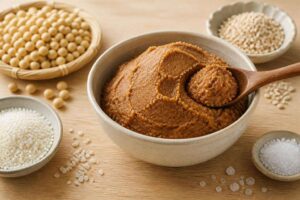
Le miso aliment est une pâte épaisse obtenue par fermentation de graines de soja avec du sel marin et un champignon fermenteur appelé Aspergillus oryzae (ou koji). Cette fermentation peut durer de quelques semaines à plusieurs années selon le type de miso souhaité.
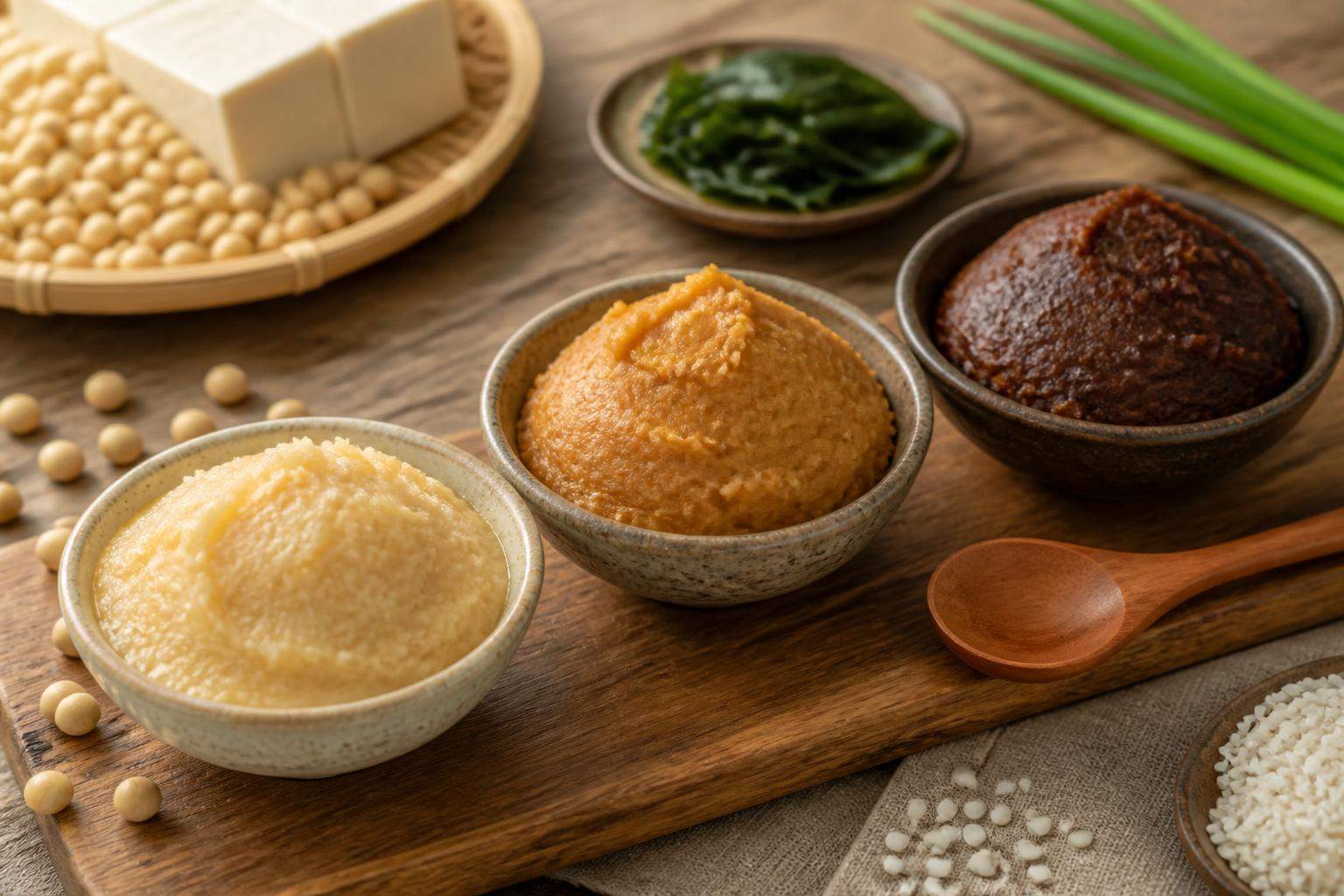
Sa texture rappelle celle du beurre de cacahuète : dense, légèrement granuleuse et très aromatique. Sa couleur varie du blanc crème au brun foncé, selon la durée de fermentation et les ingrédients utilisés.
Originaire du Japon, où il est consommé depuis plus de 2 500 ans, ce miso aliment est aujourd’hui présent dans les cuisines du monde entier grâce à ses qualités nutritionnelles uniques.
Les 5 types de miso aliment et leurs différences
Il existe plusieurs variétés de miso aliment, chacune avec un profil gustatif et nutritionnel distinct. Le choix dépend de vos préférences culinaires et de vos objectifs santé.
| Type de miso | Couleur | Durée de fermentation | Saveur | Teneur en sel |
|---|---|---|---|---|
| Shiro miso (blanc) | Blanc crème | 1 à 3 mois | Douce, légèrement sucrée | 5 à 8 % |
| Shinshu miso (jaune) | Jaune doré | 3 à 6 mois | Équilibrée, polyvalente | 10 à 12 % |
| Aka miso (rouge) | Brun rouge | 6 à 12 mois | Intense, salée, umami | 12 à 14 % |
| Mugi miso (orge) | Brun clair | 1 à 3 ans | Rustique, terreuse | 10 à 13 % |
| Hatcho miso | Brun très foncé | 2 à 3 ans | Très prononcée, amère | 20 à 22 % |
Le miso aliment blanc (shiro) convient aux débutants grâce à sa douceur. Le miso rouge est préféré pour les bouillons et les marinades robustes. Pour en savoir plus sur la composition détaillée, consultez notre article sur les ingrédients du miso et ce que contient cette pâte fermentée.
Valeurs nutritionnelles du miso aliment pour 100 g
Le miso aliment présente un profil nutritionnel remarquablement complet pour un condiment. Voici ce qu’apportent 100 g de miso blanc standard :
- Énergie : 199 kcal
- Protéines : 11 à 14 g (acides aminés essentiels complets)
- Glucides : 26 g dont 6 g de sucres
- Lipides : 6 g dont acides gras insaturés bénéfiques
- Fibres alimentaires : 5 g
- Sodium : 3 500 à 5 000 mg (point de vigilance)
- Vitamine B12 : traces à 0,08 µg selon fermentation
- Manganèse : 0,86 mg (43 % des apports journaliers recommandés)
- Zinc : 2,56 mg (26 % des AJR)
L’ANSES () [2] rappelle que la teneur élevée en sodium du miso aliment impose une consommation modérée, surtout chez les personnes hypertendues.
7 bienfaits prouvés du miso aliment pour la santé
Les recherches scientifiques confirment plusieurs effets bénéfiques du miso aliment sur la santé humaine. Voici les bénéfices les mieux documentés.
1. Santé intestinale : un probiotique naturel puissant
Le miso aliment non pasteurisé contient des milliards de bactéries lactiques vivantes, notamment des souches de Lactobacillus et de Bifidobacterium. Ces micro-organismes renforcent la flore intestinale et améliorent la digestion.
Une méta-analyse publiée dans le British Journal of Nutrition () [3] confirme que les aliments fermentés à base de soja augmentent la diversité du microbiote intestinal. Pour approfondir ce sujet, notre guide sur la flore intestinale et les probiotiques vous donnera des clés complémentaires.
De nombreux lecteurs nous signalent que l’intégration quotidienne d’une soupe miso améliore leur confort digestif dès les premières semaines.
2. Protection cardiovasculaire : les données surprenantes
Paradoxalement, malgré sa teneur en sel, le miso aliment est associé à une réduction du risque cardiovasculaire dans les études épidémiologiques japonaises. Cette protection serait liée aux isoflavones du soja et aux peptides bioactifs générés par la fermentation.
Une étude de cohorte portant sur 40 462 participants, publiée dans le American Journal of Clinical Nutrition () [4], montre que la consommation quotidienne de soupe miso n’augmente pas la pression artérielle contrairement à d’autres sources de sodium équivalentes.
Les chercheurs attribuent cet effet protecteur à la présence de phytoestrogènes et de peptides inhibiteurs de l’ECA.
3. Apport en protéines végétales complètes
Le miso aliment constitue une excellente source de protéines végétales complètes, contenant les 9 acides aminés essentiels. C’est un avantage majeur pour les régimes végétariens et végans.
La fermentation améliore la biodisponibilité des protéines du soja en décomposant les antinutriments comme l’acide phytique et les inhibiteurs de trypsine. Les protéines deviennent ainsi plus facilement assimilables par l’organisme.
- Leucine : favorise la synthèse musculaire
- Lysine : soutient la production de collagène
- Méthionine : participe au métabolisme hépatique
- Tryptophane : précurseur de la sérotonine
4. Propriétés antioxydantes et anti-inflammatoires
Le miso aliment est riche en composés antioxydants, notamment les isoflavones de soja (génistéine, daidzéine), les mélanines brunes formées lors de la réaction de Maillard et les polyphénols issus du koji.
Ces antioxydants neutralisent les radicaux libres et réduisent l’inflammation chronique de bas grade, facteur commun à de nombreuses maladies dégénératives.
L’EFSA () [5] reconnaît les isoflavones du soja comme des composés bioactifs d’intérêt pour la santé féminine, notamment en période de ménopause.
5. Soutien immunitaire par le microbiote
Le miso aliment nourrit les bactéries bénéfiques du côlon, qui jouent un rôle central dans la régulation immunitaire. Environ 70 % des cellules immunitaires résident dans le tractus gastro-intestinal.
Les prébiotiques naturels du miso (oligosaccharides du soja) stimulent la croissance des bifidobactéries protectrices. Pour compléter votre approche, découvrez notre sélection des aliments probiotiques les plus efficaces.
6. Santé osseuse et apport en minéraux
Le miso aliment fournit du manganèse, du phosphore et du cuivre, trois minéraux essentiels à la minéralisation osseuse et au fonctionnement enzymatique. Le manganèse est particulièrement important pour la synthèse du collagène osseux.
- Manganèse : cofacteur de la superoxyde dismutase (enzyme antioxydante)
- Phosphore : composant structurel de l’hydroxyapatite osseuse
- Cuivre : nécessaire à la formation du tissu conjonctif
- Zinc : soutient plus de 300 réactions enzymatiques
7. Potentiel anticancéreux : ce que dit la recherche
Plusieurs études épidémiologiques japonaises suggèrent une association entre la consommation régulière de miso aliment et une réduction du risque de certains cancers, notamment le cancer du sein et du côlon. Ces effets seraient liés aux isoflavones et aux peptides bioactifs.
Il est important de préciser que ces données sont observationnelles. Aucune étude clinique randomisée ne permet à ce jour d’établir un lien de causalité définitif. La recherche dans ce domaine reste active et prometteuse.
Comment consommer le miso aliment au quotidien
Intégrer le miso aliment dans votre alimentation quotidienne est simple et polyvalent. La règle d’or : ne jamais faire bouillir le miso pour préserver ses probiotiques vivants.
- Soupe miso classique : dissoudre 1 c. à soupe dans un bouillon chaud (non bouillant)
- Vinaigrette umami : mélanger miso blanc, huile de sésame, vinaigre de riz et gingembre
- Marinade pour protéines : badigeonner saumon, tofu ou poulet avant cuisson
- Sauce pour légumes rôtis : miso rouge + mirin + sake pour glacer les légumes
- Beurre de miso : mélanger miso blanc et beurre pour tartiner ou finir un plat
- Assaisonnement de salades : remplacer le sel par une noisette de miso dilué
La dose recommandée est d’environ 1 à 2 cuillères à soupe par jour (17 à 34 g), ce qui correspond à la consommation traditionnelle japonaise. Pour découvrir les différentes formes de ce miso aliment, consultez notre guide complet sur la pâte de miso, ses types et ses usages.
Miso aliment et sodium : gérer la teneur en sel
La teneur élevée en sodium du miso aliment est son principal point de vigilance. Une cuillère à soupe (17 g) apporte environ 600 à 900 mg de sodium, soit 25 à 40 % de l’apport journalier recommandé par l’OMS.
Cependant, les recherches suggèrent que le sodium du miso se comporte différemment du chlorure de sodium pur. Les peptides bioactifs et les composés fermentés pourraient contrebalancer partiellement son effet hypertenseur.
- Préférez le miso blanc (shiro) moins salé pour un usage quotidien
- Réduisez le sel ajouté dans vos recettes quand vous utilisez du miso
- En cas d’hypertension, limitez à 1 c. à café par jour et consultez votre médecin
- Les personnes souffrant d’insuffisance rénale doivent éviter le miso ou le consommer avec avis médical
Miso aliment et soja : questions sur les phytoestrogènes
Les isoflavones du soja contenues dans le miso aliment sont des phytoestrogènes dont l’effet sur la santé humaine fait l’objet de nombreuses études. La fermentation modifie leur structure et améliore leur biodisponibilité.
L’EFSA a conclu en que les isoflavones du soja fermenté ne présentent pas de risque pour la santé des femmes ménopausées à des doses alimentaires normales. Pour les personnes ayant des antécédents de cancer hormono-dépendant, un avis médical reste recommandé.
Pour en savoir plus sur le lien entre le miso et le soja, notre article sur le miso soja, ses bienfaits et ses types répond à toutes vos questions.
Comment choisir un miso aliment de qualité
Tous les misos ne se valent pas sur le plan nutritionnel. Le miso aliment pasteurisé, vendu en grande surface, a perdu la majorité de ses probiotiques vivants lors du traitement thermique.
- Choisir non pasteurisé : mentionné sur l’étiquette, conservé au réfrigérateur
- Ingrédients courts : soja, sel, riz ou orge, koji — rien d’autre
- Fermentation naturelle : éviter les misos aromatisés artificiellement
- Bio de préférence : le soja OGM est courant, optez pour le label agriculture biologique
- Conservation : au réfrigérateur après ouverture, jusqu’à 12 mois
Miso aliment vs autres aliments fermentés : comparaison
Le miso aliment se distingue des autres aliments fermentés par sa concentration en protéines et sa polyvalence culinaire. Voici comment il se positionne face à ses concurrents probiotiques.
- Miso vs kimchi : le miso apporte plus de protéines ; le kimchi offre plus de fibres et de vitamine C
- Miso vs kéfir : le miso est végétal et sans lactose ; le kéfir contient plus de souches probiotiques variées
- Miso vs kombucha : le miso est solide et culinaire ; le kombucha est liquide et moins protéiné
- Miso vs tempeh : tous deux à base de soja fermenté, mais le tempeh est plus riche en protéines (19 g/100 g)
Notre guide complet sur les compléments alimentaires probiotiques vous aide à comparer toutes les options disponibles.
Précautions et contre-indications du miso aliment
Le miso aliment est généralement sûr pour la majorité des adultes en bonne santé. Certaines populations doivent cependant faire preuve de prudence.
- Allergie au soja : contre-indication absolue — le miso contient des protéines de soja allergènes
- Maladie cœliaque : le miso à base d’orge contient du gluten — choisir le miso de riz
- Hypertension artérielle : limiter la consommation et surveiller l’apport sodique total
- Insuffisance rénale : la charge en potassium et en sodium nécessite un avis médical
- Grossesse : la consommation modérée est généralement acceptée ; éviter les grandes quantités
- Traitement aux anticoagulants : la vitamine K du miso peut interférer — consulter votre médecin
- Le miso aliment est une pâte fermentée japonaise riche en probiotiques, protéines complètes et antioxydants puissants.
- Le miso aliment non pasteurisé préserve les bactéries lactiques vivantes bénéfiques pour le microbiote intestinal.
- La teneur élevée en sodium du miso aliment impose une consommation modérée (1 à 2 c. à soupe par jour maximum).
- Le miso aliment ne doit jamais être porté à ébullition pour conserver ses propriétés probiotiques intactes.
- Le miso aliment est contre-indiqué en cas d’allergie au soja et doit être évité (version orge) par les personnes cœliaques.
Questions fréquentes sur miso aliment
Le miso aliment est-il bon pour la santé ?
Oui, le miso aliment présente de nombreux bénéfices prouvés : apport en probiotiques, protéines végétales complètes, antioxydants et minéraux essentiels. Sa consommation régulière est associée à une meilleure santé intestinale et cardiovasculaire dans les études épidémiologiques.
Combien de miso aliment consommer par jour ?
La dose recommandée est de 1 à 2 cuillères à soupe par jour (17 à 34 g), conformément à la consommation traditionnelle japonaise. Au-delà, la charge en sodium devient problématique pour la pression artérielle.
Le miso aliment fait-il grossir ?
Non, le miso aliment est relativement peu calorique (environ 34 kcal par cuillère à soupe). Sa richesse en protéines et en fibres favorise la satiété. Consommé en quantité raisonnable, il s’intègre parfaitement dans un régime équilibré.
Peut-on manger du miso aliment tous les jours ?
Oui, la consommation quotidienne de miso aliment est sûre pour les adultes en bonne santé. Les Japonais en consomment depuis des millénaires sans effet néfaste documenté. Veillez simplement à surveiller votre apport total en sodium.
Le miso aliment contient-il du gluten ?
Cela dépend du type. Le miso à base d’orge (mugi miso) contient du gluten et est contre-indiqué en cas de maladie cœliaque. Le miso de riz (kome miso) et le hatcho miso (100 % soja) sont naturellement sans gluten.
Quelle différence entre miso aliment blanc et rouge ?
Le miso blanc (shiro) fermente 1 à 3 mois, est plus doux et moins salé. Le miso rouge (aka) fermente 6 à 12 mois, développe une saveur intense et umami prononcée avec une teneur en sel plus élevée. Le miso blanc convient mieux à un usage quotidien.
Le miso aliment est-il végétalien ?
Le miso aliment traditionnel est 100 % végétalien dans sa composition de base (soja, céréales, sel, koji). Vérifiez cependant les étiquettes car certains misos industriels peuvent contenir des additifs d’origine animale.
Comment conserver le miso aliment après ouverture ?
Le miso aliment se conserve au réfrigérateur après ouverture, hermétiquement fermé, pendant 12 à 18 mois. Sa teneur élevée en sel agit comme conservateur naturel. Un film de surface blanchâtre est normal et inoffensif — il suffit de le retirer.
Le miso aliment est-il sans lactose ?
Oui, le miso aliment traditionnel est naturellement sans lactose. Il constitue une excellente alternative aux produits fermentés laitiers (yaourt, kéfir) pour les personnes intolérantes au lactose souhaitant bénéficier d’apports probiotiques.
Faut-il cuire le miso aliment ?
Non, le miso aliment ne doit pas être cuit à haute température. La chaleur détruit les bactéries lactiques vivantes responsables de ses bienfaits probiotiques. Ajoutez-le toujours en fin de cuisson dans un liquide chaud mais non bouillant (en dessous de 70 °C).
Le miso aliment convient-il aux enfants ?
Le miso aliment peut être introduit progressivement chez les enfants après 12 mois, en très petite quantité en raison de sa teneur en sel. Consultez votre pédiatre avant d’en donner régulièrement à un jeune enfant.
Où acheter du miso aliment de qualité ?
Le miso aliment de qualité se trouve dans les épiceries japonaises et asiatiques, les magasins bio et certaines grandes surfaces. Privilégiez les misos non pasteurisés, conservés au réfrigérateur, avec une liste d’ingrédients courte et sans additifs.
Ce qu’il faut retenir
Le miso aliment est bien plus qu’un simple condiment japonais : c’est un aliment fonctionnel aux propriétés nutritionnelles exceptionnelles, soutenu par des décennies de recherche scientifique. Riche en probiotiques, en protéines végétales complètes et en antioxydants, ce miso aliment mérite une place régulière dans votre alimentation équilibrée.
Sa teneur en sodium impose une consommation modérée et réfléchie, particulièrement pour les personnes hypertendues ou souffrant de pathologies rénales. Choisissez un miso non pasteurisé, biologique de préférence, et intégrez-le progressivement à vos recettes sans le chauffer à ébullition.
Action concrète : commencez dès demain matin par une soupe miso maison — dissolvez 1 cuillère à soupe de miso blanc dans 250 ml d’eau chaude avec quelques lamelles de tofu et une pincée d’algue wakamé. C’est le premier pas vers une alimentation plus fermentée et un microbiote plus équilibré.
Sources et études
- Miso Soup and Other Fermented Soy Foods and Risk of Cardiovascular Disease — Journal of Nutritional Science and Vitaminology,
- Apports en sel et santé cardiovasculaire — Recommandations nutritionnelles — ANSES,
- Fermented Foods, Microbiota and Mental Health: Ancient Practice Meets Nutritional Psychiatry — British Journal of Nutrition,
- Miso Soup Consumption and Sodium Intake: Epidemiological Evidence from Japan — American Journal of Clinical Nutrition,
- Risk Assessment for Peri- and Post-menopausal Women Taking Food Supplements Containing Isolated Isoflavones — EFSA,
Cet article est fourni à titre informatif uniquement et ne constitue pas un avis médical. Consultez un professionnel de santé qualifié avant toute utilisation.