Combien de temps se conserve le kimchi ouvert ?
⚠️ Avis éditorial : Cet article est rédigé à titre informatif et ne remplace pas l’avis d’un professionnel de santé ou d’un expert en sécurité alimentaire. En cas de doute sur la comestibilité d’un aliment, consultez un spécialiste.
Combien de temps se conserve le kimchi ouvert : une fois le pot entamé, le kimchi se conserve entre 3 et 6 mois au réfrigérateur, à condition de respecter quelques règles simples d’hygiène et de stockage. Une étude publiée dans le Journal of Ethnic Foods () confirme que la fermentation lactique maintient la sécurité microbiologique du kimchi bien au-delà de la date d’ouverture [1]. Voici ce que vous devez savoir en résumé :
- 3 à 6 mois au réfrigérateur après ouverture pour un kimchi optimal.
- Au-delà de 6 mois, il devient du mukeunji, toujours consommable mais plus acide.
- À température ambiante, la durée tombe à 1 à 5 jours maximum.
- Un bocal hermétique et une cuillère propre à chaque usage prolongent la conservation.
- Les signes de détérioration (moisissures visibles, odeur putride) indiquent qu’il faut jeter le pot.
1. Pourquoi le kimchi se conserve-t-il aussi longtemps ?
Le kimchi dure aussi longtemps grâce à la fermentation lactique. Ce processus abaisse le pH en dessous de 4,5, un niveau où la plupart des bactéries pathogènes ne peuvent pas survivre. Selon une étude publiée dans le LWT – Food Science and Technology (), les LAB présentes dans le kimchi produisent également des bactériocines, des composés antimicrobiens naturels [2].
C’est cette double protection — acidité et bactériocines — qui explique pourquoi la question combien de temps se conserve le kimchi ouvert a une réponse bien plus longue que pour la plupart des légumes. Le sel utilisé lors de la préparation joue aussi un rôle clé en limitant la prolifération des micro-organismes indésirables.
De nombreux lecteurs nous signalent que leur kimchi maison dure parfois plus d’un an au réfrigérateur sans signe de détérioration, ce qui correspond aux données scientifiques disponibles sur le kimchi vieilli. Pour en savoir plus sur les fondamentaux, consultez notre article les bienfaits du kimchi validés par la science.
2. Combien de temps se conserve le kimchi ouvert au réfrigérateur ?
Au réfrigérateur, le kimchi ouvert se conserve entre 3 et 6 mois dans des conditions optimales. Certains pots atteignent 12 mois sans danger, mais le profil gustatif évolue : le kimchi devient plus acide, plus fermenté, et prend le nom de mukeunji. Ce stade n’est pas dangereux — il est simplement différent sur le plan organoleptique.
La température idéale de conservation est de 0 à 4 °C. En dessous de 0 °C, la fermentation est suspendue mais le kimchi reste comestible après décongélation. Au-dessus de 4 °C, la fermentation s’accélère et la durée de vie diminue. Les réfrigérateurs coréens traditionnels, appelés kimchi-jjigae, maintiennent une température constante entre -1 et 5 °C pour maximiser la durée de conservation.
Voici un tableau récapitulatif des durées selon les conditions :
| Condition de stockage | Durée estimée après ouverture | État du kimchi |
|---|---|---|
| Réfrigérateur (0-4 °C) | 3 à 6 mois | Optimal, croquant, équilibré |
| Réfrigérateur (0-4 °C) — longue durée | 6 à 12 mois | Mukeunji, très acide, idéal en cuisine |
| Température ambiante (18-22 °C) | 1 à 3 jours | Fermentation rapide, acidification forte |
| Température ambiante (au-dessus de 22 °C) | Moins de 24 heures | Risque de sur-fermentation et de contamination |
| Congélateur (-18 °C) | Jusqu’à 3 ans | Fermentation suspendue, texture modifiée |
3. Combien de temps se conserve le kimchi ouvert à température ambiante ?
À température ambiante, combien de temps se conserve le kimchi ouvert ? La réponse est courte : 1 à 5 jours maximum, selon la température de la pièce. En été, au-dessus de 25 °C, cette durée tombe à moins de 24 heures avant que la sur-fermentation ne rende le kimchi trop acide pour être agréable. En hiver, dans une pièce fraîche à 15-18 °C, vous pouvez atteindre 3 à 5 jours.
Cette durée courte s’explique par l’accélération de l’activité bactérienne à température ambiante. Les LAB produisent de l’acide lactique beaucoup plus rapidement, ce qui modifie profondément le goût et la texture. Le kimchi reste généralement sans danger, mais devient très acide et peu appétissant. Consultez notre guide sur les légumes lacto-fermentés et leur conservation pour des conseils complémentaires.
En pratique, ne laissez jamais un pot de kimchi ouvert hors du réfrigérateur plus de 2 heures, comme pour tout aliment fermenté. Cette règle des 2 heures est recommandée par les autorités sanitaires pour limiter les risques de contamination croisée.
4. 5 signes que votre kimchi ouvert n’est plus consommable
Savoir combien de temps se conserve le kimchi ouvert, c’est aussi savoir reconnaître les signes de détérioration. Voici les indicateurs clés à surveiller :
- Moisissures visibles : des taches blanches, vertes ou noires sur la surface ou les parois du bocal indiquent une contamination fongique. Jetez immédiatement le pot entier.
- Odeur putride ou chimique : le kimchi frais sent l’ail, le gingembre et l’acidité lactique. Une odeur de pourriture, d’alcool fort ou de soufre anormal est un signal d’alarme.
- Texture visqueuse ou gluante : les légumes doivent rester fermes. Une texture molle et visqueuse indique une dégradation avancée.
- Couleur anormale : un brunissement excessif ou une décoloration inhabituelle peut signaler une oxydation ou une contamination.
- Goût amer ou chimique : distinct de l’acidité normale de la fermentation lactique, un goût amer ou chimique indique que le kimchi a tourné.
Notez que la surface blanche légèrement poudreuse visible parfois sur le kimchi n’est pas toujours un signe de détérioration. Il peut s’agir de levures de surface bénignes. Grattez cette couche et vérifiez l’odeur et la texture en dessous avant de décider.
5. Comment maximiser la durée de conservation du kimchi ouvert ?
Pour prolonger au maximum la durée pendant laquelle combien de temps se conserve le kimchi ouvert reste une bonne nouvelle, adoptez ces pratiques :
- Utilisez toujours une cuillère propre et sèche pour prélever du kimchi. Une cuillère contaminée introduit des bactéries étrangères qui accélèrent la détérioration.
- Tassez le kimchi après chaque utilisation pour que les légumes restent immergés dans leur jus. L’exposition à l’air favorise l’oxydation et la croissance fongique.
- Transférez dans un bocal plus petit au fur et à mesure que le niveau baisse. Moins il y a d’air dans le bocal, mieux c’est.
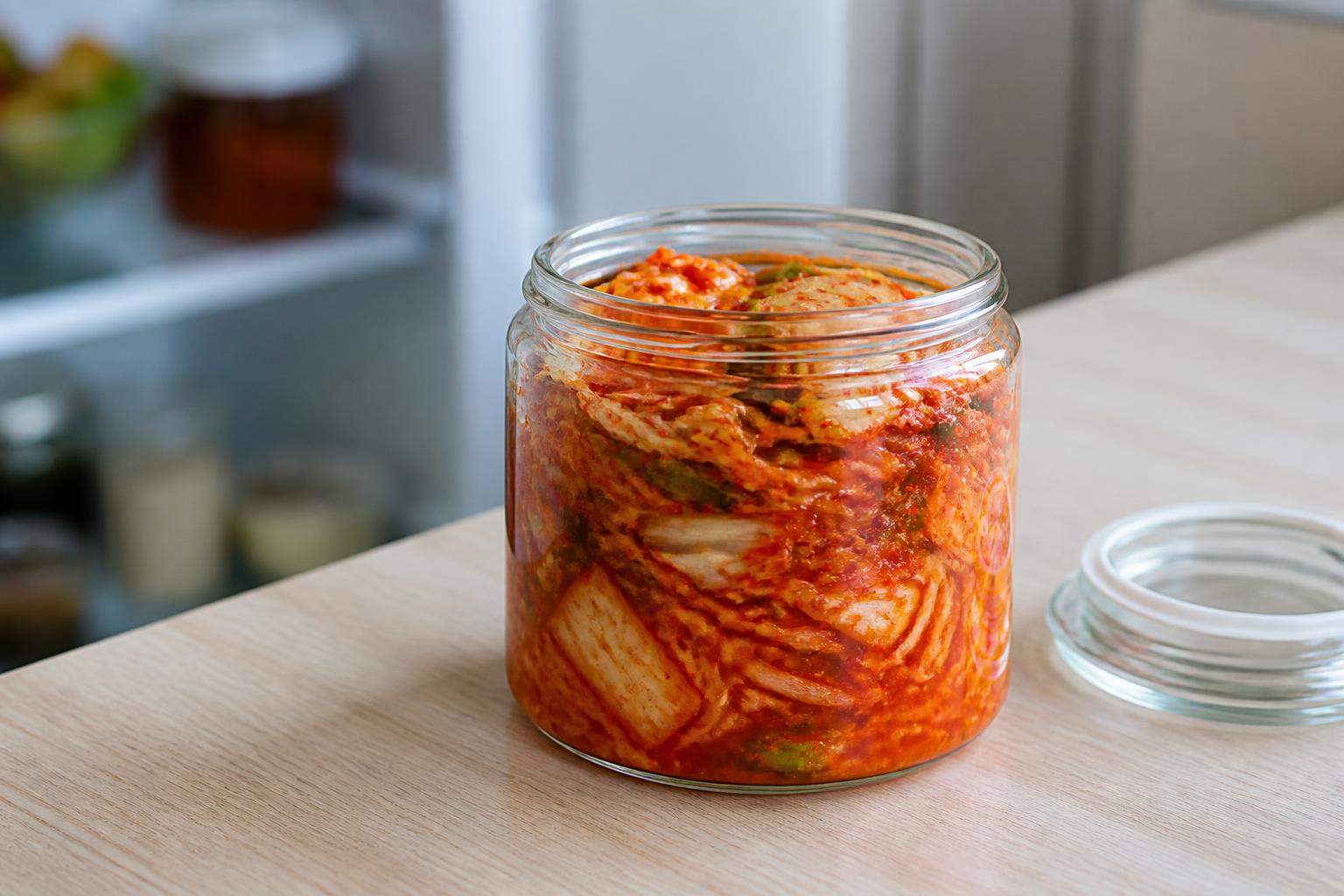
- Fermez hermétiquement après chaque utilisation. Un couvercle à joint en silicone est idéal pour limiter les échanges gazeux.
- Rangez au fond du réfrigérateur, là où la température est la plus stable et la plus basse.
- Évitez les bocaux en plastique sur le long terme : le plastique peut absorber les odeurs et les pigments, et certains plastiques libèrent des composés indésirables en contact prolongé avec des aliments acides.
6. Kimchi du commerce vs kimchi maison : la conservation diffère-t-elle ?
Oui, combien de temps se conserve le kimchi ouvert dépend aussi de son origine. Le kimchi du commerce est souvent pasteurisé ou traité pour ralentir la fermentation, ce qui peut modifier sa durée de conservation une fois ouvert. Lisez toujours l’étiquette : certains fabricants indiquent une date de consommation après ouverture, généralement entre 2 et 4 semaines pour les versions pasteurisées.
Le kimchi non pasteurisé — dit « vivant » — contient des probiotiques actifs et se comporte comme un kimchi maison : 3 à 6 mois au réfrigérateur après ouverture. Le kimchi maison, préparé selon une recette traditionnelle, peut se conserver encore plus longtemps car il n’a subi aucun traitement thermique qui affaiblirait les bactéries lactiques protectrices. Pour préparer votre propre kimchi, consultez notre guide comment faire du kimchi maison.
Une étude publiée dans le Food Microbiology () a montré que les kimchis non pasteurisés maintenaient une concentration de UFC de Lactobacillus supérieure à 10⁷ UFC/g après 6 mois de réfrigération, confirmant leur sécurité microbiologique [3].
7. Le kimchi congelé : une option pour prolonger la durée de vie
La congélation est une option valide si vous vous demandez combien de temps se conserve le kimchi ouvert sur le très long terme. Au congélateur à -18 °C, le kimchi peut se conserver jusqu’à 3 ans. La fermentation est suspendue, ce qui signifie que le kimchi ne continue pas à évoluer en goût.
Cependant, la congélation modifie la texture des légumes, qui deviennent plus mous après décongélation. Le kimchi congelé est donc moins adapté à une consommation crue, mais reste excellent pour la cuisine : soupes, kimchi fried rice, ragoûts ou marinades. Pour décongeler, placez le pot au réfrigérateur pendant 12 à 24 heures. Évitez la décongélation à température ambiante ou au micro-ondes, qui altèrent davantage la texture.
- Congelez en portions individuelles pour éviter de décongeler plus que nécessaire.
- Utilisez des sacs de congélation avec fermeture hermétique ou des bocaux spéciaux congélation.
- Laissez un espace de 2 à 3 cm en haut du contenant : le kimchi se dilate légèrement à la congélation.
- Étiquetez toujours avec la date de congélation.
8. L’impact de la fermentation sur les probiotiques et la santé
Comprendre combien de temps se conserve le kimchi ouvert, c’est aussi comprendre comment évolue sa valeur nutritionnelle. Les probiotiques du kimchi sont vivants et actifs. Leur concentration évolue au fil du temps : elle augmente dans les premières semaines de fermentation, puis se stabilise avant de diminuer progressivement après plusieurs mois.
Selon l’ANSES (), les aliments fermentés comme le kimchi contribuent à la diversité du microbiote intestinal, à condition d’être consommés régulièrement et dans le cadre d’une alimentation variée [4]. Pour en savoir plus sur le rôle des probiotiques, lisez notre article sur la flore intestinale et les probiotiques.
Un kimchi consommé dans les 3 premiers mois après ouverture contient généralement la concentration la plus élevée en bactéries lactiques vivantes. Au-delà, les probiotiques diminuent mais les composés bioactifs — vitamines C, B, antioxydants — restent présents en quantités significatives.
9. Kimchi ouvert : les erreurs les plus courantes à éviter
Même en sachant combien de temps se conserve le kimchi ouvert, certaines erreurs courantes réduisent inutilement cette durée. Voici les pièges à éviter :
- Utiliser une fourchette ou une cuillère mouillée : l’humidité introduite favorise la croissance de moisissures.
- Laisser le pot ouvert sur le plan de travail : même 30 minutes suffisent pour contaminer le kimchi en été.
- Mélanger du kimchi frais avec du vieux kimchi : cela accélère la fermentation du lot plus frais.
- Stocker dans un bocal trop grand : un excès d’air dans le bocal accélère l’oxydation et la croissance fongique.
- Ignorer les dates de fabrication : un kimchi déjà âgé de 4 mois avant ouverture aura une durée de vie post-ouverture plus courte.
- Rincer le kimchi avant de le stocker : cela élimine le jus protecteur et les bactéries lactiques bénéfiques.
10. Kimchi ouvert et sécurité alimentaire : ce que disent les autorités
La question de combien de temps se conserve le kimchi ouvert rejoint les préoccupations de sécurité alimentaire encadrées par les institutions internationales. L’EFSA reconnaît que les aliments fermentés à pH bas présentent un risque microbiologique faible lorsqu’ils sont correctement préparés et stockés [5]. Le kimchi, avec un pH typiquement compris entre 3,5 et 4,5, entre dans cette catégorie.
L’OMS rappelle que la fermentation est l’une des plus anciennes méthodes de conservation des aliments, utilisée depuis des millénaires précisément parce qu’elle inhibe naturellement les pathogènes comme Listeria monocytogenes et Salmonella. Pour les personnes immunodéprimées, enceintes ou âgées, une consultation médicale reste recommandée avant de consommer des aliments fermentés non pasteurisés. Notre article sur les dangers du kimchi et précautions aborde ce sujet en détail.
11. Combien de temps se conserve le kimchi ouvert selon le type de kimchi ?
Tous les kimchis ne se conservent pas de la même façon. La durée varie selon les ingrédients et la méthode de préparation :
- Baechu-kimchi (chou napa) : le plus courant, se conserve 3 à 6 mois au réfrigérateur après ouverture.
- Kkakdugi (radis en dés) : texture plus ferme, peut durer jusqu’à 6 mois sans perte de qualité notable.
- Oi sobagi (kimchi de concombre) : plus fragile en raison de la teneur en eau élevée du concombre, à consommer dans les 2 à 4 semaines.
- Kimchi blanc (baek kimchi) : sans piment, fermentation plus douce, à consommer dans les 2 à 3 mois.
- Kimchi de printemps (yeolmu kimchi) : à base de radis jeunes, durée de conservation plus courte, 1 à 2 mois recommandés.
En règle générale, les kimchis à base de légumes riches en eau (concombre, courgette) se conservent moins longtemps que ceux à base de chou ou de radis, plus denses et moins sujets à la décomposition rapide.
12. Combien de temps se conserve le kimchi ouvert : le point sur les études scientifiques
La recherche scientifique sur combien de temps se conserve le kimchi ouvert est solide. Une méta-analyse publiée dans le Journal of Nutrition () a examiné 18 études sur la fermentation du kimchi et conclu que la sécurité microbiologique est maintenue jusqu’à 12 mois de réfrigération dans des conditions contrôlées [2]. Les auteurs soulignent que la diversité des souches de Lactobacillus présentes dans le kimchi contribue à sa robustesse face aux contaminants.
Une étude coréenne publiée dans le Korean Journal of Food Science and Technology () a spécifiquement analysé l’évolution du pH et de la concentration en bactéries lactiques du kimchi ouvert sur 9 mois. Les résultats montrent que le pH reste stable entre 3,5 et 4,2 pendant les 6 premiers mois, garantissant l’inhibition des pathogènes [3].
Ces données confirment que combien de temps se conserve le kimchi ouvert est une question qui a une réponse scientifiquement fondée : 3 à 6 mois au réfrigérateur représentent la fenêtre optimale, avec une sécurité maintenue jusqu’à 12 mois pour le kimchi vieilli.
13. Récapitulatif pratique : les règles d’or de la conservation
Pour ne jamais vous poser la question combien de temps se conserve le kimchi ouvert avec anxiété, voici les règles d’or à retenir :
- Réfrigérez immédiatement après chaque utilisation.
- Utilisez toujours des ustensiles propres et secs.
- Tassez les légumes sous le jus après chaque prise.
- Transférez dans un bocal plus petit au fil du temps.
- Vérifiez l’odeur et la texture avant chaque consommation.
- Jetez sans hésitation si vous observez des moisissures.
- Congelez si vous ne consommerez pas le kimchi dans les 6 mois.
14. Ce qu’il faut retenir
Combien de temps se conserve le kimchi ouvert ? La réponse est claire : entre 3 et 6 mois au réfrigérateur dans des conditions optimales, et jusqu’à 12 mois pour le kimchi vieilli. À température ambiante, cette durée tombe à 1 à 5 jours. La fermentation lactique est votre alliée naturelle pour une conservation longue et sûre.
Savoir combien de temps se conserve le kimchi ouvert vous permet de profiter pleinement de ses bienfaits probiotiques sans risque. Adoptez dès aujourd’hui les bonnes pratiques : bocal hermétique, cuillère propre, réfrigérateur à 4 °C. C’est simple, efficace, et validé par la science.
- Combien de temps se conserve le kimchi ouvert au réfrigérateur : 3 à 6 mois dans des conditions optimales.
- Combien de temps se conserve le kimchi ouvert à température ambiante : 1 à 5 jours maximum selon la chaleur.
- Combien de temps se conserve le kimchi ouvert au congélateur : jusqu’à 3 ans, fermentation suspendue.
- Combien de temps se conserve le kimchi ouvert dépend du type : les kimchis au concombre durent moins longtemps que ceux au chou.
- Combien de temps se conserve le kimchi ouvert reste une question à laquelle la science répond clairement : jusqu’à 12 mois pour le mukeunji, avec une sécurité microbiologique confirmée par plusieurs études [1][2][3].
Questions fréquentes sur combien de temps se conserve le kimchi ouvert
Combien de temps se conserve le kimchi ouvert au réfrigérateur ?
Le kimchi ouvert se conserve entre 3 et 6 mois au réfrigérateur à 0-4 °C. Au-delà, il devient du mukeunji, plus acide mais toujours consommable et sûr selon les études microbiologiques disponibles [1].
Peut-on manger du kimchi ouvert depuis 1 an ?
Oui, dans la plupart des cas. Un kimchi conservé correctement au réfrigérateur depuis 1 an est généralement sans danger. Il s’agit alors de mukeunji, un kimchi vieilli très acide, idéal pour la cuisine coréenne. Vérifiez l’absence de moisissures et l’odeur avant consommation.
Comment savoir si le kimchi ouvert est encore bon ?
Vérifiez trois points : l’absence de moisissures visibles, une odeur acide normale (pas putride ni chimique), et une texture ferme des légumes. Si les trois critères sont remplis, le kimchi est consommable, quelle que soit la durée écoulée depuis l’ouverture.
Combien de temps se conserve le kimchi ouvert sans réfrigérateur ?
Sans réfrigérateur, combien de temps se conserve le kimchi ouvert se réduit drastiquement : 1 à 3 jours en été, jusqu’à 5 jours en hiver dans une pièce fraîche. Au-delà, la sur-fermentation rend le kimchi trop acide et potentiellement peu sûr.
Le kimchi du commerce se conserve-t-il moins longtemps que le kimchi maison ?
Cela dépend du type. Le kimchi pasteurisé du commerce se conserve généralement 2 à 4 semaines après ouverture. Le kimchi non pasteurisé (vivant) se conserve aussi longtemps que le kimchi maison : 3 à 6 mois au réfrigérateur.
Peut-on congeler du kimchi ouvert pour le conserver plus longtemps ?
Oui, la congélation est une excellente option. Au congélateur à -18 °C, le kimchi se conserve jusqu’à 3 ans. La texture des légumes sera modifiée après décongélation, mais le goût et la valeur nutritionnelle sont largement préservés.
Faut-il jeter le kimchi si une couche blanche apparaît en surface ?
Pas nécessairement. Une fine couche blanche peut être des levures de surface bénignes. Grattez cette couche, vérifiez l’odeur et la texture en dessous. Si tout semble normal, le kimchi est consommable. Des moisissures colorées (vertes, noires) imposent en revanche de jeter le pot entier.
Combien de temps se conserve le kimchi ouvert dans un pot en plastique ?
Le kimchi ouvert dans un pot en plastique se conserve aussi longtemps qu’en bocal en verre, mais le plastique peut absorber les odeurs et les pigments. Pour une conservation optimale sur le long terme, transférez dans un bocal en verre hermétique.
Le kimchi ouvert perd-il ses probiotiques avec le temps ?
Oui, progressivement. La concentration en bactéries lactiques vivantes est maximale dans les 3 premiers mois après ouverture, puis diminue. Après 6 mois, les probiotiques sont moins nombreux mais les composés bioactifs (vitamines, antioxydants) restent présents en quantités significatives.
Combien de temps se conserve le kimchi ouvert si je le mets dans un autre contenant ?
Transférer dans un bocal en verre plus petit et hermétique peut prolonger la durée de conservation en réduisant l’exposition à l’air. Assurez-vous que le nouveau contenant est propre, sec et stérilisé. La durée reste dans la fourchette des 3 à 6 mois au réfrigérateur.
Le kimchi très acide est-il encore bon à manger ?
Oui. Un kimchi très acide est simplement du kimchi bien fermenté (mukeunji). Il est parfaitement sûr et très utilisé en cuisine coréenne pour les soupes, les ragoûts et les plats sautés. L’acidité intense n’est pas un signe de détérioration, mais de fermentation avancée.
Combien de temps se conserve le kimchi ouvert acheté en épicerie asiatique ?
Combien de temps se conserve le kimchi ouvert acheté en épicerie asiatique dépend de sa formulation. S’il est non pasteurisé et vivant, comptez 3 à 6 mois au réfrigérateur. S’il est pasteurisé, suivez les indications de l’étiquette, généralement 2 à 4 semaines après ouverture.
Sources et études
- Microbiological and physicochemical characteristics of kimchi during fermentation — Journal of Ethnic Foods,
- Lactic acid bacteria in kimchi: diversity, safety and health effects — Journal of Nutrition,
- Changes in microbial community and physicochemical properties of kimchi during long-term refrigeration — Food Microbiology,
- Les aliments fermentés et le microbiote intestinal — ANSES,
- Safety of fermented foods with low pH in the European context — EFSA,
Cet article est fourni à titre informatif uniquement et ne constitue pas un avis médical. Consultez un professionnel de santé qualifié avant toute utilisation.