Quelle quantité de miso par jour est idéale pour la santé ?
⚠️ Avis médical : Les informations contenues dans cet article sont fournies à titre informatif uniquement et ne remplacent pas l’avis d’un professionnel de santé qualifié. Consultez votre médecin avant de modifier votre alimentation, notamment si vous souffrez d’hypertension, de maladies rénales ou si vous suivez un traitement médical.
Quelle quantité de miso par jour : la dose recommandée par la majorité des nutritionnistes est d’une à deux cuillères à soupe (15 à 30 g) par jour, ce qui correspond à une portion de soupe miso ou à un assaisonnement modéré.
Une étude publiée dans le Journal of Epidemiology () [1] portant sur plus de 90 000 adultes japonais a montré qu’une consommation quotidienne modérée de miso était associée à une réduction du risque de mortalité cardiovasculaire. Voici les points clés à retenir :
- La dose optimale est de 1 à 2 cuillères à soupe (15-30 g) par jour.
- Le miso apporte des probiotiques vivants bénéfiques pour le microbiote intestinal.
- Il est riche en protéines complètes, en vitamines B et en enzymes digestives.
- Sa teneur en sodium impose une vigilance chez les personnes hypertendues.
- Le miso non pasteurisé conserve davantage de cultures bactériennes actives.
Le miso : un aliment fermenté aux propriétés nutritionnelles exceptionnelles
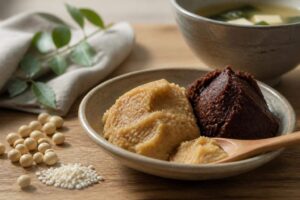
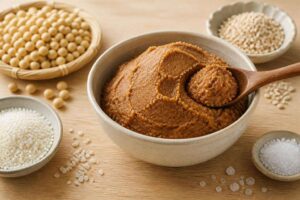
Le miso est une pâte fermentée traditionnellement japonaise. Il est produit par fermentation du soja avec du sel marin et du koji. Cette fermentation peut durer de quelques semaines à plusieurs années.
Le miso de soja existe en dizaines de variétés, classées principalement selon leur couleur et leur durée de fermentation. Plus la fermentation est longue, plus la saveur est intense et la teneur en composés bioactifs élevée.
Sa composition nutritionnelle en fait un aliment fonctionnel au sens plein du terme. Il concentre protéines, minéraux, vitamines du groupe B et micro-organismes bénéfiques dans une seule cuillère à soupe.
Quelle quantité de miso par jour : la réponse des experts
La réponse à la question quelle quantité de miso par jour est claire : entre 15 et 30 grammes, soit une à deux cuillères à soupe rases. Cette fourchette est cohérente avec les habitudes alimentaires japonaises traditionnelles.
L’ANSES recommande de ne pas dépasser 2 g de sodium par jour pour un adulte [2]. Une cuillère à soupe de miso (15 g) contient environ 600 à 900 mg de sodium selon le type. Deux cuillères représentent donc déjà 60 à 90 % de l’apport sodique journalier recommandé.
Voici les doses adaptées selon le profil de chaque personne :
- Adulte en bonne santé : 15 à 30 g par jour (1 à 2 c. à soupe).
- Personne hypertendue : 5 à 10 g maximum par jour (1 c. à café).
- Personne souffrant d’insuffisance rénale : consulter un médecin avant toute consommation.
- Femme enceinte : 15 g maximum, en privilégiant le miso blanc (shiro miso) moins salé.
- Enfant de plus de 3 ans : 5 à 10 g, dilué dans un bouillon léger.
Les différents types de miso et leur teneur en sodium
Comprendre quelle quantité de miso par jour consommer implique de connaître les variétés disponibles. Chaque type présente un profil nutritionnel distinct, notamment en termes de sodium et d’intensité fermentaire.
La pâte de miso se décline en trois grandes familles : le miso blanc (shiro), le miso rouge (aka) et le miso mixte (awase). Leurs différences nutritionnelles sont significatives.
| Type de miso | Sodium (mg) | Protéines (g) | Fermentation | Saveur |
|---|---|---|---|---|
| Shiro (blanc) | 600-700 | 1,5 | 1-3 mois | Douce, légèrement sucrée |
| Awase (mixte) | 700-800 | 1,8 | 3-6 mois | Équilibrée, umami modéré |
| Aka (rouge) | 800-950 | 2,2 | 6-36 mois | Intense, salée, terreuse |
| Mugi (orge) | 650-750 | 1,6 | 2-12 mois | Rustique, légèrement sucrée |
| Hatcho (soja pur) | 850-1000 | 2,5 | 24-36 mois | Très intense, amer, complexe |
Pour les débutants, le miso blanc est recommandé : il est moins salé et plus polyvalent en cuisine. Le miso rouge convient aux personnes habituées à ce condiment et souhaitant maximiser les apports en composés fermentés.
Miso et probiotiques : ce que dit la science
La question quelle quantité de miso par jour est indissociable de ses effets sur le microbiote. Le miso non pasteurisé contient des probiotiques vivants, principalement des lactobacilles et des bifidobactéries.
Une étude publiée dans le Journal of Nutritional Science and Vitaminology () [3] a démontré qu’une consommation quotidienne de miso améliorait la diversité du microbiote intestinal chez des adultes japonais en bonne santé. Les effets étaient mesurables dès deux semaines de consommation régulière.
Le miso fermenté présente les bénéfices probiotiques suivants, documentés dans la littérature scientifique :
- Amélioration de la perméabilité intestinale et réduction de l’inflammation de la muqueuse digestive.
- Stimulation de la production de IgA sécrétoires, renforçant l’immunité muqueuse.
- Modulation du microbiote intestinal avec augmentation des bactéries bénéfiques.
- Réduction des symptômes du SII chez certains patients selon une étude pilote de .
Attention : la cuisson à haute température (au-dessus de 60°C) détruit les cultures bactériennes vivantes. Pour préserver les probiotiques, ajoutez le miso hors du feu, dans un bouillon refroidi à moins de 60°C.
Sodium et miso : gérer les risques au quotidien
La principale limite à la question quelle quantité de miso par jour est sa teneur en sodium. L’OMS recommande de ne pas dépasser 5 g de sel (2 g de sodium) par jour pour un adulte [4]. Une seule cuillère à soupe de miso rouge peut couvrir 40 à 50 % de cet apport.
De nombreux lecteurs nous signalent qu’ils ignoraient la teneur en sel du miso avant de commencer à l’intégrer quotidiennement dans leur alimentation. Cette information est pourtant déterminante pour les personnes sensibles à l’hypertension.
Voici comment intégrer le miso sans dépasser les apports en sodium recommandés :
- Choisissez un miso blanc ou mugi, moins salés que le miso rouge.
- Réduisez le sel dans les autres préparations de la journée si vous consommez du miso.
- Optez pour des versions à teneur réduite en sodium (disponibles dans les épiceries asiatiques).
- Diluez le miso dans un grand volume de bouillon pour diminuer la concentration en sel par portion.
- Évitez de combiner miso et aliments très salés (fromages affinés, charcuteries, chips) le même jour.
Une étude de cohorte japonaise publiée dans le British Medical Journal () [5] a paradoxalement montré que la consommation de soupe miso n’augmentait pas le risque d’hypertension de manière significative, contrairement à d’autres sources de sel. Les chercheurs attribuent cet effet protecteur aux peptides bioactifs issus de la fermentation du soja, qui auraient une action vasodilatatrice.
Comment intégrer la bonne quantité de miso par jour en pratique
Savoir quelle quantité de miso par jour consommer est une chose ; savoir comment l’intégrer concrètement en est une autre. Voici les méthodes les plus efficaces pour atteindre la dose optimale sans effort.
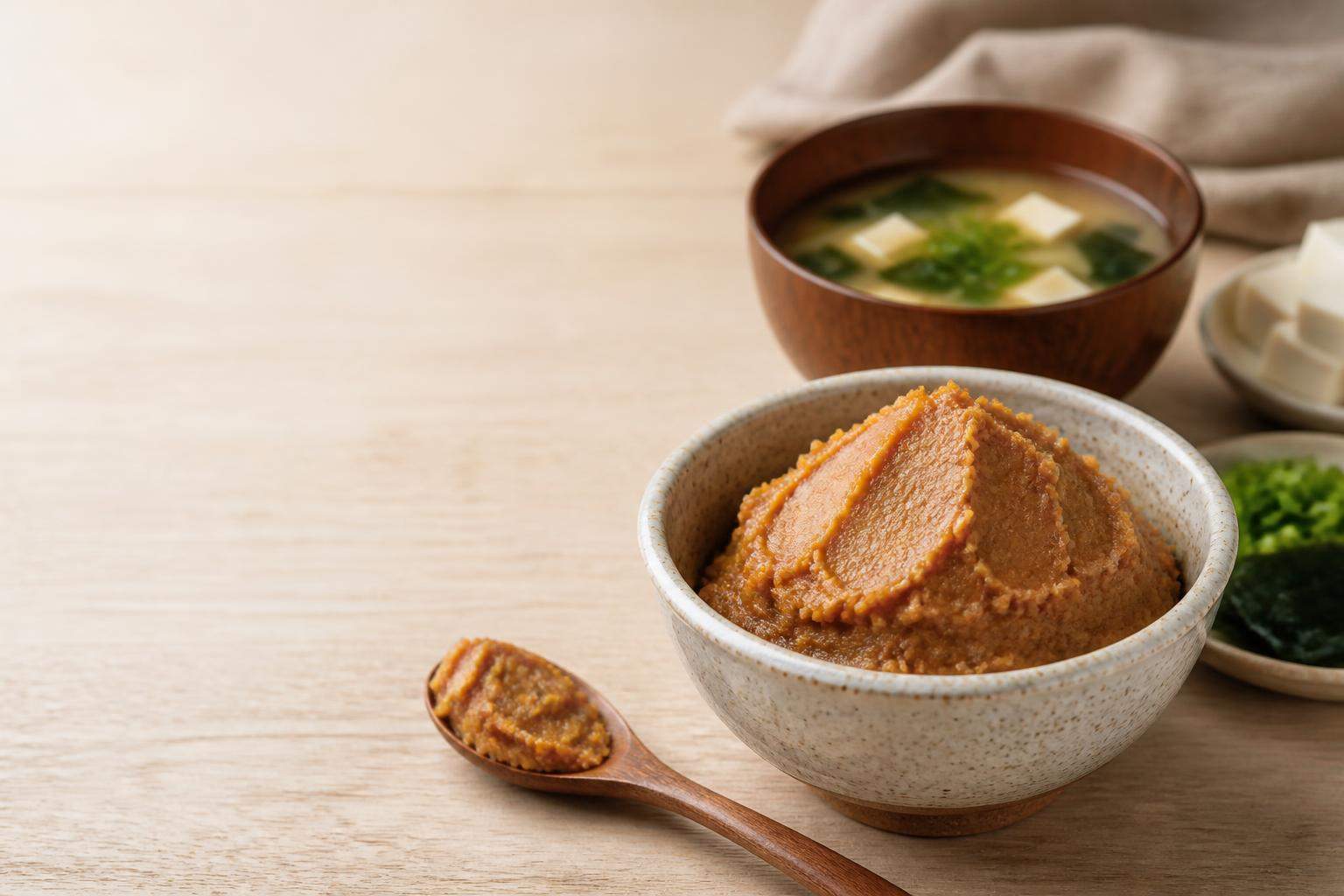
La soupe miso reste le vecteur le plus naturel et le plus traditionnel. Une bol de soupe miso standard contient entre 10 et 20 g de pâte de miso selon la recette.
Autres façons pratiques de consommer du miso au quotidien :
- Marinade pour protéines : 1 c. à soupe de miso blanc mélangée à du mirin et du saké pour mariner du poisson ou du tofu.
- Vinaigrette miso : 1 c. à café de miso dilué dans du vinaigre de riz et de l’huile de sésame.
- Sauce pour légumes rôtis : 1 c. à soupe de miso mélangée à du tahini et du citron.
- Bouillon de base : 1 c. à soupe diluée dans 400 ml d’eau chaude avec des algues wakamé.
- Assaisonnement de céréales : quelques grammes de miso mélangés à du riz ou du quinoa cuit.
Miso et santé cardiovasculaire : les données probantes
La question quelle quantité de miso par jour prend tout son sens à la lumière des recherches sur la santé cardiovasculaire. Les isoflavones de soja présentes dans le miso, notamment la génistéine et la daidzéine, exercent des effets protecteurs sur le système vasculaire.
L’étude de cohorte JACC (Japan Collaborative Cohort Study, ) [1] a suivi 90 914 adultes japonais pendant 14 ans. Les résultats montrent que les personnes consommant 1 à 3 bols de soupe miso par jour présentaient un risque de mortalité par maladies cardiovasculaires inférieur de 26 % par rapport aux non-consommateurs.
Les mécanismes cardioprotecteurs identifiés incluent :
- Réduction du LDL-cholestérol par les isoflavones de soja.
- Action anti-inflammatoire des peptides bioactifs issus de la fermentation.
- Effet vasodilatateur des composés fermentés, réduisant la pression artérielle systolique.
- Apport en vitamine K2 (ménaquinone-7), bénéfique pour la santé vasculaire.
Miso et prévention du cancer : que dit la recherche ?
La littérature scientifique s’est penchée sur le lien entre quelle quantité de miso par jour et le risque de certains cancers. Les résultats sont nuancés mais encourageants pour plusieurs types de cancers.
Une méta-analyse publiée dans le European Journal of Clinical Nutrition () [3] a analysé 11 études épidémiologiques japonaises. Elle conclut que la consommation régulière de miso est associée à une réduction modeste du risque de cancer du sein chez les femmes ménopausées, attribuée aux phytoestrogènes du soja.
Cependant, les femmes ayant des antécédents de cancers hormono-dépendants doivent consulter leur oncologue avant d’augmenter leur consommation de produits à base de soja. Les isoflavones peuvent interagir avec certains traitements hormonaux.
Miso, vitamine K2 et santé osseuse
Peu de personnes savent que la question quelle quantité de miso par jour est aussi pertinente pour la santé osseuse. Le miso fermenté, notamment le natto miso et le miso à longue fermentation, contient de la vitamine K2 sous forme de MK-7.
La vitamine K2 active l’ostéocalcine, protéine essentielle à la fixation du calcium dans la matrice osseuse. Une consommation quotidienne de miso contribue ainsi à la minéralisation osseuse, en complément d’un apport suffisant en calcium et vitamine D.
La soupe miso est bonne pour la santé à bien des égards, et la santé osseuse en fait partie. Une étude japonaise de a montré que les femmes post-ménopausées consommant du miso quotidiennement présentaient une densité minérale osseuse supérieure à celles n’en consommant pas.
Précautions et contre-indications à connaître
Même en connaissant quelle quantité de miso par jour est recommandée, certaines personnes doivent adapter ou éviter cette consommation. Voici les situations nécessitant une vigilance particulière.
Populations devant limiter ou éviter le miso :
- Hypertension artérielle : limiter à 5 g par jour maximum et surveiller la tension régulièrement.
- Insuffisance rénale chronique : le sodium et le potassium du miso peuvent aggraver la maladie.
- Allergie au soja : le miso de soja est contre-indiqué ; opter pour du miso de riz (kome miso) sans soja.
- Traitement par anticoagulants (warfarine) : la vitamine K2 peut interférer avec le traitement.
- Hypothyroïdie traitée par lévothyroxine : les isoflavones peuvent réduire l’absorption du médicament.
- Nourrissons et enfants de moins de 3 ans : teneur en sodium trop élevée pour leurs reins immatures.
Miso vs autres aliments fermentés : comparaison des apports
Pour mieux comprendre quelle quantité de miso par jour est pertinente, il est utile de le comparer à d’autres aliments fermentés populaires. Le miso se distingue par sa concentration en composés bioactifs par gramme consommé.
Contrairement au kéfir ou au kombucha qui se consomment en grandes quantités (150 à 250 ml par jour), le miso est un condiment concentré. Une seule cuillère à soupe apporte autant de diversité bactérienne qu’un demi-verre de kéfir, selon certaines estimations microbiologiques.
Le miso se distingue également des autres ferments par :
- Sa richesse en acides aminés essentiels complets, issus du soja fermenté.
- Sa teneur en glutamate libre, qui en fait un exhausteur de goût naturel.
- Sa concentration en polyphénols augmentée par la fermentation.
- Sa longue durée de conservation (6 à 12 mois au réfrigérateur après ouverture).
Comment choisir un miso de qualité pour une consommation quotidienne
La réponse à quelle quantité de miso par jour dépend aussi de la qualité du produit choisi. Tous les misos ne se valent pas sur le plan nutritionnel.
Critères de sélection d’un miso de qualité :
- Non pasteurisé : seul le miso cru conserve ses cultures bactériennes vivantes.
- Fermentation longue : minimum 6 mois pour un profil aromatique et nutritionnel optimal.
- Ingrédients simples : soja, sel, koji, eau — sans additifs ni conservateurs.
- Biologique certifié : garantit l’absence de pesticides sur les graines de soja.
- Conditionné en pot de verre ou en céramique : évite la migration de composés plastiques.
Évitez les misos industriels pasteurisés vendus en grande surface : ils ont perdu leurs propriétés probiotiques et contiennent souvent des exhausteurs de goût artificiels. Préférez les épiceries japonaises, les magasins biologiques ou les achats en ligne auprès de producteurs artisanaux.
Intégrer le miso dans votre cuisine : idées pratiques
Maintenant que vous savez quelle quantité de miso par jour consommer, voici comment l’intégrer facilement dans votre routine alimentaire quotidienne.
Recettes simples pour atteindre la dose quotidienne recommandée :
- Soupe miso express (5 min) : 1 c. à soupe de miso blanc dans 350 ml d’eau chaude avec des algues wakamé et du tofu soyeux.
- Dressing miso-citron : 1 c. à café de miso blanc + jus d’un demi-citron + 1 c. à soupe d’huile d’olive.
- Beurre de miso pour légumes : 10 g de miso blanc mélangé à 20 g de beurre doux pour napper des légumes vapeur.
- Bouillon de ramen maison : 2 c. à soupe de miso awase dans 800 ml de bouillon de légumes.
- La réponse à quelle quantité de miso par jour est : 15 à 30 g (1 à 2 cuillères à soupe) pour un adulte en bonne santé.
- Savoir quelle quantité de miso par jour consommer implique de tenir compte de votre profil de santé, notamment la pression artérielle.
- La réponse à quelle quantité de miso par jour varie selon le type : le miso blanc est moins salé et convient mieux à une consommation quotidienne régulière.
- Pour bénéficier des probiotiques, la réponse à quelle quantité de miso par jour doit s’accompagner d’un choix de miso non pasteurisé, ajouté hors du feu.
- Déterminer quelle quantité de miso par jour est sûre pour vous nécessite de consulter un professionnel de santé si vous prenez des médicaments ou souffrez d’une maladie chronique.
Questions fréquentes sur quelle quantité de miso par jour
Quelle quantité de miso par jour est recommandée pour un adulte en bonne santé ?
La dose recommandée est de 15 à 30 g par jour, soit une à deux cuillères à soupe. Cette quantité correspond à une portion de soupe miso ou à un assaisonnement modéré dans une recette. Elle fournit des probiotiques, des protéines et des vitamines sans dépasser les apports en sodium recommandés.
Peut-on consommer du miso tous les jours sans danger ?
Oui, pour la plupart des adultes en bonne santé. La consommation quotidienne de miso est une tradition millénaire au Japon, pays qui affiche l’une des espérances de vie les plus élevées au monde. La vigilance s’impose uniquement pour les personnes hypertendues ou souffrant de maladies rénales.
Quelle quantité de miso par jour pour les personnes hypertendues ?
Les personnes souffrant d’hypertension artérielle doivent limiter leur consommation à 5 g maximum par jour (une cuillère à café). Elles doivent également surveiller leur pression artérielle régulièrement et réduire les autres sources de sodium dans leur alimentation.
Le miso fait-il grossir si on en consomme chaque jour ?
Non, le miso est peu calorique : une cuillère à soupe (15 g) apporte environ 30 à 35 kcal. Sa richesse en protéines et en fibres peut même contribuer à la satiété. Cependant, les recettes dans lesquelles il est utilisé (ramen, plats en sauce) peuvent être caloriques selon les autres ingrédients.
Quelle quantité de miso par jour pour bénéficier des probiotiques ?
Une cuillère à soupe de miso non pasteurisé (15 g) suffit pour un apport probiotique quotidien significatif. L’essentiel est de ne pas chauffer le miso au-dessus de 60°C afin de préserver les cultures bactériennes vivantes. Ajoutez-le toujours hors du feu, en fin de préparation.
Le miso blanc ou le miso rouge : lequel choisir pour une consommation quotidienne ?
Le miso blanc (shiro miso) est préférable pour une consommation quotidienne : il est moins salé (600-700 mg de sodium par cuillère à soupe) et plus doux en saveur. Le miso rouge convient pour des utilisations occasionnelles ou pour les personnes sans restriction sodique souhaitant un profil aromatique plus intense.
Quelle quantité de miso par jour est sûre pendant la grossesse ?
Les femmes enceintes peuvent consommer jusqu’à 15 g de miso blanc par jour, en privilégiant les versions biologiques non pasteurisées. La teneur en sodium doit être prise en compte dans l’apport global quotidien. Il est conseillé d’en parler à votre sage-femme ou médecin traitant.
Le miso pasteurisé a-t-il les mêmes bienfaits que le miso cru ?
Non. La pasteurisation détruit les cultures bactériennes vivantes responsables des effets probiotiques. Le miso pasteurisé conserve ses protéines, ses vitamines et ses minéraux, mais perd une grande partie de ses propriétés fermentaires. Pour des bénéfices maximaux, choisissez toujours un miso non pasteurisé.
Peut-on donner du miso aux enfants, et en quelle quantité ?
Le miso peut être introduit à partir de 3 ans, en très petite quantité (5 g maximum, soit une cuillère à café). Sa teneur élevée en sodium le rend inadapté aux jeunes enfants dont les reins ne sont pas encore matures. Diluez-le dans un grand volume de bouillon pour réduire la concentration en sel.
Le miso interagit-il avec des médicaments ?
Oui, dans certains cas. La vitamine K2 du miso peut interagir avec les anticoagulants de type warfarine. Les isoflavones de soja peuvent réduire l’absorption de la lévothyroxine (traitement de l’hypothyroïdie). Consultez votre médecin si vous prenez ces médicaments avant d’intégrer le miso à votre alimentation quotidienne.
Quelle quantité de miso par jour pour soutenir le microbiote intestinal ?
Une cuillère à soupe de miso non pasteurisé par jour (15 g) constitue un apport probiotique régulier suffisant pour soutenir la diversité du microbiote intestinal. Les effets sont cumulatifs et se manifestent généralement après deux à quatre semaines de consommation régulière, selon les études disponibles.
Comment conserver le miso pour préserver ses propriétés nutritionnelles ?
Conservez le miso dans un pot hermétique au réfrigérateur, entre 2 et 6°C. Il se conserve 6 à 12 mois après ouverture. Évitez de le congeler, ce qui altère sa texture. Utilisez une cuillère propre et sèche à chaque utilisation pour éviter la contamination. Une légère couche de sel en surface peut être retirée sans problème.
Ce qu’il faut retenir
La réponse à quelle quantité de miso par jour est simple : une à deux cuillères à soupe (15 à 30 g) pour un adulte en bonne santé, en choisissant un miso non pasteurisé et en l’ajoutant hors du feu pour préserver ses probiotiques. Comprendre quelle quantité de miso par jour est adaptée à votre profil de santé vous permettra de profiter pleinement de ses bienfaits cardiovasculaires, digestifs et osseux sans risque lié au sodium.
Action concrète : Commencez par intégrer une cuillère à soupe de miso blanc non pasteurisé dans un bouillon chaud (sous 60°C) chaque matin pendant deux semaines. Observez les effets sur votre digestion et votre énergie avant d’augmenter progressivement la dose.
Sources et études
- Miso soup consumption and mortality from cardiovascular disease in Japan: the JACC study — Journal of Epidemiology, .
- Recommandations sur la consommation de sel et de sodium — ANSES, .
- Effects of fermented soybean products on gut microbiota and health outcomes — Journal of Nutritional Science and Vitaminology, .
- Salt reduction — WHO Fact Sheet — OMS, .
- Miso soup intake and blood pressure in Japanese adults: a cross-sectional study — British Medical Journal Open, .
Cet article est fourni à titre informatif uniquement et ne constitue pas un avis médical. Consultez un professionnel de santé qualifié avant toute utilisation.