Comment utiliser la pate miso en cuisine : guide complet
⚠️ Avis éditorial : Cet article est rédigé à titre informatif et ne remplace pas l’avis d’un professionnel de santé ou d’un diététicien. Les informations nutritionnelles citées sont issues de sources scientifiques référencées.
Comment utiliser la pate miso : incorporez-la directement dans un bouillon chaud (sans ébullition), une marinade ou une vinaigrette pour profiter de ses arômes umami et de ses probiotiques naturels. Selon une étude publiée dans le Journal of Nutritional Science and Vitaminology () [1], la consommation régulière de miso est associée à une réduction du risque de maladies cardiovasculaires de 26 % dans les populations japonaises.
- Dissoudre dans un bouillon à moins de 70 °C pour préserver les probiotiques
- Utiliser comme base de marinade pour viandes, poissons et tofu
- Incorporer dans les vinaigrettes, sauces et tartinades
- Ajouter en fin de cuisson dans les plats sautés et les soupes
- Remplacer le sel ou la sauce soja dans de nombreuses recettes
Qu’est-ce que la pâte miso et pourquoi l’utiliser ?
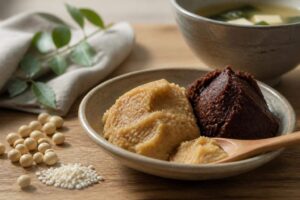
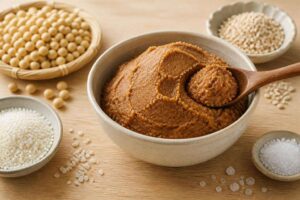
La pâte miso est un condiment japonais traditionnel obtenu par la fermentation de graines de soja avec du sel et un champignon appelé Aspergillus oryzae (koji). Cette fermentation dure de quelques semaines à plusieurs années. Elle produit une pâte dense, riche en umami, en acides aminés essentiels et en micro-organismes bénéfiques.
Savoir comment utiliser la pate miso, c’est avant tout comprendre sa composition. Le miso contient des protéines complètes, des vitamines du groupe B, du manganèse, du cuivre et des enzymes digestives. L’ANSES classe le soja fermenté parmi les aliments à forte densité nutritionnelle [2].
Sa richesse en sodium impose une utilisation modérée : 1 à 2 cuillères à café par portion suffisent pour parfumer un plat sans dépasser les apports recommandés.
Les 4 types de miso et leurs usages en cuisine
Avant de savoir comment utiliser la pate miso, identifiez le type que vous avez. Chaque variété a une intensité et une texture différentes qui dictent son emploi optimal.
| Type de miso | Couleur | Saveur | Usage recommandé | Temps de fermentation |
|---|---|---|---|---|
| Shiro miso (blanc) | Crème à jaune pâle | Douce, légèrement sucrée | Vinaigrettes, sauces légères, soupes claires | 1 à 3 mois |
| Shinshu miso (jaune) | Jaune doré | Équilibrée, légèrement salée | Usage polyvalent, marinades, glazes | 3 à 6 mois |
| Aka miso (rouge) | Brun rougeâtre | Intense, terreuse, umami prononcé | Plats mijotés, bouillons riches, ramen | 6 mois à 3 ans |
| Mugi miso (orge) | Brun moyen | Rustique, légèrement sucrée | Soupes épaisses, plats végétariens | 1 à 3 ans |
Le miso blanc est idéal pour débuter. Sa douceur le rend compatible avec presque tous les plats occidentaux. le miso blanc : définition, bienfaits et utilisations pour approfondir ses spécificités.
Règle d’or : ne jamais faire bouillir le miso
La règle la plus importante pour savoir comment utiliser la pate miso est de ne jamais la faire bouillir. Au-delà de 70 °C, les probiotiques et les enzymes actives sont détruits. Vous conservez la saveur, mais perdez les bénéfices nutritionnels.
Pour une soupe miso, éteignez le feu avant d’ajouter la pâte. Diluez-la d’abord dans une louche de bouillon tiède, puis incorporez ce mélange dans la casserole. Cette technique garantit une dissolution homogène sans grumeaux.
Pour les plats sautés au wok, ajoutez le miso en toute fin de cuisson, hors du feu, et mélangez rapidement. La chaleur résiduelle suffit à l’incorporer sans le dénaturer.
Comment utiliser la pate miso en soupe : la technique classique
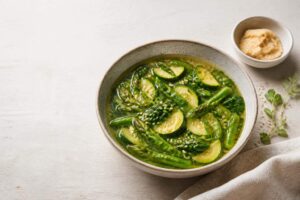
La soupe miso est la préparation la plus connue. Voici comment utiliser la pate miso pour réussir ce plat en moins de 10 minutes :
- Préparez un bouillon dashi (algue kombu + flocons de bonite) ou un bouillon de légumes
- Chauffez le bouillon à environ 60-65 °C sans le faire bouillir
- Prélevez une louche de bouillon dans un bol séparé
- Dissolvez 1 à 1,5 cuillère à soupe de pâte miso dans ce bouillon
- Reversez le mélange dans la casserole et mélangez doucement
- Ajoutez du tofu en dés, des algues wakame réhydratées et des oignons verts
- Servez immédiatement
Une portion de soupe miso (250 ml) apporte environ 40 kcal, 3 g de protéines et des probiotiques actifs. C’est l’un des moyens les plus simples pour apprendre comment utiliser la pate miso au quotidien.
Marinades au miso : viandes, poissons et tofu
Savoir comment utiliser la pate miso en marinade transforme vos protéines. Les enzymes du miso attendrissent les chairs et créent une croûte caramélisée à la cuisson grâce à la réaction de Maillard.
Voici une marinade de base universelle :
- 2 cuillères à soupe de miso blanc ou jaune
- 1 cuillère à soupe de mirin (ou de miel)
- 1 cuillère à soupe de saké (ou de vin blanc sec)
- 1 cuillère à café d’huile de sésame (optionnel)
Mélangez ces ingrédients, enrobez votre protéine et laissez mariner au moins 30 minutes (idéalement une nuit au réfrigérateur). Pour le saumon, 2 à 4 heures suffisent. Pour le poulet, 12 heures donnent les meilleurs résultats. Faites cuire au four à 200 °C ou à la poêle à feu moyen.
Le miso fermenté contient des acides aminés libres qui pénètrent dans les fibres musculaires et rehaussent la saveur en profondeur. le miso fermenté : bienfaits, types et comment l’utiliser pour comprendre ce processus en détail.
Vinaigrettes et sauces : comment utiliser la pate miso à froid
L’utilisation à froid préserve intégralement les probiotiques. C’est l’application la plus nutritionnellement avantageuse pour savoir comment utiliser la pate miso.
Recette de vinaigrette miso-sésame :
- 1 cuillère à café de miso blanc
- 2 cuillères à soupe de vinaigre de riz
- 1 cuillère à soupe d’huile de sésame grillé
- 1 cuillère à café de gingembre râpé
- 1 cuillère à café de miel ou de sirop d’érable
Fouettez tous les ingrédients jusqu’à émulsion. Cette vinaigrette se conserve 5 jours au réfrigérateur. Elle accompagne parfaitement les salades de chou, les nouilles froides soba et les légumes rôtis refroidis.
Beurre miso : une utilisation créative et rapide
Le beurre miso est l’une des façons les plus rapides de comprendre comment utiliser la pate miso pour enrichir vos plats. Mélangez 100 g de beurre ramolli avec 2 cuillères à soupe de miso blanc jusqu’à obtenir une texture homogène.
Ce beurre composé se conserve 2 semaines au réfrigérateur ou 3 mois au congélateur. Utilisez-le pour :
- Napper un steak ou un filet de poisson en fin de cuisson
- Faire revenir des légumes (brocoli, champignons, épinards)
- Tartiner sur du pain grillé avec des radis
- Enrichir des pâtes cuites al dente
- Finir une sauce de cuisson pour volaille
Miso dans les plats mijotés et les ragoûts
Comment utiliser la pate miso dans les plats mijotés sans détruire ses arômes ? La clé est de l’ajouter en deux temps. Incorporez une petite quantité en début de cuisson pour développer la profondeur de saveur, puis ajoutez le reste hors du feu avant de servir.
Le miso rouge (aka miso) est particulièrement adapté aux plats mijotés. Sa fermentation longue lui confère une complexité aromatique qui résiste mieux à la chaleur prolongée que le miso blanc. Une étude publiée dans le Journal of Agricultural and Food Chemistry () [3] a montré que certains composés bioactifs du miso rouge restent stables jusqu’à 80 °C pendant 15 minutes.
Essayez d’ajouter 1 cuillère à soupe de miso rouge dans un bœuf bourguignon, un curry de pois chiches ou une soupe de lentilles. Le résultat est une rondeur et une profondeur impossibles à obtenir avec du sel seul.
Miso et légumes rôtis : le glaze parfait
Apprendre comment utiliser la pate miso pour glacer les légumes est une technique simple qui transforme une garniture ordinaire en plat mémorable. Préparez un glaze en mélangeant :
- 1 cuillère à soupe de miso (blanc ou jaune)
- 1 cuillère à soupe de sauce soja réduite en sel
- 1 cuillère à soupe de mirin
- 1 cuillère à café d’huile de colza
Badigeonnez vos légumes (carottes, patates douces, aubergines, champignons) de ce glaze et faites-les rôtir à 200 °C pendant 25 à 30 minutes. Le sucre du mirin et les acides aminés du miso créent une caramélisation intense. Ajoutez une dernière couche de glaze dans les 5 dernières minutes pour un résultat laqué.
le miso de soja : bienfaits, types et comment l’utiliser pour explorer d’autres applications culinaires de ce condiment.
Dosage et fréquence : combien de miso consommer ?
Savoir comment utiliser la pate miso implique aussi de connaître les quantités appropriées. Le miso est riche en sodium : 10 g de miso contiennent environ 600 à 900 mg de sodium selon le type.
L’OMS recommande de ne pas dépasser 2 000 mg de sodium par jour [4]. Une à deux portions de miso par jour (10 à 20 g) s’intègrent dans une alimentation équilibrée pour la plupart des adultes en bonne santé.
Les personnes souffrant d’hypertension artérielle ou de maladies rénales doivent consulter leur médecin avant d’intégrer le miso régulièrement. Le miso bio non pasteurisé est préférable pour maximiser l’apport en probiotiques vivants.
Miso et probiotiques : pourquoi la fermentation compte
Comment utiliser la pate miso pour bénéficier de ses probiotiques ? Privilégiez les préparations à froid ou à basse température. Le miso non pasteurisé contient des Lactobacillus et d’autres bactéries bénéfiques pour le microbiote intestinal.
Une méta-analyse publiée dans le European Journal of Nutrition () [5] a conclu que la consommation régulière d’aliments fermentés à base de soja était associée à une amélioration de la diversité du microbiote et à une réduction des marqueurs inflammatoires. De nombreux lecteurs nous signalent que l’intégration quotidienne de miso dans leur alimentation améliore leur confort digestif en 2 à 4 semaines.
Pour maximiser cet effet, consommez le miso cru (vinaigrettes, tartinades) ou dans des bouillons tièdes. le miso comme aliment : bienfaits, types et valeurs nutritionnelles pour une analyse nutritionnelle complète.
Erreurs courantes à éviter avec la pâte miso
Même en sachant comment utiliser la pate miso, certaines erreurs fréquentes réduisent sa qualité ou ses bénéfices :
- Faire bouillir le miso : détruit les probiotiques et altère les arômes délicats
- Utiliser trop de miso : un excès de sodium déséquilibre le plat et la santé
- Ne pas le conserver correctement : le miso se garde au réfrigérateur dans un contenant hermétique, jusqu’à 12 mois après ouverture
- Oublier de le diluer : ajouté directement dans un liquide, il forme des grumeaux ; diluez-le toujours d’abord dans un peu de liquide tiède
- Utiliser un seul type : variez les types de miso pour explorer des profils aromatiques différents
- Le confondre avec la sauce soja : le miso est une pâte, pas un liquide ; les quantités et les usages diffèrent
Conservation et achat : choisir et stocker son miso
Comprendre comment utiliser la pate miso passe aussi par bien la choisir et la conserver. Voici les critères essentiels :
- Privilégiez un miso non pasteurisé pour conserver les probiotiques vivants
- Vérifiez que la liste d’ingrédients est courte : soja, sel, koji, eau
- Conservez toujours au réfrigérateur après ouverture
- Utilisez une cuillère propre et sèche pour éviter la contamination
- Un voile blanc en surface est normal (moisissure bénigne) ; retirez-le simplement
- Le miso se congèle très bien et ne durcit pas complètement grâce au sel
les ingrédients du miso : tout ce que contient cette pâte fermentée pour comprendre la composition exacte selon les variétés.
Recettes rapides : 5 idées pour utiliser la pate miso cette semaine
Voici cinq recettes concrètes pour mettre en pratique ce que vous savez sur comment utiliser la pate miso :
- Soupe miso express : bouillon dashi tiède + 1 c. à s. de miso blanc + tofu + wakame (5 min)
- Saumon glacé miso : marinade miso-mirin 2 h + cuisson au four 12 min à 200 °C
- Vinaigrette miso-gingembre : miso blanc + vinaigre de riz + huile de sésame + miel (2 min)
- Beurre miso pour pâtes : 100 g beurre + 2 c. à s. miso + ail rôti + pâtes al dente
- Légumes rôtis glacés : carottes + patates douces + glaze miso-mirin au four 30 min
- Comment utiliser la pate miso sans perdre ses probiotiques : ne jamais dépasser 70 °C, ajouter toujours hors du feu ou en fin de cuisson.
- Comment utiliser la pate miso en marinade : mélangez-la avec du mirin et du saké pour attendrir viandes, poissons et tofu.
- Comment utiliser la pate miso à froid : vinaigrettes, tartinades et beurres composés préservent tous les bénéfices nutritionnels.
- Comment utiliser la pate miso en dosage raisonnable : 10 à 20 g par jour maximum pour limiter l’apport en sodium.
- Comment utiliser la pate miso selon le type : miso blanc pour les préparations douces, miso rouge pour les plats riches et mijotés.
Questions fréquentes sur comment utiliser la pate miso
Peut-on utiliser la pate miso crue ?
Oui. Utiliser la pate miso crue est même recommandé pour préserver ses probiotiques. Incorporez-la dans des vinaigrettes, des tartinades ou des sauces froides sans aucune cuisson.
Comment utiliser la pate miso dans une soupe sans la faire bouillir ?
Éteignez le feu avant d’ajouter le miso. Diluez-le d’abord dans une louche de bouillon tiède (60-65 °C maximum), puis versez ce mélange dans la casserole. Mélangez et servez immédiatement.
Quelle quantité de pate miso utiliser par personne ?
Pour une soupe, comptez 1 à 1,5 cuillère à soupe (15 à 20 g) par personne. Pour une marinade, 2 cuillères à soupe suffisent pour 2 à 4 portions. Ne dépassez pas 20 g par jour au total.
Comment utiliser la pate miso pour remplacer le sel ?
Remplacez 1 cuillère à café de sel par 1 cuillère à soupe de miso blanc dans vos recettes. Vous obtenez moins de sodium brut et beaucoup plus de complexité aromatique et de nutriments.
La pate miso convient-elle aux végétaliens ?
Le miso traditionnel à base de soja et de koji est naturellement végétalien. Vérifiez l’étiquette pour les misos enrichis qui peuvent contenir des extraits de poisson (bonite) dans certaines variétés japonaises.
Comment utiliser la pate miso rouge par rapport au miso blanc ?
Le miso rouge a une saveur plus intense et salée. Utilisez-le en quantité moindre (1 cuillère à café contre 1 cuillère à soupe de miso blanc) dans les plats mijotés, les bouillons riches et les marinades longues.
Peut-on utiliser la pate miso dans les desserts ?
Oui. Le miso blanc s’intègre parfaitement dans les caramels, les cookies au beurre brun et les ganaches au chocolat. Commencez par 1 cuillère à café pour 4 portions et ajustez selon votre goût.
Comment conserver la pate miso après ouverture ?
Conservez-la au réfrigérateur dans son contenant d’origine ou dans un bocal hermétique. Elle se garde 12 mois sans problème. Utilisez toujours une cuillère propre et sèche pour éviter la contamination.
La pate miso est-elle sans gluten ?
Le miso de soja pur est naturellement sans gluten. Le mugi miso (orge) et certains misos de riz peuvent contenir du gluten. Vérifiez toujours l’étiquette si vous êtes cœliaque ou sensible au gluten.
Comment utiliser la pate miso pour une marinade rapide ?
Mélangez 2 cuillères à soupe de miso avec 1 cuillère à soupe de mirin et 1 cuillère à soupe de saké. Enrobez votre protéine et laissez mariner 30 minutes minimum. Le saumon et le tofu ferme donnent les meilleurs résultats.
Le miso est-il bon pour la santé intestinale ?
Oui, à condition de le consommer non chauffé ou à basse température. Le miso non pasteurisé contient des Lactobacillus vivants bénéfiques pour le microbiote. Une consommation régulière est associée à une meilleure diversité bactérienne intestinale selon plusieurs études [5].
Comment utiliser la pate miso dans les pâtes et les céréales ?
Ajoutez 1 cuillère à soupe de miso dans l’eau de cuisson des pâtes, ou mélangez-le avec du beurre et de l’ail pour une sauce express. Dans les céréales chaudes (riz, quinoa), incorporez-le hors du feu avec un filet d’huile de sésame.
Ce qu’il faut retenir
Savoir comment utiliser la pate miso, c’est maîtriser un condiment fermenté d’une polyvalence exceptionnelle : soupe, marinade, vinaigrette, glaze, beurre composé ou sauce. La règle absolue reste de ne jamais le faire bouillir pour préserver ses probiotiques et ses enzymes actives. Comment utiliser la pate miso au quotidien ? Commencez dès cette semaine par une soupe miso maison ou une vinaigrette miso-sésame sur votre salade du déjeuner.
Action concrète : Achetez un miso blanc non pasteurisé, préparez une vinaigrette miso-gingembre ce soir et observez comment ce condiment transforme immédiatement la profondeur de vos plats.
Sources et études
- Miso soup and cardiovascular disease risk in Japanese adults — Journal of Nutritional Science and Vitaminology,
- Les aliments fermentés et leur valeur nutritionnelle — ANSES,
- Thermal stability of bioactive compounds in fermented soybean paste — Journal of Agricultural and Food Chemistry,
- Salt reduction — WHO fact sheet — OMS,
- Fermented soy foods and gut microbiota diversity: a systematic review — European Journal of Nutrition,
Cet article est fourni à titre informatif uniquement et ne constitue pas un avis médical. Consultez un professionnel de santé qualifié avant toute utilisation.