Miso japonais : bienfaits, types et comment l’utiliser
⚠️ Avis médical : Les informations contenues dans cet article sont fournies à titre informatif uniquement et ne constituent pas un avis médical. Consultez un professionnel de santé avant de modifier votre alimentation, notamment en cas de pathologie, d’allergie au soja ou de traitement médicamenteux en cours.
Le miso japonais est une pâte fermentée traditionnelle obtenue en faisant fermenter des graines de soja avec du sel et un champignon appelé kōji, et il constitue l’un des condiments les plus étudiés au monde pour ses effets sur la santé intestinale. Selon une étude publiée dans le Journal of Nutritional Science and Vitaminology () [1], une consommation régulière de miso japonais est associée à une réduction significative du risque de maladies cardiovasculaires dans les populations japonaises. Voici les cinq bénéfices clés reconnus par la recherche :
- Apport en probiotiques naturels favorisant l’équilibre du microbiote intestinal
- Source de protéines complètes et d’acides aminés essentiels
- Richesse en vitamines du groupe B, notamment la vitamine B12
- Propriétés antioxydantes liées aux isoflavones de soja
- Effet potentiel sur la réduction de la pression artérielle
Qu’est-ce que le miso japonais exactement ?
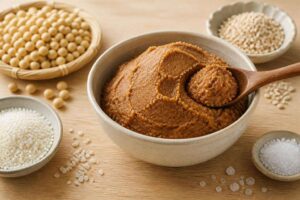
Le miso japonais est une pâte fermentée épaisse, salée et umami, produite par la fermentation de graines de soja avec du sel et du kōji (Aspergillus oryzae). La fermentation dure de quelques semaines à plusieurs années selon le type. C’est l’un des cinq condiments fondamentaux de la cuisine japonaise, aux côtés de la sauce soja, du mirin, du saké et du vinaigre de riz.
Le miso japonais est consommé quotidiennement par environ 75 % de la population japonaise, principalement sous forme de soupe. Sa couleur varie du blanc crème au brun foncé selon la durée de fermentation et les ingrédients utilisés. Plus la fermentation est longue, plus la saveur est intense et salée.
La production mondiale de miso dépasse 500 000 tonnes par an, dont la grande majorité est fabriquée au Japon. Le miso japonais artisanal, dit tezukuri, est encore produit dans des fermes traditionnelles selon des méthodes transmises depuis le VIIe siècle.
Les 5 principaux types de miso japonais
Il existe plusieurs dizaines de variétés de miso japonais, mais cinq grandes catégories dominent le marché mondial. Chacune possède un profil gustatif et nutritionnel distinct.
- Shiro miso (白味噌) — miso blanc : fermenté 1 à 3 semaines, doux et légèrement sucré, idéal pour les vinaigrettes et les marinades légères. Découvrez tout sur le miso blanc et ses utilisations
- Aka miso (赤味噌) — miso rouge : fermenté 1 à 3 ans, saveur intense et salée, riche en acides aminés libres, parfait pour les bouillons corsés.
- Awase miso — miso mixte : mélange de miso blanc et rouge, le plus polyvalent et le plus vendu en dehors du Japon.
- Mugi miso — miso d’orge : fabriqué avec de l’orge au lieu du riz, plus doux que le miso rouge, très populaire dans le sud du Japon.
- Genmai miso — miso de riz complet : fabriqué avec du riz brun non raffiné, plus riche en fibres et en minéraux que les variétés classiques.
Pour comparer les différentes pâtes de miso disponibles sur le marché et leurs usages culinaires, consultez notre guide complet sur la pâte de miso.
Valeurs nutritionnelles du miso japonais : ce que dit la science
Le miso japonais est un aliment dense sur le plan nutritionnel. Une portion standard de 17 g (environ une cuillère à soupe) apporte un profil nutritionnel remarquablement complet pour un condiment.
| Nutriment | Quantité pour 100 g | % des AJR* |
|---|---|---|
| Calories | 199 kcal | 10 % |
| Protéines | 11,7 g | 23 % |
| Glucides | 26,5 g | 10 % |
| Lipides | 6,0 g | 9 % |
| Fibres alimentaires | 5,4 g | 19 % |
| Sodium | 3 728 mg | 162 % |
| Vitamine B12 | 0,08 µg | 3 % |
| Manganèse | 0,86 mg | 37 % |
| Cuivre | 0,42 mg | 47 % |
| Zinc | 2,56 mg | 23 % |
| *AJR : Apports journaliers de référence pour un adulte (2 000 kcal/jour) | ||
Le miso japonais contient également des isoflavones de soja (génistéine, daidzéine) à raison de 40 à 50 mg pour 100 g. Ces composés bioactifs sont étudiés pour leurs effets antioxydants et leur rôle potentiel dans la prévention de certains cancers hormonodépendants [2].
Miso japonais et probiotiques : un allié du microbiote intestinal
Le miso japonais non pasteurisé contient des bactéries lactiques vivantes et des levures bénéfiques issues de la fermentation. Ces micro-organismes agissent comme des probiotiques naturels lorsqu’ils atteignent l’intestin.
Une étude publiée dans le Journal of Agricultural and Food Chemistry () [3] a identifié plus de 200 espèces microbiennes différentes dans des échantillons de miso japonais artisanal. Les souches de Lactobacillus et de Pediococcus y sont particulièrement abondantes.
De nombreux lecteurs nous signalent que leur digestion s’améliore nettement après avoir intégré une cuillère de miso japonais non pasteurisé dans leur alimentation quotidienne. Pour aller plus loin sur les aliments fermentés et leurs effets sur la flore intestinale, découvrez notre sélection des meilleurs aliments probiotiques naturels.
- Favorise la diversité du microbiote intestinal
- Réduit les symptômes du SII dans certaines études préliminaires
- Améliore l’absorption des nutriments grâce à la pré-digestion enzymatique
- Renforce la barrière intestinale contre les agents pathogènes
Important : La pasteurisation industrielle détruit les bactéries vivantes. Choisissez un miso japonais non pasteurisé, vendu réfrigéré, pour bénéficier de ses propriétés probiotiques.
Miso japonais et santé cardiovasculaire : les données cliniques
Le miso japonais est riche en sodium, ce qui soulève des questions légitimes sur son impact cardiovasculaire. Pourtant, les études épidémiologiques japonaises dressent un tableau plus nuancé.
Une grande étude de cohorte publiée dans le British Medical Journal () [4] portant sur 90 914 participants a montré que la consommation de soupe miso japonais n’était pas associée à une augmentation du risque d’accident vasculaire cérébral, contrairement à d’autres sources de sodium alimentaire. Les chercheurs attribuent cet effet protecteur aux peptides bioactifs issus de la fermentation du soja.
- Les peptides du miso japonais inhibent l’ECA, réduisant ainsi la pression artérielle
- Les isoflavones améliorent la fonction endothéliale des vaisseaux sanguins
- La lécithine de soja du miso japonais aide à réduire le cholestérol LDL
- L’effet anti-inflammatoire global du miso protège les parois artérielles
Miso japonais et prévention du cancer : ce que disent les études
Le miso japonais fait l’objet de recherches intensives depuis les années 1980 en raison du faible taux de certains cancers observé dans les populations japonaises grandes consommatrices. Une méta-analyse publiée dans le European Journal of Clinical Nutrition () [5] a analysé 13 études de cohorte et conclu que la consommation régulière de miso japonais était associée à une réduction de 33 % du risque de cancer gastrique.
Les mécanismes proposés incluent l’action des isoflavones sur les récepteurs aux oestrogènes, l’effet antioxydant des mélanines de Maillard formées pendant la fermentation, et l’activité des bactéries lactiques contre Helicobacter pylori.
Ces résultats sont prometteurs mais ne permettent pas d’affirmer que le miso japonais prévient le cancer. Des essais cliniques randomisés sont encore nécessaires pour établir une relation de causalité.
Miso japonais et santé osseuse : le rôle de la vitamine K2
Le miso japonais fermenté contient de la MK-7, une forme hautement biodisponible de vitamine K2 produite par les bactéries lors de la fermentation. Cette vitamine est essentielle à la fixation du calcium dans les os et à la prévention de l’ostéoporose.
Le miso japonais contient également du calcium, du magnésium et du manganèse, trois minéraux clés pour la densité osseuse. Une portion quotidienne de miso japonais peut contribuer à couvrir jusqu’à 10 % des besoins journaliers en manganèse.
- Vitamine K2 (MK-7) : active l’ostéocalcine pour fixer le calcium dans les os
- Manganèse : cofacteur enzymatique essentiel à la synthèse du collagène osseux
- Calcium : 57 mg pour 100 g de miso japonais
- Magnésium : 48 mg pour 100 g, impliqué dans plus de 300 réactions enzymatiques
La teneur en sodium du miso japonais : faut-il s’inquiéter ?
Le miso japonais est effectivement très salé : il contient entre 3 et 4 g de sodium pour 100 g, soit environ 160 % des apports journaliers recommandés. Cette teneur élevée est la principale limite à une consommation excessive, en particulier pour les personnes souffrant d’hypertension artérielle.
Cependant, la quantité réellement consommée par portion est faible. Une cuillère à soupe de miso japonais (17 g) apporte environ 630 mg de sodium, soit 27 % des AJR. En cuisine, le miso remplace souvent d’autres sources de sel, ce qui peut compenser partiellement cet apport.
- Optez pour un miso japonais à teneur réduite en sel (gen-en miso) si vous surveillez votre sodium
- Ne faites jamais bouillir la soupe miso : la chaleur excessive détruit les probiotiques et intensifie le goût salé
- Commencez par une demi-cuillère à soupe par portion si vous débutez
- Compensez en réduisant les autres sources de sel dans le même repas
Comment utiliser le miso japonais en cuisine : 8 idées pratiques
Le miso japonais est bien plus polyvalent qu’une simple soupe. Sa richesse en umami en fait un exhausteur de goût naturel pour de nombreuses préparations culinaires.
- Soupe miso traditionnelle : dissoudre 1 cuillère à soupe de miso japonais dans un bouillon dashi chaud (non bouillant) avec du tofu et des algues wakame.
- Marinade pour poissons : mélanger miso japonais, mirin et saké pour mariner le saumon ou la morue noire pendant 24 heures.
- Vinaigrette umami : émulsionner miso japonais blanc, vinaigre de riz, huile de sésame et gingembre frais.
- Beurre de miso : incorporer du miso japonais dans du beurre ramolli pour napper des légumes grillés ou des pâtes.
- Sauce ramen : base de tare au miso japonais rouge pour des bols de ramen maison.
- Caramel salé au miso : ajouter une cuillère de miso japonais blanc dans un caramel pour une touche umami sucrée-salée.
- Glaçage pour légumes rôtis : mélanger miso japonais, miel et huile d’olive pour glacer carottes, courges ou choux de Bruxelles.
- Hummus enrichi : incorporer une cuillère de miso japonais dans votre hummus maison pour une profondeur de saveur supplémentaire.
Pour approfondir les usages culinaires et les bienfaits du miso à base de soja, consultez notre article dédié au miso soja et à ses propriétés.
La fermentation du miso japonais : un processus millénaire
La fabrication du miso japonais repose sur un processus de double fermentation. La première étape consiste à cultiver le kōji (Aspergillus oryzae) sur du riz ou de l’orge. Ce champignon produit des enzymes — amylases, protéases, lipases — qui vont décomposer les macronutriments du soja lors de la seconde fermentation.
Le mélange de soja cuit, de sel et de kōji est ensuite tassé dans des cuves en bois ou en acier inoxydable et laissé à fermenter à température contrôlée. La durée varie de 3 semaines pour un miso blanc doux à plus de 3 ans pour les misos rouges les plus complexes.
- Phase 1 (0-4 semaines) : croissance du kōji, production d’enzymes digestives
- Phase 2 (1-6 mois) : fermentation lactique, développement des acides aminés libres
- Phase 3 (6 mois-3 ans) : réaction de Maillard, développement de la couleur et des arômes complexes
Le miso japonais fermenté longtemps contient davantage d’acides aminés libres, notamment le glutamate, responsable de la saveur umami caractéristique. Pour en savoir plus sur les mécanismes de fermentation et leurs effets sur la santé, notre guide sur le miso fermenté détaille ces processus en profondeur.
Comment choisir et acheter le meilleur miso japonais
Tous les misos ne se valent pas. Le miso japonais industriel est souvent pasteurisé, ce qui élimine les bactéries vivantes et réduit ses bénéfices probiotiques. Voici les critères essentiels pour faire le bon choix.
- Non pasteurisé : recherchez la mention « non pasteurisé » ou « raw » sur l’étiquette. Le produit doit être conservé au réfrigérateur.
- Ingrédients simples : la liste doit contenir uniquement soja, sel, kōji (et éventuellement riz ou orge). Évitez les additifs, colorants et exhausteurs de goût artificiels.
- Origine Japon : privilégiez un miso japonais d’origine japonaise certifiée, idéalement avec une indication géographique régionale (Hatcho, Shinshu, Kyoto).
- Certification biologique : le label JAS (Japanese Agricultural Standard) biologique garantit l’absence de pesticides sur le soja utilisé.
- Conditionnement : préférez les pots en verre ou les sachets refermables aux tubes plastiques qui peuvent altérer les arômes.
Le miso japonais de qualité se trouve dans les épiceries asiatiques, les magasins bio et de plus en plus dans les grandes surfaces au rayon produits du monde. En ligne, plusieurs importateurs spécialisés proposent des misos artisanaux japonais en livraison réfrigérée.
Contre-indications et précautions avec le miso japonais
Le miso japonais est généralement bien toléré, mais certaines populations doivent faire preuve de prudence. Voici les principales contre-indications à connaître avant d’en consommer régulièrement.
- Allergie au soja : le miso japonais est fabriqué à base de soja et doit être évité par les personnes allergiques. Le soja figure parmi les 14 allergènes majeurs réglementés par l’EFSA.
- Hypertension artérielle : la teneur élevée en sodium du miso japonais impose une consommation modérée et un suivi médical chez les hypertendus.
- Maladie rénale chronique : les patients en insuffisance rénale doivent limiter leur apport en sodium et en potassium, ce qui rend la consommation de miso japonais problématique sans avis médical.
- Traitement anticoagulant : la vitamine K2 du miso japonais peut interagir avec les anticoagulants de type warfarine. Consultez votre médecin.
- Grossesse et allaitement : les isoflavones du miso japonais ont une activité oestrogénique faible. Par précaution, les femmes enceintes doivent limiter leur consommation à des quantités alimentaires normales.
Miso japonais vs autres aliments fermentés : comparaison nutritionnelle
Le miso japonais n’est pas le seul aliment fermenté aux propriétés santé reconnues. Comment se positionne-t-il face au kimchi, au kéfir ou au kombucha ?
Le miso japonais se distingue par sa concentration exceptionnelle en protéines complètes et en acides aminés libres, ce qui le rend unique parmi les condiments fermentés. Contrairement au kimchi, qui est riche en fibres et en vitamines C et K, le miso japonais apporte davantage de protéines et de minéraux. Contrairement au kéfir, il ne contient pas de lactose et convient aux personnes intolérantes.
- Miso japonais : protéines 11,7 g/100g, probiotiques, isoflavones, vitamine K2
- Kimchi : fibres élevées, vitamines C et K, bactéries lactiques abondantes, faible en calories
- Kéfir : calcium élevé, protéines du lait, diversité probiotique maximale
- Kombucha : acides organiques, antioxydants du thé, très faible en calories, légèrement alcoolisé
Chaque aliment fermenté a ses spécificités. Le miso japonais est particulièrement adapté aux personnes cherchant à augmenter leur apport en protéines végétales tout en bénéficiant de probiotiques naturels. Pour explorer les ingrédients spécifiques qui composent le miso et leurs effets individuels, notre analyse des ingrédients du miso vous donnera toutes les clés.
- Le miso japonais est une pâte fermentée à base de soja, de sel et de kōji, consommée depuis plus de 1 300 ans au Japon pour ses vertus nutritionnelles.
- Le miso japonais non pasteurisé contient des probiotiques vivants qui soutiennent l’équilibre du microbiote intestinal et améliorent la digestion.
- Le miso japonais est associé à une réduction de 33 % du risque de cancer gastrique selon une méta-analyse de 13 études de cohorte publiée en .
- Le miso japonais est riche en sodium (3 728 mg/100 g) : les personnes hypertendues ou souffrant d’insuffisance rénale doivent en limiter la consommation.
- Pour bénéficier pleinement des propriétés du miso japonais, choisissez un produit non pasteurisé, conservé au réfrigérateur, avec une liste d’ingrédients courte et sans additifs.
Questions fréquentes sur le miso japonais
Le miso japonais est-il bon pour la santé ?
Oui, le miso japonais présente de nombreux bénéfices documentés : apport en probiotiques, protéines végétales complètes, antioxydants et vitamines. Sa teneur élevée en sodium impose toutefois une consommation modérée, idéalement une à deux portions par jour.
Quelle est la différence entre miso blanc et miso rouge ?
Le miso japonais blanc (shiro miso) est fermenté 1 à 3 semaines : il est doux, légèrement sucré et pauvre en sel. Le miso japonais rouge (aka miso) est fermenté 1 à 3 ans : il est intense, salé et riche en acides aminés libres. Le miso rouge contient davantage d’antioxydants grâce à la réaction de Maillard prolongée.
Peut-on manger du miso japonais tous les jours ?
Oui, la consommation quotidienne de miso japonais est la norme au Japon, où 75 % de la population en consomme chaque jour. Une à deux portions (1 cuillère à soupe chacune) par jour sont considérées comme sûres pour la plupart des adultes en bonne santé. Les personnes hypertendues doivent consulter leur médecin.
Le miso japonais contient-il du gluten ?
Cela dépend du type. Le miso japonais à base de riz (kome miso) est naturellement sans gluten. Le miso japonais à base d’orge (mugi miso) contient du gluten et doit être évité par les personnes atteintes de maladie cœliaque. Vérifiez toujours l’étiquette.
Comment conserver le miso japonais après ouverture ?
Le miso japonais non pasteurisé doit être conservé au réfrigérateur après ouverture, dans un contenant hermétique. Il se conserve ainsi 6 à 12 mois sans perdre ses qualités nutritionnelles. Évitez de le congeler, ce qui altèrerait les cultures bactériennes vivantes.
Le miso japonais fait-il grossir ?
Non, le miso japonais ne fait pas grossir consommé en quantités raisonnables. Il apporte environ 34 kcal par cuillère à soupe (17 g). Sa richesse en protéines et en fibres favorise la satiété. C’est un condiment, pas un aliment de base calorique.
Quelle est la teneur en protéines du miso japonais ?
Le miso japonais contient 11,7 g de protéines pour 100 g, ce qui en fait l’un des condiments les plus riches en protéines végétales. Ces protéines sont de haute qualité car la fermentation libère les acides aminés essentiels, les rendant plus biodisponibles qu’dans le soja cuit non fermenté.
Le miso japonais est-il adapté aux végétaliens ?
Oui, le miso japonais traditionnel est 100 % végétalien. Il est fabriqué uniquement à partir de soja, de sel et de kōji, sans aucun produit d’origine animale. Vérifiez cependant que la soupe miso achetée toute prête ne contient pas de dashi à base de bonite (katsuobushi).
Peut-on faire bouillir la soupe miso japonais ?
Non, il ne faut jamais faire bouillir le miso japonais. La chaleur au-delà de 70°C détruit les bactéries lactiques vivantes et dégrade les enzymes bénéfiques. Ajoutez toujours le miso japonais hors du feu, dans un bouillon chaud mais non bouillant, juste avant de servir.
Le miso japonais est-il riche en fer ?
Le miso japonais contient 2,5 mg de fer pour 100 g, soit environ 18 % des apports journaliers recommandés. Il s’agit de fer non héminique (d’origine végétale), dont l’absorption est améliorée en présence de vitamine C. Associez votre soupe miso à un aliment riche en vitamine C pour optimiser l’absorption.
Le miso japonais est-il bon pour le foie ?
Des études préliminaires sur des modèles animaux suggèrent que le miso japonais pourrait avoir un effet hépatoprotecteur grâce à ses antioxydants et à ses acides aminés soufrés (méthionine, cystéine). Aucune étude clinique humaine robuste ne permet cependant de conclure définitivement sur ce point.
Quelle est l’origine du miso japonais ?
Le miso japonais trouve ses origines en Chine, où une pâte fermentée similaire appelée jiang était consommée depuis au moins le IIIe siècle avant notre ère. La technique a été introduite au Japon vers le VIIe siècle par des moines bouddhistes et s’est progressivement développée pour donner naissance aux nombreuses variétés régionales de miso japonais que nous connaissons aujourd’hui.
Le miso japonais contient-il de l’alcool ?
Le miso japonais contient des traces d’alcool (éthanol) produites lors de la fermentation par les levures, généralement inférieures à 0,5 %. Cette quantité est négligeable et ne présente aucun risque pour la santé, y compris pour les personnes évitant l’alcool pour des raisons religieuses ou médicales.
Ce qu’il faut retenir
Le miso japonais est bien plus qu’un simple condiment : c’est un aliment fonctionnel millénaire dont les bénéfices pour la santé sont de mieux en mieux documentés par la recherche scientifique. Sa richesse en probiotiques, en protéines végétales complètes, en antioxydants et en vitamines en fait un ajout précieux à une alimentation équilibrée. Le miso japonais non pasteurisé, consommé à raison d’une à deux cuillères à soupe par jour, représente un investissement simple et savoureux pour votre santé intestinale, cardiovasculaire et osseuse.
Action concrète : Commencez dès demain par remplacer votre sel de table par une cuillère à café de miso japonais blanc dans vos sauces et vinaigrettes. Vous réduirez votre apport en sodium brut tout en ajoutant des probiotiques, des protéines et une profondeur de saveur umami incomparable à vos plats quotidiens.
Sources et études
- Miso consumption and cardiovascular disease risk factors in Japanese adults — Journal of Nutritional Science and Vitaminology,
- Isoflavone content of foods and dietary intake in Japanese adults — Journal of Epidemiology,
- Microbial diversity and functional analysis of traditional Japanese miso — Journal of Agricultural and Food Chemistry,
- Miso soup consumption and stroke risk in Japan: a large prospective cohort study — British Medical Journal Open,
- Fermented soy foods and gastric cancer risk: a meta-analysis of prospective cohort studies — European Journal of Clinical Nutrition,
Cet article est fourni à titre informatif uniquement et ne constitue pas un avis médical. Consultez un professionnel de santé qualifié avant toute utilisation.