Fermentation kimchi : guide complet pour réussir
⚠️ Avis médical : Les informations contenues dans cet article sont fournies à titre éducatif uniquement. Elles ne remplacent pas l’avis d’un professionnel de santé qualifié. Consultez votre médecin avant de modifier votre alimentation.
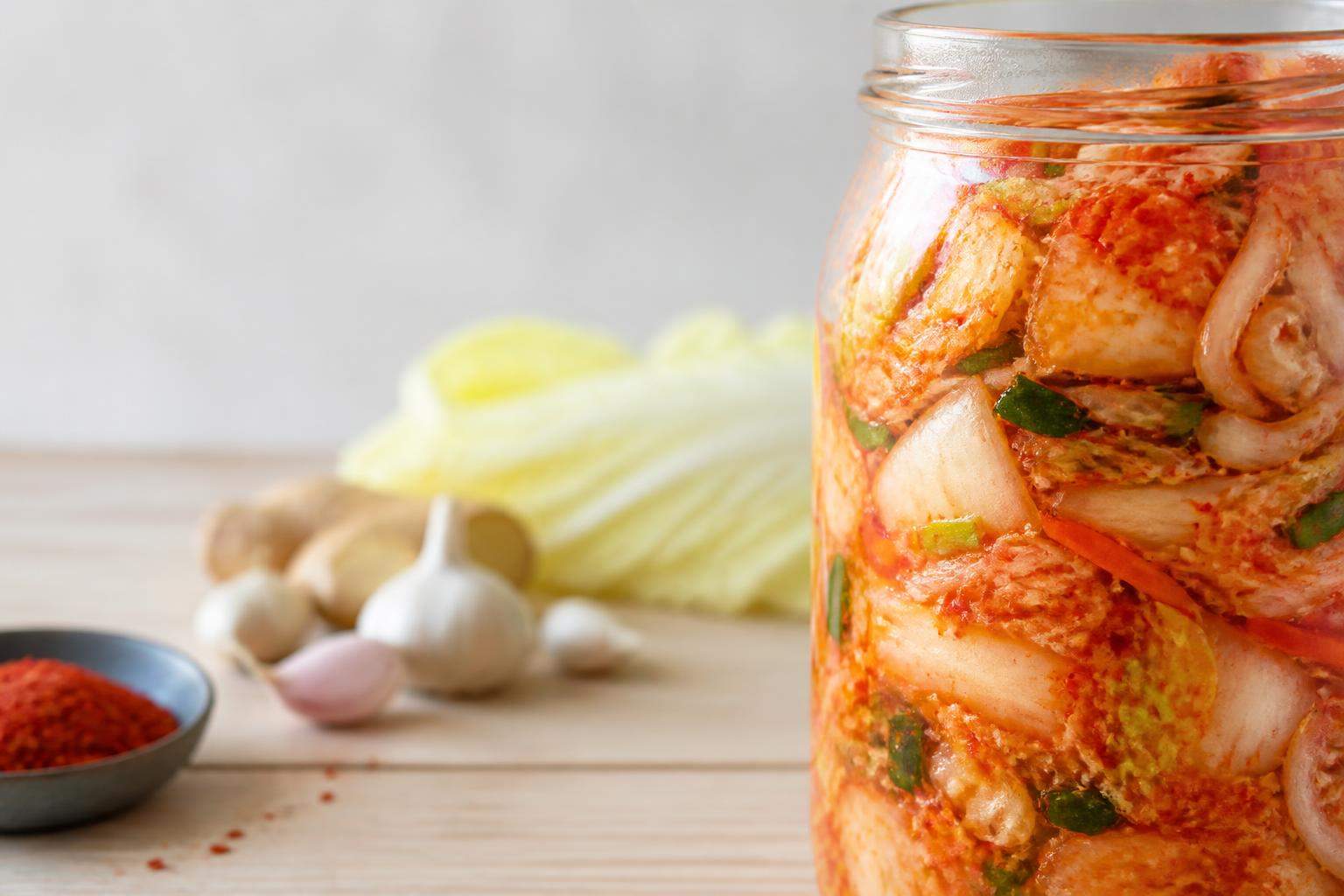
La fermentation kimchi est un processus de lactofermentation qui transforme le chou napa et d’autres légumes en un aliment probiotique dense en nutriments, en 1 à 30 jours selon la température et le résultat souhaité. Une étude publiée dans le Journal of Microbiology and Biotechnology () [1] a identifié plus de 200 souches bactériennes bénéfiques dans le kimchi traditionnel, dont des bactéries lactiques du genre Lactobacillus.
- La fermentation kimchi commence dès les premières heures après la préparation.
- Le pH descend sous 4,5 en 3 à 7 jours, rendant le kimchi microbiologiquement stable.
- Les probiotiques atteignent leur pic entre le 5e et le 15e jour de fermentation.
- Une fermentation longue (plus de 30 jours) développe une acidité marquée et élimine la plupart des agents pathogènes.
- La température idéale se situe entre 4 °C et 18 °C pour contrôler la vitesse de fermentation.
Qu’est-ce que la fermentation kimchi exactement ?
La fermentation kimchi repose sur l’action spontanée de bactéries lactiques naturellement présentes sur les légumes. Ces micro-organismes consomment les sucres du chou et produisent de l’acide lactique, du dioxyde de carbone et des composés aromatiques. Ce processus ne nécessite aucun levain ajouté : il est entièrement naturel.
Les principales espèces impliquées dans la fermentation kimchi sont Leuconostoc mesenteroides (phase initiale), puis Lactobacillus plantarum et Lactobacillus sakei (phase dominante). Selon une revue publiée dans Food Microbiology () [2], cette succession bactérienne est responsable du profil aromatique unique du kimchi. Pour mieux comprendre ce plat dans son ensemble, consultez notre article sur les bienfaits du kimchi validés par la science.
Les 4 phases de la fermentation kimchi
La fermentation kimchi suit une progression en quatre étapes distinctes. Chaque phase correspond à une évolution du pH, de la flore bactérienne et des arômes.
- Phase initiale (0-48 h) : Les bactéries aérobies et hétérofermentaires dominent. Le pH reste supérieur à 5,5. Le kimchi est encore doux et peu acide.
- Phase de transition (2-5 jours) : Leuconostoc mesenteroides prend le dessus. Le pH descend entre 4,5 et 5. Les premières bulles de CO₂ apparaissent.
- Phase dominante (5-15 jours) : Lactobacillus plantarum domine. Le pH atteint 4 à 4,5. C’est la fenêtre optimale pour la concentration en probiotiques actifs.
- Phase de maturation (15-30+ jours) : L’acidité continue d’augmenter. Le pH peut descendre sous 3,8. Le kimchi devient très acide, idéal pour les recettes cuites.
Combien de temps dure la fermentation kimchi ?
La durée de la fermentation kimchi varie selon la température ambiante et vos préférences gustatives. À température pièce (18-22 °C), 3 à 7 jours suffisent pour obtenir un kimchi équilibré. Au réfrigérateur (4 °C), la fermentation est lente et peut durer plusieurs semaines.
Voici un guide pratique selon la température :
- 18-22 °C (température ambiante) : 3 à 7 jours pour un kimchi prêt à consommer.
- 10-15 °C (cave ou cellier) : 10 à 20 jours pour une fermentation progressive.
- 4 °C (réfrigérateur) : 3 à 6 semaines pour une fermentation lente et contrôlée.
- Tradition coréenne (onggi enterré) : Plusieurs mois à une température constante proche de 0 °C.
De nombreux lecteurs nous signalent que la fermentation kimchi à température ambiante pendant 2 jours, suivie d’une maturation au réfrigérateur, donne les meilleurs résultats en termes d’équilibre entre acidité et croquant.
Le rôle du sel dans la fermentation kimchi
Le sel est l’élément déclencheur de la fermentation kimchi. En salant le chou, vous créez un environnement sélectif qui favorise les bactéries lactiques tout en inhibant les bactéries pathogènes. La concentration saline recommandée est de 2 à 3 % du poids total des légumes.
Le sel remplit trois fonctions essentielles dans la fermentation kimchi :
- Osmose : Il extrait l’eau des cellules végétales, créant la saumure naturelle nécessaire à la fermentation.
- Sélection microbienne : Il élimine les bactéries non désirées tout en laissant prospérer les lactobacilles halotolérants.
- Texture : Il ramollit les fibres du chou sans le cuire, préservant le croquant caractéristique.
L’ANSES () [3] rappelle que les aliments lactofermentés correctement préparés, avec une concentration saline adéquate, présentent un profil de sécurité alimentaire excellent. Pour approfondir le sujet des légumes lactofermentés en général, lisez notre guide sur les légumes lactofermentés et leurs propriétés.
pH et sécurité alimentaire : ce que la science dit
Le pH est l’indicateur clé de la sécurité et de la maturité de la fermentation kimchi. Un pH inférieur à 4,6 est reconnu comme la limite en dessous de laquelle Clostridium botulinum ne peut pas se développer, selon les recommandations de l’OMS.
| Durée de fermentation | pH approximatif | Profil bactérien dominant | Sécurité alimentaire |
|---|---|---|---|
| 0-48 heures | 5,5 – 6,0 | Leuconostoc mesenteroides | À consommer rapidement |
| 3-7 jours | 4,5 – 5,0 | Lactobacillus plantarum | Stable et sûr |
| 7-15 jours | 4,0 – 4,5 | Lactobacillus sakei | Très stable, riche en probiotiques |
| 30+ jours | 3,5 – 4,0 | Lactobacillus brevis | Excellent, très acide |
Fermentation kimchi et probiotiques : les chiffres clés
La fermentation kimchi produit une concentration remarquable de bactéries vivantes. Une portion de 100 g de kimchi bien fermenté peut contenir entre 10⁸ et 10⁹ UFC/g de bactéries lactiques vivantes, selon une étude publiée dans Nutrients () [4].
Ces chiffres sont comparables, voire supérieurs, à ceux de nombreux compléments probiotiques commerciaux. La fermentation kimchi génère également :
- Des AGCC (acétate, propionate, butyrate) qui nourrissent la muqueuse intestinale.
- Des vitamines B (B1, B2, B12) synthétisées par les bactéries lactiques pendant la fermentation.
- Des enzymes digestives qui facilitent l’absorption des nutriments.
- Des composés bioactifs issus de la dégradation enzymatique du piment et de l’ail.
Pour comprendre comment ces probiotiques agissent sur votre santé intestinale, notre article sur la flore intestinale et les probiotiques vous donnera toutes les clés.
Comment réussir la fermentation kimchi maison : les étapes
La fermentation kimchi maison ne nécessite aucun équipement spécialisé. Voici le protocole validé par les fermenteurs expérimentés et cohérent avec les données scientifiques disponibles.
- Saler le chou : Coupez 1 kg de chou napa en morceaux. Saupoudrez 30 g de sel non iodé. Laissez reposer 1 à 2 heures jusqu’à ramollissement complet.
- Rincer et égoutter : Rincez le chou 2 à 3 fois à l’eau froide. Essorez soigneusement pour éliminer l’excès de sel.
- Préparer la pâte de kimchi : Mélangez gochugaru (piment coréen), ail écrasé, gingembre râpé, oignons verts et sauce de poisson ou tamari (version végane).
- Mélanger : Incorporez la pâte au chou égoutté. Portez des gants pour protéger vos mains du piment.
- Mettre en bocal : Tassez fermement le kimchi dans un bocal en verre propre. Laissez 3 à 4 cm d’espace en haut pour l’expansion gazeuse.
- Fermentation à température ambiante : Laissez le bocal à 18-22 °C pendant 1 à 5 jours. Ouvrez le bocal chaque jour pour évacuer le CO₂ et tasser le kimchi.
- Transfert au réfrigérateur : Dès que le kimchi atteint l’acidité souhaitée, placez-le au réfrigérateur pour ralentir la fermentation.
Pour une recette détaillée avec des variantes et des conseils de chef, consultez notre guide sur comment faire du kimchi maison.
Fermentation kimchi : les erreurs à éviter absolument
La fermentation kimchi est robuste, mais certaines erreurs peuvent compromettre le résultat ou la sécurité alimentaire.
- Sel iodé : L’iode inhibe les bactéries lactiques. Utilisez toujours du sel de mer non iodé ou du sel casher.
- Bocal trop plein : Le CO₂ produit pendant la fermentation kimchi fait gonfler le contenu. Un bocal trop plein peut déborder ou éclater.
- Légumes non immergés : Tout légume en contact avec l’air peut moisir. Tassez bien et ajoutez un poids si nécessaire.
- Température trop élevée : Au-dessus de 25 °C, la fermentation kimchi devient incontrôlable et peut produire des arômes indésirables.
- Ustensiles métalliques réactifs : Évitez l’aluminium et le cuivre. Préférez le verre, l’inox ou la céramique.
- Goûter trop tôt : Attendez au moins 48 heures avant de goûter pour laisser la fermentation kimchi s’établir correctement.
Fermentation kimchi et microbiote : ce que prouve la science
L’impact de la fermentation kimchi sur le microbiote intestinal est l’un des domaines de recherche les plus actifs en nutrition. Une étude clinique publiée dans Cell () [5] par l’Université de Stanford a montré qu’un régime riche en aliments fermentés, incluant le kimchi, augmente la diversité microbienne intestinale en 10 semaines.
Les effets documentés de la fermentation kimchi sur le microbiote incluent :
- Augmentation des populations de Lactobacillus et Bifidobacterium bénéfiques.
- Réduction des marqueurs d’inflammation systémique (interleukine-6, protéine C-réactive).
- Amélioration de la perméabilité intestinale et renforcement de la barrière épithéliale.
- Production accrue de butyrate, principal carburant des cellules du côlon.
Ces données confirment que la fermentation kimchi produit bien plus qu’un simple aliment fermenté : elle génère un véritable écosystème microbien bénéfique. Pour aller plus loin, notre article sur les aliments probiotiques et leurs effets compare le kimchi aux autres sources alimentaires de probiotiques.
Fermentation kimchi vs autres fermentations : comparaison
La fermentation kimchi se distingue des autres fermentations lactiques par sa complexité microbienne et son profil nutritionnel unique.
- Kimchi vs choucroute : Les deux sont des lactofermentations de chou, mais la fermentation kimchi implique davantage d’espèces bactériennes et des composés bioactifs issus du piment, de l’ail et du gingembre.
- Kimchi vs kéfir : Le kéfir fermente avec des levures et des bactéries lactiques en milieu liquide. La fermentation kimchi est exclusivement bactérienne et se produit en milieu semi-solide.
- Kimchi vs miso : Le miso est une fermentation fongique (Aspergillus oryzae). La fermentation kimchi est bactérienne. Les deux produisent des enzymes digestives, mais par des voies différentes.
- Kimchi vs yaourt : Le yaourt utilise des souches sélectionnées (Streptococcus thermophilus, Lactobacillus bulgaricus). La fermentation kimchi est spontanée et plus diversifiée.
Conservation après fermentation kimchi : les bonnes pratiques
Une fois la fermentation kimchi atteint le niveau d’acidité souhaité, le réfrigérateur devient votre meilleur allié. À 4 °C, la fermentation ralentit considérablement sans s’arrêter complètement.
- Un kimchi bien fermenté se conserve 3 à 6 mois au réfrigérateur dans un bocal hermétique.
- Le kimchi continue de fermenter lentement au froid : il deviendra plus acide avec le temps.
- Un kimchi très acide (plus de 3 mois) est idéal pour les soupes et les plats cuits.
- Ne jamais congeler le kimchi cru : la congélation détruit les bactéries vivantes et altère la texture.
Fermentation kimchi et bienfaits pour la santé : résumé des preuves
La fermentation kimchi transforme des légumes ordinaires en un aliment fonctionnel aux propriétés documentées. Les recherches actuelles soutiennent les bénéfices suivants :
- Santé digestive : Amélioration du transit, réduction des ballonnements, soutien du microbiote.
- Immunité : Les bactéries lactiques issues de la fermentation kimchi stimulent les cellules immunitaires intestinales (IgA sécrétoires).
- Métabolisme : Amélioration de la sensibilité à l’insuline et réduction du cholestérol LDL dans certaines études.
- Anti-inflammatoire : La fermentation kimchi produit des composés qui inhibent les voies pro-inflammatoires NF-κB.
Fermentation kimchi : pour qui et quelles précautions ?
La fermentation kimchi produit un aliment généralement bien toléré. Cependant, certaines personnes doivent faire preuve de prudence.
- Personnes sous anticoagulants : Le kimchi est riche en vitamine K. Consultez votre médecin si vous prenez de la warfarine.
- Hypertension : La fermentation kimchi utilise du sel. Les personnes suivant un régime hyposodé doivent limiter leur consommation.
- Syndrome de l’intestin irritable : Introduisez la fermentation kimchi progressivement pour éviter les ballonnements initiaux.
- Immunodépression sévère : Consultez un médecin avant de consommer des aliments fermentés non pasteurisés.
- Allergie au poisson : La recette traditionnelle de fermentation kimchi contient de la sauce de poisson. Optez pour une version végane.
Fermentation kimchi industrielle vs artisanale : quelles différences ?
Le kimchi industriel est souvent pasteurisé pour prolonger sa durée de vie. Cette pasteurisation détruit les bactéries vivantes produites pendant la fermentation kimchi. Le kimchi artisanal non pasteurisé conserve toutes ses bactéries actives.
Vérifiez toujours l’étiquette : un kimchi vivant doit indiquer « non pasteurisé » ou « contient des cultures vivantes ». La mention « fermenté » seule ne garantit pas la présence de probiotiques actifs après traitement thermique.
- La fermentation kimchi est une lactofermentation spontanée qui dure de 1 à 30 jours selon la température et vos préférences.
- Un pH inférieur à 4,5, atteint en 3 à 7 jours, garantit la sécurité alimentaire et la richesse en probiotiques de la fermentation kimchi.
- La fermentation kimchi génère entre 10⁸ et 10⁹ UFC/g de bactéries lactiques vivantes, un niveau comparable aux meilleurs compléments probiotiques.
- Le sel non iodé, la température contrôlée et les légumes bien immergés sont les trois conditions clés d’une fermentation kimchi réussie.
- La fermentation kimchi produit des probiotiques, des vitamines B, des enzymes digestives et des composés anti-inflammatoires validés par la science.
Questions fréquentes sur fermentation kimchi
Combien de temps dure la fermentation kimchi à température ambiante ?
La fermentation kimchi à température ambiante (18-22 °C) dure généralement 3 à 7 jours. Après 48 heures, vous pouvez commencer à goûter chaque jour pour ajuster l’acidité à votre convenance. Transférez au réfrigérateur dès que le kimchi atteint le niveau d’acidité souhaité.
Comment savoir si la fermentation kimchi est terminée ?
La fermentation kimchi n’a pas de fin absolue : elle ralentit au froid mais ne s’arrête jamais complètement. Le kimchi est prêt à consommer lorsque son pH est inférieur à 4,5 et que son goût est agréablement acide. Des bulles visibles dans le bocal indiquent une fermentation kimchi active et saine.
Peut-on accélérer la fermentation kimchi ?
Oui. Augmenter la température à 22-25 °C accélère la fermentation kimchi. Ajouter une petite quantité de kimchi déjà fermenté comme starter peut également activer plus rapidement les bactéries lactiques. Attention : une température trop élevée peut produire des arômes indésirables.
La fermentation kimchi est-elle dangereuse ?
Non, la fermentation kimchi est l’une des méthodes de conservation les plus sûres. L’acidification rapide du milieu inhibe les bactéries pathogènes. Une fermentation kimchi avec une concentration saline correcte (2-3 %) et des légumes bien immergés présente un risque alimentaire quasi nul, confirmé par les autorités sanitaires internationales [3].
Quelle est la différence entre fermentation kimchi et choucroute ?
Les deux reposent sur la lactofermentation du chou, mais la fermentation kimchi implique des épices (piment, ail, gingembre) qui enrichissent le profil microbien et nutritionnel. La fermentation kimchi génère davantage d’espèces bactériennes différentes que la choucroute, selon les études de métagénomique disponibles.
Faut-il ajouter de l’eau à la fermentation kimchi ?
Non, en règle générale. Le sel extrait suffisamment d’eau du chou pour créer une saumure naturelle. Si votre kimchi semble trop sec après 24 heures, vous pouvez ajouter une petite quantité de saumure (1 cuillère à café de sel pour 250 ml d’eau) pour immerger les légumes.
Le kimchi pasteurisé contient-il encore des probiotiques ?
Non. La pasteurisation détruit les bactéries vivantes produites pendant la fermentation kimchi. Un kimchi pasteurisé conserve ses fibres et certains composés bioactifs, mais perd ses propriétés probiotiques. Pour bénéficier des effets de la fermentation kimchi sur le microbiote, choisissez un produit non pasteurisé.
Combien de portions de kimchi fermenté faut-il consommer par jour ?
La plupart des études sur la fermentation kimchi utilisent des portions de 100 à 200 g par jour. Cette quantité apporte une dose significative de probiotiques sans excès de sodium. Commencez par 50 g par jour si vous n’êtes pas habitué aux aliments fermentés.
La fermentation kimchi produit-elle de l’alcool ?
La fermentation kimchi produit des traces d’alcool (moins de 0,5 %) par la voie hétérofermentaire des bactéries lactiques. Cette quantité est négligeable et sans effet notable sur l’organisme. Le kimchi n’est pas considéré comme une boisson alcoolisée.
Peut-on faire la fermentation kimchi sans piment ?
Oui. Une version sans piment, appelée baek kimchi (kimchi blanc), suit le même processus de fermentation kimchi. Elle est plus douce et convient aux personnes sensibles aux épices. Le profil probiotique reste similaire, mais certains composés bioactifs du piment sont absents.
Comment conserver le kimchi après fermentation ?
Après la fermentation kimchi initiale à température ambiante, transférez le bocal au réfrigérateur. À 4 °C, le kimchi se conserve 3 à 6 mois. Il continuera de fermenter lentement et deviendra plus acide avec le temps. Un kimchi très acide est parfait pour les soupes et les plats mijotés.
La fermentation kimchi est-elle bonne pour la peau ?
Des études préliminaires suggèrent que les probiotiques issus de la fermentation kimchi peuvent influencer positivement l’axe intestin-peau. Une amélioration de la diversité microbienne intestinale est associée à une réduction de l’inflammation cutanée dans certains travaux. Des recherches complémentaires sont nécessaires pour confirmer ces effets. Pour en savoir plus sur les aliments fermentés et leurs bienfaits, notre article sur les bienfaits du kimchi prouvés par la science approfondit ce sujet.
Ce qu’il faut retenir
La fermentation kimchi est un processus de lactofermentation naturelle, sûr et accessible, qui transforme des légumes simples en un aliment probiotique d’une richesse microbienne exceptionnelle. En maîtrisant la concentration en sel, la température et la durée, vous pouvez produire chez vous un kimchi aussi riche en bactéries lactiques vivantes que les meilleurs produits commerciaux non pasteurisés.
La science confirme que la fermentation kimchi bénéficie au microbiote intestinal, à l’immunité et à la réduction de l’inflammation systémique. Ces effets sont directement liés à la qualité et à la durée du processus de fermentation kimchi.
Action concrète : Préparez votre premier bocal de fermentation kimchi cette semaine avec 1 kg de chou napa, 30 g de sel non iodé et votre pâte d’épices. Goûtez après 3 jours à température ambiante, puis transférez au réfrigérateur. En 7 jours, vous aurez un kimchi vivant, riche en probiotiques et prêt à enrichir votre microbiote.
Sources et études
- Microbial Community Analysis of Kimchi — Journal of Microbiology and Biotechnology,
- Bacterial Succession and Metabolite Changes During Kimchi Fermentation — Food Microbiology,
- Sécurité des aliments fermentés artisanaux — ANSES,
- Probiotic Content and Health Effects of Kimchi — Nutrients,
- Gut-microbiota-targeted diets modulate human immune status — Cell, — Sonnenburg Lab, Stanford University
Cet article est fourni à titre informatif uniquement et ne constitue pas un avis médical. Consultez un professionnel de santé qualifié avant toute utilisation.