Recette kimchi maison : la méthode validée par la science
⚠️ Avis médical : Les informations contenues dans cet article sont fournies à titre éducatif uniquement. Elles ne remplacent pas l’avis d’un professionnel de santé. Consultez votre médecin avant de modifier votre alimentation si vous souffrez d’une pathologie chronique.
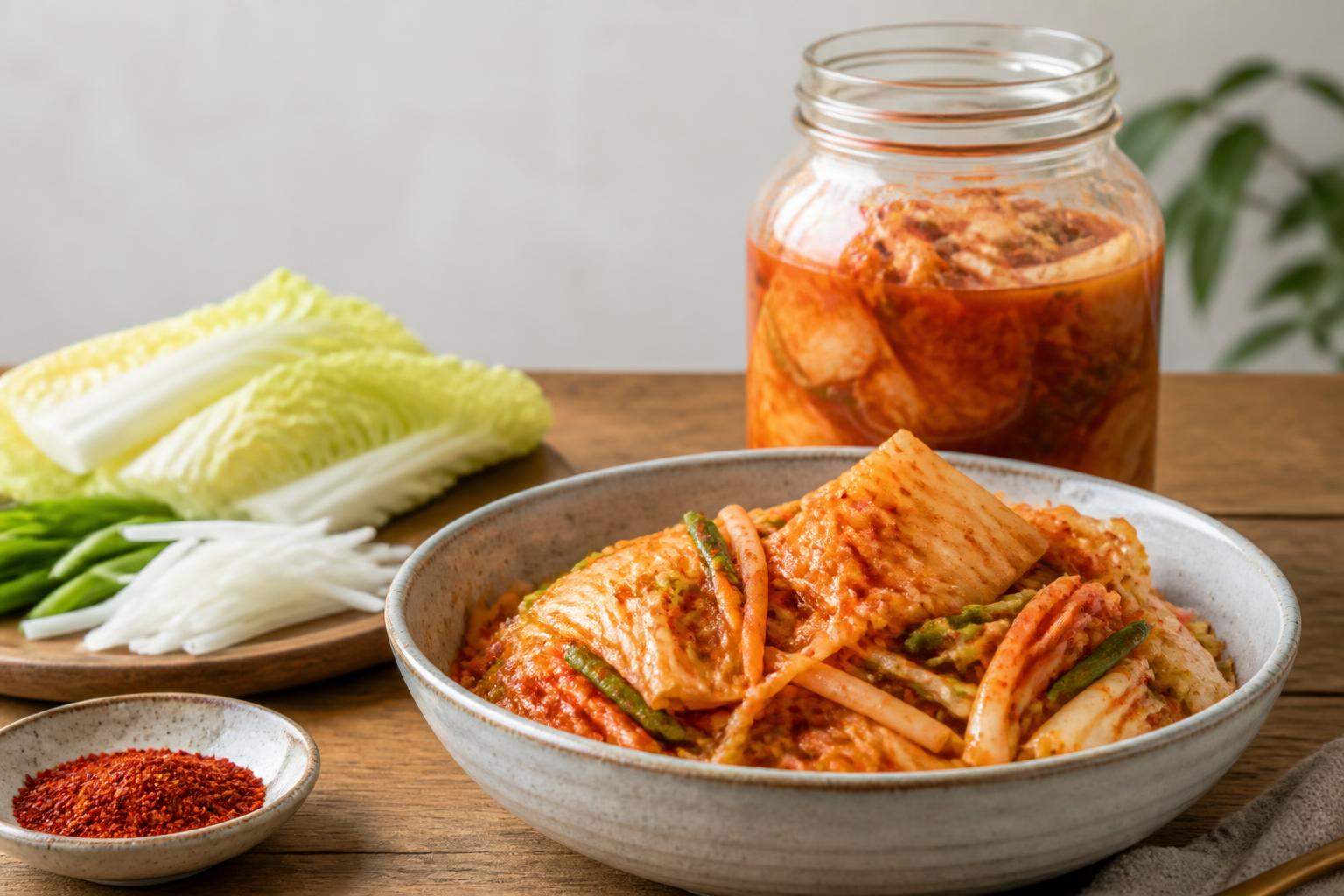
Recette kimchi : préparer du kimchi maison consiste à faire fermenter du chou nappa salé avec une pâte épicée à base de gochugaru, d’ail et de gingembre, puis à laisser la lacto-fermentation opérer pendant 1 à 5 jours à température ambiante. Une étude publiée dans le Journal of Ethnic Foods () [1] recense plus de 200 variétés de kimchi en Corée, toutes reposant sur ce même principe de fermentation.
- Temps de préparation actif : environ 45 minutes
- Fermentation à température ambiante : 1 à 5 jours selon la saison
- Conservation au réfrigérateur : jusqu’à 6 mois
- Apport en probiotiques : plusieurs milliards d’UFC par portion
- Ingrédient principal : chou nappa (baechu), disponible en grande surface
Qu’est-ce que le kimchi et pourquoi le faire soi-même ?
Le kimchi est le condiment fermenté national de la Corée, inscrit au patrimoine UNESCO depuis . La recette kimchi maison vous garantit un produit vivant, sans conservateurs ni additifs. Vous contrôlez chaque ingrédient et le niveau de fermentation.
Les versions industrielles vendues en supermarché contiennent souvent du vinaigre pour simuler l’acidité, ce qui tue les bactéries bénéfiques. Préparer votre propre recette kimchi, c’est préserver l’intégralité des bactéries lactiques vivantes. Découvrez notre guide complet sur ce qu’est le kimchi pour comprendre ses origines et ses variantes régionales.
De nombreux lecteurs nous signalent que leur première recette kimchi maison était bien plus simple qu’ils ne l’imaginaient, et que le résultat surpassait largement les versions du commerce.
Les ingrédients essentiels de la recette kimchi traditionnelle
La recette kimchi de base repose sur une liste d’ingrédients précise. Voici ce dont vous avez besoin pour 1 kg de kimchi fini :
- 1 kg de chou nappa (aussi appelé chou chinois ou baechu)
- 30 g de sel non iodé (le sel iodé inhibe la fermentation)
- 30 à 50 g de gochugaru (flocons de piment coréen, disponibles en épicerie asiatique)
- 6 gousses d’ail finement râpées
- 1 cuillère à café de gingembre frais râpé
- 2 cuillères à soupe de sauce de poisson (ou sauce soja pour une version végane)
- 1 cuillère à soupe de sucre ou de purée de poire asiatique
- 3 oignons verts coupés en tronçons de 3 cm
- 1 cuillère à soupe de farine de riz glutineux (pour épaissir la pâte)
La farine de riz glutineux n’est pas indispensable, mais elle aide la pâte épicée à adhérer aux feuilles de chou. Sans elle, votre recette kimchi reste tout à fait réussie.
Matériel nécessaire avant de commencer
Avant de vous lancer dans la recette kimchi, rassemblez ce matériel :
- Un grand saladier (au moins 5 litres)
- Des gants en latex ou en nitrile (le gochugaru tache durablement)
- Un bocal en verre hermétique d’au moins 1,5 litre
- Une planche à découper et un couteau de chef
- Une râpe fine pour l’ail et le gingembre
- Une balance de cuisine
Évitez les récipients en métal réactif (aluminium, acier non inoxydable) : l’acidité du kimchi peut les corroder. Le verre ou le plastique alimentaire de qualité sont idéaux pour cette recette kimchi.
Étape 1 : saler et attendrir le chou (2 à 4 heures)
Coupez le chou nappa en deux dans la hauteur, puis chaque moitié en deux. Séparez les feuilles et coupez-les en morceaux de 5 cm. Placez-les dans le grand saladier.
Saupoudrez le sel sur le chou et massez-le vigoureusement pendant 5 minutes. Le sel va extraire l’eau du chou par osmose, le rendre souple et créer un environnement favorable aux bactéries lactiques. Laissez reposer 2 à 4 heures, en retournant le chou toutes les 30 minutes.
Le chou est prêt quand il plie sans se casser. Rincez-le abondamment sous l’eau froide (2 à 3 fois) et essorez-le bien entre vos mains. Cette étape est cruciale pour la réussite de votre recette kimchi.
Étape 2 : préparer la pâte épicée (yangnyeom)
La pâte épicée, appelée yangnyeom, est le cœur de la recette kimchi. Dans une petite casserole, mélangez la farine de riz avec 120 ml d’eau froide. Portez à ébullition en remuant constamment jusqu’à obtenir une bouillie transparente. Laissez refroidir.
Dans un bol, combinez la bouillie de riz refroidie, le gochugaru, l’ail râpé, le gingembre, la sauce de poisson et le sucre. Mélangez jusqu’à obtenir une pâte homogène de couleur rouge vif. Ajustez la quantité de gochugaru selon votre tolérance au piment.
Étape 3 : assembler et mélanger le kimchi
Enfilez vos gants. Ajoutez le chou essoré et les oignons verts dans le bol contenant la pâte épicée. Mélangez à la main en massant chaque morceau de chou pour bien l’enrober de yangnyeom. Cette étape manuelle est essentielle dans la recette kimchi traditionnelle : elle assure une répartition uniforme des arômes.
Goûtez et ajustez l’assaisonnement. Le mélange doit être légèrement trop salé et très épicé à ce stade : la fermentation va adoucir et complexifier les saveurs. Apprenez-en plus sur les légumes lacto-fermentés et leurs mécanismes de transformation.
Étape 4 : mettre en bocal et lancer la fermentation
Tassez le kimchi dans votre bocal en verre propre, en appuyant fermement pour chasser les bulles d’air. Laissez environ 3 cm d’espace en haut du bocal : le kimchi va gonfler pendant la fermentation. Fermez le couvercle sans le bloquer complètement pour permettre aux gaz de s’échapper.
Laissez le bocal à température ambiante (18 à 22°C) pendant 1 à 2 jours en été, 3 à 5 jours en hiver. Ouvrez le bocal une fois par jour pour appuyer sur le kimchi avec une cuillère propre et libérer les gaz. Votre recette kimchi est prête quand elle sent légèrement acidulé et pétille légèrement.
Transférez ensuite au réfrigérateur. La fermentation continue lentement au froid, développant des saveurs plus complexes au fil des semaines.
Tableau des temps de fermentation selon la température
| Température ambiante | Durée de fermentation initiale | Résultat attendu |
|---|---|---|
| 10 à 15°C (automne/hiver) | 4 à 7 jours | Fermentation lente, saveurs douces |
| 16 à 20°C (printemps/automne) | 2 à 4 jours | Équilibre acidité/épices optimal |
| 21 à 25°C (été) | 1 à 2 jours | Fermentation rapide, acidité prononcée |
| Au réfrigérateur (4°C) | 2 à 4 semaines | Fermentation lente, saveurs très complexes |
5 variantes populaires de la recette kimchi
La recette kimchi classique au chou nappa n’est qu’un point de départ. Voici les variantes les plus appréciées :
- Kkakdugi : recette kimchi au daïkon (radis blanc) coupé en cubes, plus croquante
- Oi sobagi : recette kimchi au concombre farci, prête en 24 heures
- Kimchi végane : remplacez la sauce de poisson par de la sauce soja ou du miso blanc
- Kimchi blanc (baek kimchi) : sans gochugaru, idéal pour les enfants et les personnes sensibles au piment
- Yeolmu kimchi : recette kimchi aux radis jeunes avec leurs feuilles, version printanière
Consultez notre guide détaillé sur comment faire du kimchi maison pour découvrir d’autres variantes régionales et leurs spécificités de préparation.
Les bienfaits scientifiquement prouvés de la recette kimchi
La recette kimchi produit un aliment exceptionnellement riche en bactéries lactiques vivantes. Selon une méta-analyse publiée dans le Journal of Medicinal Food () [3], la consommation régulière de kimchi est associée à une amélioration significative de la diversité du microbiote intestinal.
- Probiotiques : 1 à 10 milliards d’UFC de Lactobacillus plantarum et L. brevis par portion de 100 g
- Vitamine C : le chou fermenté conserve mieux sa vitamine C que le chou cuit
- Vitamine K2 : synthétisée par les bactéries pendant la fermentation
- Fibres prébiotiques : le chou nappa nourrit les bonnes bactéries intestinales
- Composés bioactifs : allicine (ail), gingérols (gingembre), capsaïcine (piment)
L’ANSES () [4] reconnaît les aliments fermentés comme une source naturelle de probiotiques contribuant à l’équilibre de la flore intestinale. Découvrez comment les probiotiques agissent sur la flore intestinale pour mieux comprendre les mécanismes en jeu.
Erreurs fréquentes à éviter dans la recette kimchi
Même expérimentés, certains cuisiniers commettent des erreurs qui compromettent la réussite de la recette kimchi. Voici les plus courantes :
- Utiliser du sel iodé : l’iode inhibe les bactéries lactiques et bloque la fermentation
- Ne pas bien rincer le chou : un excès de sel donne un kimchi immangeable
- Fermer hermétiquement le bocal : la pression des gaz peut faire exploser le couvercle
- Utiliser un bocal non propre : des bactéries indésirables peuvent contaminer la fermentation
- Goûter trop tôt : la recette kimchi a besoin de temps pour développer ses arômes
- Négliger les gants : le gochugaru tache les mains pendant plusieurs jours
Comment savoir si votre recette kimchi a bien fermenté ?
Un kimchi correctement fermenté présente plusieurs signes distinctifs. Il sent légèrement acidulé, comme une choucroute épicée. Des petites bulles apparaissent quand vous appuyez sur le chou. Le liquide au fond du bocal est trouble et légèrement effervescent.
Un kimchi raté, en revanche, sent la pourriture (odeur de soufre intense) ou présente des moisissures visibles en surface. Si c’est le cas, jetez l’ensemble et recommencez. Une recette kimchi réussie ne présente jamais de moisissures : l’acidité lactique les empêche de se développer.
Si votre kimchi est trop acide après quelques semaines au réfrigérateur, ne le jetez pas. Le kimchi très fermenté (appelé mukeunji) est idéal pour cuisiner : soupes, ragoûts, crêpes coréennes et riz sauté. Découvrez tous les bienfaits prouvés du kimchi selon les dernières études scientifiques.
Conservation et durée de vie de votre recette kimchi
Une fois la fermentation initiale terminée, conservez votre recette kimchi au réfrigérateur. Voici les durées de conservation à respecter :
- Kimchi frais (1 à 3 jours de fermentation) : optimal dans les 2 premières semaines
- Kimchi mi-fermenté (1 à 2 semaines) : saveurs équilibrées, à consommer dans le mois
- Kimchi bien fermenté (1 à 3 mois) : plus acide, parfait pour cuisiner
- Kimchi très fermenté (3 à 6 mois) : mukeunji, saveurs très complexes
Utilisez toujours une cuillère propre pour servir le kimchi. Évitez de contaminer le bocal avec des ustensiles ayant touché d’autres aliments. Une recette kimchi bien conservée ne présente aucun risque sanitaire : l’acidité lactique constitue une barrière naturelle contre les pathogènes.
Recette kimchi et sodium : ce qu’il faut savoir
Une portion de 100 g de kimchi contient entre 400 et 700 mg de sodium selon la recette kimchi utilisée. L’OMS recommande de ne pas dépasser 2 000 mg de sodium par jour [5]. Une portion raisonnable de 50 g par repas reste dans des limites acceptables pour la plupart des adultes en bonne santé.
Si vous suivez un régime hyposodé pour raison médicale, réduisez la quantité de sel dans votre recette kimchi à 20 g pour 1 kg de chou. La fermentation sera légèrement plus longue mais tout aussi réussie. Consultez votre médecin si vous souffrez d’hypertension artérielle ou d’insuffisance rénale avant d’intégrer régulièrement le kimchi à votre alimentation.
- La recette kimchi traditionnelle nécessite du chou nappa, du sel non iodé, du gochugaru, de l’ail et du gingembre : cinq ingrédients suffisent pour un résultat authentique.
- La recette kimchi repose sur la lacto-fermentation naturelle : aucune levure ni vinaigre ajouté n’est nécessaire pour lancer le processus.
- La recette kimchi produit plusieurs milliards de bactéries Lactobacillus vivantes par portion, selon les données de Food Microbiology ().
- La recette kimchi se conserve jusqu’à 6 mois au réfrigérateur et gagne en complexité aromatique avec le temps.
- La recette kimchi peut être adaptée en version végane en remplaçant la sauce de poisson par de la sauce soja ou du miso blanc.
Questions fréquentes sur recette kimchi
Combien de temps faut-il pour réussir une recette kimchi ?
La préparation active d’une recette kimchi prend environ 45 minutes. Il faut ensuite compter 2 à 4 heures pour le salage du chou, puis 1 à 5 jours de fermentation à température ambiante selon la saison.
Peut-on faire une recette kimchi sans gochugaru ?
Oui. Vous pouvez remplacer le gochugaru par du paprika doux mélangé à un peu de piment de Cayenne. Le résultat sera différent mais la recette kimchi fonctionnera. Le gochugaru reste cependant irremplaçable pour l’authenticité du goût.
La recette kimchi est-elle adaptée aux végétaliens ?
La recette kimchi traditionnelle contient de la sauce de poisson ou des crevettes fermentées. Pour une version végane, remplacez ces ingrédients par de la sauce soja, du tamari ou du miso blanc en quantité équivalente.
Pourquoi ma recette kimchi ne fermente-t-elle pas ?
Les causes les plus fréquentes sont l’utilisation de sel iodé, une température ambiante trop basse (en dessous de 10°C) ou un bocal insuffisamment propre. Assurez-vous d’utiliser du sel de mer non iodé et de maintenir une température de 18 à 22°C.
Combien de fois par semaine peut-on manger le kimchi d’une recette kimchi maison ?
La plupart des études nutritionnelles utilisent des portions de 50 à 100 g, 3 à 5 fois par semaine. Cette fréquence est associée aux bénéfices observés sur le microbiote sans risque de surcharge sodée pour un adulte en bonne santé.
Peut-on congeler le résultat d’une recette kimchi ?
La congélation est déconseillée : elle tue les bactéries lactiques vivantes et altère la texture croquante du chou. Le réfrigérateur reste la meilleure option pour conserver votre recette kimchi jusqu’à 6 mois.
Quel sel utiliser dans la recette kimchi ?
Utilisez du sel de mer gros non iodé, du sel de Guérande ou du sel casher. Évitez absolument le sel de table iodé et le sel fin de cuisine qui contiennent souvent des anti-agglomérants perturbant la fermentation.
La recette kimchi est-elle dangereuse pour la santé ?
Une recette kimchi correctement préparée ne présente aucun danger. L’acidité lactique inhibe naturellement les bactéries pathogènes. Les personnes sous anticoagulants doivent cependant surveiller leur consommation en raison de la teneur en vitamine K2.
Comment rendre une recette kimchi moins piquante ?
Réduisez la quantité de gochugaru à 15 g pour 1 kg de chou, ou optez pour du gochugaru doux (maïl gochugaru). Vous pouvez aussi ajouter de la purée de poire asiatique pour adoucir l’ensemble de la recette kimchi.
Quelle est la différence entre une recette kimchi et la choucroute ?
Les deux reposent sur la lacto-fermentation, mais la recette kimchi utilise du chou nappa, de l’ail, du gingembre et du piment, tandis que la choucroute n’utilise que du chou blanc et du sel. Le profil bactérien et le goût sont très différents.
Peut-on utiliser du chou blanc dans une recette kimchi ?
Le chou blanc peut remplacer le chou nappa dans une recette kimchi de substitution. La texture sera plus ferme et le goût légèrement différent. Le chou nappa reste préférable pour sa texture tendre et sa teneur en eau adaptée à la fermentation.
Comment utiliser le kimchi très fermenté d’une vieille recette kimchi ?
Le kimchi très fermenté (mukeunji) est idéal pour cuisiner : soupe kimchi (kimchi jjigae), riz sauté au kimchi (kimchi bokkeumbap), crêpes coréennes (kimchijeon) ou ragoût de tofu. Sa forte acidité enrichit les plats mijotés.
Ce qu’il faut retenir
La recette kimchi maison est accessible à tous, ne nécessite aucun équipement spécialisé et produit un aliment fermenté vivant aux bénéfices nutritionnels documentés par la science. Avec du chou nappa, du sel non iodé, du gochugaru et quelques aromates, vous obtenez en moins d’une heure de préparation un condiment qui se conserve des mois et enrichit votre microbiote à chaque repas.
La recette kimchi est aussi une porte d’entrée vers le monde fascinant de la fermentation maison. Une fois maîtrisée, elle vous donnera envie d’explorer d’autres légumes fermentés et d’autres traditions culinaires vivantes. Action concrète : commencez cette semaine avec 500 g de chou nappa et la moitié des doses indiquées pour vous familiariser avec le processus sans gaspillage.
Sources et études
- Diversity of kimchi and its health benefits — Journal of Ethnic Foods,
- Lactic acid bacteria counts and probiotic potential of traditional kimchi — Food Microbiology,
- Health benefits of kimchi as a probiotic food — Journal of Medicinal Food,
- Aliments fermentés et microbiote intestinal — ANSES,
- Salt reduction — WHO Fact Sheet — OMS,
Cet article est fourni à titre informatif uniquement et ne constitue pas un avis médical. Consultez un professionnel de santé qualifié avant toute utilisation.