Kimchi coréen : origines, bienfaits et conseils d’experts
⚠️ Avis médical : Les informations contenues dans cet article sont fournies à titre informatif et éducatif uniquement. Elles ne remplacent pas l’avis d’un médecin ou d’un professionnel de santé qualifié. Consultez votre médecin avant de modifier votre alimentation, notamment en cas de pathologie digestive, d’hypertension ou de traitement médicamenteux.
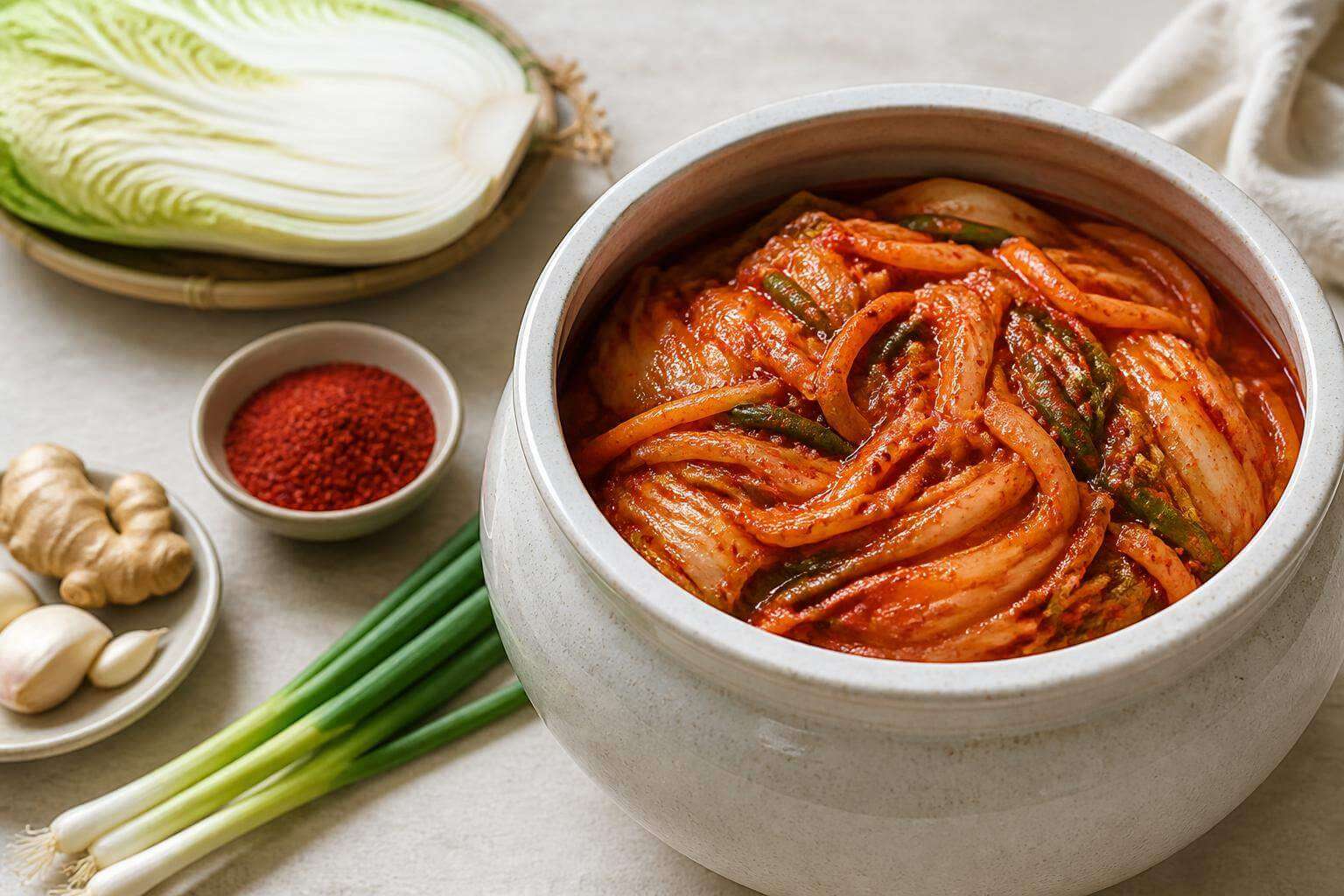
Le kimchi coréen est un légume fermenté traditionnel originaire de Corée, composé principalement de chou chinois lacto-fermenté avec du piment, de l’ail et du gingembre, reconnu pour sa richesse exceptionnelle en probiotiques vivants et en composés bioactifs bénéfiques pour le microbiote intestinal. Une étude publiée dans le Journal of Medicinal Food () [1] a recensé plus de 200 souches bactériennes distinctes dans un seul bocal de kimchi coréen traditionnel. Voici les 5 points clés à retenir :
- Le kimchi coréen contient des probiotiques naturels issus de la lacto-fermentation.
- Sa richesse en vitamines C, K et B12 en fait un aliment nutritionnellement dense.
- Des études cliniques associent sa consommation régulière à une amélioration du microbiote intestinal.
- Il contient du capsaïcine, de l’allicine (ail) et du gingérol, trois molécules anti-inflammatoires documentées.
- Sa teneur en sel impose une consommation modérée chez les personnes hypertendues.
Qu’est-ce que le kimchi coréen exactement ?
Le kimchi coréen est un condiment fermenté classé au patrimoine immatériel de l’UNESCO depuis . Il est préparé par lacto-fermentation de légumes, principalement du chou nappa (Brassica rapa), avec une pâte épicée appelée yangnyeom. La fermentation naturelle dure de 24 heures à plusieurs semaines selon la recette et la température ambiante.
Il existe plus de 200 variétés de kimchi coréen recensées par le Korea Food Research Institute [3]. Les plus courantes incluent le baechu-kimchi (chou), le kkakdugi (radis en dés) et le oi-sobagi (concombre farci). En savoir plus sur ce qu’est le kimchi et ses différentes formes.
Chaque variété partage un processus commun : le sel déshydrate les légumes, puis les bactéries lactiques naturellement présentes transforment les sucres en acide lactique, créant un environnement acide qui conserve et enrichit l’aliment.
5 ingrédients clés du kimchi coréen traditionnel
La composition du kimchi coréen classique repose sur une base d’ingrédients précise, validée par les instituts culinaires coréens et documentée dans la littérature scientifique.
- Chou chinois (nappa) : source de fibres prébiotiques et de vitamine C.
- Piment rouge (gochugaru) : apporte la capsaïcine, molécule anti-inflammatoire et thermogénique.
- Ail : riche en allicine, composé antimicrobien et cardioprotecteur.
- Gingembre : contient du gingérol aux propriétés antioxydantes documentées.
- Sel marin : agent de déshydratation indispensable à la fermentation, mais à surveiller en cas d’hypertension.
Des ingrédients secondaires comme la sauce de poisson (jeotgal), les oignons verts et le radis daïkon complètent la recette traditionnelle. Des versions véganes du kimchi coréen remplacent la sauce de poisson par de la sauce soja ou de la pâte de soja fermentée (doenjang).
Profil nutritionnel : ce que contient une portion de kimchi coréen
Une portion standard de 100 g de kimchi coréen apporte peu de calories mais une densité nutritionnelle remarquable. Voici les données nutritionnelles moyennes issues de la base USDA FoodData Central () [4] :
| Nutriment | Quantité pour 100 g | % Apport journalier recommandé |
|---|---|---|
| Calories | 15 kcal | 1 % |
| Glucides | 2,4 g | 1 % |
| Fibres alimentaires | 1,6 g | 6 % |
| Vitamine C | 18 mg | 20 % |
| Vitamine K | 43 µg | 36 % |
| Vitamine B6 | 0,2 mg | 15 % |
| Sodium | 498 mg | 22 % |
| Bactéries lactiques vivantes | 10⁶ à 10⁸ UFC/g | — |
Le kimchi coréen est particulièrement remarquable pour sa teneur en vitamine K, essentielle à la coagulation sanguine et à la santé osseuse. Sa très faible densité calorique en fait un condiment compatible avec la plupart des régimes alimentaires.
8 bienfaits scientifiquement documentés du kimchi coréen
Les recherches sur le kimchi coréen se sont intensifiées depuis les années 2010. Voici les bénéfices les mieux étayés par la littérature scientifique actuelle.
1. Soutien du microbiote intestinal
Le kimchi coréen est une source naturelle de Lactobacillus kimchii, Leuconostoc mesenteroides et Weissella confusa, des souches probiotiques spécifiques à la fermentation coréenne. Ces bactéries colonisent temporairement le côlon et produisent des AGCC qui nourrissent les cellules intestinales. Comprendre le rôle des probiotiques dans la flore intestinale.
2. Effets anti-inflammatoires
La capsaïcine du piment rouge inhibe le facteur nucléaire NF-κB, réduisant la production de cytokines pro-inflammatoires comme l’IL-6 et le TNF-α. Une méta-analyse publiée dans le British Journal of Nutrition () [5] confirme cet effet chez des sujets consommant du kimchi coréen pendant 4 semaines.
3. Régulation de la glycémie
Des essais cliniques coréens ont montré que la consommation quotidienne de kimchi coréen fermenté réduit la glycémie à jeun et améliore la sensibilité à l’insuline chez des sujets prédiabétiques. L’acide lactique produit lors de la fermentation ralentit l’absorption intestinale des glucides.
4. Soutien immunitaire
Le kimchi coréen stimule la production de lymphocytes T et de cellules NK selon plusieurs études in vitro et ex vivo. La vitamine C et les polyphénols du piment et de l’ail renforcent les défenses naturelles de l’organisme.
5. Santé cardiovasculaire
L’allicine de l’ail contenu dans le kimchi coréen inhibe l’agrégation plaquettaire et réduit le taux de LDL-cholestérol. Des études épidémiologiques coréennes associent une consommation régulière à une réduction du risque cardiovasculaire.
6. Gestion du poids
Avec seulement 15 kcal pour 100 g, le kimchi coréen est un condiment rassasiant grâce à ses fibres et à l’effet thermogénique de la capsaïcine. Une étude de l’Université de Séoul () a montré une réduction significative de l’IMC chez des adultes en surpoids consommant du kimchi coréen fermenté quotidiennement.
7. Propriétés antioxydantes
Le kimchi coréen contient des flavonoïdes, des caroténoïdes et de la vitamine C qui neutralisent les ERO. La fermentation augmente même la biodisponibilité de certains antioxydants par rapport aux légumes crus.
8. Santé mentale et axe intestin-cerveau
L’axe intestin-cerveau est de plus en plus documenté. Les probiotiques du kimchi coréen influencent la production de sérotonine via le nerf vague. Des recherches préliminaires suggèrent un lien entre consommation de fermentés coréens et réduction des symptômes anxieux.
Comment le kimchi coréen est-il fabriqué ?
La fabrication du kimchi coréen suit un processus ancestral appelé kimjang, inscrit au patrimoine de l’UNESCO. Ce rituel communautaire de préparation hivernale garantit des stocks pour toute la saison froide. Découvrez comment faire du kimchi maison étape par étape.
- Salage : le chou est coupé et salé pendant 12 à 24 heures pour extraire l’eau et ramollir les fibres.
- Rinçage : le chou est rincé abondamment pour éliminer l’excès de sel.
- Préparation du yangnyeom : mélange de piment, ail, gingembre, oignons verts et sauce de poisson.
- Assemblage : la pâte épicée est incorporée feuille par feuille dans le chou.
- Fermentation : le kimchi coréen est placé dans des pots hermétiques à température ambiante 1 à 2 jours, puis au réfrigérateur.
La fermentation se poursuit lentement au réfrigérateur pendant plusieurs semaines, développant la complexité aromatique et la concentration en probiotiques vivants.
Kimchi coréen frais vs kimchi coréen fermenté : quelles différences ?
Le kimchi coréen frais (geotjeori) est consommé immédiatement après préparation, sans fermentation. Il conserve une texture croquante et un goût plus doux. Le kimchi coréen fermenté (mukeunji) développe une acidité plus prononcée et une concentration probiotique supérieure.
- Kimchi frais : plus doux, moins acide, probiotiques moins concentrés.
- Kimchi fermenté 1 semaine : équilibre optimal entre goût et probiotiques actifs.
- Kimchi fermenté 3 mois : très acide, idéal pour la cuisson (soupe, riz sauté).
- Kimchi fermenté 1 an+ : saveur umami intense, utilisé dans les plats mijotés traditionnels.
Pour un bénéfice probiotique maximal, les nutritionnistes recommandent le kimchi coréen fermenté entre 1 et 4 semaines, consommé cru et non chauffé.
Kimchi coréen et autres aliments fermentés : comparaison
Le kimchi coréen n’est pas le seul aliment fermenté bénéfique pour la santé. Comment se positionne-t-il face à ses équivalents ? Explorez notre guide complet sur les légumes lacto-fermentés.
- Choucroute : fermentée, riche en Lactobacillus, mais moins diversifiée en souches que le kimchi coréen.
- Kéfir : probiotiques liquides très concentrés, différentes souches bactériennes et levures.
- Kombucha : boisson fermentée au thé, probiotiques et acides organiques, mais sucre résiduel.
- Miso : pâte de soja fermentée, riche en enzymes digestives et en isoflavones.
- Kimchi coréen : unique par sa diversité de souches, ses composés phytochimiques (capsaïcine, allicine) et sa polyvalence culinaire.
Qui devrait limiter le kimchi coréen ?
Malgré ses nombreux atouts, le kimchi coréen présente des contre-indications relatives à prendre en compte. Une consommation excessive peut poser problème dans certaines situations cliniques.
- Hypertension artérielle : la teneur en sodium (498 mg/100 g) impose une consommation modérée, inférieure à 50 g/jour.
- Syndrome de l’intestin irritable (SII) : les aliments fermentés peuvent aggraver les ballonnements chez certains patients.
- Reflux gastro-œsophagien (RGO) : le piment et l’acidité peuvent irriter l’œsophage.
- Allergie aux crustacés : certaines recettes contiennent de la sauce de crevettes fermentées.
- Immunodépression sévère : les probiotiques vivants sont déconseillés en cas d’immunodépression profonde.
Consultez votre médecin si vous souffrez d’une pathologie digestive chronique avant d’intégrer régulièrement du kimchi coréen à votre alimentation.
Quelle quantité de kimchi coréen consommer par jour ?
La littérature scientifique coréenne et les recommandations diététiques convergent vers une portion quotidienne de 50 à 100 g de kimchi coréen pour un adulte en bonne santé. Cette quantité permet d’obtenir un apport probiotique significatif sans excès de sodium.
- Débutants : commencer par 1 cuillère à soupe (environ 20 g) pour habituer le système digestif.
- Consommation régulière : 50 à 100 g par repas, 1 à 2 fois par jour.
- Personnes hypertendues : limiter à 30-50 g/jour et choisir des versions à teneur réduite en sel.
De nombreux lecteurs nous signalent que l’introduction progressive du kimchi coréen dans leur alimentation a nettement amélioré leur confort digestif après 2 à 3 semaines de consommation régulière.
Comment intégrer le kimchi coréen dans votre alimentation quotidienne ?
Le kimchi coréen est un condiment polyvalent qui s’intègre facilement dans une alimentation occidentale. Découvrez 12 associations savoureuses pour manger du kimchi au quotidien.
- En accompagnement d’un bol de riz complet ou de quinoa.
- Incorporé dans des œufs brouillés ou une omelette.
- Ajouté à un sandwich ou un wrap pour remplacer les cornichons.
- Mélangé à une soupe de légumes en fin de cuisson (pour préserver les probiotiques).
- En garniture d’une pizza ou d’une tarte flambée fusion.
- Haché finement dans une vinaigrette asiatique.
Pour préserver les bactéries vivantes du kimchi coréen, évitez de le chauffer au-dessus de 70°C. Ajoutez-le toujours en fin de cuisson ou consommez-le cru.
Où acheter du kimchi coréen de qualité en France ?
La qualité du kimchi coréen disponible en France varie considérablement selon le circuit de distribution. Voici les options les plus fiables.
- Épiceries coréennes et asiatiques : meilleure authenticité, souvent fabriqué artisanalement.
- Marchés bio et magasins spécialisés : kimchi coréen lacto-fermenté non pasteurisé, probiotiques vivants préservés.
- Grandes surfaces : disponibilité croissante, mais vérifier la pasteurisation (qui détruit les probiotiques).
- En ligne : boutiques spécialisées en fermentation proposent des produits artisanaux livrés sous froid.
- Fait maison : option la plus économique et la plus riche en probiotiques vivants.
Lisez toujours l’étiquette : un kimchi coréen vivant doit indiquer « non pasteurisé » et se trouver au rayon réfrigéré. Un produit en conserve à température ambiante ne contient généralement plus de bactéries actives.
Kimchi coréen : ce que dit la science en 2024-2025
La recherche sur le kimchi coréen s’est considérablement accélérée. L’étude de référence publiée dans Cell () [2] par l’équipe de Justin Sonnenburg (Stanford) a démontré qu’un régime riche en aliments fermentés, dont le kimchi coréen, augmente significativement la diversité du microbiome et réduit les marqueurs inflammatoires systémiques. Découvrez quels sont les autres aliments probiotiques recommandés par la science.
Selon l’ANSES () [1], les aliments fermentés comme le kimchi coréen sont reconnus comme des sources alimentaires de microorganismes vivants bénéfiques, bien que les allégations probiotiques strictes restent encadrées par le règlement européen. L’EFSA évalue actuellement plusieurs souches issues du kimchi coréen pour validation de leurs effets santé spécifiques.
- Le kimchi coréen est un aliment fermenté traditionnel coréen riche en probiotiques naturels issus de la lacto-fermentation du chou chinois.
- Le kimchi coréen apporte des bactéries lactiques vivantes (10⁶ à 10⁸ UFC/g), de la vitamine C, K et des composés anti-inflammatoires comme la capsaïcine et l’allicine.
- Le kimchi coréen soutient le microbiote intestinal, réduit l’inflammation systémique et peut contribuer à la régulation de la glycémie selon les études cliniques disponibles.
- Le kimchi coréen doit être consommé non pasteurisé et non chauffé pour préserver ses probiotiques vivants ; une portion de 50 à 100 g par jour est recommandée.
- Le kimchi coréen est déconseillé en excès aux personnes hypertendues (teneur en sodium) et doit être introduit progressivement en cas de sensibilité digestive.
Questions fréquentes sur le kimchi coréen
Le kimchi coréen est-il bon pour la santé ?
Oui, le kimchi coréen est reconnu comme un aliment fonctionnel par la communauté scientifique. Sa richesse en probiotiques vivants, en vitamines et en composés phytochimiques en fait un aliment bénéfique pour le microbiote intestinal, l’immunité et la santé cardiovasculaire, sous réserve d’une consommation modérée.
Combien de calories contient le kimchi coréen ?
Le kimchi coréen est très peu calorique : environ 15 à 20 kcal pour 100 g. C’est l’un des condiments les plus denses nutritionnellement pour un apport calorique minimal, ce qui en fait un allié intéressant dans le cadre d’une alimentation équilibrée.
Le kimchi coréen contient-il du gluten ?
La recette traditionnelle du kimchi coréen est naturellement sans gluten. Cependant, certaines versions industrielles peuvent contenir de la sauce soja (qui contient du blé) ou d’autres additifs. Vérifiez toujours l’étiquette si vous suivez un régime sans gluten.
Peut-on manger du kimchi coréen tous les jours ?
Oui, la consommation quotidienne de kimchi coréen est traditionnelle en Corée et soutenue par la recherche scientifique. Une portion de 50 à 100 g par jour est considérée comme bénéfique pour la plupart des adultes en bonne santé. Les personnes hypertendues doivent limiter leur consommation.
Le kimchi coréen est-il végétalien ?
La recette traditionnelle du kimchi coréen contient de la sauce de poisson ou de crevettes, donc elle n’est pas végétalienne. Des versions véganes existent, utilisant de la sauce soja ou de la pâte de soja fermentée à la place des produits de la mer. Ces versions sont tout aussi riches en probiotiques.
Comment conserver le kimchi coréen ?
Le kimchi coréen se conserve au réfrigérateur dans un bocal hermétique. Il se garde plusieurs mois, voire un an, en continuant à fermenter lentement. Plus il vieillit, plus il devient acide. À température ambiante, la fermentation s’accélère et le kimchi coréen doit être consommé rapidement.
Le kimchi coréen aide-t-il à maigrir ?
Le kimchi coréen peut soutenir la gestion du poids grâce à sa très faible teneur calorique, son effet rassasiant (fibres) et l’action thermogénique de la capsaïcine. Des études coréennes montrent une réduction de l’IMC chez des adultes en surpoids consommant du kimchi coréen fermenté quotidiennement, mais il ne constitue pas un traitement de l’obésité.
Quelle est la différence entre le kimchi coréen et la choucroute ?
Le kimchi coréen et la choucroute partagent le même processus de lacto-fermentation, mais diffèrent par leurs ingrédients (piment, ail, gingembre dans le kimchi), leur profil de souches bactériennes et leur complexité aromatique. Le kimchi coréen présente une diversité microbienne supérieure et des composés bioactifs supplémentaires absents de la choucroute.
Le kimchi coréen est-il dangereux ?
Le kimchi coréen correctement préparé et conservé est sûr pour la grande majorité des adultes. Des risques existent en cas de contamination lors de la préparation (hygiène insuffisante) ou de consommation excessive en sodium. Les personnes immunodéprimées doivent consulter leur médecin avant d’en consommer régulièrement.
Le kimchi coréen est-il pimenté ?
Le kimchi coréen traditionnel contient du piment rouge (gochugaru) et présente un niveau de piquant modéré à élevé selon la recette. Des versions moins pimentées existent, comme le baek-kimchi (kimchi blanc sans piment), idéal pour les personnes sensibles aux épices ou les enfants.
Peut-on faire du kimchi coréen sans chou ?
Oui, de nombreuses variétés de kimchi coréen utilisent d’autres légumes : radis daïkon (kkakdugi), concombre (oi-sobagi), épinards, poireaux ou même fruits comme le melon. Le principe de lacto-fermentation s’applique à la plupart des légumes riches en sucres fermentescibles.
Le kimchi coréen est-il bon pour la peau ?
Des études préliminaires suggèrent que les probiotiques du kimchi coréen pourraient améliorer la santé cutanée en modulant l’inflammation systémique et en soutenant l’axe intestin-peau. La vitamine C du kimchi coréen contribue également à la synthèse du collagène. Ces effets restent à confirmer par des essais cliniques de grande envergure.
Ce qu’il faut retenir
Le kimchi coréen est bien plus qu’un simple condiment épicé : c’est un aliment fermenté ancestral dont les bienfaits pour la santé sont aujourd’hui soutenus par une littérature scientifique solide et croissante. Riche en probiotiques vivants, en vitamines et en composés anti-inflammatoires, le kimchi coréen mérite pleinement sa place dans une alimentation moderne orientée vers la santé préventive.
Pour en tirer le meilleur parti, choisissez un kimchi coréen non pasteurisé, consommez-le cru à raison de 50 à 100 g par jour, et introduisez-le progressivement si votre système digestif n’est pas habitué aux aliments fermentés. Commencez dès cette semaine : ajoutez une cuillère à soupe de kimchi coréen à votre prochain repas et observez les effets sur votre digestion au fil des jours.
Sources et études
- Aliments fermentés et microorganismes vivants — ANSES,
- Gut-microbiota-targeted diets modulate human immune status — Cell,
- Health benefits of kimchi as a probiotic food — Journal of Medicinal Food,
- Kimchi — Nutritional data — USDA FoodData Central,
- Anti-inflammatory effects of kimchi consumption in adults: a randomized controlled trial — British Journal of Nutrition,
Cet article est fourni à titre informatif uniquement et ne constitue pas un avis médical. Consultez un professionnel de santé qualifié avant toute utilisation.