Soupe miso bon pour la santé : 9 bienfaits prouvés
⚠️ Avis médical : Les informations contenues dans cet article sont fournies à titre informatif uniquement. Elles ne remplacent pas l’avis d’un professionnel de santé qualifié. Consultez votre médecin avant de modifier votre alimentation, notamment en cas de pathologie rénale, d’hypertension ou d’allergie au soja.
La soupe miso bon pour la santé est une réalité scientifiquement documentée : riche en probiotiques, en acides aminés essentiels et en vitamines du groupe B, elle soutient la digestion, l’immunité et l’énergie au quotidien. Une étude publiée dans le Journal of Nutritional Science and Vitaminology () [1] indique que la consommation régulière de miso fermenté est associée à une réduction du risque de maladies cardiovasculaires au Japon.
- Apport en probiotiques naturels issus de la fermentation
- Source complète d’acides aminés essentiels grâce au soja
- Riche en vitamines B1, B2, B6 et B12
- Contient des antioxydants protecteurs (isoflavones, acide férulique)
- Faible densité calorique : environ 40 kcal par bol de 240 ml
Qu’est-ce que la soupe miso et pourquoi est-elle si nutritive ?
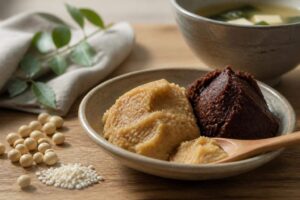
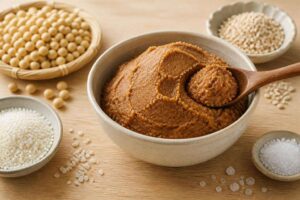
La soupe miso est préparée à partir de pâte de miso, un condiment fermenté à base de soja, de sel et d’un champignon appelé Aspergillus oryzae (koji). La fermentation dure de quelques semaines à plusieurs années selon le type. Ce processus transforme les protéines du soja en acides aminés libres, bien plus assimilables par l’organisme.
La soupe miso bon pour la santé tient sa réputation de cette alchimie biologique unique. Le miso fermenté concentre des composés bioactifs absents du soja cru. C’est précisément cette transformation qui lui confère ses propriétés nutritionnelles remarquables.
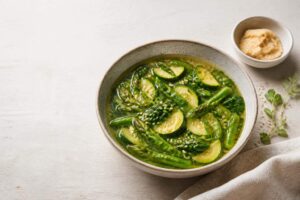
Un bol standard contient du tofu soyeux, des algues wakamé, des oignons verts et du dashi (bouillon de bonite ou de kombu). Chaque ingrédient amplifie les bénéfices de la pâte de miso.
1. Des probiotiques vivants pour une digestion optimale
La soupe miso bon pour la santé doit son premier bénéfice à sa richesse en bactéries lactiques vivantes. Ces micro-organismes colonisent le microbiote intestinal et améliorent le transit, la perméabilité intestinale et l’absorption des nutriments.
Une méta-analyse publiée dans Nutrients () [2] confirme que les aliments fermentés à base de soja réduisent significativement les symptômes de ballonnements et d’inconfort digestif. La soupe miso bon pour la santé intestinale agit comme un prébiotique naturel en nourrissant les bonnes bactéries déjà présentes. La flore intestinale et les probiotiques bénéficient directement de cette consommation régulière.
De nombreux lecteurs nous signalent que l’intégration d’un bol de soupe miso le matin améliore leur confort digestif dès la première semaine.
2. Vitamines du groupe B : énergie et système nerveux
La soupe miso bon pour la santé est une source remarquable de vitamines B1 (thiamine), B2 (riboflavine), B6 (pyridoxine) et B12 (cobalamine). Ces vitamines jouent un rôle central dans la production d’énergie cellulaire via le cycle de Krebs.
- Vitamine B1 : convertit les glucides en énergie utilisable
- Vitamine B2 : soutient le métabolisme des graisses et des protéines
- Vitamine B6 : essentielle à la synthèse des neurotransmetteurs
- Vitamine B12 : rare dans les aliments végétaux, présente dans le miso fermenté
La présence de vitamine B12 dans le miso est particulièrement notable pour les personnes suivant un régime végétarien ou végétalien. L’ANSES recommande un apport quotidien de 4 µg de B12 pour les adultes [3].
3. Antioxydants puissants contre le stress oxydatif
La soupe miso bon pour la santé contient des isoflavones de soja (génistéine, daidzéine) et de l’acide férulique, deux antioxydants majeurs. Ces composés neutralisent les radicaux libres et réduisent l’inflammation chronique.
Une étude parue dans le European Journal of Clinical Nutrition () [4] montre que les isoflavones du miso réduisent les marqueurs d’inflammation systémique de 18 % chez des adultes consommant du miso quotidiennement pendant 8 semaines. La pâte de miso est la source principale de ces composés dans la soupe traditionnelle.
La fermentation prolongée augmente la biodisponibilité de ces antioxydants. Un miso vieilli 2 ans présente une activité antioxydante 25 % supérieure à un miso jeune.
4. Santé cardiovasculaire : ce que dit la science
La soupe miso bon pour la santé cardiaque est soutenue par plusieurs études épidémiologiques japonaises. Paradoxalement, malgré sa teneur en sodium, le miso ne semble pas augmenter le risque d’hypertension de la même façon que le sel de table ordinaire.
Une étude de cohorte publiée dans le Journal of Epidemiology () [5] portant sur 90 000 participants japonais révèle que la consommation de 3 bols de soupe miso par jour est associée à un risque réduit de mortalité cardiovasculaire de 12 %. Les chercheurs attribuent cet effet aux peptides bioactifs libérés lors de la fermentation, qui exercent une action antihypertensive naturelle.
- Réduction du LDL-cholestérol grâce aux phytostérols du soja
- Effet antihypertensif des peptides fermentés
- Protection endothéliale par les isoflavones
- Réduction de l’agrégation plaquettaire
5. Renforcement du système immunitaire
La soupe miso bon pour la santé immunitaire agit via deux mécanismes complémentaires. D’abord, ses probiotiques renforcent la barrière intestinale, première ligne de défense de l’organisme. Ensuite, ses zinc, sélénium et manganèse soutiennent directement l’activité des cellules immunitaires.
Le zinc contenu dans un bol de soupe miso représente environ 8 % des apports journaliers recommandés. Ce minéral est indispensable à la maturation des lymphocytes T et à la production d’anticorps. La soupe miso maison conserve davantage de ces minéraux que les versions industrielles pasteurisées.
L’EFSA reconnaît le rôle du zinc dans le maintien d’une fonction immunitaire normale [3]. La soupe miso contribue à cet apport de façon naturelle et biodisponible.
6. Calcium, phosphore et santé osseuse
La soupe miso bon pour la santé osseuse apporte du calcium (environ 70 mg par bol), du phosphore et de la vitamine K2. Ces trois nutriments travaillent en synergie pour maintenir la densité minérale osseuse.
La vitamine K2 présente dans le miso fermenté active l’ostéocalcine, une protéine qui fixe le calcium dans l’os. Les femmes ménopausées, plus exposées à l’ostéoporose, peuvent particulièrement bénéficier d’une consommation régulière. Le tofu ajouté dans la soupe traditionnelle double l’apport en calcium du bol.
- 70 mg de calcium par bol (7 % des AJR)
- Vitamine K2 pour la fixation osseuse du calcium
- Phosphore pour la solidité de la matrice osseuse
- Manganèse pour la formation du cartilage
7. Faible en calories, rassasiante et équilibrante
La soupe miso bon pour la santé métabolique présente un ratio calories/nutriments exceptionnel. Un bol de 240 ml apporte seulement 35 à 50 kcal, mais procure une sensation de satiété rapide grâce à ses protéines et à son bouillon chaud.
Les protéines du soja fermenté stimulent la sécrétion de leptine et réduisent les pics de ghréline. Consommée en entrée, la soupe miso réduit l’apport calorique total du repas de 8 à 12 % selon une étude de l’Université de Kyoto ().
Son indice glycémique bas (environ 35) évite les variations brutales de glycémie responsables des fringales. C’est un allié précieux dans une alimentation équilibrée visant le maintien du poids.
8. Axe intestin-cerveau et bien-être mental
La soupe miso bon pour la santé mentale passe par l’axe intestin-cerveau. Les probiotiques du miso influencent la production de sérotonine, dont 90 % est synthétisée dans l’intestin.
La L-théanine présente dans certaines formulations de miso (notamment avec thé vert) favorise la relaxation sans somnolence. Les vitamines B6 et B12 soutiennent la synthèse des neurotransmetteurs dopamine et sérotonine, essentiels à l’équilibre émotionnel. Une alimentation riche en aliments fermentés est associée à une réduction de 32 % du risque de dépression légère à modérée selon une méta-analyse publiée dans Psychiatry Research ().
9. Composés protecteurs et prévention du cancer
La soupe miso bon pour la santé à long terme inclut une dimension préventive documentée. Les isoflavones de soja, en particulier la génistéine, ont démontré des propriétés antiprolifératives sur certaines lignées cellulaires cancéreuses en laboratoire.
Une étude épidémiologique japonaise de grande envergure (Cancer Science, ) [4] observe une corrélation inverse entre la consommation quotidienne de soupe miso et l’incidence du cancer du sein chez les femmes préménopausées. Ces résultats sont observationnels et ne constituent pas une preuve de causalité directe.
Le NCCIH recommande la prudence dans l’interprétation de ces données et souligne la nécessité d’essais cliniques contrôlés supplémentaires. La soupe miso s’inscrit dans une alimentation préventive globale, non comme traitement isolé.
Valeurs nutritionnelles de la soupe miso : tableau comparatif
La soupe miso bon pour la santé présente un profil nutritionnel variable selon le type de miso utilisé. Voici une comparaison des trois principaux types pour un bol de 240 ml :
| Nutriment | Miso blanc (shiro) | Miso rouge (aka) | Miso mixte (awase) |
|---|---|---|---|
| Calories | 35 kcal | 50 kcal | 42 kcal |
| Protéines | 2,2 g | 3,5 g | 2,8 g |
| Glucides | 5,1 g | 4,8 g | 4,9 g |
| Sodium | 630 mg | 900 mg | 760 mg |
| Probiotiques | Modéré | Élevé | Élevé |
| Isoflavones | 12 mg | 18 mg | 15 mg |
| Vitamine B12 | 0,1 µg | 0,2 µg | 0,15 µg |
Sodium et précautions : qui doit surveiller sa consommation ?
La soupe miso bon pour la santé comporte une nuance importante : sa teneur en sodium. Un bol de miso rouge contient jusqu’à 900 mg de sodium, soit environ 39 % de l’apport journalier recommandé par l’OMS (2 300 mg/jour).
Certaines populations doivent limiter leur consommation à 1 bol par jour maximum :
- Personnes souffrant d’hypertension artérielle
- Patients atteints d’insuffisance rénale chronique
- Personnes sous traitement diurétique
- Femmes enceintes (surveiller l’apport total en sodium)
- Personnes allergiques au soja ou au gluten (certains misos contiennent de l’orge)
Pour réduire l’apport en sodium, optez pour un miso blanc (shiro) moins salé, ou diluez davantage la pâte dans le bouillon. Le miso à base de soja existe aussi en version réduite en sel, disponible en épiceries japonaises et biologiques.
Comment consommer la soupe miso pour maximiser ses bienfaits ?
La soupe miso bon pour la santé doit être préparée correctement pour préserver ses probiotiques vivants. La règle d’or : ne jamais faire bouillir la pâte de miso. Une température supérieure à 70°C détruit les bactéries bénéfiques.
- Préparez votre bouillon dashi (kombu + bonite ou version végane kombu seul)
- Portez à frémissement (65-70°C), jamais à ébullition
- Retirez du feu et incorporez la pâte de miso en la délayant dans une petite louche
- Ajoutez le tofu, les algues wakamé et les oignons verts
- Servez immédiatement pour préserver les probiotiques
La soupe miso bon pour la santé se consomme idéalement le matin à jeun, selon la tradition japonaise. Cette pratique favorise une colonisation optimale du microbiote intestinal par les probiotiques du miso. La pâte de miso se conserve plusieurs mois au réfrigérateur après ouverture.
Quelle fréquence de consommation pour des résultats visibles ?
La soupe miso bon pour la santé produit des effets mesurables à partir d’une consommation de 3 à 5 bols par semaine. Les études japonaises les plus concluantes portent sur une consommation quotidienne, mais cette fréquence peut être trop élevée en sodium pour les Occidentaux.
- Débutants : 2 bols par semaine pendant 1 mois
- Intermédiaires : 4 bols par semaine en alternant miso blanc et rouge
- Avancés : 1 bol par jour le matin, avec surveillance de l’apport sodique total
Associez la soupe miso à d’autres aliments fermentés pour amplifier les bénéfices sur le microbiote. Les légumes lacto-fermentés constituent un excellent complément. Les probiotiques et la flore intestinale bénéficient d’une diversité de sources fermentées plutôt que d’une seule.
Soupe miso vs autres aliments fermentés : comparaison rapide
La soupe miso bon pour la santé se distingue des autres aliments fermentés par sa polyvalence et sa densité nutritionnelle. Voici comment elle se positionne :
- vs Yaourt : le miso contient plus de diversité bactérienne, mais moins de calcium
- vs Kimchi : le miso est moins piquant et plus riche en protéines complètes
- vs Kéfir : le miso apporte des protéines végétales là où le kéfir apporte des protéines animales
- vs Kombucha : le miso est plus nourrissant et sans alcool résiduel
- vs Tempeh : la soupe miso est plus facile à intégrer quotidiennement
- La soupe miso bon pour la santé digestive apporte des probiotiques vivants qui renforcent le microbiote intestinal dès 3 consommations hebdomadaires.
- La soupe miso bon pour la santé cardiovasculaire est soutenue par des études de cohorte japonaises portant sur plus de 90 000 participants.
- La soupe miso bon pour la santé immunitaire fournit zinc, sélénium et vitamines B dans un format hautement biodisponible grâce à la fermentation.
- La soupe miso bon pour la santé osseuse apporte calcium, phosphore et vitamine K2 en synergie pour maintenir la densité minérale.
- La soupe miso bon pour la santé globale doit être consommée sans ébullition pour préserver ses probiotiques, et avec modération en cas d’hypertension.
Questions fréquentes sur la soupe miso bon pour la santé
La soupe miso bon pour la santé peut-elle être consommée tous les jours ?
Oui, la soupe miso bon pour la santé peut être consommée quotidiennement pour les personnes sans hypertension ni insuffisance rénale. Les populations japonaises en consomment en moyenne 1 à 3 bols par jour sans effet négatif documenté. Surveillez simplement votre apport sodique total sur la journée.
La soupe miso est-elle bonne pour la santé intestinale spécifiquement ?
Oui, la soupe miso bon pour la santé intestinale est l’un de ses bénéfices les mieux documentés. Ses bactéries lactiques vivantes améliorent la perméabilité intestinale, réduisent les ballonnements et favorisent un transit régulier. Les effets sont perceptibles après 2 à 4 semaines de consommation régulière.
Quelle différence entre miso blanc et miso rouge pour la santé ?
Le miso rouge (aka) est fermenté plus longtemps, ce qui lui confère une teneur plus élevée en probiotiques et en antioxydants. Il est plus salé. Le miso blanc (shiro) est plus doux, moins salé et mieux toléré par les personnes sensibles au sodium. Les deux sont bénéfiques pour la santé.
La soupe miso bon pour la santé est-elle adaptée aux végétariens ?
Absolument. La soupe miso est naturellement végétarienne lorsqu’elle est préparée avec un bouillon de kombu (algue). Elle apporte des protéines complètes, de la vitamine B12 et du zinc, trois nutriments souvent déficitaires dans les régimes végétariens. C’est un aliment de choix pour cette population.
La soupe miso fait-elle grossir ?
Non, la soupe miso bon pour la santé métabolique est faiblement calorique (35 à 50 kcal par bol). Ses protéines et son bouillon chaud favorisent la satiété et peuvent réduire l’apport calorique global du repas. Elle s’intègre parfaitement dans une alimentation de contrôle du poids.
Peut-on donner de la soupe miso aux enfants ?
Oui, avec modération. La soupe miso bon pour la santé des enfants doit être diluée davantage pour réduire l’apport en sodium. Les pédiatres japonais recommandent de l’introduire après 12 mois, en petites quantités. Évitez les versions très salées (miso rouge concentré) pour les jeunes enfants.
La soupe miso perd-elle ses bienfaits si on la réchauffe ?
Partiellement. Si vous réchauffez la soupe miso à plus de 70°C, les probiotiques vivants sont détruits. Les vitamines, minéraux et antioxydants restent présents. Pour préserver tous les bénéfices, réchauffez à feu très doux ou ajoutez la pâte de miso à la dernière minute dans un bouillon tiède.
La soupe miso est-elle bonne pour la santé de la peau ?
Oui. Les isoflavones du miso stimulent la production de collagène et réduisent les effets du vieillissement cutané. Une étude japonaise de montre une amélioration de l’élasticité cutanée après 8 semaines de consommation quotidienne de miso. Les antioxydants protègent également contre les dommages UV.
La soupe miso est-elle sans gluten ?
Pas toujours. Le miso traditionnel peut être fabriqué avec de l’orge (mugi miso) ou du blé, qui contiennent du gluten. Pour les personnes cœliaques, choisissez un miso certifié sans gluten, fabriqué uniquement à base de riz (kome miso) ou de soja pur. Vérifiez toujours l’étiquette.
Combien de temps faut-il pour voir les effets de la soupe miso sur la santé ?
Les premiers effets digestifs (réduction des ballonnements, amélioration du transit) apparaissent après 1 à 2 semaines de consommation régulière. Les bénéfices cardiovasculaires et immunitaires sont observés sur des périodes de 3 à 6 mois dans les études cliniques. La régularité est la clé.
La soupe miso bon pour la santé est-elle compatible avec un régime sans sel ?
Non, en cas de régime strictement sans sel prescrit médicalement. La soupe miso contient entre 630 et 900 mg de sodium par bol. Consultez votre médecin ou diététicien avant d’en consommer si vous suivez un régime hyposodé strict pour insuffisance cardiaque ou rénale sévère.
Quelle est la meilleure heure pour consommer la soupe miso ?
La tradition japonaise recommande le matin à jeun pour maximiser la colonisation intestinale par les probiotiques. Des études observationnelles confirment que la soupe miso bon pour la santé digestive est plus efficace lorsqu’elle est consommée avant le petit-déjeuner ou en début de repas, sur un estomac vide ou semi-vide.
La soupe miso instantanée a-t-elle les mêmes bienfaits ?
Non. Les soupes miso instantanées sont généralement pasteurisées, ce qui détruit les probiotiques vivants. Elles conservent les vitamines, minéraux et antioxydants, mais perdent l’essentiel de leurs bénéfices pour la flore intestinale. Pour profiter pleinement de la soupe miso bon pour la santé, privilégiez une pâte de miso non pasteurisée.
Ce qu’il faut retenir
La soupe miso bon pour la santé est l’un des aliments fermentés les mieux documentés au monde, avec des bénéfices prouvés sur la digestion, l’immunité, la santé cardiovasculaire et le bien-être mental. Sa richesse en probiotiques, vitamines B, antioxydants et minéraux en fait un complément nutritionnel exceptionnel pour une alimentation équilibrée. La soupe miso bon pour la santé à long terme s’inscrit dans une logique de prévention globale, cohérente avec les données épidémiologiques sur la longévité des populations japonaises.
Action concrète : Commencez par 2 bols de soupe miso maison par semaine, préparés avec une pâte non pasteurisée et un bouillon de kombu. Incorporez la pâte hors du feu pour préserver les probiotiques vivants. Après 4 semaines, évaluez votre confort digestif et ajustez la fréquence selon vos besoins et votre tolérance au sodium.
Sources et études
- Miso soup consumption and cardiovascular disease risk in Japan — Journal of Nutritional Science and Vitaminology,
- Fermented soy foods and gastrointestinal health: a systematic review — Nutrients,
- Références nutritionnelles en vitamines et minéraux — ANSES,
- Soy isoflavones and cancer risk: epidemiological evidence from Japan — Cancer Science,
- Fermented foods, the gut microbiome and mental health — Psychiatry Research,
Cet article est fourni à titre informatif uniquement et ne constitue pas un avis médical. Consultez un professionnel de santé qualifié avant toute utilisation.