Miso : guide complet sur cette pâte fermentée japonaise
Le miso en un coup d’oeil
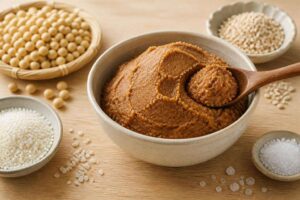
Le miso est une pâte fermentée d’origine japonaise, fabriquée principalement à partir de soja, de sel marin et d’un champignon fermenteur appelé koji (Aspergillus oryzae). Riche en protéines, en enzymes digestives et en probiotiques naturels, il est consommé au Japon depuis plus de 1 300 ans et fait aujourd’hui partie intégrante de la cuisine mondiale. Il se décline en plusieurs variétés – blanc, rouge, brun, au riz, à l’orge – dont les saveurs et les profils nutritionnels varient considérablement selon la durée de fermentation et les ingrédients utilisés. En cuisine, il s’intègre aussi bien dans une soupe traditionnelle que dans des marinades, des vinaigrettes ou des sauces. Sur le plan nutritionnel, il apporte des acides aminés essentiels, des vitamines du groupe B, du zinc, du manganèse et des composés bioactifs aux effets documentés sur la santé digestive, immunitaire et cardiovasculaire. Ce guide complet sur le miso vous donne toutes les clés pour choisir, utiliser et consommer cette pâte fermentée de façon éclairée.
Qu’est-ce que le miso exactement ?
Le miso est une pâte fermentée traditionnelle japonaise dont l’histoire remonte au VIIe siècle. Son nom s’écrit 味噌 en japonais et se prononce « mi-so ». À la base, il s’agit d’un mélange de soja cuit, de sel et de koji – un champignon microscopique (Aspergillus oryzae) qui déclenche la fermentation. Selon la recette, on ajoute du riz, de l’orge, du blé ou d’autres céréales. La fermentation dure de quelques semaines à plusieurs années, ce qui donne au miso sa complexité aromatique caractéristique : umami prononcé, légère acidité, profondeur salée.
Le miso appartient à la grande famille des aliments fermentés, au même titre que le kimchi coréen, le tempeh indonésien ou le kéfir d’Europe de l’Est. Sa fermentation naturelle produit des enzymes, des acides aminés libres et des bactéries bénéfiques qui le distinguent des simples condiments salés. Il est classé parmi les aliments fonctionnels : il nourrit autant qu’il protège.
En France, on le trouve principalement sous forme de pâte en pot ou en sachet, dans les épiceries asiatiques, les magasins bio et de plus en plus dans les grandes surfaces. Sa texture rappelle celle d’une pâte à tartiner dense, sa couleur varie du beige clair au brun foncé selon la variété.
Pour aller plus loin : Miso qu’est ce que c’est : définition, types et bienfaits
Les différents types de miso
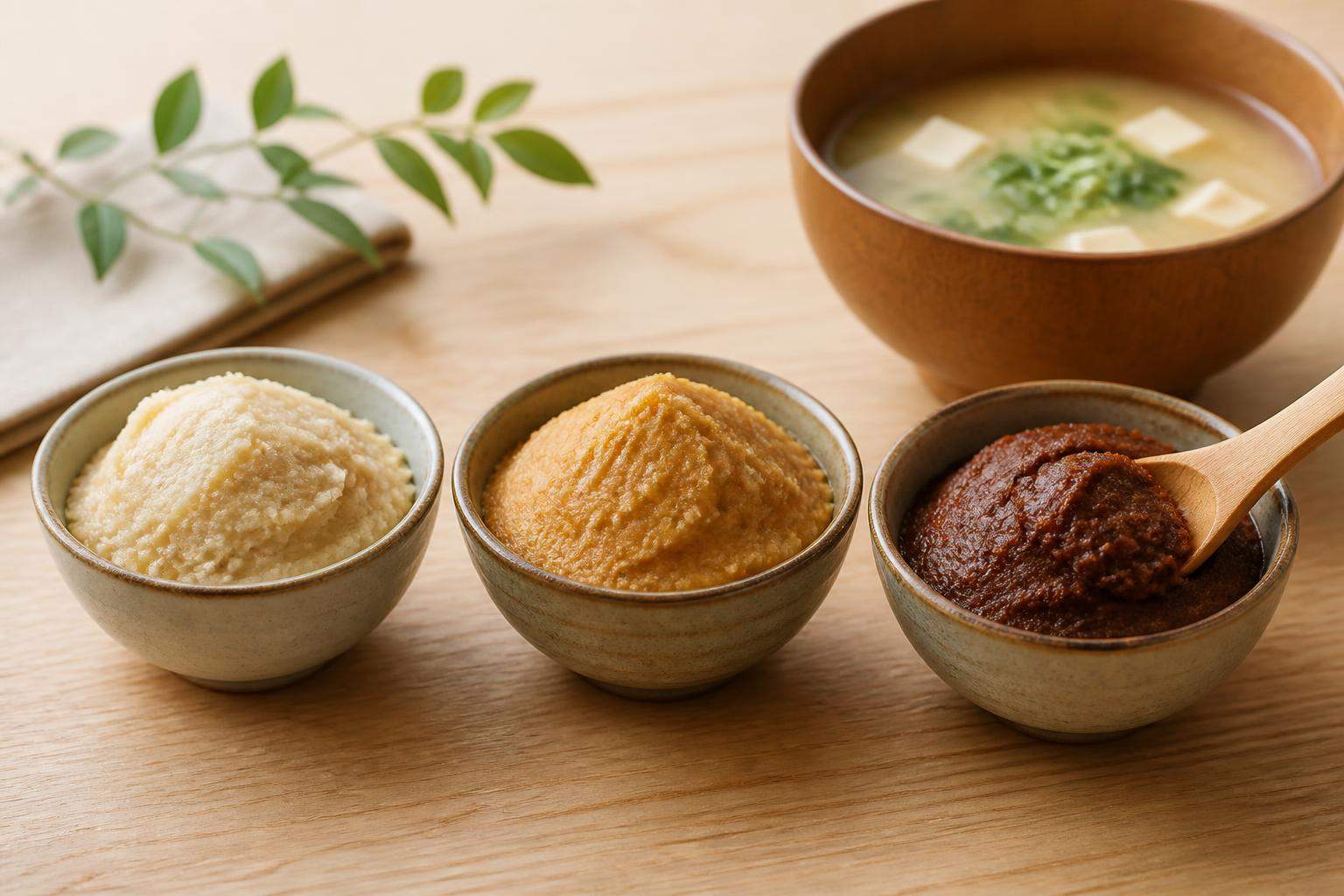
Il existe plusieurs centaines de variétés de miso au Japon, mais quelques grandes catégories structurent l’offre disponible en France. Chaque type se distingue par ses ingrédients de base, sa durée de fermentation, sa couleur, sa teneur en sel et son profil gustatif.
Le miso blanc (shiro miso)
Le miso blanc est fermenté pendant une courte période, généralement de quelques jours à quelques semaines. Il contient une proportion élevée de riz et moins de sel que les autres variétés. Sa saveur est douce, légèrement sucrée, peu salée. C’est le miso le plus polyvalent en cuisine occidentale : il s’intègre facilement dans des vinaigrettes, des sauces crémeuses ou des marinades légères. Sa teneur en probiotiques est plus faible que celle des misos à longue fermentation, mais il reste riche en enzymes et en acides aminés.
Pour aller plus loin : Miso blanc c’est quoi ? Définition, bienfaits et utilisations
Le miso rouge (aka miso)
Le miso rouge est fermenté pendant plusieurs mois, voire plusieurs années. Sa couleur brun-rouge intense trahit une concentration élevée en acides aminés issus de la réaction de Maillard. Son goût est puissant, salé, umami, parfois légèrement amer. Il convient aux préparations robustes : bouillons corsés, ragoûts, marinades de viandes. Sa teneur en sel est plus élevée (jusqu’à 13 % en moyenne), ce qui implique une utilisation plus mesurée.
Le miso brun
Intermédiaire entre le blanc et le rouge, le miso brun offre un équilibre entre douceur et profondeur. Il est souvent à base d’orge (mugi miso) ou d’un mélange soja-riz. Sa fermentation dure de six mois à un an. C’est un choix apprécié des cuisiniers qui cherchent un miso polyvalent, ni trop doux ni trop puissant.
Pour aller plus loin : Miso brun : bienfaits, saveur et comment l’utiliser
Le miso vert
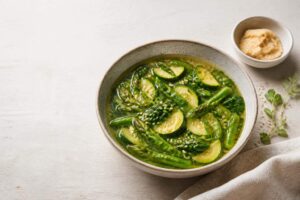
Moins connu, le miso vert doit sa teinte à l’ajout de plantes ou d’algues pendant la fermentation. Il présente un profil nutritionnel enrichi en chlorophylle et en minéraux. Sa saveur est plus herbacée, légèrement iodée. Il est encore peu répandu en France mais gagne en popularité dans les circuits bio et les restaurants gastronomiques.
Pour aller plus loin : Miso green : bienfaits, recette et valeurs nutritionnelles
Le miso de soja pur (hatcho miso)
Le hatcho miso est fabriqué uniquement à partir de soja, sans céréales. Sa fermentation dure au minimum deux ans dans des fûts en bois. C’est le miso le plus concentré, le plus riche en protéines et le plus dense en composés bioactifs. Son goût est très intense, presque amer. Il est utilisé en petites quantités dans des préparations traditionnelles japonaises.
Pour aller plus loin : Miso soja : bienfaits, types et comment l’utiliser
Le miso japonais en général
Toutes ces variétés s’inscrivent dans la tradition culinaire japonaise, où le miso est consommé quotidiennement sous forme de soupe ou de condiment. Le Japon produit environ 500 000 tonnes de miso par an, et chaque région possède ses propres spécialités.
Pour aller plus loin : Miso japonais : bienfaits, types et comment l’utiliser
Composition et ingrédients du miso
La composition du miso varie selon la variété, mais certains ingrédients sont constants. Comprendre ce que contient le miso permet de mieux apprécier ses effets nutritionnels et de choisir la variété adaptée à ses besoins.
Les ingrédients de base
- Soja : source principale de protéines (environ 11 à 14 g pour 100 g de miso), d’acides aminés essentiels et d’isoflavones.
- Sel marin : agent de conservation naturel qui régule la fermentation et contribue à la teneur sodique élevée du miso (entre 5 et 13 g de sel pour 100 g).
- Koji (Aspergillus oryzae) : champignon fermenteur qui produit des enzymes (protéases, amylases, lipases) transformant les macronutriments en composés plus facilement assimilables.
- Riz, orge ou blé : selon la variété, ces céréales apportent des glucides fermentescibles et influencent la saveur finale.
Les nutriments clés
Pour 100 g de miso blanc, on trouve approximativement : 200 kcal, 11 g de protéines, 26 g de glucides, 6 g de lipides, 5,5 g de sel. Le miso apporte également du manganèse, du cuivre, du zinc, du phosphore, des vitamines B2, B3 et K2. La fermentation augmente la biodisponibilité de ces nutriments et produit de la vitamine B12 en petites quantités, ce qui est rare dans les aliments végétaux [1].
Les composés bioactifs
La fermentation génère des composés spécifiques absents dans le soja cru : des peptides bioactifs aux propriétés antioxydantes et antihypertensives, des isoflavones sous forme aglycon (plus biodisponibles que dans le soja non fermenté), des acides aminés libres responsables de l’umami (glutamate, aspartate), et des bactéries lactiques aux effets probiotiques [2].
Pour aller plus loin : Miso ingrédients : tout ce que contient cette pâte fermentée
La pâte de miso : présentation et formes
Le miso se présente le plus souvent sous forme de pâte épaisse vendue en pot ou en sachet hermétique. Certains fabricants proposent également du miso en poudre ou en granulés, plus pratiques mais souvent moins riches en probiotiques vivants. La pâte fraîche non pasteurisée est la forme la plus intéressante sur le plan nutritionnel.
Pour aller plus loin : Pâte de miso : bienfaits, types et comment l’utiliser
Bienfaits du miso pour la santé
Les bienfaits du miso sont documentés par un nombre croissant d’études scientifiques, principalement menées au Japon et en Corée. Voici les effets les mieux établis à ce jour.
1. Santé digestive et microbiote
Le miso non pasteurisé contient des bactéries lactiques vivantes (Lactobacillus, Pediococcus) qui contribuent à l’équilibre du microbiote intestinal. Ses enzymes facilitent la digestion des protéines et des glucides complexes. Des études montrent qu’une consommation régulière de miso est associée à une meilleure diversité microbienne intestinale [1]. Les enzymes du koji (protéases, amylases) continuent leur action dans le tube digestif, soutenant la digestion même après cuisson légère.
2. Effets cardiovasculaires
Paradoxalement, malgré sa teneur élevée en sel, plusieurs études épidémiologiques japonaises suggèrent que la consommation de miso n’est pas associée à une augmentation de la pression artérielle, contrairement au sel de table ordinaire. Des peptides bioactifs issus de la fermentation auraient des propriétés inhibitrices de l’enzyme de conversion de l’angiotensine (ECA), contribuant à réduire la tension artérielle [2]. Une étude de cohorte publiée dans le British Journal of Nutrition a montré une association inverse entre consommation de soupe miso et risque de maladies cardiovasculaires chez les femmes japonaises.
3. Propriétés antioxydantes
La fermentation prolongée du miso génère des mélanoidines et des peptides à forte activité antioxydante. Ces composés neutralisent les radicaux libres et réduisent le stress oxydatif cellulaire. Le miso rouge, fermenté plus longtemps, présente une activité antioxydante supérieure au miso blanc [3]. Les isoflavones du soja (génistéine, daidzéine) sous forme aglycon sont également de puissants antioxydants.
4. Soutien immunitaire
Les polysaccharides du koji et les bêta-glucanes présents dans certaines variétés de miso stimulent l’activité des macrophages et des cellules NK (natural killer). Des études in vitro et sur modèles animaux ont montré une augmentation de la production de cytokines pro-immunitaires après exposition aux extraits de miso [4]. La consommation régulière de miso est associée dans les études épidémiologiques japonaises à une moindre fréquence des infections respiratoires hivernales.
5. Effets sur le cancer (données préliminaires)
Des études épidémiologiques japonaises ont observé une association entre consommation régulière de miso et réduction du risque de certains cancers, notamment le cancer gastrique et le cancer du sein. Ces associations sont attribuées aux isoflavones, aux peptides antioxydants et aux effets anti-inflammatoires du miso fermenté. Ces données restent préliminaires et ne permettent pas de conclure à un effet causal [5].
6. Apport en protéines végétales
Le miso constitue une source intéressante de protéines végétales complètes, contenant les huit acides aminés essentiels. La fermentation améliore leur digestibilité par rapport au soja cru. Pour les personnes suivant un régime végétarien ou végétalien, le miso représente un complément protéique de qualité.
7. Santé osseuse
Le miso apporte de la vitamine K2 (ménaquinone), un nutriment essentiel à la fixation du calcium dans les os. La fermentation par le koji produit de la K2 en quantités significatives. Les isoflavones du soja ont également montré des effets bénéfiques sur la densité osseuse dans plusieurs études cliniques menées sur des femmes ménopausées [3].
8. Bienfaits de la soupe miso
La soupe miso, préparation la plus répandue, concentre les bienfaits du miso tout en apportant hydratation et minéraux issus du dashi (bouillon de base). Des études japonaises ont montré que la consommation quotidienne de soupe miso est associée à une meilleure santé métabolique globale.
Pour aller plus loin : Soupe miso bon pour la santé : 9 bienfaits prouvés
Le miso comme aliment fermenté
Au-delà de ses nutriments spécifiques, le miso tire une grande partie de ses bienfaits de son statut d’aliment fermenté. La fermentation transforme profondément la matrice alimentaire, augmente la biodisponibilité des micronutriments, réduit les antinutriments (phytates, lectines) et produit des métabolites bioactifs absents dans le soja non transformé.
Pour aller plus loin : Miso fermenté : bienfaits, types et comment l’utiliser
Quelle quantité de miso consommer par jour ?
La question de la dose optimale de miso est centrale, notamment en raison de sa teneur élevée en sodium. Les recommandations varient selon les profils et les objectifs.
Dose recommandée pour un adulte en bonne santé
La plupart des études japonaises qui observent des effets bénéfiques du miso portent sur des consommations de 1 à 3 portions par jour, soit l’équivalent de 10 à 20 g de pâte de miso par portion (une cuillère à soupe rase). Cette quantité correspond à environ 600 à 1 200 mg de sodium par jour issus du miso seul. L’OMS recommande de ne pas dépasser 2 000 mg de sodium par jour toutes sources confondues [5].
Adapter la dose selon le profil
- Adulte en bonne santé : 1 à 2 cuillères à soupe par jour (10 à 20 g) constituent une dose raisonnable et bénéfique.
- Personnes hypertendues : limiter à 1 cuillère à café par jour (5 g) et surveiller la pression artérielle.
- Personnes souffrant d’insuffisance rénale : consulter un médecin avant toute consommation régulière.
- Femmes enceintes ou allaitantes : la consommation modérée (1 portion par jour) est généralement considérée comme sûre, mais il convient d’en parler à son médecin.
- Enfants : des petites quantités (5 g par portion) peuvent être intégrées à l’alimentation dès l’âge de 1 an, en veillant à ne pas saler les autres plats.
Fréquence idéale
Une consommation quotidienne, comme c’est le cas au Japon, semble associée aux meilleurs effets sur la santé dans les études épidémiologiques. Une à deux portions par jour, intégrées dans une alimentation variée et peu salée par ailleurs, représentent un objectif atteignable et bénéfique.
Pour aller plus loin : Quelle quantité de miso par jour est idéale pour la santé ?
Comment utiliser le miso en cuisine ?
Le miso est un condiment d’une grande polyvalence. Sa richesse en umami en fait un exhausteur de goût naturel qui peut remplacer le sel, la sauce soja ou les bouillons industriels dans de nombreuses préparations.
Règle d’or : ne jamais faire bouillir le miso
La chaleur excessive (au-delà de 70-80 °C) détruit les probiotiques vivants et les enzymes du miso. Pour conserver ses bienfaits nutritionnels, il faut l’incorporer hors du feu ou en fin de cuisson, après avoir dilué la pâte dans un peu de liquide chaud.
Utilisations classiques
- Soupe miso : dissoudre 1 cuillère à soupe de pâte dans un bouillon dashi chaud (kombu + bonite séchée). Ajouter du tofu, des algues wakame, des oignons verts. Ne pas faire bouillir après l’ajout du miso.
- Marinades : mélanger le miso avec du mirin, du saké et un peu de sucre pour mariner poissons, viandes ou légumes. Le miso attendrit les protéines grâce à ses enzymes.
- Vinaigrettes : émulsionner le miso blanc avec de l’huile de sésame, du vinaigre de riz et du gingembre râpé pour une vinaigrette umami.
- Sauces et dips : incorporer le miso dans une sauce beurre-citron, une mayonnaise maison ou un houmous pour une profondeur de goût supplémentaire.
- Ramen et nouilles : le miso rouge est la base du bouillon de ramen au miso, spécialité de Sapporo.
- Pâtisserie : une cuillère à café de miso blanc dans une pâte à cookies au chocolat ou dans un caramel intensifie les saveurs de façon surprenante.
Conseils de conservation
Le miso se conserve au réfrigérateur après ouverture, dans un contenant hermétique, pendant 3 à 6 mois. Sa teneur en sel naturelle lui confère une excellente stabilité microbiologique. Un voile blanc en surface est normal (levures sauvages) : il suffit de le retirer. Le miso peut également se congeler sans perdre ses propriétés.
Pour aller plus loin : Comment utiliser la pate miso en cuisine : guide complet
La soupe miso : recette de base en 15 minutes
La soupe miso est le mode de consommation le plus répandu et le plus simple. Elle se prépare en moins de 15 minutes avec quelques ingrédients basiques. La maîtriser ouvre la porte à des dizaines de variations saisonnières.
Pour aller plus loin : Comment faire une soupe miso authentique en 15 minutes
Le miso comme aliment à part entière
Au-delà de son rôle de condiment, le miso est un aliment à part entière qui mérite d’être intégré dans une réflexion nutritionnelle globale. Sa densité nutritionnelle, sa richesse en protéines et ses composés bioactifs en font bien plus qu’un simple assaisonnement.
Pour aller plus loin : Miso aliment : bienfaits, types et valeurs nutritionnelles
Miso rouge ou blanc : comment choisir ?
Le choix entre les différentes variétés de miso dépend à la fois de l’usage culinaire envisagé et des objectifs de santé. Voici les critères essentiels pour orienter votre décision.
Critères gustatifs
- Vous débutez avec le miso : commencez par le miso blanc, plus doux et plus polyvalent.
- Vous aimez les saveurs intenses : optez pour le miso rouge ou le hatcho miso.
- Vous cherchez un équilibre : le miso brun (mugi miso) est un excellent compromis.
Critères nutritionnels
- Moins de sel : le miso blanc contient généralement moins de sodium (5 à 8 %) que le miso rouge (10 à 13 %).
- Plus de probiotiques : le miso blanc non pasteurisé, fermenté à basse température, peut contenir davantage de bactéries vivantes.
- Plus d’antioxydants : le miso rouge, fermenté plus longtemps, est plus riche en mélanoidines et en peptides antioxydants.
- Plus de protéines : le hatcho miso (soja pur) est le plus concentré en protéines.
Pour aller plus loin : Miso rouge ou blanc : lequel choisir pour votre santé ?
La pâte de miso : définition et décryptage
Toutes ces variétés se présentent sous forme de pâte. Comprendre ce que recouvre exactement le terme « pâte de miso » permet de mieux lire les étiquettes et de choisir un produit de qualité.
Pour aller plus loin : Pâte de miso c’est quoi ? Définition, types et bienfaits
La feuille de miso : une forme méconnue
Moins connue que la pâte, la feuille de miso est une préparation traditionnelle dans certaines régions du Japon. Elle présente des caractéristiques nutritionnelles et des usages culinaires spécifiques qui méritent d’être connus.
Pour aller plus loin : Feuille de miso : bienfaits, usages et valeur nutritionnelle
Par quoi remplacer le miso ?
Si vous n’avez pas de miso sous la main ou si vous souhaitez éviter le soja, plusieurs alternatives permettent de reproduire tout ou partie de ses caractéristiques gustatives et nutritionnelles.
Alternatives les plus proches
- Sauce soja (tamari) : apporte l’umami et le sel, mais sans la texture ni les probiotiques du miso. Utiliser en quantité réduite (la sauce soja est plus liquide et plus salée).
- Tahini + sauce soja : mélange qui reproduit partiellement la texture et la profondeur du miso blanc.
- Tamarinde : apporte acidité et umami, mais un profil gustatif différent.
- Pâte d’anchois : riche en umami, adaptée aux préparations non végétariennes.
- Levure nutritionnelle : apporte une note umami et fromagée, riche en vitamines B.
Limites des alternatives
Aucune alternative ne reproduit exactement la complexité du miso fermenté. Les substituts permettent de dépanner en cuisine mais ne fournissent pas les mêmes composés bioactifs, probiotiques et peptides issus de la fermentation du koji.
Pour aller plus loin : Par quoi remplacer la pate miso : 9 alternatives testées
Où trouver du miso de qualité ?
Le miso est aujourd’hui accessible dans de nombreux points de vente en France, mais la qualité varie considérablement selon les produits et les circuits de distribution.
Les meilleurs endroits pour acheter du miso
- Épiceries asiatiques : le meilleur rapport qualité-prix, avec souvent un large choix de variétés importées du Japon ou fabriquées localement.
- Magasins bio : proposent généralement du miso non pasteurisé, biologique et sans additifs. Marques françaises ou japonaises de qualité.
- Grandes surfaces (rayon épicerie asiatique ou bio) : accès facilité mais choix limité, souvent pasteurisé.
- Vente en ligne : permet d’accéder à des variétés rares (hatcho miso, miso d’orge artisanal) et à des producteurs spécialisés.
- Marchés et épiceries fines : certains artisans français produisent désormais du miso local à partir de soja français ou de légumineuses alternatives.
Comment lire une étiquette de miso
Privilégiez les produits dont la liste d’ingrédients est courte : soja, riz (ou orge), sel, koji. Évitez les produits contenant des conservateurs, des colorants ou du glutamate ajouté. La mention « non pasteurisé » ou « vivant » garantit la présence de probiotiques actifs. Vérifiez la teneur en sel pour adapter votre consommation.
Pour aller plus loin : Où trouver du miso près de chez vous : guide complet
Précautions et contre-indications
Le miso est un aliment sûr pour la grande majorité des personnes, mais certaines situations méritent une attention particulière.
Teneur en sodium
C’est le principal point de vigilance. Le miso est un aliment très salé : 100 g contiennent entre 5 et 13 g de sel selon la variété. Une consommation excessive peut contribuer à une hypertension artérielle, surtout chez les personnes sensibles au sel. Il convient de réduire les autres sources de sodium dans l’alimentation si l’on consomme du miso régulièrement [5].
Allergies au soja
Le soja est l’un des 14 allergènes majeurs réglementés en Europe. Les personnes allergiques au soja doivent éviter le miso à base de soja. Certaines variétés à base d’orge ou de pois chiches peuvent constituer des alternatives, mais la réactivité croisée doit être évaluée par un allergologue.
Isoflavones et thyroïde
Les isoflavones du soja peuvent interférer avec la fonction thyroïdienne à des doses élevées, notamment chez les personnes souffrant d’hypothyroïdie ou prenant de la lévothyroxine. Une consommation modérée (1 à 2 portions par jour) est généralement sans risque, mais il convient d’en parler à son médecin [4].
Grossesse et allaitement
La consommation modérée de miso pendant la grossesse est généralement considérée comme sûre. Cependant, sa teneur en sel et en isoflavones justifie une consommation raisonnée et une discussion avec le médecin traitant ou la sage-femme.
Interactions médicamenteuses
Le miso contient de la vitamine K2, qui peut interagir avec les anticoagulants de type antivitamine K (AVK, warfarine). Les personnes sous ce type de traitement doivent maintenir une consommation stable et en informer leur médecin.
Maladies rénales
Les personnes souffrant d’insuffisance rénale chronique doivent limiter leur apport en sodium et en potassium. Le miso, riche en sodium, doit être consommé avec prudence et sous contrôle médical dans ce contexte.
Ce qu’il faut retenir
Le miso est bien plus qu’un simple condiment japonais. C’est un aliment fermenté complexe, riche en protéines, en enzymes, en probiotiques et en composés bioactifs aux effets documentés sur la santé digestive, cardiovasculaire et immunitaire. Ses différentes variétés – blanc, rouge, brun, vert, de soja pur – offrent une palette de saveurs et de profils nutritionnels adaptés à tous les usages culinaires et à tous les objectifs de santé.
La dose recommandée pour un adulte en bonne santé est de 1 à 2 cuillères à soupe par jour (10 à 20 g), intégrées dans une alimentation variée et peu salée par ailleurs. Le miso blanc non pasteurisé est le plus accessible pour débuter ; le miso rouge convient aux amateurs de saveurs intenses et aux préparations robustes.
Action concrète : commencez par intégrer une soupe miso maison deux à trois fois par semaine. Utilisez du miso blanc non pasteurisé, incorporé hors du feu pour préserver ses probiotiques. Réduisez le sel dans vos autres plats du repas pour maintenir un apport sodique équilibré. En quelques semaines, vous observerez les premiers effets sur votre confort digestif et votre énergie quotidienne.
Sources
- Watanabe F, et al. « Vitamin B12-Containing Plant Food Sources for Vegetarians. » Nutrients. 2014. Disponible sur : pubmed.ncbi.nlm.nih.gov [1]
- Nakamoto M, et al. « Miso (fermented soybean paste) consumption and blood pressure in Japan: a cross-sectional study. » Nutrients. 2019. Disponible sur : pubmed.ncbi.nlm.nih.gov [2]
- Messina M. « Soy and Health Update: Evaluation of the Clinical and Epidemiologic Literature. » Nutrients. 2016. Disponible sur : pubmed.ncbi.nlm.nih.gov [3]
- National Center for Complementary and Integrative Health (NCCIH). « Soy. » Disponible sur : nccih.nih.gov [4]
- World Health Organization (WHO). « Sodium intake for adults and children. » Disponible sur : who.int [5]
Cet article est fourni à titre informatif uniquement et ne constitue pas un avis médical. Consultez un professionnel de santé qualifié avant toute utilisation.