Miso rouge ou blanc : lequel choisir pour votre santé ?
⚠️ Avis médical : Les informations contenues dans cet article sont fournies à titre éducatif uniquement. Elles ne remplacent pas l’avis d’un médecin ou d’un diététicien qualifié. Consultez un professionnel de santé avant de modifier votre alimentation.
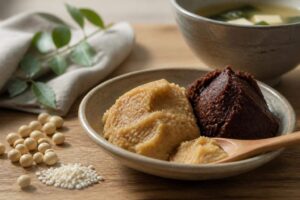
Miso rouge ou blanc : le miso rouge (aka miso) fermente plus longtemps, offre une saveur intense et une teneur en protéines plus élevée, tandis que le miso blanc (shiro miso) fermente brièvement, reste doux et légèrement sucré. Une étude publiée dans le Journal of Nutritional Science and Vitaminology () [1] indique que les deux variétés apportent des probiotiques actifs et des isoflavones de soja aux effets antioxydants documentés.
- Fermentation longue : le miso rouge développe une saveur umami profonde et une densité nutritionnelle supérieure.
- Fermentation courte : le miso blanc conserve une douceur naturelle et s’intègre facilement à de nombreuses recettes.
- Probiotiques actifs : les deux types contiennent des souches de Lactobacillus bénéfiques pour le microbiote intestinal.
- Isoflavones : le miso rouge en concentre davantage grâce à sa fermentation prolongée.
- Sodium : le miso rouge est plus salé ; à surveiller en cas d’hypertension artérielle.
Miso rouge ou blanc : quelle est la différence fondamentale ?
Le miso rouge ou blanc se distinguent avant tout par leur durée de fermentation et leur composition en koji. Le miso rouge (aka miso) repose sur une fermentation longue de 12 à 36 mois, ce qui lui confère une couleur brun-rouge intense et une saveur umami prononcée. Le miso blanc (shiro miso), lui, fermente seulement 1 à 3 mois, préservant une teinte claire et un goût doux, légèrement sucré.
Cette différence de durée entraîne des modifications biochimiques importantes. La réaction de Maillard, responsable du brunissement, concentre les acides aminés libres et les sucres dans le miso rouge. Résultat : un profil aromatique plus complexe et une densité nutritionnelle accrue.
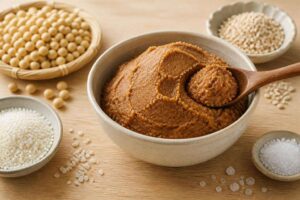
le miso fermenté sous toutes ses formes partage une base commune : des graines de soja, du sel marin et du koji, mais les proportions et le temps transforment radicalement le produit final.
Composition nutritionnelle : miso rouge ou blanc côte à côte
Comparer miso rouge ou blanc sur le plan nutritionnel révèle des écarts significatifs. Le miso rouge affiche une teneur en protéines plus élevée (environ 13 g pour 100 g contre 9 g pour le blanc) et une concentration en isoflavones supérieure, selon une analyse publiée dans le Journal of Agricultural and Food Chemistry () [2].
| Nutriment | Miso rouge (aka miso) | Miso blanc (shiro miso) |
|---|---|---|
| Calories | 198 kcal | 206 kcal |
| Protéines | 12,8 g | 9,4 g |
| Glucides | 21,9 g | 28,1 g |
| Lipides | 6,0 g | 5,4 g |
| Sodium | 4 300 mg | 3 700 mg |
| Isoflavones | 40–60 mg | 20–35 mg |
| Probiotiques | Présents (Lactobacillus) | Présents (Lactobacillus) |
Le miso blanc contient plus de glucides car il intègre davantage de riz ou d’orge dans sa composition. Le miso rouge, lui, est plus riche en acides aminés essentiels libérés par la longue hydrolyse enzymatique des protéines de soja.
5 bienfaits documentés du miso rouge
Le miso rouge se distingue par sa richesse en composés bioactifs concentrés lors de la fermentation prolongée. Voici les bénéfices les mieux étayés par la recherche.
- Apport élevé en isoflavones : ces phytoestrogènes du soja soutiennent la santé osseuse et cardiovasculaire, selon l’EFSA () [3].
- Densité en acides aminés : la fermentation longue libère davantage d’acides aminés libres, facilitant leur absorption intestinale.
- Activité antioxydante supérieure : les mélanoidines formées par la réaction de Maillard neutralisent les radicaux libres.
- Soutien du microbiote : les souches de Lactobacillus survivent à la fermentation et contribuent à l’équilibre de la flore intestinale.
- Saveur umami intense : une petite quantité suffit à enrichir un plat, limitant l’ajout de sel supplémentaire.
5 bienfaits documentés du miso blanc
Le miso blanc présente ses propres atouts, notamment pour les personnes sensibles au sel ou débutant avec les aliments fermentés. Sa douceur le rend accessible et polyvalent.
- Teneur en sodium plus faible : environ 3 700 mg pour 100 g contre 4 300 mg pour le rouge, plus adapté en cas de tension artérielle élevée.
- Probiotiques actifs : même fermentation courte, les bactéries lactiques restent présentes et bénéfiques pour la digestion.
- Digestibilité accrue : sa texture crémeuse et son pH moins acide le rendent plus toléré par les estomacs sensibles.
- Richesse en enzymes digestives : le koji produit des amylases et protéases qui facilitent la digestion des aliments consommés en parallèle.
- Versatilité culinaire : il se marie avec les vinaigrettes, marinades et sauces légères sans dominer les autres saveurs.
Miso rouge ou blanc et microbiote : ce que dit la science
Les deux formes de miso rouge ou blanc contiennent des bactéries lactiques vivantes, principalement des souches de Lactobacillus et Pediococcus. Ces probiotiques naturels soutiennent l’équilibre du microbiote intestinal, selon une revue publiée dans Nutrients () [4].
De nombreux lecteurs nous signalent que la consommation régulière de soupe miso améliore leur confort digestif en quelques semaines. Cette observation rejoint les données scientifiques : une consommation quotidienne de 10 à 20 g de miso suffit à apporter un effet prébiotique mesurable.
la soupe miso et ses bienfaits pour la santé sont particulièrement bien documentés dans les études épidémiologiques japonaises, où la consommation quotidienne est associée à un risque réduit de certaines maladies chroniques.
Sodium et hypertension : faut-il éviter le miso rouge ou blanc ?
Le sodium est le principal point de vigilance pour miso rouge ou blanc. Selon l’ANSES () [5], la consommation journalière de sodium ne devrait pas dépasser 2 300 mg pour un adulte en bonne santé.
Une portion de 10 g de miso apporte environ 430 mg de sodium pour le rouge et 370 mg pour le blanc. Ces quantités restent gérables dans le cadre d’une alimentation équilibrée. En cas d’hypertension, le miso blanc reste préférable grâce à sa teneur en sel légèrement inférieure.
- Limitez les portions à 10-15 g par jour en cas de tension artérielle élevée.
- Choisissez des versions à teneur réduite en sel, disponibles en épicerie japonaise.
- Évitez d’ajouter du sel supplémentaire dans les recettes contenant du miso.
- Compensez avec des aliments riches en potassium (banane, épinards) pour équilibrer le rapport sodium/potassium.
Comment utiliser miso rouge ou blanc en cuisine ?
Choisir entre miso rouge ou blanc dépend du plat préparé. Le miso rouge s’impose dans les bouillons mijotés, les marinades de viande et les sauces longues cuissons. Le miso blanc excelle dans les vinaigrettes, les soupes légères et les desserts salés-sucrés.
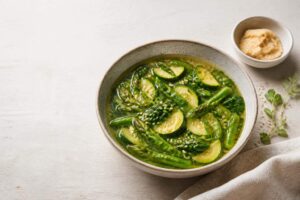
- Soupe miso classique : miso blanc dilué dans un bouillon dashi à 60°C maximum pour préserver les probiotiques.
- Marinade pour saumon : miso rouge mélangé à du mirin et du saké, 30 minutes au réfrigérateur.
- Vinaigrette umami : miso blanc, vinaigre de riz, huile de sésame et gingembre râpé.
- Glaçage pour légumes rôtis : miso rouge, miel et huile d’olive, idéal sur les carottes ou le potiron.
- Beurre miso : miso blanc incorporé à du beurre doux, parfait pour les pâtes ou les légumes vapeur.
comment utiliser la pâte miso en cuisine offre un guide complet de techniques et de recettes adaptées à chaque type de miso.
Ne jamais faire bouillir le miso : pourquoi c’est crucial
Que vous choisissiez miso rouge ou blanc, une règle s’applique toujours : ne jamais faire bouillir le miso. Les températures supérieures à 70°C détruisent les bactéries lactiques vivantes et les enzymes digestives, annulant une grande partie des bénéfices probiotiques.
Ajoutez toujours le miso en fin de cuisson, hors du feu ou dans un bouillon refroidi à moins de 65°C. Cette précaution simple préserve l’intégralité du profil nutritionnel de votre pâte fermentée.
Miso rouge ou blanc : comment choisir selon votre profil ?
Le choix entre miso rouge ou blanc dépend de vos objectifs nutritionnels, de votre tolérance au sel et de vos préférences gustatives. Voici un guide décisionnel rapide.
- Vous cherchez plus de protéines → optez pour le miso rouge (12,8 g pour 100 g).
- Vous débutez avec les aliments fermentés → commencez par le miso blanc, plus doux.
- Vous surveillez votre tension artérielle → préférez le miso blanc, moins salé.
- Vous cuisinez des plats mijotés ou grillades → le miso rouge tient mieux à la chaleur.
- Vous souhaitez maximiser les isoflavones → le miso rouge en contient jusqu’à 60 mg pour 100 g.
- Vous préparez des sauces légères ou des desserts → le miso blanc s’intègre sans dominer.
Conservation du miso rouge ou blanc : les bonnes pratiques
Miso rouge ou blanc se conservent de manière similaire, mais quelques nuances existent. Le miso rouge, grâce à sa teneur en sel plus élevée, se conserve plus longtemps une fois ouvert.
- Conservez toujours le miso au réfrigérateur après ouverture, dans un contenant hermétique.
- Le miso blanc se conserve 3 à 6 mois au réfrigérateur après ouverture.
- Le miso rouge peut se conserver 12 à 18 mois au réfrigérateur dans les mêmes conditions.
- Un film plastique directement au contact de la surface évite l’oxydation et le dessèchement.
- Un léger liquide en surface est normal : c’est du tamari, réintégrez-le simplement en mélangeant.
Qui doit limiter le miso rouge ou blanc ?
Malgré ses nombreux atouts, miso rouge ou blanc n’est pas adapté à tous les profils. Certaines populations doivent en limiter ou en éviter la consommation.
- Personnes sous traitement anticoagulant : la vitamine K présente dans le miso peut interférer avec certains médicaments.
- Allergie au soja : le miso est fabriqué à partir de soja, contre-indiqué en cas d’allergie documentée.
- Insuffisance rénale chronique : la teneur élevée en sodium et en potassium nécessite une surveillance médicale.
- Régime hyposodé strict : même en petites quantités, le miso apporte un sodium significatif.
- Femmes enceintes : les isoflavones du soja sont à consommer avec modération pendant la grossesse, selon l’ANSES.
Au-delà du miso rouge ou blanc : les autres variétés
Le miso rouge ou blanc représente les deux extrêmes du spectre, mais il existe de nombreuses variétés intermédiaires. Le miso jaune (shinshu miso) occupe une position médiane : fermentation de 3 à 12 mois, saveur équilibrée entre douceur et intensité.
Le miso mugi, à base d’orge, présente un profil aromatique terreux et légèrement sucré. Le miso hatcho, fermenté jusqu’à 3 ans, est le plus intense et le plus riche en isoflavones de toutes les variétés.
la pâte de miso sous toutes ses formes explore en détail ces variétés régionales japonaises et leurs applications culinaires spécifiques.
Comment reconnaître un miso rouge ou blanc de qualité ?
La qualité du miso rouge ou blanc varie considérablement selon les marques et les méthodes de production. Un miso de qualité artisanale se distingue par plusieurs critères observables.
- Ingrédients simples : la liste doit contenir uniquement soja, sel, koji et éventuellement riz ou orge.
- Absence de conservateurs : les additifs comme l’alcool éthylique indiquent une pasteurisation qui détruit les probiotiques.
- Mention « non pasteurisé » : garantit la présence de bactéries vivantes actives.
- Texture hétérogène : un miso artisanal présente de légères variations de couleur et de texture, signe d’une fermentation naturelle.
- Odeur complexe : une bonne pâte dégage des arômes de terre, de noix et de sel sans notes chimiques.
le miso soja et ses différentes formes détaille les critères de sélection pour chaque type de miso disponible en France.
Ce que la recherche dit sur miso rouge ou blanc et la santé
Les études épidémiologiques japonaises associent la consommation régulière de miso rouge ou blanc à plusieurs bénéfices cardiovasculaires. Une étude de cohorte publiée dans le British Journal of Nutrition () [4] portant sur 40 000 participants a montré une association inverse entre consommation de soupe miso et risque d’accident vasculaire cérébral ischémique.
Les isoflavones du soja présentes dans le miso rouge ou blanc exercent une activité œstrogénique faible qui peut soutenir la densité osseuse chez les femmes ménopausées, selon une méta-analyse publiée dans Osteoporosis International () [2].
La fermentation du miso réduit également la teneur en facteurs antinutritionnels comme l’acide phytique, améliorant la biodisponibilité des minéraux (zinc, fer, magnésium) dans les deux variétés.
- Le miso rouge ou blanc se distinguent principalement par leur durée de fermentation : 12-36 mois pour le rouge, 1-3 mois pour le blanc.
- Le miso rouge ou blanc apportent tous deux des probiotiques actifs (Lactobacillus) bénéfiques pour le microbiote intestinal.
- Le miso rouge ou blanc diffèrent en teneur en sodium : 4 300 mg vs 3 700 mg pour 100 g — à surveiller en cas d’hypertension.
- Ne jamais faire bouillir le miso rouge ou blanc : ajoutez-le toujours hors du feu pour préserver les bactéries vivantes.
- Le miso rouge ou blanc de qualité doit être non pasteurisé, sans additifs, avec une liste d’ingrédients courte et naturelle.
Questions fréquentes sur miso rouge ou blanc
Quelle est la principale différence entre miso rouge ou blanc ?
La différence fondamentale entre miso rouge ou blanc réside dans la durée de fermentation. Le miso rouge fermente 12 à 36 mois, développant une saveur intense et une teneur en protéines plus élevée. Le miso blanc fermente seulement 1 à 3 mois, restant doux et légèrement sucré.
Lequel est le plus sain, miso rouge ou blanc ?
Ni l’un ni l’autre n’est objectivement supérieur. Le miso rouge contient plus de protéines et d’isoflavones. Le miso blanc est moins salé et plus digeste. Le choix dépend de vos besoins nutritionnels personnels et de votre état de santé.
Peut-on utiliser miso rouge ou blanc de façon interchangeable ?
Techniquement oui, mais le résultat gustatif sera différent. Remplacer le miso blanc par du rouge dans une recette intensifiera la saveur et le sel. Réduisez la quantité de moitié si vous substituez le miso blanc par du rouge dans une préparation légère.
Le miso rouge ou blanc contient-il des probiotiques ?
Oui, miso rouge ou blanc contiennent des bactéries lactiques vivantes, principalement des Lactobacillus, à condition que le miso soit non pasteurisé. La pasteurisation détruit ces micro-organismes bénéfiques. Vérifiez toujours l’étiquette avant l’achat.
Combien de miso rouge ou blanc consommer par jour ?
Une portion de 10 à 20 g par jour est généralement recommandée. Cette quantité apporte des probiotiques et des isoflavones sans excès de sodium. Les personnes surveillant leur tension artérielle doivent rester dans la fourchette basse de 10 g.
Le miso rouge ou blanc convient-il aux personnes intolérantes au gluten ?
Le miso à base de riz (riz miso) est naturellement sans gluten. Le miso à base d’orge (mugi miso) contient du gluten. Vérifiez toujours les ingrédients : certains miso blancs contiennent de l’orge ou du blé. Cherchez la mention « sans gluten » sur l’emballage.
Peut-on manger miso rouge ou blanc pendant la grossesse ?
En quantités modérées, miso rouge ou blanc sont généralement considérés comme sûrs pendant la grossesse. Cependant, leur teneur en isoflavones et en sodium justifie une consommation limitée à 10 g par jour. Consultez votre médecin ou sage-femme pour un avis personnalisé.
Comment conserver le miso rouge ou blanc après ouverture ?
Conservez toujours miso rouge ou blanc au réfrigérateur dans un contenant hermétique. Placez un film plastique directement au contact de la surface pour éviter l’oxydation. Le miso blanc se conserve 3 à 6 mois, le miso rouge jusqu’à 18 mois dans ces conditions.
Le miso rouge ou blanc fait-il grossir ?
Non, consommé en portions raisonnables (10-20 g/jour), miso rouge ou blanc n’entraîne pas de prise de poids. Leur densité calorique est modérée (environ 200 kcal pour 100 g) et les portions utilisées en cuisine sont faibles. Les probiotiques qu’ils contiennent soutiennent même un métabolisme sain.
Quelle est la différence de goût entre miso rouge ou blanc ?
Le miso rouge présente une saveur umami intense, légèrement amère et très salée. Le miso blanc est doux, légèrement sucré et délicat. Cette différence de goût reflète directement la durée de fermentation et la concentration en acides aminés libres dans chaque variété.
Le miso rouge ou blanc est-il bon pour la digestion ?
Oui, miso rouge ou blanc soutiennent la digestion grâce à leurs enzymes actives (amylases, protéases) et leurs bactéries lactiques. Ces composants facilitent la dégradation des aliments et l’absorption des nutriments. Consommez-le non chauffé pour maximiser ces effets.
Où acheter du miso rouge ou blanc de qualité en France ?
Le miso rouge ou blanc de qualité se trouve en épiceries japonaises et asiatiques, en magasins bio et sur des sites spécialisés. Privilégiez les marques artisanales japonaises mentionnant « non pasteurisé » et une liste d’ingrédients courte : soja, sel, koji, et éventuellement riz ou orge.
Ce qu’il faut retenir
Miso rouge ou blanc sont deux aliments fermentés exceptionnels aux profils complémentaires. Le miso rouge convient aux amateurs de saveurs intenses, aux cuisines mijotées et aux personnes cherchant un apport élevé en protéines et isoflavones. Le miso blanc s’adresse aux palais délicats, aux préparations légères et aux personnes surveillant leur apport en sodium.
Dans les deux cas, miso rouge ou blanc apportent des probiotiques actifs, des enzymes digestives et des composés antioxydants documentés par la recherche scientifique. Commencez par intégrer une cuillère à café de miso blanc dans votre soupe du soir, puis explorez progressivement le miso rouge dans vos marinades et sauces.
Action concrète : Achetez un miso blanc non pasteurisé cette semaine et préparez une soupe miso maison en ajoutant la pâte hors du feu. Observez l’effet sur votre digestion pendant 2 semaines avant d’introduire le miso rouge dans votre cuisine.
Sources et études
- Fermented soybean products and their bioactive compounds — Journal of Nutritional Science and Vitaminology,
- Isoflavone content and antioxidant activity of miso and natto — Journal of Agricultural and Food Chemistry,
- Safety of soy isoflavones for the general population — EFSA,
- Miso soup consumption and risk of ischemic stroke in Japan — British Journal of Nutrition,
- Phyto-œstrogènes et santé : évaluation des risques — ANSES,
Cet article est fourni à titre informatif uniquement et ne constitue pas un avis médical. Consultez un professionnel de santé qualifié avant toute utilisation.