Quelle dose de psyllium pour nettoyer le côlon : 5 règles clés
⚠️ Avertissement médical : Les informations de cet article sont fournies à titre informatif uniquement. Elles ne remplacent pas l’avis d’un médecin ou d’un professionnel de santé. Consultez un professionnel avant de commencer toute cure de psyllium, en particulier si vous prenez des médicaments ou souffrez d’une pathologie digestive.
Quelle dose de psyllium pour nettoyer le côlon : la dose efficace se situe entre 5 et 15 grammes par jour, répartis en 1 à 3 prises, selon les recommandations des études cliniques et des autorités sanitaires. Une étude publiée dans le American Journal of Clinical Nutrition () [1] confirme qu’une supplémentation quotidienne en psyllium améliore significativement le transit intestinal dès 7 jours d’utilisation.
- Dose minimale efficace : 5 g par jour pour un effet de nettoyage doux
- Dose standard recommandée : 10 à 15 g par jour pour une cure de transit
- Fréquence : 1 à 3 prises journalières, toujours avec un grand verre d’eau
- Durée de cure conseillée : 3 à 7 jours pour un nettoyage colique ciblé
- Augmentation progressive indispensable pour éviter les ballonnements
1. Pourquoi le psyllium nettoie-t-il le côlon ?
Le psyllium, aussi appelé ispaghul, contient jusqu’à 85 % de fibres solubles mucilagineuses. Au contact de l’eau, ces fibres forment un gel visqueux qui tapisse la paroi du côlon. Ce gel ramollit les selles, facilite leur progression et entraîne mécaniquement les déchets vers l’extérieur.
Une étude publiée dans le Journal of Nutrition () [3] montre que la consommation régulière de Plantago ovata augmente le volume fécal de 40 % en moyenne. C’est ce mécanisme de balayage mécanique qui explique l’effet nettoyant sur le côlon.
Le psyllium agit aussi comme un prébiotique : il nourrit les bactéries bénéfiques du microbiote intestinal, renforçant ainsi la barrière colique. Pour aller plus loin sur les usages thérapeutiques du psyllium, consultez notre guide dédié.
2. Quelle dose de psyllium pour nettoyer le côlon selon la science ?
La dose de psyllium pour nettoyer le côlon varie selon l’objectif et le profil de la personne. Les études cliniques convergent vers une fourchette de 5 à 15 grammes par jour. Voici le détail :
| Objectif | Dose journalière | Nombre de prises | Durée |
|---|---|---|---|
| Nettoyage doux du côlon | 5 à 7 g | 1 à 2 prises | 7 à 14 jours |
| Cure de transit active | 10 à 15 g | 2 à 3 prises | 3 à 7 jours |
| Constipation chronique | 10 à 20 g | 2 à 3 prises | 4 à 8 semaines |
| Entretien du transit | 5 à 10 g | 1 à 2 prises | Continu possible |
Selon l’EFSA () [2], une dose de 10 g par jour est suffisante pour obtenir un effet laxatif osmotique documenté. Pour une cure de nettoyage colique, la dose de 10 à 15 g de psyllium par jour pendant 3 à 7 jours est la plus fréquemment citée dans la littérature médicale.
3. Comment mesurer concrètement votre dose de psyllium ?
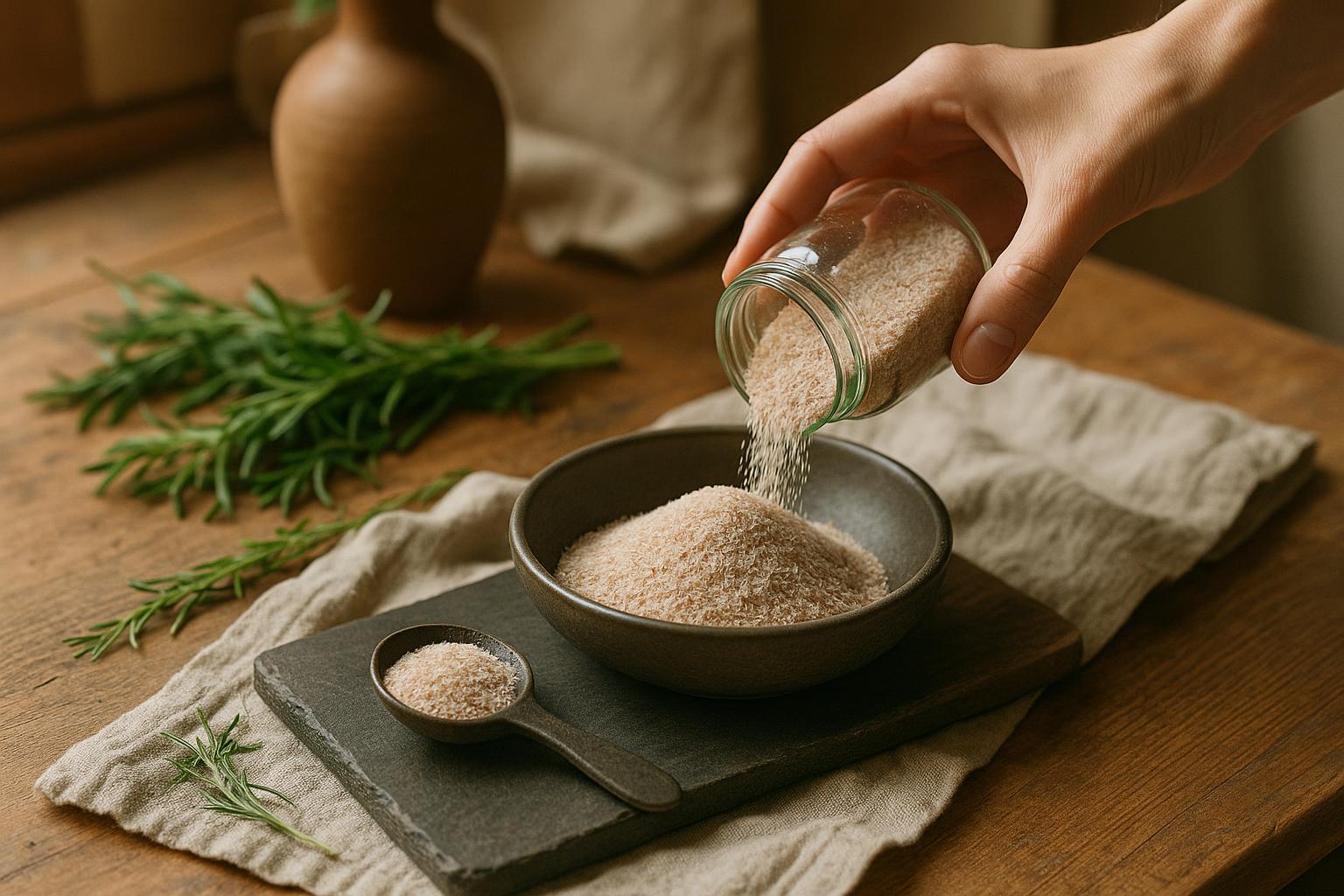
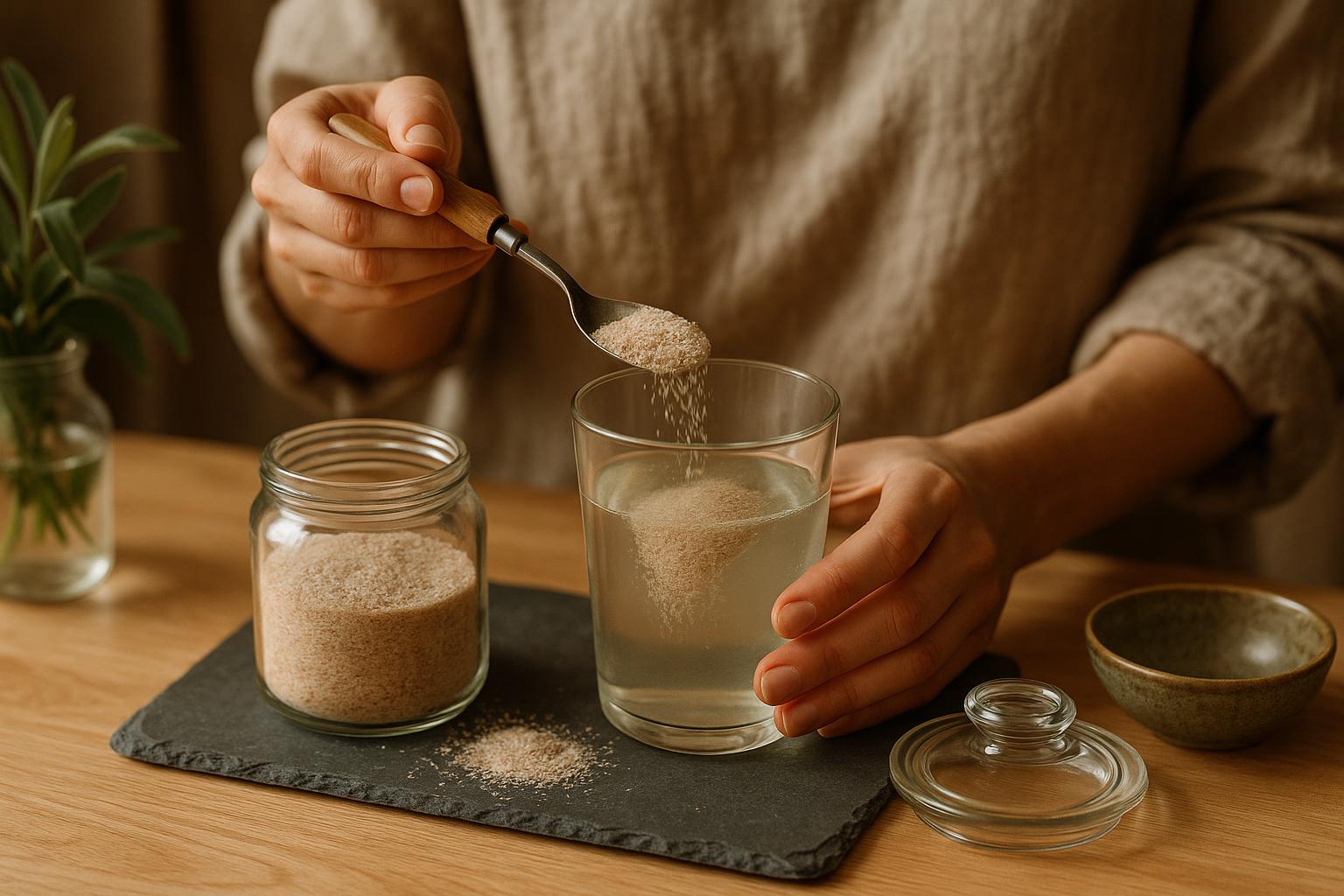
En pratique, 5 grammes de psyllium correspondent à environ 1 cuillère à café rase de poudre. Voici les équivalences utiles pour doser précisément :
- 1 cuillère à café rase ≈ 5 g de psyllium en poudre
- 1 cuillère à soupe rase ≈ 10 à 12 g de psyllium en poudre
- 1 sachet dosé (pharmacie) ≈ 3,5 à 5 g selon la marque
- 1 gélule standard ≈ 0,5 à 0,7 g (vérifier l’étiquette)
Pour une cure de nettoyage colique à 10 g/jour, prenez 2 cuillères à café matin et soir. Diluez chaque dose dans au moins 200 ml d’eau froide ou tiède. Ne jamais avaler le psyllium sec : il absorbe jusqu’à 50 fois son poids en eau et peut obstruer l’œsophage.
Si vous hésitez entre la forme poudre et les gélules, la poudre de psyllium en détail vous aidera à choisir le format le plus adapté à votre cure.
4. Quelle dose de psyllium pour nettoyer le côlon sans effets secondaires ?
La dose de psyllium pour nettoyer le côlon doit être augmentée progressivement pour éviter les effets indésirables. Commencer à 5 g/jour la première semaine est la stratégie recommandée par les gastro-entérologues.
- Semaine 1 : 5 g/jour (1 prise le matin)
- Semaine 2 : 10 g/jour (2 prises : matin et soir)
- Semaine 3 : 15 g/jour si tolérance bonne (3 prises)
- Ne jamais dépasser 20 g/jour sans suivi médical
Les effets secondaires les plus fréquents à doses trop élevées sont les ballonnements, les flatulences et les crampes abdominales. Ils surviennent surtout quand la dose est augmentée trop vite ou quand l’hydratation est insuffisante.
De nombreux lecteurs nous signalent que commencer par une demi-cuillère à café le matin pendant 3 jours avant d’augmenter la dose leur a permis d’éviter tout inconfort digestif.
5. Quelle dose de psyllium pour nettoyer le côlon en cure courte ?
Pour une cure de nettoyage colique de 3 à 7 jours, le protocole le plus documenté est le suivant :
- Matin à jeun : 5 g de psyllium dans 250 ml d’eau, boire immédiatement
- Midi avant le repas : 5 g dans 250 ml d’eau
- Soir avant le coucher : 5 g dans 250 ml d’eau
- Total : 15 g/jour pendant 3 à 7 jours maximum
Ce protocole correspond à la dose de psyllium pour nettoyer le côlon recommandée par plusieurs pharmaciens et naturopathes, en cohérence avec les données publiées dans le World Journal of Gastroenterology () [4]. Après la cure, réduisez à 5 à 10 g/jour en entretien si nécessaire.
Pour savoir si vous pouvez prendre du psyllium tous les jours, consultez notre article dédié à l’usage quotidien.
6. Psyllium blond vs psyllium brun : quelle dose choisir ?
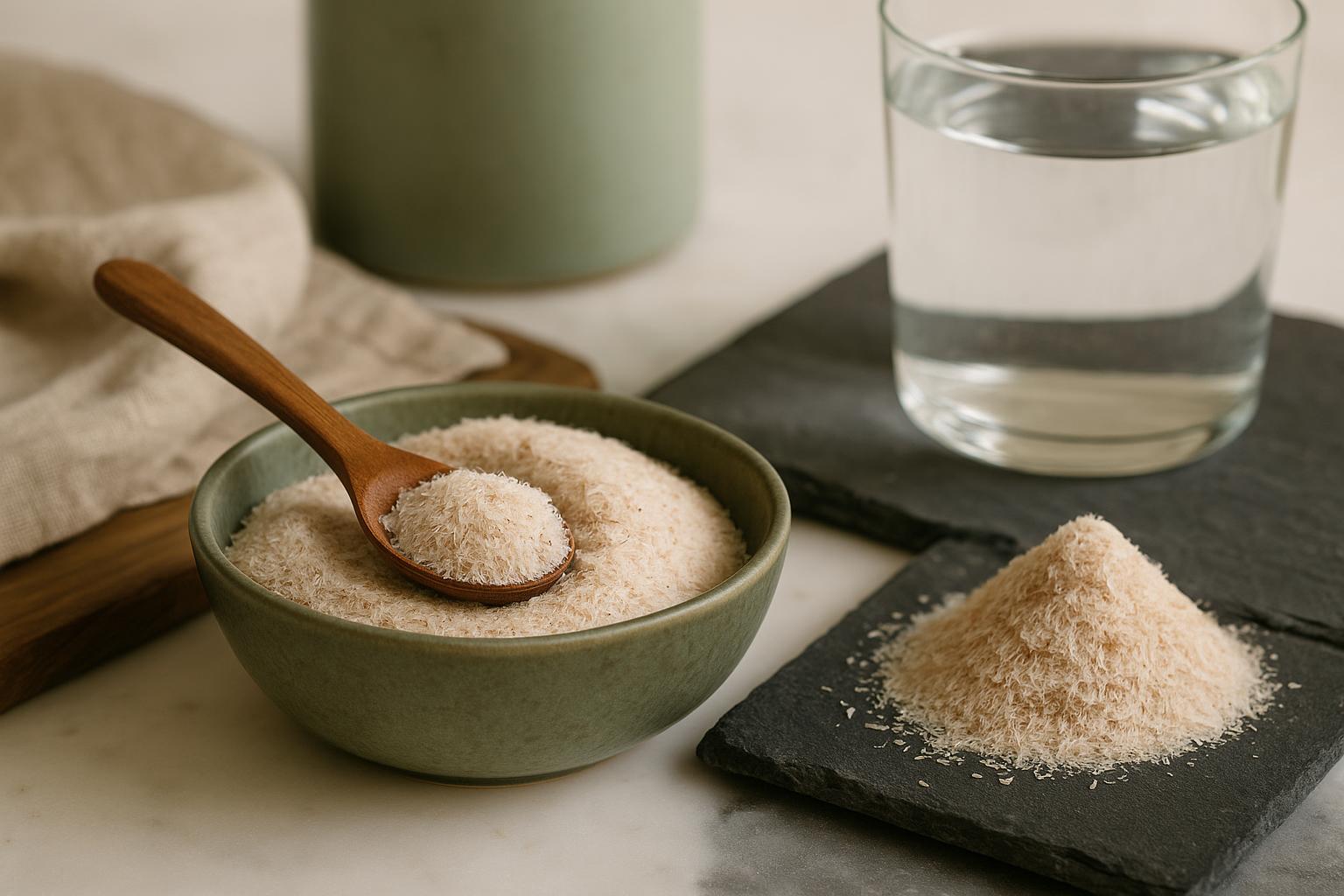
Le psyllium blond (Plantago ovata) est la forme la plus concentrée en fibres mucilagineuses : il contient 85 % de fibres contre 60 à 70 % pour le psyllium brun. La dose de psyllium pour nettoyer le côlon est donc plus faible avec la version blonde.
- Psyllium blond : 5 à 15 g/jour pour un effet nettoyant colique
- Psyllium brun : 10 à 20 g/jour pour un effet équivalent
- Le psyllium blond est la forme recommandée en pharmacie et en cure médicale
- L’ispaghul en poudre fine est plus facile à dissoudre et mieux toléré
L’ANSES [2] et l’EFSA basent leurs recommandations sur le psyllium blond. Privilégiez cette forme pour votre cure de nettoyage colique.
7. Quelle dose de psyllium pour nettoyer le côlon avec des médicaments ?
Le psyllium peut interférer avec l’absorption de certains médicaments. Sa prise doit être espacée d’au moins 1 à 2 heures avant ou après la prise médicamenteuse. Les interactions les plus documentées concernent :
- Les antidiabétiques oraux (le psyllium ralentit l’absorption du glucose)
- La metformine et les statines (absorption réduite)
- La levothyroxine (hormone thyroïdienne)
- Les anticoagulants oraux (warfarine, rivaroxaban)
- Les médicaments contre l’épilepsie
Si vous prenez un traitement chronique, consultez votre médecin avant de démarrer une cure de psyllium, même à faible dose. Le NCCIH [5] rappelle que les fibres solubles peuvent modifier la biodisponibilité de nombreux principes actifs.
8. Quelle dose de psyllium pour nettoyer le côlon chez les personnes sensibles ?
Certaines populations doivent adapter la dose de psyllium pour nettoyer le côlon. Les recommandations diffèrent selon le profil :
- Personnes âgées : commencer à 3 g/jour, augmenter très progressivement
- Enfants (10-14 ans) : maximum 5 g/jour, uniquement sur avis médical
- Femmes enceintes : 5 à 10 g/jour après avis obstétrical
- Syndrome de l’intestin irritable : 5 g/jour en phase de tolérance
- Maladie de Crohn ou rectocolite : contre-indication relative, avis médical obligatoire
Pour les personnes souffrant de constipation chronique, une dose de psyllium pour nettoyer le côlon de 10 à 20 g/jour sur 4 à 8 semaines est validée par plusieurs méta-analyses. Consultez notre article sur comment prendre le psyllium contre la constipation pour un protocole détaillé.
9. Quelle quantité d’eau boire avec le psyllium ?
L’hydratation est aussi importante que la dose de psyllium pour nettoyer le côlon. Sans eau suffisante, le gel mucilagineuse ne se forme pas correctement et le risque d’obstruction augmente.
- Minimum 200 ml d’eau par prise de 5 g de psyllium
- Boire le mélange immédiatement après préparation (le gel se forme en 2 à 3 minutes)
- Augmenter l’apport hydrique total à 2 litres d’eau par jour pendant la cure
- Éviter le lait ou les jus d’agrumes pour diluer le psyllium (interaction possible)
Une hydratation insuffisante est la première cause d’échec des cures de psyllium et d’effets secondaires comme les crampes ou l’aggravation de la constipation.
10. Psyllium et microbiote : un bénéfice au-delà du nettoyage colique
La dose de psyllium pour nettoyer le côlon a aussi un effet prébiotique documenté. Les fibres solubles du psyllium fermentent partiellement dans le côlon et nourrissent les Bifidobacterium et Lactobacillus, deux genres bactériens clés du microbiote intestinal.
Une revue publiée dans le British Journal of Nutrition () [3] montre qu’une supplémentation de 10 g/jour de psyllium pendant 4 semaines augmente significativement la diversité du microbiote. Ce double effet — nettoyage mécanique et rééquilibrage de la flore intestinale — fait du psyllium une fibre à part dans la catégorie des fibres alimentaires.
Pour optimiser cet effet sur le microbiote, vous pouvez associer le psyllium à des aliments fermentés. Notre guide sur comment consommer le psyllium au quotidien vous donne les meilleures associations alimentaires.
11. Quand prendre le psyllium pour maximiser l’effet nettoyant ?
Le moment de la prise influence l’efficacité de la dose de psyllium pour nettoyer le côlon. Voici les créneaux les plus efficaces :
- À jeun le matin : la prise la plus efficace pour déclencher le réflexe gastro-colique
- 30 minutes avant les repas : optimise la satiété et ralentit l’absorption des sucres
- Le soir au coucher : favorise un transit matinal régulier
- Éviter de prendre le psyllium pendant les repas (dilution insuffisante)
Pour un nettoyage colique optimal, la prise à jeun le matin est la plus recommandée par les gastro-entérologues. Le transit intestinal est naturellement plus actif le matin grâce au réflexe gastro-colique.
12. Ce qu’il faut retenir sur quelle dose de psyllium pour nettoyer le côlon
La dose de psyllium pour nettoyer le côlon efficacement est de 10 à 15 grammes par jour, répartis en 2 à 3 prises avec au moins 200 ml d’eau chacune, pendant 3 à 7 jours. Commencez toujours à 5 g/jour et augmentez progressivement pour éviter les inconforts digestifs.
Le psyllium blond (Plantago ovata) est la forme la plus concentrée et la mieux documentée. Il agit à la fois comme fibre mucilagineuse nettoyante et comme prébiotique pour le microbiote colique. Ne dépassez pas 20 g/jour sans avis médical.
Action concrète : Démarrez demain matin avec 1 cuillère à café de psyllium blond dans 250 ml d’eau à jeun, et augmentez d’une cuillère tous les 3 jours jusqu’à atteindre votre dose cible de 10 à 15 g/jour.
- La dose de psyllium pour nettoyer le côlon est de 5 à 15 g/jour selon l’intensité souhaitée
- Pour une cure de nettoyage colique, 10 à 15 g/jour pendant 3 à 7 jours est le protocole le plus validé scientifiquement
- Chaque prise de psyllium pour nettoyer le côlon doit être accompagnée d’au moins 200 ml d’eau
- Augmentez la dose de psyllium progressivement pour éviter ballonnements et crampes
- Consultez un médecin avant toute cure de psyllium pour nettoyer le côlon si vous prenez des médicaments ou souffrez d’une pathologie digestive
Questions fréquentes sur quelle dose de psyllium pour nettoyer le côlon
Quelle dose de psyllium pour nettoyer le côlon en une semaine ?
Pour un nettoyage colique en une semaine, prenez 10 à 15 g de psyllium par jour, répartis en 2 à 3 prises avec 200 ml d’eau chacune. Commencez à 5 g/jour les 2 premiers jours pour habituer votre intestin, puis montez à 10 à 15 g/jour les 5 jours suivants. Ce protocole est le plus documenté pour un nettoyage colique efficace.
Combien de cuillères à café de psyllium par jour pour nettoyer le côlon ?
Pour nettoyer le côlon, 2 à 3 cuillères à café de psyllium blond par jour suffisent (soit 10 à 15 g). Une cuillère à café rase correspond à environ 5 g de poudre. Répartissez les prises en matin, midi et soir avec un grand verre d’eau à chaque fois.
Quelle dose de psyllium pour nettoyer le côlon sans ballonnements ?
Pour éviter les ballonnements, commencez par 5 g de psyllium par jour (1 cuillère à café) pendant 5 à 7 jours, puis augmentez de 2 à 3 g tous les 3 jours. Boire suffisamment d’eau (au moins 2 litres par jour) est indispensable. Une augmentation trop rapide de la dose est la principale cause de ballonnements.
Le psyllium nettoie-t-il vraiment le côlon ?
Oui, le psyllium nettoie le côlon par un mécanisme mécanique : ses fibres mucilagineuses forment un gel qui ramollit les selles, augmente le volume fécal et entraîne les déchets vers l’extérieur. Des études cliniques publiées dans le American Journal of Clinical Nutrition confirment une amélioration du transit dès 7 jours de supplémentation à 10 g/jour.
Peut-on prendre du psyllium tous les jours pour nettoyer le côlon ?
Oui, le psyllium peut être pris quotidiennement à des doses d’entretien de 5 à 10 g/jour. Pour une cure de nettoyage colique intense, limitez la dose de 15 g/jour à 7 jours maximum, puis passez en entretien. L’ANSES et l’EFSA considèrent le psyllium sûr en usage prolongé aux doses recommandées.
Quelle dose de psyllium pour nettoyer le côlon chez une personne constipée ?
En cas de constipation chronique, la dose de psyllium pour nettoyer le côlon est de 10 à 20 g/jour, en 2 à 3 prises, sur 4 à 8 semaines. C’est la fourchette validée par les méta-analyses pour améliorer la fréquence et la consistance des selles. Augmentez toujours progressivement et maintenez une hydratation de 2 litres d’eau par jour.
Le psyllium blond est-il plus efficace que le psyllium brun pour nettoyer le côlon ?
Oui, le psyllium blond (Plantago ovata) contient 85 % de fibres mucilagineuses contre 60 à 70 % pour le brun. La dose nécessaire pour nettoyer le côlon est donc plus faible avec le psyllium blond : 10 à 15 g/jour contre 15 à 20 g/jour pour le brun. Le psyllium blond est la forme recommandée en pharmacie et dans les études cliniques.
À quel moment de la journée prendre le psyllium pour nettoyer le côlon ?
La prise à jeun le matin est la plus efficace pour nettoyer le côlon : elle profite du réflexe gastro-colique naturellement actif au réveil. Une prise 30 minutes avant le dîner est aussi efficace. Évitez de prendre le psyllium pendant les repas, où la dilution est insuffisante pour former correctement le gel mucilagineux.
Quelle dose de psyllium pour nettoyer le côlon en gélules ?
En gélules, chaque unité contient généralement 0,5 à 0,7 g de psyllium. Pour atteindre une dose de 10 g par jour, il faut donc prendre 14 à 20 gélules quotidiennement. La poudre est donc plus pratique pour une cure de nettoyage colique. Les gélules conviennent mieux à l’entretien du transit à faible dose.
Le psyllium peut-il irriter le côlon à forte dose ?
À des doses supérieures à 20 g/jour sans hydratation suffisante, le psyllium peut provoquer des crampes, des ballonnements et une aggravation temporaire de la constipation. Il ne provoque pas d’irritation de la muqueuse colique : c’est une fibre douce et non abrasive. Respectez la dose recommandée et buvez au moins 2 litres d’eau par jour.
Combien de temps faut-il pour que le psyllium nettoie le côlon ?
Les premiers effets du psyllium sur le transit intestinal apparaissent en 12 à 72 heures après la première prise. Pour un nettoyage colique complet, comptez 3 à 7 jours de cure à 10 à 15 g/jour. Les effets sur le microbiote et la flore intestinale sont visibles après 4 semaines d’utilisation régulière selon les études.
Quelle dose de psyllium pour nettoyer le côlon chez les personnes âgées ?
Chez les personnes âgées, la dose de psyllium pour nettoyer le côlon doit être réduite à 3 à 7 g/jour, augmentée très progressivement. Le risque de déshydratation est plus élevé dans cette population, ce qui impose une vigilance particulière sur l’hydratation. Un avis médical est recommandé avant toute cure chez les plus de 75 ans.
Peut-on associer le psyllium à d’autres fibres pour nettoyer le côlon ?
Oui, le psyllium peut être associé à d’autres fibres solubles comme l’inuline ou les fructo-oligosaccharides pour renforcer l’effet nettoyant et prébiotique. Cependant, réduisez la dose de psyllium à 5 à 7 g/jour si vous ajoutez d’autres fibres, pour éviter une surcharge fermentative et des ballonnements excessifs. Introduisez toujours les associations progressivement.
Sources et études
- Psyllium fiber supplementation and gastrointestinal transit time — American Journal of Clinical Nutrition,
- Scientific opinion on the substantiation of health claims related to psyllium seed husk — EFSA,
- Prebiotic effects of psyllium husk on gut microbiota composition — British Journal of Nutrition,
- Dietary fiber and colon health: a review of clinical evidence — World Journal of Gastroenterology,
- Psyllium: uses, side effects and interactions — NCCIH,
Cet article est fourni à titre informatif uniquement et ne constitue pas un avis médical. Consultez un professionnel de santé qualifié avant toute utilisation.