Miso qu’est ce que c’est : définition, types et bienfaits
⚠️ Avertissement médical : Les informations contenues dans cet article sont fournies à titre informatif uniquement et ne constituent pas un avis médical. Consultez un professionnel de santé avant de modifier votre alimentation, notamment en cas de pathologie, d’allergie au soja ou de traitement médicamenteux en cours.
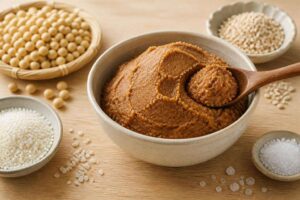
Miso qu’est ce que c’est : c’est une pâte fermentée traditionnelle japonaise, obtenue en faisant fermenter des graines de soja avec du sel et un champignon appelé koji, parfois additionné de riz ou d’orge, pendant plusieurs semaines à plusieurs années. Selon une revue publiée dans le Journal of Nutritional Science and Vitaminology () [1], le miso contient plus de 200 composés bioactifs issus de la fermentation. Voici ce que vous devez savoir en priorité :
- Le miso est une source concentrée de probiotiques naturels.
- Il existe plusieurs variétés : blanc, rouge, brun, d’orge ou de riz.
- Sa teneur en protéines complètes en fait un allié pour les régimes végétariens.
- Il est riche en vitamines du groupe B, en manganèse et en zinc.
- Sa consommation régulière est associée à une meilleure santé digestive et cardiovasculaire.
Miso qu’est ce que c’est : définition précise et origine historique
Miso qu’est ce que c’est dans son sens le plus précis ? C’est un condiment fermenté solide, de consistance proche du beurre de cacahuète, fabriqué au Japon depuis la période Nara (710-794 ap. J.-C.). Le mot « miso » signifie littéralement « source de saveur » en japonais. Cette pâte est née de l’adaptation japonaise du jiang chinois, introduit sur l’archipel vers le VIIe siècle.
Pendant des siècles, le miso a été réservé à la noblesse et aux moines bouddhistes. Il est devenu un aliment populaire à partir de la période Kamakura. Aujourd’hui, le Japon produit environ 500 000 tonnes de miso par an, et chaque région possède sa propre variété traditionnelle.
La fabrication repose sur une double fermentation : d’abord celle du koji (Aspergillus oryzae sur le riz ou l’orge), puis la fermentation longue du mélange soja-sel-koji. Ce processus génère des acides aminés libres, des enzymes digestives et des composés antioxydants uniques.
Quels sont les ingrédients du miso ?
Comprendre miso qu’est ce que c’est passe par l’analyse de sa composition. Les ingrédients de base sont toujours les mêmes, mais leurs proportions varient selon le type de miso.
- Soja : ingrédient principal, source de protéines et d’isoflavones.
- Sel marin : agent de conservation et régulateur de fermentation.
- Koji (Aspergillus oryzae) : champignon qui produit les enzymes de fermentation.
- Riz : présent dans le miso blanc (shiro) et certains misos rouges.
- Orge : utilisé dans le miso d’orge (mugi miso), plus rustique.
- Eau : pour ajuster la consistance de la pâte.
Certains misos artisanaux intègrent d’autres céréales comme le millet ou le sarrasin. Les misos industriels peuvent contenir des exhausteurs de goût ou du glutamate, à vérifier sur l’étiquette. Pour en savoir plus sur la composition détaillée, consultez notre article sur les ingrédients du miso.
Les 5 grands types de miso : comment les distinguer ?
Miso qu’est ce que c’est en termes de variétés ? Il en existe plusieurs dizaines au Japon, mais cinq grands types dominent les marchés internationaux. La couleur est le premier indicateur : plus le miso est foncé, plus sa fermentation a été longue et son goût prononcé.
| Type de miso | Couleur | Durée de fermentation | Saveur | Usage principal |
|---|---|---|---|---|
| Shiro miso (blanc) | Crème à jaune pâle | 1 à 3 mois | Douce, légèrement sucrée | Vinaigrettes, marinades légères |
| Shinshu miso (jaune) | Jaune doré | 3 à 6 mois | Équilibrée, polyvalente | Soupes, sauces |
| Aka miso (rouge) | Rouge brun | 6 mois à 3 ans | Intense, salée, umami | Bouillons riches, viandes |
| Mugi miso (orge) | Brun moyen | 1 à 3 ans | Terreuse, complexe | Ragoûts, plats mijotés |
| Hatcho miso | Brun très foncé | 2 à 3 ans minimum | Très intense, amère | Plats traditionnels japonais |
Le miso blanc est le plus accessible pour les débutants. Le miso rouge convient aux préparations hivernales. Notre guide sur le miso blanc détaille ses spécificités.
Valeurs nutritionnelles du miso : ce que contient une portion
Miso qu’est ce que c’est sur le plan nutritionnel ? C’est un aliment dense, à consommer en petites quantités. Une portion standard de 17 g (une cuillère à soupe) apporte des nutriments significatifs malgré son faible volume.
- Calories : 33 kcal pour 17 g
- Protéines : 2,2 g — acides aminés essentiels complets
- Glucides : 4,3 g dont 0,5 g de fibres
- Lipides : 1 g — majoritairement insaturés
- Sodium : 634 mg — point de vigilance pour les personnes hypertendues
- Manganèse : 10 % des AJR
- Vitamine K : 10 % des AJR
- Cuivre : 6 % des AJR
- Zinc : 5 % des AJR
Le miso contient également des isoflavones de soja (génistéine, daidzéine) et de la vitamine B12 en petites quantités, ce qui est rare pour un aliment végétal. Pour une analyse complète, notre article sur le miso comme aliment vous donnera tous les détails.
7 bienfaits du miso validés par la science
Miso qu’est ce que c’est en termes de bénéfices santé ? Les études scientifiques récentes confirment plusieurs effets positifs documentés. Voici les plus solides.
1. Santé digestive et microbiote
Le miso non pasteurisé contient des bactéries lactiques vivantes, notamment des Lactobacillus et des Pediococcus. Une étude publiée dans le Journal of Applied Microbiology () [2] a identifié jusqu’à 10 millions d’UFC par gramme dans certains misos artisanaux. Ces probiotiques soutiennent la diversité du microbiote intestinal. Pour approfondir ce sujet, notre article sur la flore intestinale et les probiotiques est une lecture complémentaire utile.
2. Protection cardiovasculaire
Malgré sa teneur en sodium, plusieurs études japonaises suggèrent que le miso n’élève pas la pression artérielle comme le sel de table ordinaire. Une étude de cohorte publiée dans le British Journal of Nutrition () [3] portant sur 90 000 participants japonais a montré une association inverse entre consommation régulière de soupe miso et risque d’AVC. Les isoflavones du soja contribuent également à réduire le LDL-cholestérol.
3. Richesse en antioxydants
La fermentation longue génère des composés antioxydants spécifiques absents du soja cru. Le miso hatcho, fermenté trois ans, présente la plus haute activité antioxydante mesurée. Ces composés protègent les cellules contre le stress oxydatif.
4. Apport en protéines végétales complètes
Le miso contient les 9 acides aminés essentiels, ce qui est rare pour une protéine végétale. La fermentation améliore la biodisponibilité de ces protéines en pré-digérant partiellement les molécules de soja. C’est un atout majeur pour les régimes végétariens et végétaliens.
5. Soutien immunitaire
Les bactéries lactiques du miso stimulent la production d’IgA sécrétoires dans l’intestin. Selon l’ANSES () [4], les aliments fermentés contribuent à l’entretien d’une réponse immunitaire équilibrée via l’axe intestin-immunité.
6. Santé osseuse
Le miso est une source de vitamine K2, essentielle à la fixation du calcium sur les os. Les isoflavones de soja ont également montré des effets bénéfiques sur la densité osseuse dans plusieurs études post-ménopause. Une méta-analyse publiée dans le European Journal of Clinical Nutrition () [5] confirme cet effet protecteur.
7. Effets potentiels sur la longévité
Les populations de la région d’Okinawa, grandes consommatrices de miso, présentent une espérance de vie parmi les plus élevées au monde. Des chercheurs de l’NCI américain ont observé une association entre consommation régulière de miso et réduction du risque de certains cancers gastro-intestinaux dans les populations asiatiques. Ces données restent associatives et ne permettent pas de conclure à un lien de causalité direct.
Comment utiliser le miso en cuisine ?
Miso qu’est ce que c’est en pratique culinaire ? C’est avant tout un exhausteur de goût umami exceptionnel. Voici ses principales applications :
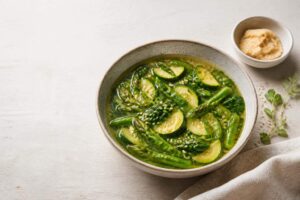
- Soupe miso : dissoudre 1 cuillère à soupe dans un bouillon chaud (ne pas faire bouillir pour préserver les probiotiques).
- Marinade : mélanger miso, mirin et saké pour mariner poissons, tofu ou viandes.
- Vinaigrette : combiner miso blanc, vinaigre de riz, huile de sésame et gingembre.
- Sauce ramen : base umami pour bouillons de nouilles japonaises.
- Beurre de miso : mélanger miso et beurre pour napper légumes rôtis ou viandes grillées.
- Dip et houmous : ajouter une cuillère à café dans les préparations à base de légumineuses.
- Pâtisserie : le miso blanc s’intègre dans les caramels et les biscuits pour une note salée-sucrée.
La règle d’or : ne jamais faire bouillir le miso. La chaleur excessive détruit les enzymes et les bactéries vivantes. Ajoutez-le toujours en fin de cuisson, hors du feu ou dans un liquide à moins de 70°C. Pour aller plus loin, notre article sur le miso japonais propose des recettes détaillées.
Miso fermenté : comprendre le processus de fabrication
Miso qu’est ce que c’est du point de vue de la fermentation ? C’est l’un des aliments fermentés les plus complexes au monde. Le processus se déroule en plusieurs étapes précises.
- Préparation du koji : des spores d’Aspergillus oryzae sont inoculées sur du riz cuit ou de l’orge, puis incubées 40 à 50 heures à 30°C.
- Cuisson du soja : les graines de soja sont trempées 12 à 24 heures, puis cuites à la vapeur jusqu’à tendreté.
- Mélange : le soja cuit, le koji et le sel sont mélangés en proportions précises selon la recette.
- Fermentation : la pâte est tassée dans des cuves en bois ou en céramique, recouverte d’un poids, et laissée à fermenter de 1 mois à 3 ans selon le type voulu.
- Affinage : le miso est retourné régulièrement pour homogénéiser la fermentation. La couleur s’assombrit progressivement par réaction de Maillard.
La durée de fermentation est le principal facteur déterminant la couleur, la saveur et le profil nutritionnel. Un miso fermenté 3 ans contient davantage d’acides aminés libres et d’antioxydants qu’un miso fermenté 1 mois. Pour comprendre ce processus en profondeur, notre article sur le miso fermenté détaille chaque étape.
Miso et sodium : faut-il s’inquiéter ?
Miso qu’est ce que c’est en termes de teneur en sel ? C’est effectivement un aliment salé : une cuillère à soupe contient environ 630 mg de sodium, soit 27 % des apports journaliers recommandés par l’OMS. Cela peut sembler élevé, mais plusieurs facteurs nuancent ce constat.
- Les portions utilisées en cuisine sont généralement petites (5 à 17 g).
- Le miso est dilué dans de grandes quantités de liquide dans la soupe miso traditionnelle.
- Des études japonaises suggèrent que le sodium du miso est métabolisé différemment du sel de table ordinaire.
- Les personnes souffrant d’hypertension artérielle, d’insuffisance rénale ou suivant un régime hyposodé doivent consulter leur médecin avant d’en consommer régulièrement.
De nombreux lecteurs nous signalent que réduire d’autres sources de sel dans leur alimentation leur permet d’intégrer le miso sans dépasser leurs apports recommandés. L’EFSA recommande de ne pas dépasser 2 000 mg de sodium par jour pour la population générale.
Miso et allergies : précautions à connaître
Miso qu’est ce que c’est pour les personnes allergiques ? C’est un aliment contenant plusieurs allergènes majeurs à identifier avant consommation.
- Soja : allergène majeur classé parmi les 14 allergènes réglementés par l’EFSA. Les personnes allergiques au soja doivent éviter tout miso à base de soja.
- Gluten : le miso de riz ou d’orge peut contenir du gluten. Vérifiez l’étiquette si vous êtes cœliaque.
- Histamine : le miso est un aliment fermenté riche en histamine. Les personnes souffrant d’intolérance à l’histamine peuvent présenter des réactions.
- Tyramine : présente en quantité notable dans les misos longtemps fermentés, à surveiller en cas de prise d’IMAO.
En cas de doute, consultez votre médecin ou un allergologue avant d’introduire le miso dans votre alimentation.
Miso vs autres aliments fermentés : quelle différence ?
Miso qu’est ce que c’est par rapport aux autres fermentés ? Le miso se distingue par sa concentration et sa complexité. Voici une comparaison rapide :
- Miso vs kimchi : le kimchi est un légume lactofermenté coréen, plus riche en fibres et en vitamine C, mais moins concentré en protéines. Les deux sont d’excellentes sources de probiotiques.
- Miso vs kéfir : le kéfir est une boisson fermentée lactée, plus riche en probiotiques par portion mais sans les isoflavones du soja.
- Miso vs kombucha : le kombucha est une boisson fermentée sucrée, moins nutritive que le miso mais plus facile à consommer quotidiennement.
- Miso vs tempeh : le tempeh est également à base de soja fermenté mais sous forme solide, avec une teneur en protéines encore plus élevée (19 g/100 g).
Chaque aliment fermenté a son profil unique. Les intégrer en rotation dans votre alimentation maximise la diversité de votre microbiote intestinal.
Comment choisir et conserver son miso ?
Miso qu’est ce que c’est en termes de qualité ? Tous les misos ne se valent pas. Voici comment choisir le meilleur.
- Privilégiez le miso non pasteurisé : la pasteurisation détruit les bactéries vivantes. Cherchez la mention « non pasteurisé » ou « vivant ».
- Lisez la liste des ingrédients : elle doit être courte — soja, sel, koji, éventuellement riz ou orge. Évitez les additifs et exhausteurs de goût.
- Choisissez le bio : le soja conventionnel est souvent issu de cultures OGM. Le label bio garantit l’absence d’OGM et de pesticides de synthèse.
- Vérifiez la durée de fermentation : mentionnée sur les emballages artisanaux, elle garantit la richesse aromatique et nutritionnelle.
Conservation : le miso se conserve au réfrigérateur après ouverture, dans un contenant hermétique. Sa durée de vie est de 12 à 18 mois pour un miso non pasteurisé, et jusqu’à 3 ans pour un miso pasteurisé. Un film blanc en surface est normal — c’est une levure inoffensive. Retirez-la simplement avant utilisation.
Miso qu’est ce que c’est pour les végétariens et végétaliens ?
Miso qu’est ce que c’est pour les personnes suivant un régime plant-based ? C’est un allié précieux. Il apporte des protéines complètes, de la vitamine B12 (en petites quantités), du zinc et du fer — des nutriments souvent déficitaires dans les régimes végétaux. La pâte de miso remplace avantageusement les bouillons de viande pour apporter de la profondeur umami aux plats végétariens. Notre article complet sur la pâte de miso détaille toutes ses applications culinaires végétales.
Ce qu’il faut retenir sur miso qu’est ce que c’est
Miso qu’est ce que c’est en résumé ? C’est une pâte fermentée japonaise millénaire, à la fois condiment, source de protéines complètes et aliment probiotique. Sa richesse en composés bioactifs issus de la fermentation en fait un aliment fonctionnel à part entière, soutenu par une littérature scientifique croissante. Intégrez une à deux cuillères à soupe de miso non pasteurisé dans votre alimentation quotidienne — en soupe, en marinade ou en vinaigrette — pour bénéficier de ses apports nutritionnels sans dépasser vos besoins en sodium.
- Miso qu’est ce que c’est : une pâte fermentée japonaise à base de soja, sel et koji, riche en probiotiques et en protéines complètes.
- Miso qu’est ce que c’est nutritionnellement : une cuillère à soupe apporte 2,2 g de protéines, 10 % des AJR en manganèse et des bactéries lactiques vivantes.
- Miso qu’est ce que c’est en cuisine : un exhausteur de goût umami à ne jamais faire bouillir pour préserver ses enzymes et ses probiotiques.
- Miso qu’est ce que c’est pour la santé : un aliment associé à une meilleure santé digestive, cardiovasculaire et osseuse selon plusieurs études publiées.
- Miso qu’est ce que c’est en termes de précautions : un aliment salé, allergène potentiel (soja, gluten), à consommer avec modération en cas d’hypertension.
Questions fréquentes sur miso qu’est ce que c’est
Miso qu’est ce que c’est exactement ?
Miso qu’est ce que c’est dans sa définition la plus simple : une pâte fermentée japonaise fabriquée à partir de soja, de sel et d’un champignon appelé koji (Aspergillus oryzae). La fermentation dure de quelques semaines à plusieurs années selon le type désiré.
Le miso est-il bon pour la santé ?
Oui, selon plusieurs études scientifiques. Le miso apporte des probiotiques, des protéines complètes, des antioxydants et des vitamines du groupe B. Sa consommation régulière est associée à une meilleure santé digestive et cardiovasculaire dans les populations japonaises étudiées.
Miso qu’est ce que c’est en termes de goût ?
Le miso a une saveur umami profonde, salée et légèrement sucrée pour les variétés blanches, ou intense et presque amère pour les variétés rouges et hatcho. La fermentation développe des notes complexes que l’on ne retrouve dans aucun autre condiment occidental.
Quelle différence entre miso blanc et miso rouge ?
Le miso blanc (shiro) est fermenté 1 à 3 mois, plus doux et légèrement sucré. Le miso rouge (aka) est fermenté 6 mois à 3 ans, plus salé, plus intense et plus riche en acides aminés libres. Le miso rouge contient généralement plus d’antioxydants.
Peut-on manger du miso tous les jours ?
Oui, à condition de surveiller votre apport total en sodium. Une à deux cuillères à soupe par jour est la quantité habituellement consommée au Japon. Les personnes hypertendues ou souffrant d’insuffisance rénale doivent consulter leur médecin avant une consommation quotidienne.
Le miso contient-il du gluten ?
Cela dépend du type. Le miso d’orge (mugi miso) contient du gluten. Le miso de riz pur est généralement sans gluten, mais des contaminations croisées sont possibles en production. Vérifiez toujours l’étiquette si vous êtes cœliaque ou intolérant au gluten.
Miso qu’est ce que c’est pour les végétaliens ?
Miso qu’est ce que c’est pour les végétaliens : un condiment 100% végétal apportant des protéines complètes, de la vitamine B12 en petites quantités et un goût umami qui remplace avantageusement les bouillons de viande dans les recettes végétales.
Comment utiliser le miso sans le cuire ?
Dissolvez le miso dans un liquide tiède (moins de 70°C) en fin de cuisson. Vous pouvez aussi l’utiliser cru dans des vinaigrettes, des dips ou des marinades froides. Cette méthode préserve les enzymes et les bactéries vivantes responsables des bienfaits probiotiques.
Le miso est-il riche en protéines ?
Relativement oui pour un condiment. Une cuillère à soupe (17 g) apporte 2,2 g de protéines complètes. Pour 100 g, le miso contient environ 12 à 13 g de protéines, avec les 9 acides aminés essentiels, ce qui est exceptionnel pour un aliment végétal.
Miso qu’est ce que c’est par rapport au soja ordinaire ?
Le miso est du soja transformé par fermentation. Cette transformation augmente la biodisponibilité des protéines, réduit les facteurs antinutritionnels du soja cru (comme l’acide phytique), génère des probiotiques et crée des centaines de composés bioactifs absents du soja non fermenté.
Où acheter du miso de qualité ?
Le miso de qualité se trouve en magasins biologiques, en épiceries asiatiques spécialisées et sur des boutiques en ligne spécialisées. Privilégiez les misos non pasteurisés, bio, avec une liste d’ingrédients courte. Les grandes surfaces proposent souvent des misos pasteurisés moins riches en probiotiques.
Miso qu’est ce que c’est par rapport au kimchi ?
Miso qu’est ce que c’est comparé au kimchi : le miso est une pâte fermentée japonaise à base de soja, tandis que le kimchi est un légume lactofermenté coréen à base de chou. Les deux sont d’excellentes sources de probiotiques, mais le miso est plus concentré en protéines et le kimchi plus riche en fibres et en vitamine C.
Ce qu’il faut retenir
Miso qu’est ce que c’est en définitive ? C’est l’un des aliments fermentés les plus complets et les plus étudiés au monde, alliant tradition millénaire et validation scientifique moderne. Miso qu’est ce que c’est pour votre santé au quotidien : un condiment umami qui enrichit vos plats tout en apportant probiotiques, protéines complètes et antioxydants en une seule cuillère à soupe. Commencez par une soupe miso maison avec du miso blanc non pasteurisé — c’est la façon la plus simple et la plus efficace d’intégrer cet aliment exceptionnel dans votre routine alimentaire.
Sources et études
- Bioactive compounds and health benefits of miso, a traditional Japanese fermented food — Journal of Nutritional Science and Vitaminology,
- Lactic acid bacteria diversity in traditional Japanese miso — Journal of Applied Microbiology,
- Miso soup consumption and stroke risk in a large Japanese cohort study — British Journal of Nutrition,
- Les aliments fermentés et leur rôle dans l’alimentation — ANSES,
- Soy isoflavones and bone mineral density: a meta-analysis of randomized controlled trials — European Journal of Clinical Nutrition,
Cet article est fourni à titre informatif uniquement et ne constitue pas un avis médical. Consultez un professionnel de santé qualifié avant toute utilisation.