Pâte de miso c’est quoi ? Définition, types et bienfaits
⚠️ Avis médical : Les informations contenues dans cet article sont fournies à titre informatif uniquement et ne remplacent pas l’avis d’un professionnel de santé qualifié. Consultez votre médecin ou diététicien avant de modifier votre alimentation de façon significative.
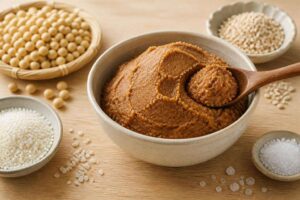
Pate de miso c’est quoi : c’est une pâte fermentée japonaise obtenue en faisant fermenter des graines de soja avec du sel et un champignon appelé kōji, parfois en y ajoutant du riz, de l’orge ou d’autres céréales. Une étude publiée dans le Journal of Nutritional Science and Vitaminology () [1] indique que le miso traditionnel contient entre 6 et 14 % de protéines complètes, selon le type et la durée de fermentation.
- Aliment fermenté : riche en probiotiques naturels bénéfiques pour le microbiote intestinal
- Source de protéines : apporte les 9 acides aminés essentiels grâce au soja
- Condiment polyvalent : utilisé en soupe, marinade, vinaigrette et sauce
- Profil nutritionnel dense : vitamines B, manganèse, cuivre, zinc et antioxydants
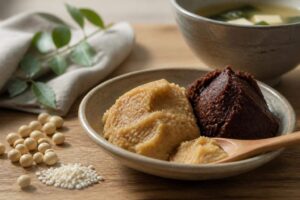
- Plusieurs variétés : miso blanc (shiro), rouge (aka), brun et mixte (awase)
Pate de miso c’est quoi : définition précise
La pate de miso c’est quoi au sens strict ? C’est un condiment traditionnel japonais issu d’une fermentation longue et contrôlée. Le soja, le sel et le kōji sont mélangés, puis laissés à fermenter de quelques semaines à plusieurs années. Cette fermentation produit une pâte dense, savoureuse et profondément umami.
Le terme japonais « miso » (味噌) se traduit littéralement par « source de saveur ». Selon l’ANSES () [2], les aliments fermentés comme le miso font partie des sources alimentaires de probiotiques les plus étudiées en Europe et en Asie.
La texture du miso ressemble à celle du beurre de cacahuète : épaisse, lisse ou légèrement granuleuse selon la variété. Sa couleur varie du beige crème au brun foncé presque noir.
Composition : quels ingrédients contient la pâte de miso ?
Comprendre pate de miso c’est quoi implique d’examiner ses ingrédients de base. La formule classique repose sur trois éléments fondamentaux.
- Graines de soja : base protéique principale, source d’isoflavones et d’acides aminés essentiels
- Sel marin : agent de conservation qui régule la fermentation et la sécurité microbiologique
- Kōji (Aspergillus oryzae) : champignon filamenteux qui produit les enzymes nécessaires à la dégradation des protéines et des glucides
- Riz ou orge : céréales optionnelles qui modifient le profil gustatif et la couleur finale
- Eau : ajustée pour obtenir la consistance souhaitée
La durée de fermentation varie de 3 semaines (miso blanc) à 3 ans (miso rouge vieilli). Cette durée influence directement la concentration en composés bioactifs. Pour en savoir plus sur les ingrédients exacts, consultez notre article sur les ingrédients du miso.
Une étude publiée dans Food Chemistry () [3] confirme que la fermentation prolongée augmente la concentration en peptides bioactifs, en acides aminés libres et en antioxydants phénoliques.
Les 5 principaux types de pâte de miso
Pate de miso c’est quoi en termes de variétés ? Il en existe des dizaines, mais cinq types dominent les marchés internationaux.
| Type de miso | Couleur | Durée fermentation | Saveur | Usage principal |
|---|---|---|---|---|
| Shiro (blanc) | Beige crème | 3 à 8 semaines | Douce, légèrement sucrée | Soupes légères, vinaigrettes |
| Shinshu (jaune) | Jaune pâle | 2 à 3 mois | Équilibrée, polyvalente | Usage quotidien universel |
| Aka (rouge) | Rouge-brun | 1 à 3 ans | Intense, salée, umami | Marinades, ragoûts, ramen |
| Awase (mixte) | Brun moyen | Variable | Complexe, équilibrée | Soupe miso classique |
| Mugi (orge) | Brun clair | 1 à 2 ans | Terreuse, rustique | Cuisine campagnarde japonaise |
Le miso blanc est le plus doux et le plus accessible pour les débutants. Le miso rouge, fermenté plus longtemps, développe une saveur plus complexe et une concentration plus élevée en composés bioactifs. Notre guide sur le miso blanc c’est quoi détaille les spécificités de cette variété populaire.
Comment se déroule la fermentation du miso ?
La fermentation est le cœur de ce que pate de miso c’est quoi en termes de processus. Elle se déroule en plusieurs étapes précises.
- Préparation du kōji : le riz ou l’orge est inoculé avec des spores d’Aspergillus oryzae pendant 40 à 50 heures
- Cuisson du soja : les graines sont trempées 12 à 24 heures puis cuites à la vapeur ou bouillies
- Mélange : le soja cuit, le kōji et le sel sont mélangés en proportions précises
- Mise en cuve : la pâte est tassée dans des cuves hermétiques pour chasser l’air
- Maturation : fermentation lente à température contrôlée, de quelques semaines à plusieurs années
- Pasteurisation (optionnelle) : certains misos industriels sont pasteurisés, ce qui inactive les probiotiques vivants
La fermentation non pasteurisée préserve les probiotiques vivants. Vérifiez toujours l’étiquette : un miso « vivant » ou « non pasteurisé » est préférable pour ses effets sur le microbiote. Pour approfondir le sujet, lisez notre article sur le miso fermenté et ses bienfaits.
Valeurs nutritionnelles de la pâte de miso
Pate de miso c’est quoi sur le plan nutritionnel ? C’est un aliment dense, à consommer en petites quantités. Voici les valeurs pour 100 g de miso blanc standard.
- Calories : 198 kcal
- Protéines : 11,7 g (dont tous les acides aminés essentiels)
- Glucides : 26,5 g
- Lipides : 6,0 g (dont acides gras insaturés)
- Fibres : 5,4 g
- Sodium : 3 600 à 4 700 mg (point d’attention majeur)
- Vitamine K : 29 µg (23 % des apports journaliers recommandés)
- Manganèse : 0,86 mg (37 % des AJR)
- Cuivre : 0,43 mg (48 % des AJR)
- Zinc : 2,56 mg (23 % des AJR)
La teneur en sodium est élevée. Une portion typique de soupe miso utilise 10 à 15 g de pâte, soit environ 400 à 700 mg de sodium. L’OMS recommande de ne pas dépasser 2 000 mg de sodium par jour [4].
De nombreux lecteurs nous signalent que la soupe miso quotidienne les aide à réduire leur consommation d’autres sources de sel, car la saveur umami intense satisfait rapidement le palais.
7 bienfaits prouvés de la pâte de miso pour la santé
Pate de miso c’est quoi pour votre santé ? La recherche scientifique identifie plusieurs effets bénéfiques documentés.
1. Santé digestive et microbiote
Le miso non pasteurisé contient des souches de Lactobacillus et d’autres bactéries bénéfiques. Ces probiotiques naturels soutiennent la diversité du microbiote intestinal. Notre article sur la relation entre miso et soja détaille ces effets.
2. Réduction du risque cardiovasculaire
Une étude de cohorte japonaise publiée dans le European Journal of Clinical Nutrition () [5] portant sur 40 000 participants a montré qu’une consommation régulière de soupe miso est associée à une réduction de 26 % du risque d’accident vasculaire cérébral, malgré la teneur en sel.
3. Propriétés antioxydantes
La fermentation prolongée génère des mélanines et des peptides antioxydants puissants. Ces composés neutralisent les radicaux libres et réduisent le stress oxydatif cellulaire.
4. Source de vitamine K2
Le miso contient de la ménaquinone (vitamine K2), essentielle à la santé osseuse et à la coagulation sanguine. Cette forme est mieux absorbée que la vitamine K1 présente dans les légumes verts.
5. Effets sur la glycémie
Les peptides issus de la fermentation du soja inhibent partiellement l’enzyme alpha-glucosidase, ralentissant l’absorption des sucres et stabilisant la glycémie postprandiale.
6. Soutien immunitaire
Les bêta-glucanes produits par le kōji stimulent les cellules NK et les macrophages, renforçant la réponse immunitaire innée.
7. Apport en isoflavones
Le miso de soja contient de la génistéine et de la daidzéine, des phytoestrogènes associés à une réduction des symptômes de la ménopause et à une protection osseuse.
Comment utiliser la pâte de miso en cuisine ?
Pate de miso c’est quoi en pratique culinaire ? C’est un exhausteur de goût universel. Voici les principales applications.
- Soupe miso : dissoudre 1 c. à soupe dans un bouillon chaud (ne jamais faire bouillir pour préserver les probiotiques)
- Marinades : mélanger avec du mirin, du saké et du gingembre pour mariner poissons, tofu ou viandes
- Vinaigrettes : combiner avec du vinaigre de riz, de l’huile de sésame et du miel
- Sauces : incorporer dans des sauces pour pâtes, nouilles soba ou ramen
- Beurre composé : mélanger avec du beurre doux pour napper des légumes rôtis ou du maïs
- Glaze : badigeonner sur des aubergines, du saumon ou du poulet avant la cuisson au four
- Tartinades : incorporer dans du houmous ou une purée d’avocat
La règle d’or : ne jamais faire bouillir le miso. Ajoutez-le toujours hors du feu ou en fin de cuisson pour préserver ses enzymes et ses probiotiques vivants. Pour des techniques détaillées, consultez notre guide sur comment utiliser la pâte miso en cuisine.
Comment choisir une bonne pâte de miso ?
Savoir pate de miso c’est quoi ne suffit pas : encore faut-il choisir le bon produit. Voici les critères essentiels.
- Non pasteurisé : préférez les mentions « vivant », « non pasteurisé » ou « unpasteurized » pour conserver les probiotiques
- Ingrédients simples : la liste doit contenir soja, sel, kōji, et éventuellement une céréale. Évitez les additifs et conservateurs
- Biologique : le soja biologique réduit l’exposition aux pesticides et garantit l’absence d’OGM
- Origine japonaise ou coréenne : les producteurs traditionnels respectent des méthodes de fermentation éprouvées
- Teneur en sodium : comparez les étiquettes si vous surveillez votre apport en sel
Le miso blanc convient aux débutants pour sa douceur. Le miso rouge s’adresse aux amateurs de saveurs intenses. Le miso awase, mélange des deux, est le plus polyvalent au quotidien.
Conservation de la pâte de miso
Pate de miso c’est quoi en termes de conservation ? C’est un aliment naturellement stable grâce à sa forte teneur en sel.
- Avant ouverture : conservez au frais ou à température ambiante selon le type (vérifiez l’étiquette)
- Après ouverture : réfrigérez toujours dans un contenant hermétique
- Durée : 3 à 6 mois après ouverture pour le miso blanc, jusqu’à 1 an pour le miso rouge
- Congélation : possible pour les grandes quantités, sans altérer la saveur ni les propriétés
- Signe de détérioration : moisissures visibles ou odeur aigre prononcée (rare grâce au sel)
Une légère couche blanche en surface est normale : c’est du kōji actif, pas une moisissure. Retirez-la simplement avant utilisation.
Précautions et contre-indications
Comprendre pate de miso c’est quoi implique aussi de connaître ses limites. Certaines personnes doivent l’utiliser avec prudence.
- Hypertension artérielle : la teneur élevée en sodium nécessite une consommation modérée et un suivi médical
- Allergie au soja : le miso contient du soja et doit être évité en cas d’allergie confirmée
- Allergie au gluten : les misos à base d’orge ou de blé contiennent du gluten ; choisissez un miso de riz certifié sans gluten
- Traitement anticoagulant : la vitamine K peut interférer avec les anticoagulants de type warfarine
- Troubles thyroïdiens : les isoflavones de soja peuvent interagir avec la thyroïde en cas de consommation très élevée
- Grossesse et allaitement : une consommation modérée est généralement considérée comme sûre, mais consultez votre médecin
L’ANSES recommande une consommation variée et modérée des aliments à base de soja dans le cadre d’une alimentation équilibrée [2].
Miso vs autres condiments fermentés : comparaison
Pate de miso c’est quoi par rapport aux autres aliments fermentés populaires ? Voici une comparaison rapide.
- Miso vs tamari : le tamari est liquide, le miso est en pâte ; les deux viennent du soja fermenté mais ont des usages différents
- Miso vs sauce soja : la sauce soja est plus liquide et moins riche en probiotiques ; le miso est plus concentré en nutriments
- Miso vs kimchi : le kimchi est un légume fermenté coréen, plus riche en fibres et en vitamine C ; le miso est plus protéiné
- Miso vs tahini : le tahini est une pâte de sésame non fermentée ; le miso apporte des probiotiques que le tahini ne contient pas
Chaque condiment fermenté a ses forces propres. Le miso se distingue par sa richesse en protéines, en probiotiques et en composés umami uniques.
Intégrer la pâte de miso dans votre alimentation quotidienne
Pate de miso c’est quoi comme habitude alimentaire ? C’est un condiment facile à intégrer progressivement.
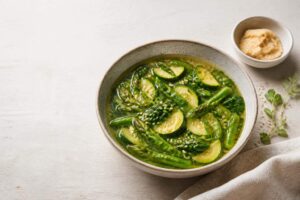
Commencez par une soupe miso simple le matin : faites chauffer un bouillon de légumes, retirez du feu, dissolvez une cuillère à café de miso blanc et ajoutez du tofu et des algues wakamé. Ce rituel matinal est pratiqué par des millions de Japonais depuis des siècles.
Incorporez ensuite le miso dans vos vinaigrettes, vos sauces pour pâtes et vos marinades. Une petite quantité suffit pour transformer un plat ordinaire en une expérience gustative complexe et satisfaisante. Notre article dédié au miso et à ses bienfaits vous guidera dans cette intégration.
Histoire et origine de la pâte de miso
Pate de miso c’est quoi dans l’histoire culinaire mondiale ? C’est l’un des condiments fermentés les plus anciens de l’humanité.
Le miso est apparu en Chine sous le nom de « jiang » il y a plus de 2 500 ans, avant d’être introduit au Japon vers le par des moines bouddhistes. Au Japon, il est devenu un aliment de base national, consommé quotidiennement par plus de 75 % de la population selon les données du ministère de l’Agriculture japonais.
Chaque région du Japon a développé ses propres variétés. Le miso de Kyoto est doux et blanc, celui de Nagoya est rouge et intense, celui du Hokkaido est riche et crémeux. Cette diversité régionale témoigne de l’importance culturelle profonde de cet aliment.
- Pate de miso c’est quoi en résumé : une pâte fermentée japonaise à base de soja, sel et kōji, riche en probiotiques, protéines et antioxydants
- Pate de miso c’est quoi en termes de variétés : blanc (doux), rouge (intense), awase (mixte), mugi (orge) et shinshu (jaune polyvalent)
- Pate de miso c’est quoi pour la santé : un aliment associé à une meilleure santé digestive, cardiovasculaire et immunitaire selon des études cliniques
- Pate de miso c’est quoi comme précaution : un condiment riche en sodium à consommer avec modération, surtout en cas d’hypertension
- Pate de miso c’est quoi comme conseil pratique : choisissez un miso non pasteurisé biologique et ne le faites jamais bouillir pour préserver ses probiotiques
Questions fréquentes sur pate de miso c’est quoi
Pate de miso c’est quoi exactement ?
Pate de miso c’est quoi en définition simple : c’est une pâte fermentée japonaise obtenue à partir de soja, de sel et du champignon kōji (Aspergillus oryzae). La fermentation dure de quelques semaines à plusieurs années selon le type désiré.
La pâte de miso est-elle bonne pour la santé ?
Oui, selon plusieurs études cliniques. Le miso non pasteurisé apporte des probiotiques, des protéines complètes, des antioxydants et des vitamines B. Une consommation régulière est associée à une meilleure santé digestive et cardiovasculaire, malgré sa teneur en sodium.
Pate de miso c’est quoi comme goût ?
Le miso a une saveur profondément umami, salée et complexe. Le miso blanc est doux et légèrement sucré. Le miso rouge est intense, salé et presque terreux. L’umami est la cinquième saveur fondamentale, qui amplifie les autres saveurs d’un plat.
Peut-on manger du miso tous les jours ?
Oui, en quantités modérées. Une à deux portions de 10 à 15 g par jour sont généralement bien tolérées. Surveillez votre apport total en sodium si vous souffrez d’hypertension. Les populations japonaises consomment du miso quotidiennement depuis des siècles sans effets négatifs documentés à ces doses.
Pate de miso c’est quoi comme différence avec la sauce soja ?
La sauce soja est un liquide fermenté, plus fluide et moins concentré en protéines. La pâte de miso est solide, plus riche en probiotiques vivants et en nutriments. Les deux viennent du soja fermenté mais ont des textures, des saveurs et des usages culinaires distincts.
Le miso contient-il du gluten ?
Cela dépend du type. Le miso de riz (kome miso) est naturellement sans gluten. Le miso d’orge (mugi miso) contient du gluten. Vérifiez toujours l’étiquette et cherchez une certification « sans gluten » si vous êtes cœliaque ou sensible au gluten.
Comment conserver la pâte de miso après ouverture ?
Conservez-la au réfrigérateur dans un contenant hermétique. Le miso blanc se conserve 3 à 6 mois, le miso rouge jusqu’à 1 an. La congélation est possible sans altérer les propriétés. Une légère croûte blanche en surface est normale et inoffensive.
Le miso est-il végétalien ?
La pâte de miso elle-même est toujours végétalienne : elle ne contient que des végétaux, du sel et du champignon kōji. Attention cependant : la soupe miso traditionnelle est souvent préparée avec du dashi, un bouillon à base de bonite séchée. Utilisez un dashi de kombu pour une version 100 % végétalienne.
Peut-on faire bouillir le miso ?
Non, il ne faut pas faire bouillir le miso. La chaleur excessive (au-dessus de 70 °C) détruit les probiotiques vivants et les enzymes actives. Ajoutez toujours le miso hors du feu, en fin de préparation, après avoir retiré la casserole de la source de chaleur.
Pate de miso c’est quoi comme alternative pour les personnes allergiques au soja ?
Il existe des misos sans soja à base de pois chiches, de lentilles ou d’autres légumineuses. Ces alternatives sont moins courantes mais disponibles dans les épiceries bio spécialisées. Elles offrent un profil nutritionnel similaire avec des protéines végétales différentes.
Le miso aide-t-il à perdre du poids ?
Le miso n’est pas un brûleur de graisses, mais il peut soutenir une gestion du poids saine. Sa richesse en protéines favorise la satiété, ses probiotiques soutiennent un microbiote équilibré associé à un poids stable, et sa saveur umami intense permet de réduire les quantités utilisées.
Où acheter de la pâte de miso en France ?
Vous trouverez du miso dans les épiceries asiatiques, les magasins bio (Naturalia, Biocoop), les grandes surfaces au rayon produits du monde, et en ligne. Privilégiez les marques japonaises traditionnelles comme Hikari, Marukome ou Miso & Easy pour un produit authentique et non pasteurisé.
Ce qu’il faut retenir
Pate de miso c’est quoi en conclusion : c’est bien plus qu’un simple condiment. C’est un aliment fermenté millénaire, dense en nutriments, riche en probiotiques et en saveur umami, qui mérite une place régulière dans votre cuisine. Pate de miso c’est quoi comme action concrète à adopter dès aujourd’hui ? Commencez par une soupe miso simple chaque matin : dissolvez une cuillère à café de miso blanc non pasteurisé dans un bouillon chaud retiré du feu, ajoutez du tofu et des algues, et observez les effets sur votre digestion et votre énergie en quelques semaines.
Sources et études
- Protein content and amino acid profile of fermented soybean paste (miso) — Journal of Nutritional Science and Vitaminology,
- Les aliments fermentés et les probiotiques : état des connaissances — ANSES,
- Bioactive peptides and antioxidant activity in fermented soybean products — Food Chemistry,
- Salt reduction fact sheet — OMS / WHO,
- Miso soup consumption and stroke risk in a Japanese cohort study — European Journal of Clinical Nutrition,
Cet article est fourni à titre informatif uniquement et ne constitue pas un avis médical. Consultez un professionnel de santé qualifié avant toute utilisation.