A quoi sert le psyllium : 7 usages médicalement validés
⚕️ Avis médical : Les informations de cet article sont fournies à titre éducatif uniquement. Elles ne remplacent pas l’avis d’un médecin ou d’un professionnel de santé qualifié. Consultez votre médecin avant de modifier votre alimentation ou d’ajouter un complément alimentaire.
a quoi sert le psyllium : cette fibre soluble issue des enveloppes de graines de Plantago ovata sert principalement à réguler le transit intestinal, réduire le cholestérol LDL, stabiliser la glycémie et nourrir le microbiote. Les études cliniques confirment son efficacité pour au moins 7 fonctions physiologiques majeures.
Selon une méta-analyse publiée sur PubMed, une supplémentation quotidienne de 10 à 15 g de psyllium réduit le cholestérol LDL de 5 à 10 % en 6 semaines. Ce résultat place le psyllium parmi les fibres les mieux documentées en nutrition clinique.
- Régule la constipation et la diarrhée
- Réduit le cholestérol LDL
- Stabilise la glycémie après les repas
- Favorise la satiété et le contrôle du poids
- Nourrit les bactéries bénéfiques du microbiote
1. a quoi sert le psyllium pour le transit intestinal ?
Le psyllium absorbe jusqu’à 40 fois son poids en eau. Il forme un gel visqueux qui lubrifie les selles et facilite leur progression dans le côlon.
En cas de constipation, ce gel augmente le volume des selles et stimule le péristaltisme. En cas de diarrhée, il absorbe l’excès d’eau et normalise la consistance des selles.
C’est cette double action qui distingue le psyllium des laxatifs classiques. Il régule sans irriter la muqueuse intestinale. Pour mieux comprendre les fibres de psyllium et leur rôle, consultez notre guide dédié.
- Constipation : augmente le volume des selles en 12 à 72 heures
- Diarrhée : normalise la consistance en absorbant l’excès d’eau
- Syndrome de l’intestin irritable : réduit la douleur abdominale
- Transit lent : stimule les contractions du côlon naturellement
2. a quoi sert le psyllium pour le cholestérol ?
Le gel formé par le psyllium piège les acides biliaires dans l’intestin grêle. Ces acides, fabriqués à partir du cholestérol, sont alors éliminés dans les selles plutôt que réabsorbés.
Le foie doit alors puiser dans ses réserves de cholestérol pour fabriquer de nouveaux acides biliaires. Ce mécanisme réduit directement le taux de LDL circulant dans le sang.
La European Food Safety Authority (EFSA) a validé cette allégation de santé : 10 g de psyllium par jour contribuent au maintien d’un taux de cholestérol normal.
3. a quoi sert le psyllium pour la glycémie ?
Le gel visqueux du psyllium ralentit la vidange gastrique. Les glucides des repas sont absorbés plus lentement dans le sang.
Ce ralentissement réduit le pic glycémique post-prandial. Une étude de l’Université de Harvard montre une réduction de 20 % du pic de glycémie après un repas riche en glucides.
Cet effet intéresse particulièrement les personnes atteintes de diabète de type 2 ou de prédiabète. L’ANSES reconnaît l’intérêt des fibres solubles dans la gestion de la glycémie post-prandiale.
- Réduit le pic glycémique de 15 à 20 % après les repas
- Améliore la sensibilité à l’insuline à long terme
- Compatible avec un régime diabétique sous supervision médicale
- Effet dose-dépendant : plus efficace à 10-15 g par jour
4. a quoi sert le psyllium pour le microbiote intestinal ?
Le psyllium agit comme un prébiotique. Les bactéries bénéfiques du côlon fermentent partiellement ses fibres pour produire des acides gras à chaîne courte (AGCC).
Ces AGCC, notamment le butyrate, nourrissent les cellules de la paroi intestinale. Ils renforcent la barrière intestinale et réduisent l’inflammation locale.
Pour compléter l’action du psyllium sur le microbiote, la différence entre ispaghul et psyllium mérite d’être connue. Associer fibres prébiotiques et aliments fermentés optimise l’équilibre de la flore intestinale.
5. a quoi sert le psyllium pour la satiété et le poids ?
Le gel formé par le psyllium dans l’estomac ralentit sa vidange. Cette action prolonge la sensation de plénitude après les repas.
Des études montrent une réduction de 10 à 15 % de l’apport calorique spontané chez les personnes consommant du psyllium avant les repas. L’effet est maximal avec 5 g dans 250 ml d’eau, 30 minutes avant de manger.
Pour approfondir ce sujet, le psyllium fait-il maigrir répond précisément à cette question avec les données scientifiques disponibles.
- Prolonge la satiété de 1 à 2 heures après le repas
- Réduit l’appétit entre les repas
- Diminue l’apport calorique total sans effort conscient
- Efficace en complément d’une alimentation équilibrée
- Sans effet stimulant ni risque de dépendance
6. a quoi sert le psyllium pour la santé cardiovasculaire ?
Au-delà du cholestérol, le psyllium contribue à la santé du cœur par plusieurs mécanismes combinés. La réduction du LDL, la stabilisation de la glycémie et la diminution de l’inflammation intestinale agissent ensemble.
Une revue publiée dans le American Journal of Clinical Nutrition conclut que la consommation régulière de fibres solubles réduit le risque cardiovasculaire global de 7 à 12 %.
La Organisation Mondiale de la Santé recommande 25 à 30 g de fibres alimentaires par jour pour la prévention des maladies cardiovasculaires. Le psyllium peut contribuer significativement à cet apport.
| Effet du psyllium | Dose efficace | Délai observé | Niveau de preuve |
|---|---|---|---|
| Régulation du transit | 5-10 g/jour | 12-72 heures | Élevé (EFSA validé) |
| Réduction cholestérol LDL | 10-15 g/jour | 4-6 semaines | Élevé (EFSA validé) |
| Stabilisation glycémie | 10 g/repas | Immédiat (repas) | Modéré à élevé |
| Satiété et contrôle poids | 5 g avant repas | 30 minutes | Modéré |
| Soutien microbiote | 5-15 g/jour | 2-4 semaines | Modéré |
| Santé cardiovasculaire | 10-15 g/jour | 6-12 semaines | Modéré à élevé |
| Réduction inflammation intestinale | 10 g/jour | 4-8 semaines | Modéré |
7. a quoi sert le psyllium pour l’inflammation intestinale ?
Le butyrate produit lors de la fermentation partielle du psyllium réduit l’expression des cytokines pro-inflammatoires dans la muqueuse intestinale. Cet effet protège la paroi du côlon.
Des études préliminaires montrent un intérêt dans la colite ulcéreuse légère à modérée. Le psyllium est parfois utilisé en complément des traitements médicaux conventionnels.
Pour aller plus loin sur les bienfaits détaillés, les bienfaits du psyllium couvre l’ensemble des propriétés documentées de cette fibre remarquable.
Comment prendre le psyllium efficacement ?
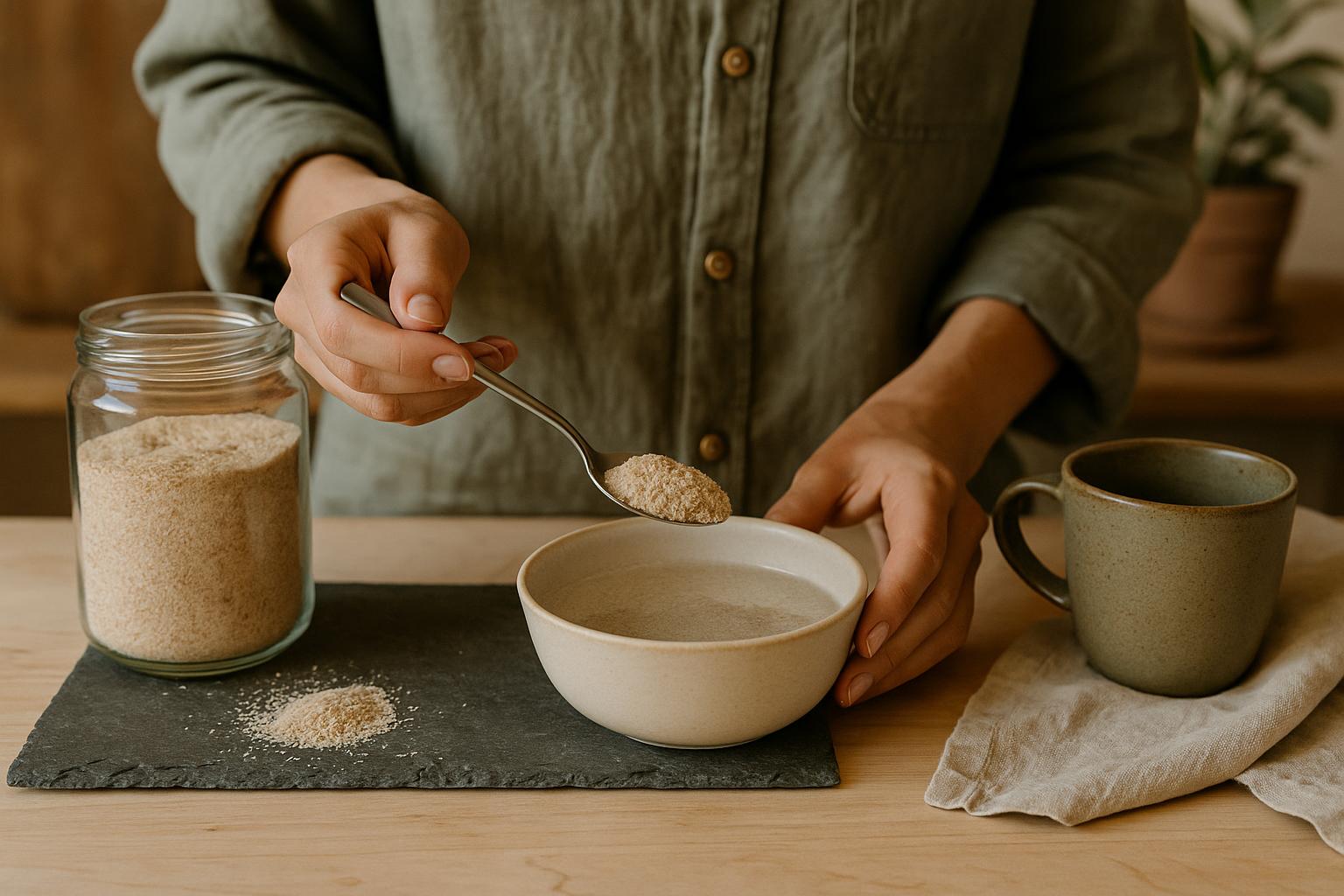
La forme et le moment de prise influencent directement l’efficacité du psyllium. La règle absolue : toujours diluer dans un grand verre d’eau (250-300 ml minimum).
Commencez par 5 g par jour pendant une semaine. Augmentez progressivement jusqu’à 10-15 g selon votre tolérance digestive. Boire suffisamment d’eau tout au long de la journée est indispensable.
- Transit : 5-10 g dans 250 ml d’eau, matin ou soir
- Cholestérol : 10-15 g répartis en 2-3 prises avec les repas
- Glycémie : 5-10 g dans 250 ml d’eau, 10-15 minutes avant le repas
- Satiété : 5 g dans 250 ml d’eau, 30 minutes avant le repas
- Microbiote : 5-10 g par jour en cure de 4 semaines minimum
Pour une prise optimale, comment prendre le psyllium pour la constipation détaille les protocoles selon les symptômes et les profils.
Psyllium blond vs psyllium brun : quelle différence ?
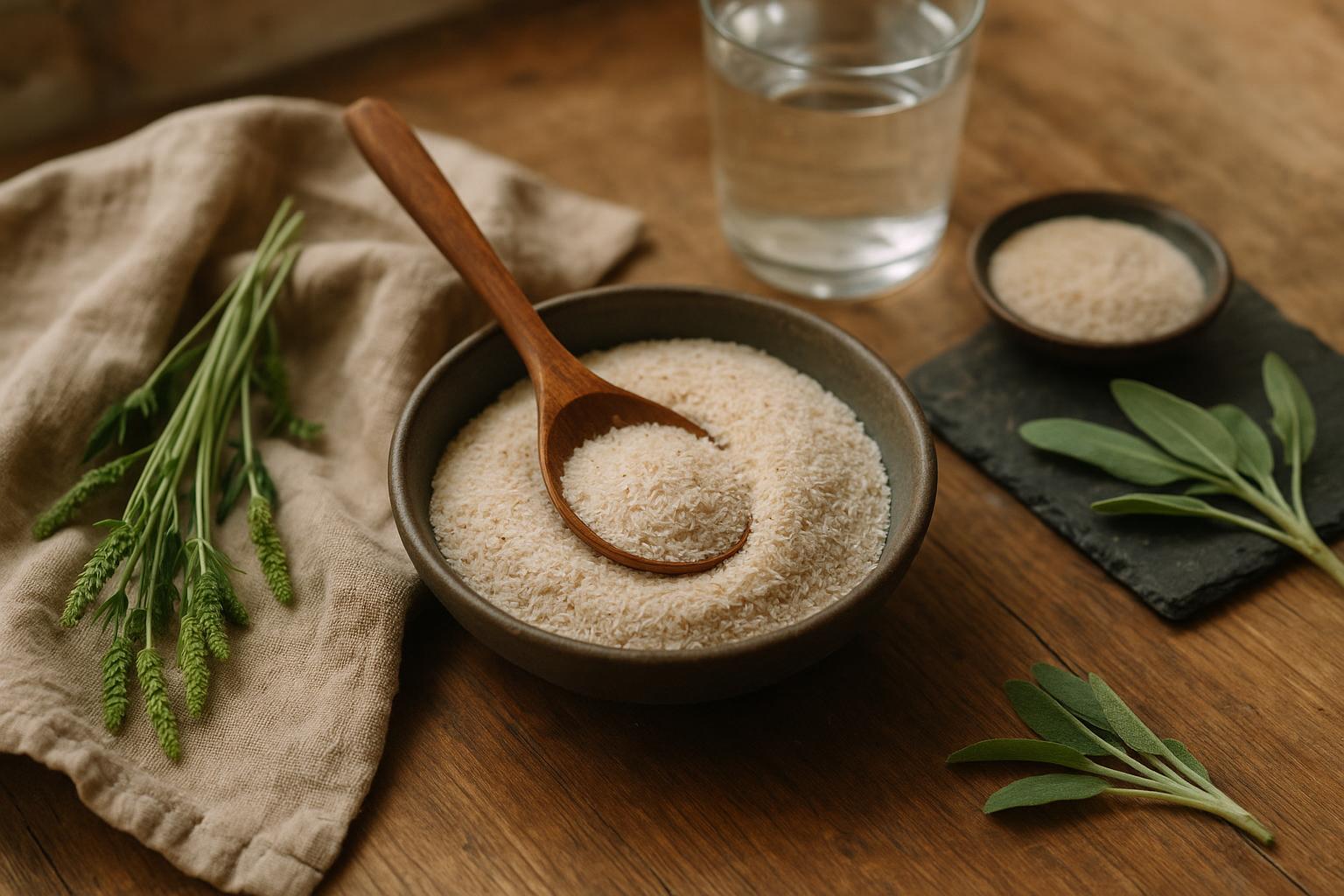
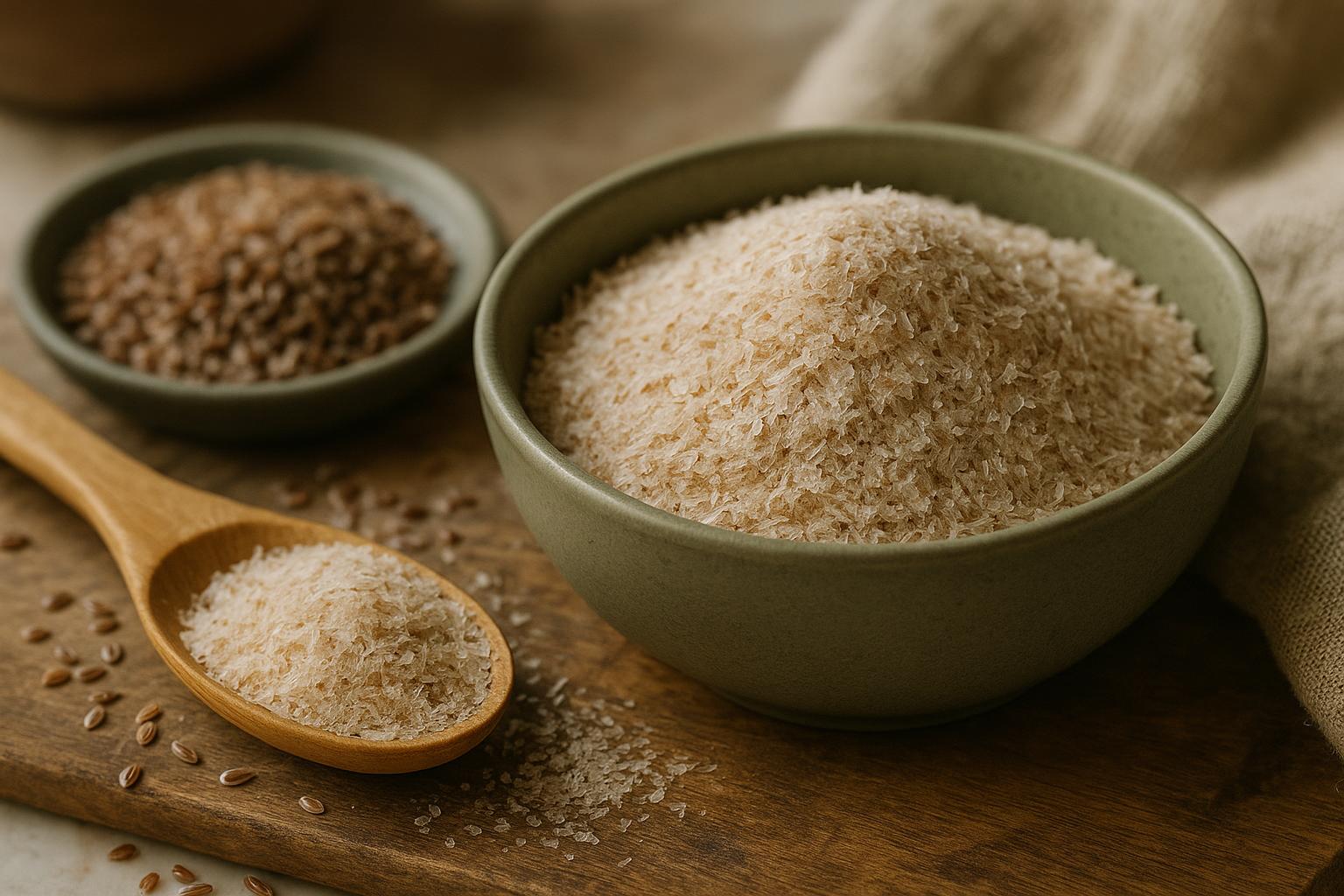
Le psyllium blond (Plantago ovata) contient 70 % de fibres solubles. Le psyllium brun (Plantago psyllium) en contient environ 40 %. Le blond est donc plus efficace pour la plupart des usages.
Le psyllium blond est aussi plus doux pour l’intestin. Il est recommandé en priorité pour les personnes sensibles ou débutantes. Les deux formes existent en poudre ou en gélules.
- Psyllium blond : 70 % fibres solubles, plus doux, plus efficace
- Psyllium brun : 40 % fibres solubles, plus accessible, moins puissant
- Poudre : absorption plus rapide, plus flexible en dosage
- Gélules : pratiques pour les déplacements, dosage fixe
Précautions et contre-indications du psyllium
Le psyllium est généralement bien toléré. Quelques précautions s’imposent cependant pour éviter les effets indésirables.
La principale erreur est de ne pas boire assez d’eau. Sans hydratation suffisante, le psyllium peut aggraver la constipation au lieu de la soulager. Boire au moins 1,5 litre d’eau par jour est indispensable.
- Toujours diluer dans au moins 250 ml d’eau
- Augmenter la dose progressivement pour éviter les ballonnements
- Espacer la prise des médicaments d’au moins 2 heures
- Éviter en cas d’occlusion intestinale ou de difficulté à avaler
- Consulter un médecin en cas de grossesse, allaitement ou maladie chronique
- Allergie rare mais possible : arrêter en cas de réaction
Le National Center for Complementary and Integrative Health (NCCIH) confirme que le psyllium est sûr pour la majorité des adultes à des doses de 5 à 15 g par jour.
a quoi sert le psyllium comparé aux autres fibres ?
Parmi les fibres alimentaires, le psyllium se distingue par sa teneur exceptionnelle en mucilages. Ces polysaccharides forment un gel beaucoup plus visqueux que celui produit par l’avoine ou le lin.
Cette viscosité élevée explique son efficacité supérieure pour le cholestérol et la glycémie. L’avoine (bêta-glucane) est comparable pour le cholestérol, mais moins efficace pour le transit.
- Psyllium : 70 % fibres solubles, gel très visqueux, polyvalent
- Avoine : 5-8 % bêta-glucane, bon pour le cholestérol
- Lin : 30 % fibres, bon pour le transit, riche en oméga-3
- Inuline : fibre prébiotique, excellente pour le microbiote
- Pectine : bonne pour la glycémie, moins pour le transit
a quoi sert le psyllium en cuisine et en boulangerie ?
Le psyllium possède une propriété unique en cuisine : il lie les ingrédients comme le gluten. C’est pour cette raison qu’il est très utilisé dans les recettes sans gluten.
Dans le pain sans gluten, le psyllium améliore la texture, la tenue et l’élasticité de la mie. Il retient l’humidité et évite l’émiettement caractéristique des pains sans gluten.
- Pain sans gluten : 1 à 2 cuillères à café pour 200 g de farine
- Smoothie : 1 cuillère à café pour épaissir et augmenter les fibres
- Porridge : 1 cuillère à café pour une texture plus crémeuse
- Yaourt : saupoudrer pour enrichir en fibres sans altérer le goût
- a quoi sert le psyllium : réguler le transit intestinal dans les deux sens, constipation comme diarrhée.
- a quoi sert le psyllium : réduire le cholestérol LDL de 5 à 10 % en 6 semaines, effet validé par l’EFSA.
- a quoi sert le psyllium : stabiliser la glycémie post-prandiale en ralentissant l’absorption des glucides.
- a quoi sert le psyllium : nourrir le microbiote via la production de butyrate lors de la fermentation colique.
- a quoi sert le psyllium : prolonger la satiété et réduire l’apport calorique spontané de 10 à 15 %.
Questions fréquentes sur a quoi sert le psyllium
a quoi sert le psyllium exactement ?
a quoi sert le psyllium ? Il sert principalement à réguler le transit intestinal, réduire le cholestérol LDL, stabiliser la glycémie après les repas, favoriser la satiété et nourrir les bactéries bénéfiques du microbiote. Ces effets sont validés par des études cliniques rigoureuses et reconnus par l’EFSA.
Le psyllium est-il efficace contre la constipation ?
Oui. Le psyllium est l’une des fibres les plus efficaces contre la constipation. Il absorbe l’eau dans le côlon, augmente le volume des selles et stimule le péristaltisme. L’effet se manifeste en 12 à 72 heures. Il faut toujours le prendre avec au moins 250 ml d’eau pour obtenir cet effet.
Peut-on prendre du psyllium tous les jours ?
Oui, le psyllium peut être pris quotidiennement. Les études cliniques portant sur des périodes de 6 à 12 mois confirment sa sécurité. Commencez par 5 g par jour et augmentez progressivement. Maintenez une hydratation suffisante. Consultez votre médecin si vous prenez des médicaments, car le psyllium peut en retarder l’absorption.
Le psyllium fait-il maigrir ?
Le psyllium favorise la perte de poids indirectement. Il prolonge la satiété, réduit l’appétit entre les repas et diminue l’apport calorique spontané de 10 à 15 %. Il n’est pas un brûleur de graisses. Son efficacité pour le poids est maximale en complément d’une alimentation équilibrée et d’une activité physique régulière.
Quelle dose de psyllium par jour est recommandée ?
La dose efficace varie selon l’objectif. Pour le transit : 5 à 10 g par jour. Pour le cholestérol et la glycémie : 10 à 15 g par jour répartis en 2 à 3 prises. Commencez toujours par 5 g et augmentez sur deux semaines pour éviter les ballonnements. Ne dépassez pas 20 g par jour sans avis médical.
Le psyllium est-il bon pour le microbiote ?
Oui. Le psyllium agit comme prébiotique. Les bactéries bénéfiques du côlon fermentent partiellement ses fibres et produisent du butyrate, un acide gras à chaîne courte. Ce butyrate nourrit les cellules de la paroi intestinale, renforce la barrière intestinale et réduit l’inflammation. L’effet prébiotique est observable après 2 à 4 semaines de consommation régulière.
a quoi sert le psyllium blond par rapport au psyllium brun ?
a quoi sert le psyllium blond ? Il contient 70 % de fibres solubles contre 40 % pour le brun. Il forme un gel plus visqueux, plus efficace pour le cholestérol, la glycémie et le transit. Il est aussi plus doux pour l’intestin. Le psyllium blond est recommandé en priorité, surtout pour les débutants ou les personnes à l’intestin sensible.
Quand prendre le psyllium pour un effet optimal ?
Le moment dépend de l’objectif. Pour la satiété et la glycémie : 30 minutes avant les repas. Pour le transit : le matin ou le soir, à jeun ou avec un repas léger. Pour le cholestérol : répartir les prises avec les repas. Espacez toujours la prise du psyllium d’au moins 2 heures par rapport à vos médicaments.
Le psyllium peut-il remplacer le gluten en boulangerie ?
Partiellement. Le psyllium ne reproduit pas toutes les propriétés du gluten, mais il apporte liant, élasticité et rétention d’humidité dans les pains sans gluten. Utilisez 1 à 2 cuillères à café pour 200 g de farine sans gluten. Le résultat est une mie plus moelleuse, moins friable et une meilleure tenue à la coupe.
Le psyllium est-il contre-indiqué avec des médicaments ?
Le psyllium peut retarder ou réduire l’absorption de certains médicaments en formant un gel dans l’intestin. Espacez toujours la prise du psyllium d’au moins 2 heures avant ou après vos médicaments. Cela concerne notamment les antidiabétiques, les anticoagulants et les médicaments pour la thyroïde. Consultez votre médecin ou pharmacien.
a quoi sert le psyllium pour le diabète ?
a quoi sert le psyllium pour les diabétiques ? Il ralentit l’absorption des glucides et réduit le pic glycémique post-prandial de 15 à 20 %. À long terme, il améliore la sensibilité à l’insuline. Il peut compléter un traitement antidiabétique, mais ne le remplace pas. Son utilisation doit être discutée avec un médecin pour ajuster les doses de médicaments si nécessaire.
Le psyllium provoque-t-il des effets secondaires ?
Les effets secondaires les plus fréquents sont les ballonnements et les gaz, surtout en début de cure. Ils diminuent après 1 à 2 semaines. Augmenter la dose progressivement et boire suffisamment d’eau les minimise. Les réactions allergiques sont rares mais possibles. En cas de douleurs abdominales intenses ou de blocage, consultez un médecin immédiatement.
Quelle est la différence entre psyllium et ispaghul ?
Ispaghul et psyllium désignent la même plante : Plantago ovata. Ispaghul est le terme pharmacologique utilisé en Europe, psyllium est le terme courant. Les enveloppes de graines (téguments) sont la partie utilisée. Elles contiennent les mucilages responsables de tous les effets thérapeutiques. Les deux termes sont donc interchangeables sur les étiquettes des produits.
Ce qu’il faut retenir
a quoi sert le psyllium ? Il sert à réguler le transit, réduire le cholestérol, stabiliser la glycémie, soutenir le microbiote et prolonger la satiété. Ces 7 effets sont documentés par des études cliniques sérieuses et reconnus par les autorités sanitaires européennes.
a quoi sert le psyllium au quotidien ? Il constitue un outil nutritionnel polyvalent, sûr et accessible pour améliorer votre santé digestive et cardiovasculaire. Son rapport bénéfice/risque est excellent lorsqu’il est pris correctement.
Action concrète : commencez par 5 g de psyllium blond dans 250 ml d’eau chaque matin pendant deux semaines. Augmentez à 10 g si vous le tolérez bien. Observez les changements sur votre transit et votre énergie après les repas.
Sources et études
- Anderson JW et al. — Cholesterol-lowering effects of psyllium intake (PubMed, 1999)
- EFSA — Scientific Opinion on the substantiation of health claims related to psyllium (2011)
- Harvard Health — How to lower your cholesterol without drugs (2023)
- NCCIH — Psyllium: What You Need to Know (2024)
- ANSES — Les fibres alimentaires : définition, sources et recommandations (2023)
Cet article est fourni à titre informatif uniquement et ne constitue pas un avis médical. Consultez un professionnel de santé qualifié avant toute utilisation.