Miso blanc c’est quoi ? Définition, bienfaits et utilisations
⚠️ Avis médical : Les informations de cet article sont fournies à titre informatif et ne remplacent pas l’avis d’un professionnel de santé. Consultez un médecin ou un diététicien avant de modifier votre alimentation.
Miso blanc c’est quoi : c’est une pâte fermentée japonaise à base de soja et de riz, obtenue par une fermentation courte de 1 à 3 mois, plus douce et moins salée que les autres variétés de miso. Selon une analyse publiée dans le Journal of Nutritional Science and Vitaminology () [1], le miso contient des concentrations significatives de probiotiques vivants, d’acides aminés essentiels et d’isoflavones de soja aux propriétés antioxydantes. Voici les 5 points clés à retenir :
- Le miso blanc, appelé shiro miso, est la variété la plus douce et la moins salée.
- Sa fermentation courte (1 à 3 mois) lui confère une couleur crème à jaune pâle.
- Il est riche en probiotiques, protéines végétales et vitamines du groupe B.
- Sa teneur en sel est inférieure à celle du miso rouge ou brun (environ 5 à 8 % contre 12 à 14 %).
- Il s’utilise en soupe, marinade, vinaigrette ou sauce pour une saveur umami délicate.
1. Miso blanc c’est quoi exactement ? La définition complète
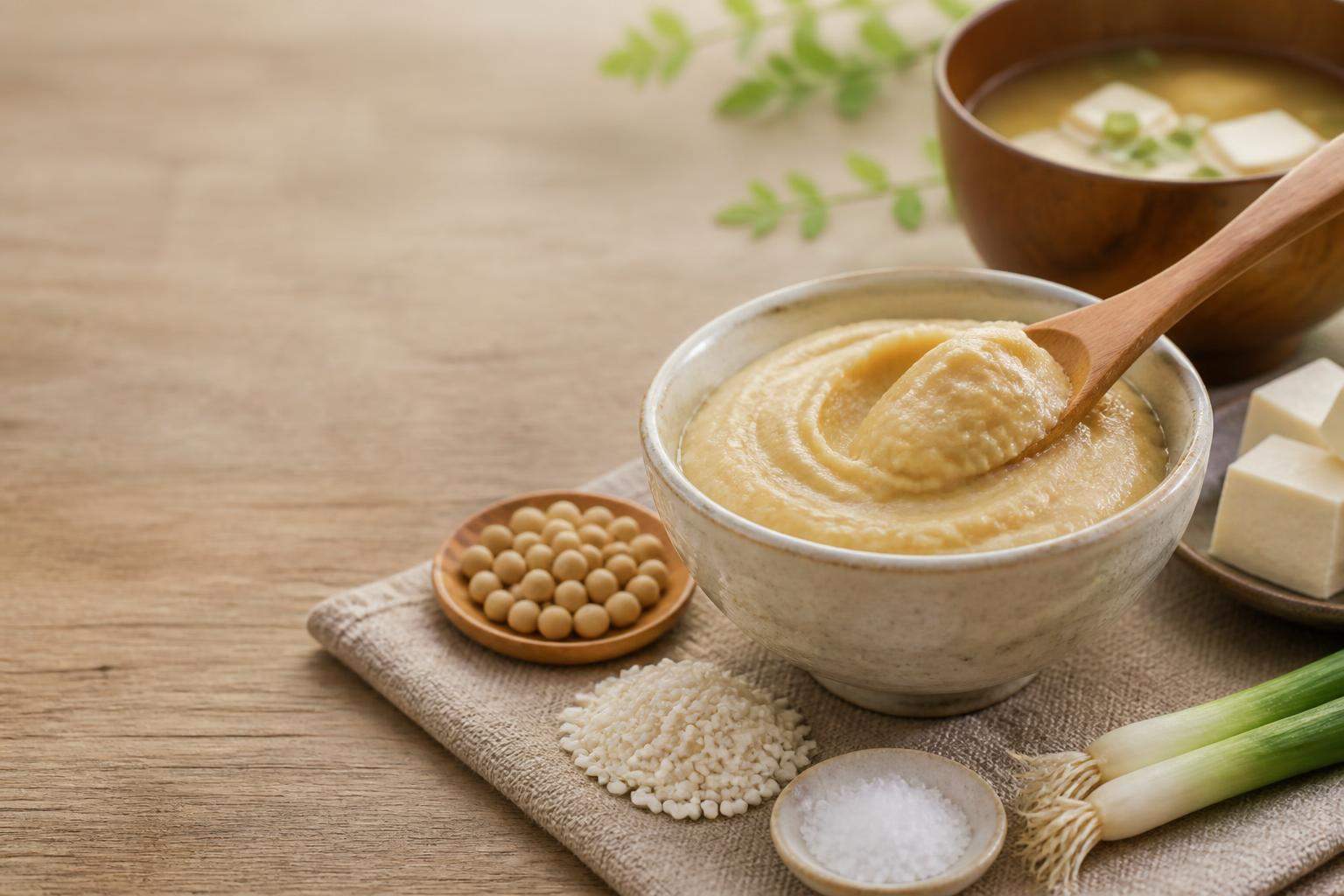
Le miso blanc c’est quoi en termes scientifiques ? C’est un condiment fermenté traditionnel japonais, classé parmi les aliments lacto-fermentés, produit par l’action du champignon Aspergillus oryzae sur un mélange de soja cuit et de céréales. La fermentation transforme les protéines, les glucides et les lipides en composés bioactifs plus facilement assimilables par l’organisme.
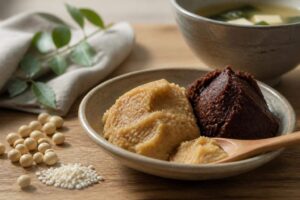
En japonais, le miso blanc s’appelle shiro miso (白味噌). Le terme « shiro » signifie littéralement « blanc » ou « clair ». Cette dénomination fait référence à sa couleur caractéristique, qui va du beige crème au jaune pâle, résultat d’une fermentation brève qui limite la réaction de Maillard responsable du brunissement.
Il se distingue fondamentalement des autres types de miso par trois paramètres : la durée de fermentation (plus courte), la proportion de riz (plus élevée) et la teneur en sel (plus faible). Ces trois facteurs combinés produisent un profil gustatif doux, légèrement sucré et subtilement umami, très différent du miso rouge (aka miso) ou du miso brun (mugi miso).
2. Composition nutritionnelle : que contient le miso blanc ?
La composition du miso blanc c’est quoi en chiffres ? Pour 100 g de pâte, on trouve en moyenne 200 kcal, 11 g de protéines, 27 g de glucides, 6 g de lipides et 5 à 8 g de sel. Une étude publiée dans Food Chemistry () [2] confirme que le processus de fermentation augmente la biodisponibilité des nutriments de 30 à 40 % par rapport au soja non fermenté.
| Nutriment | Miso blanc (shiro) | Miso rouge (aka) | Miso brun (mugi) |
|---|---|---|---|
| Calories | 200 kcal | 216 kcal | 198 kcal |
| Protéines | 11 g | 13 g | 12 g |
| Sel (sodium) | 5-8 g | 12-14 g | 10-13 g |
| Durée fermentation | 1 à 3 mois | 6 à 18 mois | 3 à 12 mois |
| Saveur dominante | Douce, légèrement sucrée | Salée, intense, umami | Terreuse, complexe |
| Isoflavones | Modérées | Élevées | Élevées |
Le miso blanc contient également des vitamines du groupe B, notamment la riboflavine (B2), la niacine (B3) et la folate (B9). Ces vitamines sont synthétisées directement par les micro-organismes actifs pendant la fermentation, ce qui en fait une source naturelle et biodisponible.
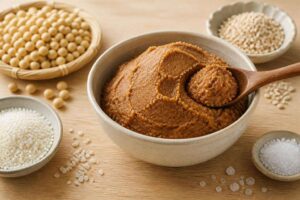
la composition détaillée de la pâte miso et ses ingrédients montre que le ratio riz/soja varie selon les producteurs, influençant directement le profil nutritionnel final du produit.
3. Comment est fabriqué le miso blanc ? Le processus de fermentation
Comprendre miso blanc c’est quoi implique de connaître son mode de fabrication. La production suit quatre étapes principales, encadrées par une tradition artisanale japonaise vieille de plus de 1 300 ans.
- Préparation du koji : le riz est inoculé avec des spores d’Aspergillus oryzae, qui produisent des enzymes (amylases, protéases) pendant 40 à 50 heures à 30°C.
- Cuisson du soja : les fèves de soja sont trempées 12 à 16 heures puis cuites à la vapeur jusqu’à ramollissement complet.
- Mélange et salage : le koji, le soja cuit et le sel marin sont mélangés dans des proportions précises. Pour le miso blanc, la proportion de koji est plus élevée et le sel plus faible.
- Fermentation courte : le mélange fermente de 1 à 3 mois à température contrôlée, sans presse lourde, ce qui préserve la douceur et la couleur claire.
Cette fermentation courte est la clé de l’identité du shiro miso. Elle limite la production de composés bruns (réaction de Maillard) et préserve les sucres naturels du riz, d’où la note légèrement sucrée caractéristique. Les bactéries lactiques actives pendant ce processus produisent de l’acide lactique, qui abaisse le pH et crée un environnement probiotique stable.
4. Bienfaits du miso blanc pour la santé : ce que dit la science
Le miso blanc c’est quoi du point de vue santé ? C’est avant tout une source concentrée de composés bioactifs aux effets documentés sur plusieurs systèmes de l’organisme. L’ANSES reconnaît les aliments fermentés comme contributeurs potentiels à l’équilibre du microbiote intestinal [3].
- Santé intestinale : les probiotiques vivants du miso blanc soutiennent la diversité du microbiote. Une méta-analyse publiée dans Nutrients () [4] associe la consommation régulière d’aliments fermentés à une réduction de 23 % des troubles digestifs fonctionnels.
- Apport en protéines végétales : avec 11 g de protéines pour 100 g, le miso blanc est un complément protéique intéressant pour les régimes végétariens et végans.
- Activité antioxydante : les isoflavones de soja (génistéine, daidzéine) et les peptides issus de la fermentation neutralisent les radicaux libres responsables du vieillissement cellulaire.
- Soutien cardiovasculaire : malgré sa teneur en sel, des études japonaises suggèrent que les peptides bioactifs du miso exercent un effet hypotenseur modéré par inhibition de l’enzyme de conversion de l’angiotensine (ECA).
- Richesse en vitamines B : la fermentation synthétise des vitamines B2, B3 et B9, essentielles au métabolisme énergétique et à la santé neurologique.
- Faible index glycémique : la fermentation dégrade une partie des glucides simples, abaissant l’impact glycémique du produit final.
la flore intestinale et les probiotiques bénéficient directement de la consommation régulière d’aliments fermentés comme le miso blanc, selon les données disponibles en nutrition clinique.
5. Miso blanc vs miso rouge vs miso brun : quelles différences ?
Savoir miso blanc c’est quoi suppose de le distinguer clairement des autres variétés. Les trois grands types de miso diffèrent par leur durée de fermentation, leur teneur en sel et leur profil aromatique.
- Miso blanc (shiro miso) : fermentation 1 à 3 mois, sel 5-8 %, saveur douce et légèrement sucrée. Idéal pour les soupes légères, vinaigrettes et marinades délicates.
- Miso jaune (shinshu miso) : fermentation 3 à 6 mois, sel 8-11 %, saveur équilibrée entre douceur et umami. Polyvalent en cuisine.
- Miso rouge (aka miso) : fermentation 6 à 18 mois, sel 12-14 %, saveur intense, salée et terreuse. Convient aux plats mijotés et aux bouillons robustes.
- Miso brun (mugi miso) : à base d’orge plutôt que de riz, fermentation 3 à 12 mois, saveur rustique et complexe avec des notes de noisette.
Pour les personnes qui débutent avec la pâte miso, le miso blanc c’est quoi de plus accessible : sa douceur et sa faible salinité en font le point d’entrée idéal. Il supporte mieux la chaleur que le miso rouge sans développer d’amertume.
tout savoir sur la pâte de miso, ses types et ses applications culinaires vous permettra de choisir la variété la mieux adaptée à vos recettes et à vos objectifs nutritionnels.
6. Comment utiliser le miso blanc en cuisine ?
Le miso blanc c’est quoi en termes culinaires ? C’est un exhausteur de goût naturel riche en umami, utilisable dans une grande variété de préparations. Sa douceur le rend particulièrement polyvalent.
- Soupe miso légère : dissoudre 1 cuillère à soupe dans un bouillon chaud (sans ébullition pour préserver les probiotiques). Ajouter tofu soyeux, algues wakame et ciboulette.
- Marinade pour poisson : mélanger miso blanc, mirin et sake. Mariner le saumon ou la morue 24 heures avant cuisson au four.
- Vinaigrette umami : fouetter miso blanc, huile de sésame, vinaigre de riz et gingembre râpé pour une sauce salade originale.
- Beurre composé : incorporer 1 cuillère à café de miso blanc dans du beurre ramolli pour napper les légumes grillés ou les viandes blanches.
- Sauce pour pâtes : diluer dans la crème ou le lait végétal pour une sauce crémeuse aux notes umami subtiles.
- Glaze pour légumes rôtis : mélanger miso blanc, sirop d’érable et huile d’olive pour glacer carottes, patates douces ou choux de Bruxelles.
Règle d’or : ne jamais faire bouillir le miso blanc. La chaleur excessive (au-delà de 70°C) détruit les probiotiques vivants et altère les arômes délicats. Ajoutez-le toujours hors du feu ou en fin de cuisson.
7. Miso blanc et probiotiques : un aliment vivant ?
La question miso blanc c’est quoi en termes de probiotiques mérite une réponse nuancée. Le miso non pasteurisé contient effectivement des micro-organismes vivants, principalement des bactéries lactiques (Lactobacillus spp.) et des levures issues de la fermentation au koji.
Cependant, la majorité des misos commerciaux sont pasteurisés pour prolonger leur durée de conservation. La pasteurisation élimine les micro-organismes vivants. Pour bénéficier des probiotiques du miso blanc, recherchez spécifiquement la mention « non pasteurisé » ou « vivant » sur l’étiquette.
- Miso non pasteurisé : contient des probiotiques vivants actifs.
- Miso pasteurisé : conserve les nutriments (protéines, vitamines, minéraux) mais sans probiotiques vivants.
- Les deux formes conservent les peptides bioactifs et les isoflavones issus de la fermentation.
les aliments probiotiques naturels incluent le miso non pasteurisé aux côtés du kéfir, du kimchi et du kombucha, tous reconnus pour leur contribution à l’équilibre du microbiote intestinal.
8. Miso blanc et sodium : faut-il s’inquiéter ?
Le miso blanc c’est quoi du point de vue de la teneur en sel ? Avec 5 à 8 g de sel pour 100 g, le miso blanc est la variété la moins salée. Mais une portion standard en cuisine représente 15 à 20 g de pâte, soit 0,75 à 1,6 g de sel par portion, ce qui reste modéré dans le cadre d’une alimentation équilibrée.
L’OMS recommande de ne pas dépasser 5 g de sel par jour [5]. Une portion de soupe miso au miso blanc représente donc environ 16 à 32 % de cet apport journalier maximal. Cela reste gérable si le reste de l’alimentation est peu salé.
- Personnes hypertendues : préférer le miso blanc au miso rouge, et limiter à 1 portion par jour.
- Personnes en bonne santé : 1 à 2 portions quotidiennes ne posent généralement pas de problème.
- Personnes sous traitement diurétique : consulter un médecin avant d’intégrer le miso régulièrement.
De nombreux lecteurs nous signalent que remplacer le sel de table par du miso blanc dans leurs recettes leur permet de réduire leur consommation globale de sodium tout en enrichissant la saveur de leurs plats.
9. Comment bien choisir son miso blanc ?
Savoir miso blanc c’est quoi ne suffit pas : encore faut-il choisir un produit de qualité. Voici les critères essentiels à vérifier sur l’étiquette.
- Ingrédients simples : soja, riz, sel, koji. Évitez les produits avec additifs, colorants ou exhausteurs de goût artificiels (glutamate monosodique ajouté).
- Fermentation traditionnelle : recherchez la mention « fermenté naturellement » ou « artisanal ».
- Non pasteurisé : pour bénéficier des probiotiques vivants.
- Bio certifié : garantit l’absence de pesticides sur le soja et le riz utilisés.
- Origine japonaise ou coréenne : gage de tradition et de savoir-faire fermentaire éprouvé.
- Conditionnement : préférer les pots en verre ou les sachets hermétiques sans BPA.
le miso à base de soja, ses différentes variétés et les critères de qualité vous aideront à faire un choix éclairé en magasin bio ou en épicerie japonaise.
10. Conservation du miso blanc : combien de temps et comment ?
Le miso blanc c’est quoi en termes de conservation ? C’est un aliment fermenté naturellement stable grâce à son acidité et sa teneur en sel, mais qui demande quelques précautions pour préserver ses qualités organoleptiques et nutritionnelles.
- Avant ouverture : se conserve 12 à 24 mois à température ambiante, à l’abri de la lumière et de la chaleur.
- Après ouverture : réfrigérer impérativement. Se conserve 3 à 6 mois au réfrigérateur dans un contenant hermétique.
- Signe de détérioration : moisissures visibles (autres que la pellicule blanche normale en surface, qui est inoffensive et peut être retirée), odeur aigre anormale ou texture liquéfiée.
- Congélation possible : le miso blanc se congèle bien. Sa texture ne change pas significativement après décongélation.
11. Miso blanc : précautions et contre-indications
Le miso blanc c’est quoi du point de vue des contre-indications ? Malgré ses nombreux atouts, certaines populations doivent l’utiliser avec prudence.
- Allergie au soja : le miso blanc contient du soja, allergène majeur listé par la réglementation européenne. Contre-indiqué en cas d’allergie confirmée.
- Allergie au gluten : certains misos blancs contiennent du riz (sans gluten), mais d’autres utilisent de l’orge. Vérifier systématiquement l’étiquette.
- Hypothyroïdie : les isoflavones de soja peuvent interférer avec l’absorption des hormones thyroïdiennes. Consulter un médecin en cas de traitement hormonal.
- Régime hyposodé strict : même le miso blanc reste relativement salé. À consommer avec modération sous contrôle médical.
- Grossesse : la consommation modérée est généralement considérée comme sûre, mais éviter le miso non pasteurisé par précaution.
12. Miso blanc et miso vert : quelle différence ?
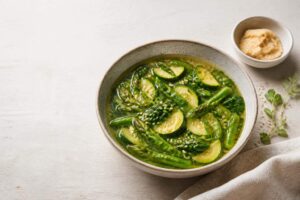
Le miso blanc c’est quoi par rapport au miso vert ? Le miso vert est une variante moderne, souvent enrichie en herbes (spiruline, matcha, basilic) ou en légumes verts. Il n’est pas un type traditionnel de miso japonais, contrairement au shiro miso. Sa composition nutritionnelle varie selon les producteurs.
le miso green, ses bienfaits spécifiques et ses valeurs nutritionnelles vous permettront de comprendre en quoi il se distingue du miso blanc traditionnel et comment l’intégrer dans votre alimentation.
13. 3 recettes simples à base de miso blanc
Maintenant que vous savez miso blanc c’est quoi, voici trois recettes concrètes pour l’intégrer facilement dans votre quotidien.
-
Soupe miso blanc classique (5 min) :
- Porter 400 ml de bouillon dashi à frémissement (sans ébullition).
- Hors du feu, diluer 1 cuillère à soupe de miso blanc dans un peu de bouillon chaud.
- Ajouter 50 g de tofu soyeux en dés et des algues wakame réhydratées.
- Servir immédiatement avec de la ciboulette ciselée.
-
Vinaigrette miso blanc-sésame :
- Mélanger 1 cuillère à café de miso blanc, 2 cuillères à soupe d’huile de sésame, 1 cuillère à soupe de vinaigre de riz et 1 cuillère à café de miel.
- Émulsionner et assaisonner une salade de chou, carottes et edamame.
-
Marinade miso blanc pour saumon :
- Mélanger 2 cuillères à soupe de miso blanc, 1 cuillère à soupe de mirin, 1 cuillère à café de sauce soja et 1 cuillère à café de gingembre frais râpé.
- Enduire les pavés de saumon et laisser mariner 2 heures au réfrigérateur.
- Cuire au four à 200°C pendant 12 minutes.
Ce qu’il faut retenir sur le miso blanc c’est quoi
Le miso blanc c’est quoi en résumé ? C’est la variété de pâte miso japonaise la plus douce, la moins salée et la plus accessible pour les néophytes, obtenue par une fermentation courte de 1 à 3 mois à partir de soja, de riz et de koji. Le miso blanc c’est quoi de plus qu’un simple condiment : c’est une source de probiotiques, de protéines végétales, d’isoflavones et de vitamines B, documentée par des études scientifiques publiées dans des journaux à comité de lecture.
Action concrète : commencez par intégrer une cuillère à soupe de miso blanc non pasteurisé dans votre soupe du soir, trois fois par semaine. Choisissez un produit bio, sans additifs, et conservez-le au réfrigérateur après ouverture pour préserver ses propriétés nutritionnelles.
- Le miso blanc c’est quoi : une pâte fermentée japonaise douce, à base de soja et de riz, fermentée 1 à 3 mois avec le champignon Aspergillus oryzae.
- Le miso blanc c’est quoi en termes de sel : la variété la moins salée (5-8 %), idéale pour les personnes sensibles au sodium.
- Le miso blanc c’est quoi nutritionnellement : une source de probiotiques vivants (si non pasteurisé), de protéines végétales, d’isoflavones et de vitamines B.
- Le miso blanc c’est quoi en cuisine : un exhausteur de goût umami polyvalent, utilisable en soupe, marinade, vinaigrette ou sauce, à ne jamais faire bouillir.
- Le miso blanc c’est quoi comme précaution : un aliment à éviter en cas d’allergie au soja, et à consommer avec modération en cas d’hypothyroïdie ou de régime hyposodé strict.
Questions fréquentes sur miso blanc c’est quoi
Le miso blanc c’est quoi exactement ?
Le miso blanc c’est quoi : c’est une pâte fermentée japonaise (shiro miso) produite à partir de soja, de riz et de sel, fermentée 1 à 3 mois grâce au champignon Aspergillus oryzae. C’est la variété la plus douce et la moins salée de la famille des misos.
Quelle est la différence entre miso blanc et miso rouge ?
Le miso blanc fermente 1 à 3 mois et contient 5-8 % de sel, contre 6 à 18 mois et 12-14 % de sel pour le miso rouge. Le miso blanc est doux et légèrement sucré, tandis que le miso rouge est intense, salé et umami puissant.
Le miso blanc c’est quoi comme apport en protéines ?
Le miso blanc c’est quoi comme source protéique : environ 11 g de protéines pour 100 g de pâte. Ces protéines sont issues du soja fermenté, donc plus biodisponibles que les protéines du soja cru, selon une étude publiée dans Food Chemistry () [2].
Le miso blanc contient-il du gluten ?
Le miso blanc traditionnel à base de riz est naturellement sans gluten. Cependant, certains misos blancs peuvent être fabriqués avec de l’orge ou dans des ateliers traitant du blé. Vérifiez toujours l’étiquette si vous êtes cœliaque ou intolérant au gluten.
Peut-on manger du miso blanc tous les jours ?
Oui, une à deux portions quotidiennes (15-20 g) de miso blanc sont généralement bien tolérées par les personnes en bonne santé. Les études épidémiologiques japonaises associent la consommation quotidienne de miso à des bénéfices cardiovasculaires et digestifs mesurables.
Le miso blanc c’est quoi comme aliment probiotique ?
Le miso blanc c’est quoi en termes de probiotiques : un aliment fermenté vivant s’il est non pasteurisé. Il contient des bactéries lactiques et des levures bénéfiques pour le microbiote intestinal. Le miso pasteurisé conserve les nutriments mais pas les micro-organismes vivants.
Comment conserver le miso blanc après ouverture ?
Après ouverture, conservez le miso blanc dans un contenant hermétique au réfrigérateur. Il se conserve 3 à 6 mois sans perdre ses qualités nutritionnelles. Une fine pellicule blanche en surface est normale et inoffensive : retirez-la simplement avant utilisation.
Le miso blanc est-il adapté aux végétariens et végans ?
Oui, le miso blanc est 100 % végétal. Il est composé uniquement de soja, de riz, de sel et de koji. Il constitue une excellente source de protéines végétales complètes et de vitamines B pour les personnes suivant un régime végétarien ou végan.
Quelle quantité de miso blanc utiliser par recette ?
Une portion standard est de 1 cuillère à soupe (environ 15-17 g) par personne pour une soupe ou une sauce. Pour les marinades, comptez 2 cuillères à soupe pour 2 portions de viande ou de poisson. Commencez par de petites quantités pour ajuster selon votre goût.
Le miso blanc c’est quoi comme alternative au sel ?
Le miso blanc c’est quoi comme substitut : un exhausteur de goût umami naturel qui permet de réduire l’ajout de sel dans les recettes. Sa richesse en acide glutamique amplifie les saveurs, permettant d’utiliser moins de sodium tout en obtenant un résultat gustatif plus complexe.
Où acheter du miso blanc de qualité ?
Vous trouverez du miso blanc dans les épiceries japonaises et asiatiques, les magasins bio (Biocoop, La Vie Claire), et en ligne sur des sites spécialisés. Privilégiez les produits bio, non pasteurisés, avec une liste d’ingrédients courte : soja, riz, sel, koji.
Le miso blanc c’est quoi comme aliment pour la peau ?
Le miso blanc c’est quoi pour la beauté : une source d’isoflavones de soja (génistéine, daidzéine) qui exercent une activité antioxydante et peuvent soutenir l’élasticité cutanée. Des études préliminaires suggèrent que les isoflavones du soja fermenté contribuent à réduire les signes visibles du vieillissement cutané.
Sources et études
- Fermented soybean products and their bioactive compounds — Journal of Nutritional Science and Vitaminology,
- Bioavailability of nutrients in fermented versus non-fermented soybean — Food Chemistry,
- Les aliments fermentés et le microbiote intestinal — ANSES,
- Fermented foods and gut microbiota: a systematic review and meta-analysis — Nutrients,
- Salt reduction — WHO Fact Sheet — OMS,
Cet article est fourni à titre informatif uniquement et ne constitue pas un avis médical. Consultez un professionnel de santé qualifié avant toute utilisation.