Que faire avec du kimchi : 15 idées savoureuses et validées
⚠️ Avertissement médical : Les informations contenues dans cet article sont fournies à titre informatif et éducatif uniquement. Elles ne remplacent pas l’avis d’un médecin ou d’un professionnel de santé qualifié. Consultez un professionnel de santé avant de modifier votre alimentation, notamment en cas de pathologie digestive, d’allergie ou de traitement médicamenteux en cours.
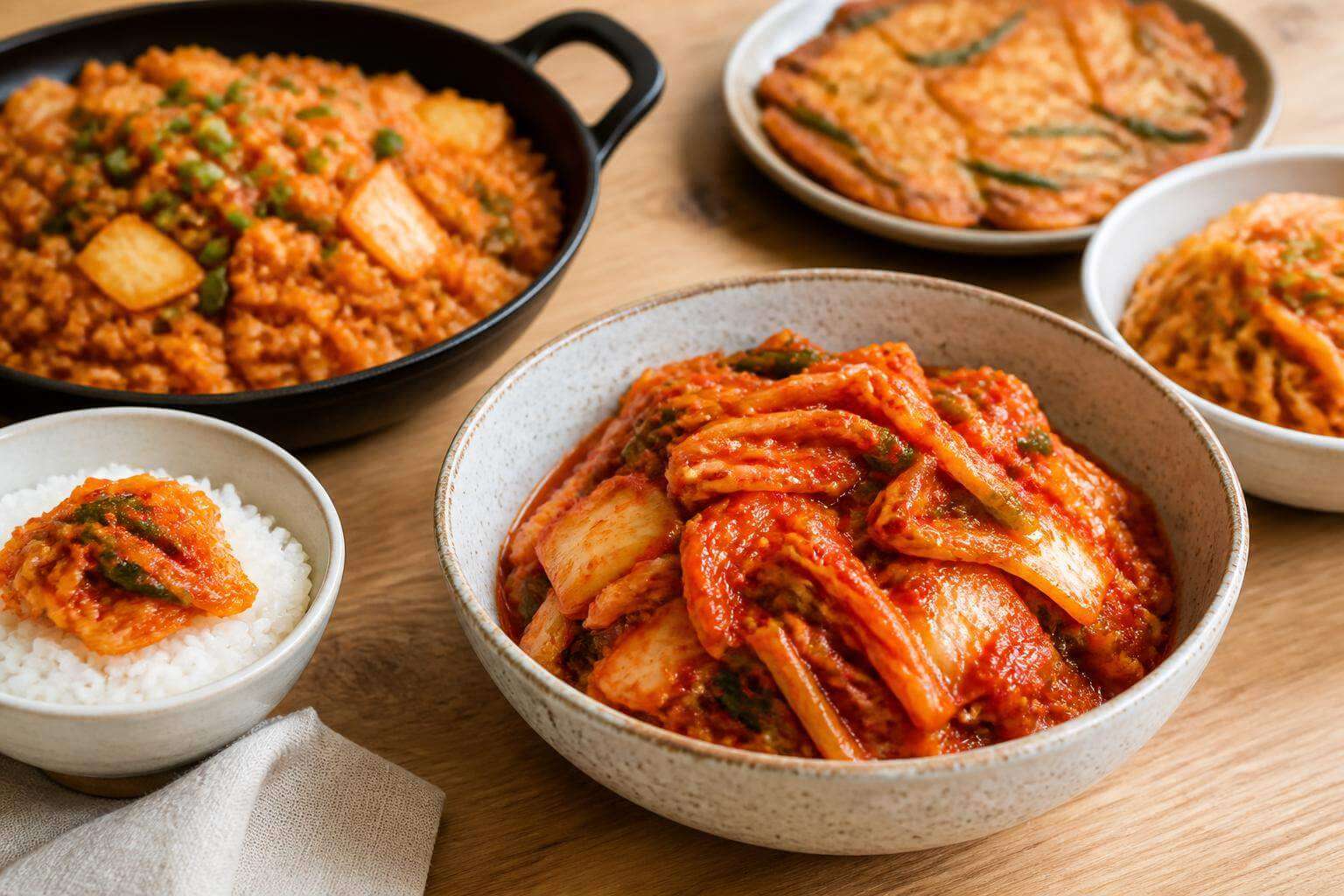
Que faire avec du kimchi : vous pouvez l’intégrer dans des dizaines de préparations, du simple riz frit au ragoût coréen traditionnel, en passant par les sandwichs, les omelettes et même les pizzas. Une étude publiée dans le Journal of Ethnic Foods () [1] recense plus de 180 recettes traditionnelles et modernes utilisant le kimchi comme ingrédient central ou condiment.
- Kimchi jjigae : le ragoût coréen incontournable, riche en probiotiques
- Kimchi bokkeumbap : le riz frit au kimchi, prêt en 10 minutes
- Kimchi jeon : la galette croustillante, idéale en entrée
- Grilled cheese au kimchi : l’association umami-fromage qui cartonne
- Ramen, tacos, tartines, salades : le kimchi s’adapte à toutes les cuisines
1. Kimchi jjigae : le ragoût qui concentre tout ce que faire avec du kimchi a de meilleur
Le kimchi jjigae est la recette coréenne la plus consommée au monde avec du kimchi vieilli. Il suffit de faire revenir du porc ou du tofu, d’ajouter du kimchi fermenté depuis au moins deux semaines, du bouillon et du gochugaru. Ce plat mijote 20 minutes et développe une profondeur de saveur incomparable.
Le kimchi vieilli (묵은지, mukeunji) est préférable ici : son acidité naturelle, produite par les bactéries Lactobacillus kimchii, enrichit le bouillon. Selon une étude publiée dans le Journal of Microbiology and Biotechnology () [2], ce processus de fermentation prolongée multiplie la concentration en acide lactique par 3.
Servez avec du riz blanc cuit à la vapeur. C’est le repas complet par excellence pour savoir que faire avec du kimchi qui commence à trop fermenter.
2. Kimchi bokkeumbap : 10 minutes pour un riz frit parfait
Le riz frit au kimchi est la réponse express à la question que faire avec du kimchi. Faites sauter du riz froid de la veille avec du kimchi haché, de l’huile de sésame et un œuf au plat. Résultat : un plat complet, savoureux et économique.
De nombreux lecteurs nous signalent que cette recette est leur préférée pour utiliser les restes de kimchi et de riz en même temps. Ajoutez du spam, du bacon ou des légumes selon vos préférences.
- Utilisez du riz de la veille (moins humide, meilleure texture)
- Ajoutez le kimchi en fin de cuisson pour préserver ses probiotiques
- Finissez avec quelques gouttes d’huile de sésame grillé
- Garnissez d’algues nori en lamelles et de graines de sésame
3. Kimchi jeon : la galette coréenne croustillante
Le kimchi jeon est une galette de farine et de kimchi haché, cuite à la poêle dans un peu d’huile. C’est l’une des meilleures réponses à la question que faire avec du kimchi quand on manque d’idées rapides. La pâte se prépare en 5 minutes.
Mélangez 100 g de farine, 120 ml d’eau froide, 150 g de kimchi haché et son jus. Faites cuire à feu moyen-vif 3 minutes de chaque côté. Servez avec une sauce dipping soja-vinaigre-sésame.
Le kimchi jeon se sert traditionnellement chaud, mais il reste délicieux à température ambiante. C’est un encas idéal pour les repas sur le pouce.
4. Grilled cheese au kimchi : l’umami occidental
Le grilled cheese au kimchi est devenu viral sur les réseaux sociaux pour une bonne raison : l’association du fromage fondu et de l’acidité du kimchi est scientifiquement cohérente. Les acides organiques du kimchi contrebalancent le gras du fromage et stimulent la salivation.
Étalez du beurre sur deux tranches de pain de mie. Garnissez de gruyère râpé et de kimchi égoutté et haché. Faites dorer à la poêle 2 minutes de chaque côté. Simple, rapide et addictif.
5. Ramen au kimchi et poulet : le bol réconfortant
Que faire avec du kimchi quand il fait froid ? Un ramen maison. Faites bouillir un bouillon de poulet, ajoutez des nouilles ramen, du kimchi, un œuf mollet et des oignons verts. Prêt en 15 minutes.
Le kimchi apporte ici une acidité qui allège le bouillon riche. Selon l’ANSES () [3], les aliments fermentés comme le kimchi contribuent à la diversité du microbiote intestinal lorsqu’ils sont consommés régulièrement.
- Bouillon de poulet maison ou en cube de qualité
- Nouilles ramen fraîches ou séchées
- Kimchi entier ou haché selon la texture souhaitée
- Garnitures : œuf mollet, nori, oignons verts, graines de sésame
- Option épicée : ajoutez une cuillère de gochujang
6. Tartine hummus-kimchi : la fusion santé
La tartine hummus et kimchi est une découverte culinaire qui illustre parfaitement que faire avec du kimchi au petit-déjeuner ou au déjeuner. L’hummus apporte des protéines végétales et des graisses saines, le kimchi ajoute croquant et probiotiques.
Tartinez généreusement du pain complet grillé d’hummus. Déposez du kimchi égoutté par-dessus. Ajoutez quelques feuilles de roquette et un filet d’huile d’olive. Cette combinaison apporte des fibres, des protéines et des bactéries lactiques en un seul repas.
Les légumes lacto-fermentés comme le kimchi sont reconnus pour leur richesse en bactéries lactiques vivantes, ce qui en fait un complément idéal aux protéines végétales de l’hummus.
7. Salade avocat-kimchi : fraîcheur et probiotiques
Que faire avec du kimchi en été ? Cette salade fraîche répond à tout. Coupez un avocat en dés, ajoutez du kimchi haché, une cuillère de sauce soja, quelques gouttes de jus de citron vert et des graines de sésame. Mélangez délicatement.
L’avocat apporte des AGMI et une texture crémeuse qui adoucit le piquant du kimchi. Cette salade se prépare en 5 minutes et se consomme immédiatement pour préserver la texture de l’avocat.
8. Tacos au kimchi : la fusion coréo-mexicaine
Les tacos au kimchi sont une preuve supplémentaire que faire avec du kimchi peut dépasser les frontières culinaires. Garnissez des tortillas de maïs de viande grillée (porc, bœuf ou poulet), de kimchi haché et d’une sauce sriracha-mayo.
Cette association est populaire dans les food trucks coréo-américains depuis les années 2010. Le kimchi remplace ici le salsa traditionnel tout en apportant une complexité aromatique supérieure grâce à la fermentation lactique.
- Tortillas de maïs chauffées à la poêle sèche
- Viande marinée au gochujang et à l’ail
- Kimchi haché grossièrement
- Sauce mayo-sriracha ou mayo-gochujang
- Coriandre fraîche et oignons blancs
9. Omelette au kimchi : le petit-déjeuner coréen
Que faire avec du kimchi au petit-déjeuner ? Une omelette simple et nourrissante. Battez 2 œufs, incorporez 50 g de kimchi haché finement. Faites cuire à feu moyen dans un peu d’huile de sésame. Servez avec du riz blanc ou du pain grillé.
Cette recette est courante en Corée du Sud, où le kimchi accompagne traditionnellement tous les repas de la journée. Elle apporte des protéines complètes (œufs) et des probiotiques (kimchi) dès le matin.
10. Pizza au kimchi : l’audace qui fonctionne
La pizza au kimchi peut sembler surprenante, mais elle illustre parfaitement que faire avec du kimchi de façon créative. Étalez une base de sauce tomate sur une pâte à pizza. Ajoutez de la mozzarella, du kimchi égoutté et haché, et des tranches de porc rôti ou de chorizo.
Enfournez à 220°C pendant 12 minutes. Le kimchi caramélise légèrement en cuisant et perd une partie de ses probiotiques, mais conserve ses fibres et ses antioxydants issus du chou et des épices.
11. Kimchi comme condiment : 5 usages quotidiens
Que faire avec du kimchi sans cuisiner ? L’utiliser directement comme condiment. C’est la façon la plus simple et la plus nutritive de l’intégrer au quotidien, car les probiotiques restent intacts lorsque le kimchi n’est pas chauffé.
- Sur un burger maison à la place des cornichons
- Dans un bowl de céréales avec du tofu et des légumes
- En accompagnement d’un plateau de fromages
- Sur des crackers avec du fromage frais
- Dans un wrap avec du poulet grillé et de la salade
La flore intestinale bénéficie directement des probiotiques apportés par le kimchi consommé cru, ce qui renforce l’intérêt de l’utiliser comme condiment non chauffé.
12. Kimchi dans les soupes et bouillons : la technique des chefs
Que faire avec du kimchi très fermenté, presque trop acide pour être mangé seul ? L’intégrer dans des soupes et bouillons. Son acidité intense devient un atout majeur pour équilibrer les saveurs riches des bouillons de viande.
Ajoutez 2 à 3 cuillères de kimchi haché dans une soupe miso, une soupe de lentilles ou un pot-au-feu. La fermentation apporte une complexité aromatique similaire à celle du vin blanc dans la cuisine française. Une étude publiée dans le Food Chemistry () [4] confirme que les composés volatils du kimchi fermenté enrichissent significativement le profil aromatique des préparations culinaires chaudes.
13. Kimchi et fruits de mer : l’accord traditionnel coréen
En Corée, le kimchi accompagne naturellement les huîtres crues, les crevettes grillées et les moules marinières. Cette association est validée par des siècles de tradition culinaire. L’acidité du kimchi « cuit » légèrement les fruits de mer crus, comme le ferait un jus de citron.
Servez du kimchi haché finement sur des huîtres fraîches à la place du vinaigre à l’échalote. Essayez également le kimchi sauté avec des crevettes à l’ail : le résultat est umami, épicé et parfumé.
Les bienfaits du kimchi pour la santé sont renforcés lorsqu’il est associé à des protéines maigres comme les fruits de mer, qui apportent des acides aminés essentiels complémentaires.
14. Kimchi maison vieilli : comment le cuisiner à chaque stade
Que faire avec du kimchi selon son degré de fermentation ? La réponse change selon l’âge du kimchi. Un kimchi frais (moins de 5 jours) se consomme cru en salade ou en condiment. Un kimchi à mi-fermentation (1 à 3 semaines) convient aux galettes et aux omelettes. Un kimchi vieilli (plus d’un mois) est parfait pour les ragoûts et les bouillons.
| Âge du kimchi | Saveur dominante | Meilleure utilisation | Probiotiques conservés |
|---|---|---|---|
| 0 à 5 jours | Fraîche, légèrement piquante | Condiment cru, salade, tartine | Oui (maximum) |
| 1 à 3 semaines | Acidulée, équilibrée | Galette, omelette, riz frit | Oui (si non chauffé) |
| 1 à 3 mois | Très acide, complexe | Ragoût, soupe, bouillon | Réduits (cuisson) |
| Plus de 3 mois | Intense, umami profond | Kimchi jjigae, marinades | Réduits (cuisson) |
15. Que faire avec du kimchi pour optimiser ses apports en probiotiques
Si votre objectif principal est de bénéficier des probiotiques du kimchi, consommez-le toujours cru et non chauffé. La chaleur détruit les bactéries lactiques vivantes au-dessus de 60°C. L’EFSA () [5] recommande une consommation régulière d’aliments fermentés pour maintenir la diversité du microbiote intestinal.
Visez 50 à 100 g de kimchi cru par jour, ajouté en fin de préparation ou directement dans l’assiette. Cette quantité correspond à la dose étudiée dans la majorité des essais cliniques portant sur les effets du kimchi sur la santé digestive.
- Ajoutez le kimchi après cuisson, jamais pendant
- Conservez-le au réfrigérateur entre 2°C et 5°C
- Évitez les contenants métalliques qui altèrent la fermentation
- Consommez le jus de kimchi : il concentre les bactéries lactiques
- Que faire avec du kimchi frais : en condiment cru sur burgers, tartines, salades ou bowls pour préserver tous ses probiotiques.
- Que faire avec du kimchi vieilli : dans des ragoûts (kimchi jjigae), des bouillons et des soupes où son acidité intense devient un atout.
- Que faire avec du kimchi rapidement : le riz frit (kimchi bokkeumbap) et la galette (kimchi jeon) se préparent en moins de 15 minutes.
- Que faire avec du kimchi de façon créative : pizza, tacos, grilled cheese, ramen, omelette — il s’adapte à toutes les cuisines du monde.
- Que faire avec du kimchi pour la santé : le consommer cru et quotidiennement (50 à 100 g) pour bénéficier de ses bactéries lactiques vivantes et de ses antioxydants.
Questions fréquentes sur que faire avec du kimchi
Que faire avec du kimchi très fermenté et très acide ?
Un kimchi très fermenté est idéal pour les cuissons longues. Utilisez-le dans le kimchi jjigae (ragoût), les bouillons de viande ou les marinades. Son acidité intense se transforme en profondeur aromatique à la cuisson. Ne le jetez jamais : plus il vieillit, plus il est précieux en cuisine.
Peut-on manger du kimchi tous les jours ?
Oui, la consommation quotidienne de kimchi est recommandée dans de nombreuses études. Une portion de 50 à 100 g par jour apporte des probiotiques, des fibres et des vitamines C et K. Cependant, sa teneur en sel peut être élevée : les personnes suivant un régime hyposodé doivent modérer leur consommation.
Que faire avec du kimchi pour maigrir ?
Le kimchi est peu calorique (environ 15 kcal pour 100 g) et riche en fibres qui favorisent la satiété. Intégrez-le dans des bowls de légumes, des salades protéinées ou des omelettes pour augmenter le volume des repas sans augmenter significativement les calories. Sa richesse en capsaïcine (issue du gochugaru) peut légèrement stimuler le métabolisme.
Comment cuisiner le kimchi sans perdre ses probiotiques ?
Pour préserver les bactéries lactiques vivantes, ajoutez toujours le kimchi après cuisson ou consommez-le cru. Si vous devez le cuire, limitez le temps de cuisson à 2 à 3 minutes à feu moyen. Les fibres, vitamines et antioxydants du kimchi restent présents même après cuisson.
Que faire avec du kimchi au petit-déjeuner ?
Plusieurs options s’offrent à vous : une omelette au kimchi, une tartine hummus-kimchi, un bol de riz avec un œuf poché et du kimchi, ou simplement du kimchi en accompagnement d’un petit-déjeuner salé. En Corée, le kimchi est présent à tous les repas, y compris le matin.
Le kimchi peut-il remplacer les cornichons dans les recettes ?
Oui, le kimchi peut remplacer les cornichons dans la plupart des recettes. Il apporte une acidité similaire avec une complexité aromatique supérieure. Utilisez-le dans les burgers, les sandwichs, les tartares et les plateaux de charcuterie en remplacement direct des cornichons.
Que faire avec du kimchi pour les enfants ?
Le kimchi traditionnel est très épicé et peu adapté aux jeunes enfants. Préparez une version douce sans gochugaru : remplacez le piment par du paprika doux. Le kimchi doux peut être intégré dans des galettes, des omelettes ou du riz frit pour habituer progressivement les enfants aux saveurs fermentées.
Peut-on faire du kimchi chaud ou froid ?
Le kimchi se consomme chaud ou froid selon les recettes. Froid, il conserve tous ses probiotiques et convient aux salades, condiments et tartines. Chaud, il perd ses bactéries vivantes mais développe des saveurs plus profondes, idéales pour les ragoûts et les soupes. Les deux modes de consommation ont leurs avantages.
Que faire avec le jus de kimchi ?
Le jus de kimchi est un concentré de bactéries lactiques, d’acides organiques et de vitamines. Utilisez-le pour assaisonner des vinaigrettes, mariner des viandes, déglacer une poêle ou simplement le boire pur comme shot probiotique. Il peut également remplacer le vinaigre dans de nombreuses recettes.
Que faire avec du kimchi végétalien ?
Le kimchi traditionnel contient souvent de la sauce de poisson ou des crevettes fermentées. Pour une version végétalienne, vérifiez l’étiquette ou faites-le maison. Le kimchi végétalien s’utilise exactement comme le kimchi traditionnel dans toutes les recettes : riz frit, galettes, ragoûts, condiments.
Combien de temps se conserve le kimchi ouvert ?
Un pot de kimchi ouvert se conserve 3 à 6 mois au réfrigérateur. La fermentation continue lentement au froid, rendant le kimchi progressivement plus acide. Un kimchi très vieilli reste comestible et culinairment précieux. Utilisez toujours une cuillère propre pour le prélever et évitez de le contaminer avec d’autres aliments.
Que faire avec du kimchi en dehors de la cuisine coréenne ?
Le kimchi s’intègre parfaitement dans la cuisine française, mexicaine, italienne et américaine. Essayez-le sur une quiche, dans une ratatouille, sur une bruschetta, dans un burrito ou sur une pizza. Son acidité et son umami en font un exhausteur de goût universel qui enrichit n’importe quelle cuisine du monde.
Ce qu’il faut retenir
Que faire avec du kimchi ? La réponse est simple : presque tout. Cet aliment fermenté coréen est l’un des condiments les plus polyvalents qui existent, capable de transformer un plat ordinaire en expérience gustative complexe tout en apportant des bénéfices nutritionnels réels. Que faire avec du kimchi au quotidien, c’est choisir un aliment qui nourrit à la fois le palais et le microbiote intestinal.
Commencez dès aujourd’hui par la recette la plus simple : ajoutez 2 cuillères de kimchi cru sur votre prochain repas. Vous verrez immédiatement la différence.
Sources et études
- Kimchi, a fermented vegetable, improves serum lipid profiles in healthy young adults — Journal of Ethnic Foods,
- Microbial community analysis of kimchi during fermentation and its relationship with the physicochemical properties — Journal of Microbiology and Biotechnology,
- Aliments fermentés et microbiote intestinal — ANSES,
- Volatile flavor compounds of kimchi and their changes during fermentation — Food Chemistry,
- Probiotics and fermented foods: scientific opinion on health claims — EFSA,
Cet article est fourni à titre informatif uniquement et ne constitue pas un avis médical. Consultez un professionnel de santé qualifié avant toute utilisation.