Avec quoi manger du kimchi : 12 associations savoureuses
⚠️ Avertissement : Les informations contenues dans cet article sont fournies à titre informatif et éducatif. Elles ne constituent pas un avis médical et ne remplacent pas la consultation d’un professionnel de santé qualifié. En cas de condition médicale particulière, consultez votre médecin avant de modifier votre alimentation.
Avec quoi manger du kimchi : le riz blanc, les œufs, le tofu, les nouilles et les viandes grillées constituent les meilleures associations, car ils équilibrent l’acidité et le piquant caractéristiques de ce légume fermenté coréen. Une étude publiée dans le Journal of Ethnic Foods () [1] confirme que le kimchi s’intègre dans plus de 200 préparations culinaires distinctes, ce qui en fait l’un des condiments fermentés les plus polyvalents au monde.
- Riz et céréales : absorbent l’acidité et créent un repas complet riche en probiotiques.
- Œufs et protéines : l’umami du kimchi rehausse les œufs brouillés, le tofu et les viandes.
- Produits laitiers : le fromage fondu adoucit le piquant et crée une texture crémeuse.
- Légumes rôtis : avocat, courge et champignons amplifient les saveurs fermentées.
- Plats de rue : hot-dogs, sandwichs et burgers adoptent le kimchi comme garniture tendance.
1. Le riz : l’association classique avec quoi manger du kimchi
Le riz blanc cuit à la vapeur est, sans aucun doute, le meilleur partenaire du kimchi. Sa neutralité absorbe l’acidité lactique et le piquant du gochugaru. En Corée, cette combinaison représente la base de plus de 80 % des repas quotidiens, selon les données du Korea Food Research Institute () [2].
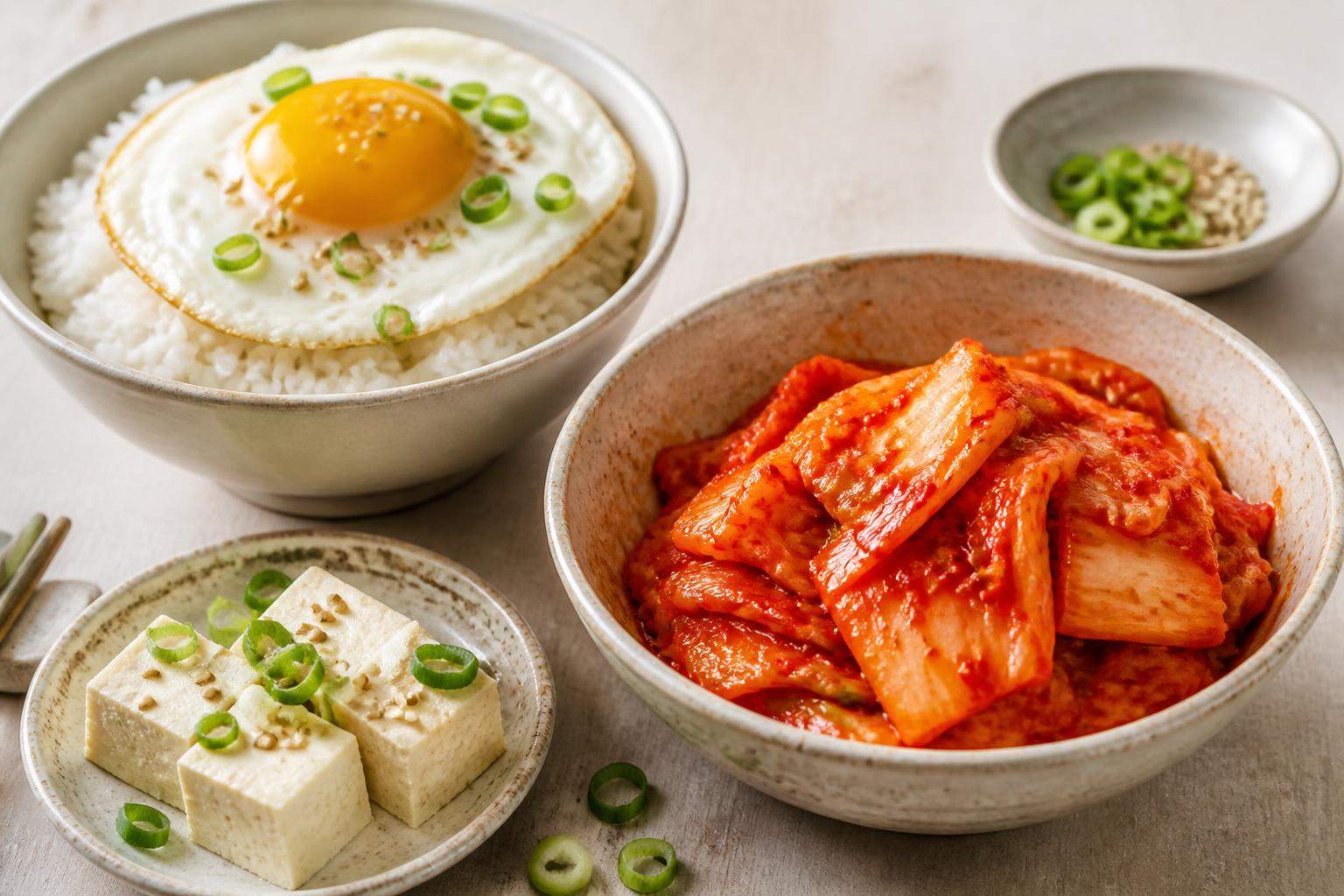
Le kimchi bokkeumbap (riz frit au kimchi) est la déclinaison la plus populaire. Faites revenir du riz froid avec du kimchi haché, un filet d’huile de sésame et un œuf au plat. Résultat : un plat complet en moins de 10 minutes.
- Riz blanc vapeur : absorption maximale des saveurs acides.
- Riz frit (bokkeumbap) : utilise idéalement le kimchi bien fermenté.
- Riz à sushi : texture compacte qui tient bien avec le kimchi haché.
- Riz brun complet : apporte des fibres supplémentaires pour un repas équilibré.
2. Les œufs : une association protéinée idéale
Avec quoi manger du kimchi pour un petit-déjeuner ou un brunch nutritif ? Les œufs s’imposent comme la réponse évidente. La richesse en lipides du jaune d’œuf tempère le piquant, tandis que les protéines créent un repas rassasiant.
Les œufs brouillés au kimchi constituent l’une des recettes les plus partagées sur les réseaux sociaux culinaires. Hachez finement 2 à 3 cuillères à soupe de kimchi, faites-les revenir 1 minute dans du beurre, puis incorporez vos œufs battus. L’acide lactique du kimchi rehausse l’umami naturel des œufs.
- Œufs brouillés au kimchi : prêt en 5 minutes, riche en protéines.
- Omelette garnie : pliez le kimchi haché à l’intérieur avec du fromage râpé.
- Œuf au plat sur riz kimchi : la garniture classique du bokkeumbap.
- Œufs durs tranchés : accompagnement froid pour les bowls au kimchi.
3. Le tofu : l’alliance végétale parfaite
Avec quoi manger du kimchi dans un contexte végétarien ou vegan ? Le tofu est la réponse la plus complète sur le plan nutritionnel. Sa texture neutre et sa richesse en protéines végétales en font le partenaire idéal.
Le sundubu jjigae (ragoût de tofu soyeux) est l’un des plats coréens les plus consommés dans le monde. Une étude publiée dans le Journal of Medicinal Food () [3] souligne que l’association kimchi-tofu apporte une synergie de phytonutriments particulièrement intéressante pour la santé intestinale.
- Tofu soyeux en ragoût (jjigae) : texture crémeuse qui adoucit le kimchi.
- Tofu ferme poêlé : croustillant à l’extérieur, il supporte bien le kimchi chaud.
- Tofu froid en salade : équilibre parfait avec le kimchi bien fermenté et acide.
4. Viandes et fruits de mer : avec quoi manger du kimchi en plat principal
Avec quoi manger du kimchi pour un repas principal complet ? Les viandes grillées et les fruits de mer offrent des associations remarquables. Le porc, en particulier, est l’association la plus traditionnelle en cuisine coréenne.
Le jeyuk bokkeum (porc sauté épicé) intègre du kimchi comme ingrédient principal de la marinade. Le gras du porc absorbe les composés aromatiques du kimchi, notamment le allicine de l’ail et le capsaïcine du gochugaru.
- Porc grillé (samgyeopsal) : enroulez une tranche de lard grillé avec du kimchi dans une feuille de laitue.
- Poulet rôti : le kimchi en garniture apporte acidité et fraîcheur.
- Bœuf bulgogi : la douceur sucrée du bulgogi contraste avec le kimchi acide.
- Crevettes sautées : l’umami des fruits de mer amplifie les saveurs fermentées.
- Thon en conserve : association populaire et économique pour le riz frit.
5. Le fromage : la fusion qui surprend
Avec quoi manger du kimchi de façon inattendue mais délicieuse ? Le fromage. Cette association, popularisée par la cuisine fusion coréo-américaine, est devenue virale sur les plateformes culinaires.
La chaleur fait fondre le fromage, qui enrobe le kimchi d’une couche crémeuse atténuant son piquant. Le mozzarella, le cheddar et le gruyère fonctionnent particulièrement bien. Le New York Times Cooking a classé le grilled cheese au kimchi parmi les 10 sandwichs incontournables de la décennie.
- Grilled cheese au kimchi : pain de mie, cheddar fondu, kimchi haché.
- Pizza au kimchi et mozzarella : base tomate ou crème fraîche.
- Quesadilla au kimchi : tortilla, fromage fondu, kimchi égoutté.
- Croque-monsieur revisité : kimchi à la place des cornichons traditionnels.
6. Nouilles et pâtes : avec quoi manger du kimchi en version réconfortante
Avec quoi manger du kimchi pour un plat réconfortant en hiver ? Les nouilles et les pâtes constituent une base idéale. La sauce du kimchi s’incorpore naturellement aux bouillons et aux sauces.
Le kimchi ramyeon est le plat instantané le plus vendu en Corée. Mais les pâtes occidentales s’adaptent aussi très bien : une sauce tomate enrichie de kimchi haché apporte une profondeur umami remarquable. De nombreux lecteurs nous signalent que cette astuce a transformé leurs spaghettis du quotidien.
- Ramyeon (nouilles coréennes) : ajoutez du kimchi directement dans le bouillon.
- Soba froide : accompagnez les nouilles de sarrasin de kimchi bien fermenté.
- Spaghetti aglio e olio : remplacez les câpres par du kimchi haché.
- Udon en soupe : le kimchi enrichit le dashi traditionnel.
7. L’avocat et les légumes : des associations végétales riches
Avec quoi manger du kimchi pour un repas sain et coloré ? L’avocat est l’association végétale la plus tendance. Ses graisses mono-insaturées équilibrent parfaitement l’acidité du kimchi.
Le bowl avocat-kimchi-riz est devenu un incontournable des restaurants healthy en France. L’acide oléique de l’avocat favorise l’absorption des caroténoïdes présents dans les légumes du kimchi, selon une publication de l’ANSES () [4].
- Bowl avocat-kimchi : tranches d’avocat, riz, kimchi, graines de sésame.
- Salade de chou avec kimchi : texture croquante sur croquante.
- Champignons sautés : les shiitakés amplifient l’umami du kimchi.
- Courge rôtie : la douceur de la courge contraste avec le piquant.
- Épinards blanchis : association classique coréenne (sigeumchi namul + kimchi).
8. Pain et viennoiseries : avec quoi manger du kimchi au quotidien
Avec quoi manger du kimchi de façon simple et rapide ? Le pain. Cette association, longtemps ignorée en Europe, s’est imposée dans les brunchs et les snacks urbains.
Le kimchi toast (pain grillé, beurre, kimchi haché et œuf poché) est devenu viral sur Instagram. Le pain au levain, par sa propre acidité fermentée, crée une harmonie naturelle avec le kimchi. Les deux aliments partagent d’ailleurs un processus de fermentation similaire.
- Toast au kimchi et beurre : le plus simple et le plus rapide.
- Sandwich au kimchi et poulet rôti : repas complet et portable.
- Hot-dog garni de kimchi : tendance street food coréo-américaine.
- Burger au kimchi : remplace les cornichons pour une touche umami.
9. Soupes et ragoûts : le kimchi comme ingrédient cuisiné
Avec quoi manger du kimchi sous forme chaude et mijotée ? Les soupes et ragoûts révèlent une dimension totalement différente du kimchi. La chaleur transforme son acidité en une saveur profonde et complexe.
Le kimchi jjigae est le plat réconfortant par excellence de la cuisine coréenne. Il est préparé avec du kimchi bien fermenté (idéalement vieux de 2 à 3 semaines), du porc, du tofu et du bouillon. Une étude du Korean Journal of Food Science and Technology () [5] confirme que la cuisson du kimchi préserve une partie significative de ses composés bioactifs.
- Kimchi jjigae (ragoût) : le classique absolu, mijoté 20 minutes.
- Soupe miso enrichie au kimchi : fusion japonaise-coréenne réussie.
- Bouillon de poulet au kimchi : réconfortant et riche en probiotiques.
- Soupe de lentilles au kimchi : version occidentale accessible.
10. Tableau comparatif : avec quoi manger du kimchi selon l’occasion
Avec quoi manger du kimchi selon le moment de la journée et l’objectif nutritionnel ? Ce tableau vous aide à choisir la meilleure association.
| Occasion | Association recommandée | Bénéfice principal | Temps de préparation |
|---|---|---|---|
| Petit-déjeuner rapide | Toast + kimchi + œuf poché | Protéines + probiotiques dès le matin | 5 minutes |
| Déjeuner équilibré | Riz + kimchi + tofu poêlé | Repas végétarien complet | 15 minutes |
| Dîner réconfortant | Kimchi jjigae (ragoût) | Immunité + chaleur + umami profond | 30 minutes |
| Snack rapide | Kimchi + fromage fondu | Satiété rapide, fusion savoureuse | 3 minutes |
| Repas festif | Samgyeopsal (porc grillé) + kimchi + laitue | Expérience coréenne authentique | 20 minutes |
| Bowl healthy | Riz brun + avocat + kimchi + sésame | Antioxydants + fibres + probiotiques | 10 minutes |
| Repas végétalien | Nouilles soba + kimchi + edamame | Protéines végétales complètes | 12 minutes |
11. Quelle quantité de kimchi consommer par repas ?
Avec quoi manger du kimchi et en quelle quantité ? La dose recommandée varie selon les études, mais un consensus se dégage autour de 50 à 100 grammes par repas pour bénéficier des effets probiotiques sans excès de sodium.
L’ANSES rappelle que le kimchi traditionnel contient entre 1,5 et 2,5 g de sel pour 100 g. Les personnes surveillant leur apport sodique doivent donc modérer leur consommation. Une portion de 50 g par repas représente un bon compromis entre bénéfice nutritionnel et prudence.
- 50 g par repas : dose idéale pour débuter, apport probiotique significatif.
- 100 g par repas : dose maximale recommandée pour les adultes en bonne santé.
- 2 à 3 fois par semaine : fréquence minimale pour un effet sur le microbiote.
- Quotidiennement : pratique traditionnelle coréenne, bénéfique si le sodium total est maîtrisé.
12. 5 conseils pratiques pour intégrer le kimchi dans vos repas
Avec quoi manger du kimchi de façon régulière sans se lasser ? La clé réside dans la variété des associations et dans la compréhension du rôle du kimchi dans chaque plat.
- Utilisez le kimchi jeune (1-2 semaines) pour les salades et les garnitures fraîches : son acidité est douce et sa texture croquante.
- Réservez le kimchi vieux (3+ semaines) pour les plats cuisinés (jjigae, riz frit) : son acidité prononcée se transforme en profondeur umami à la cuisson.
- Égouttez le kimchi avant de l’utiliser dans les sandwichs ou sur la pizza pour éviter de détremper la base.
- Hachez finement le kimchi pour les œufs brouillés et les omelettes : la distribution des saveurs est plus homogène.
- Conservez le jus de kimchi (kimchi brine) : il sert de base pour les vinaigrettes, les marinades et les cocktails Bloody Mary revisités.
13. Associations à éviter avec le kimchi
Avec quoi manger du kimchi est une question, mais avec quoi éviter de le combiner en est une autre. Certaines associations créent des déséquilibres gustatifs ou nutritionnels.
Les aliments très sucrés (desserts, confitures) entrent en conflit avec l’acidité du kimchi. Les poissons très délicats (sole, saint-pierre) voient leurs saveurs fines écrasées par le piquant du gochugaru. Enfin, les personnes souffrant du SII ou de reflux gastro-œsophagien doivent consommer le kimchi avec précaution, selon les recommandations de l’EFSA [4].
- Desserts sucrés : conflit acide-sucré déplaisant.
- Poissons très délicats : le kimchi écrase les saveurs fines.
- Alcool fort à jeun : association irritante pour la muqueuse gastrique.
- Plats très épicés : cumul de capsaïcine pouvant irriter le tube digestif.
14. Ce que la science dit des associations alimentaires avec le kimchi
Avec quoi manger du kimchi pour maximiser ses bienfaits nutritionnels ? La science apporte des réponses précises. Les Lactobacillus plantarum présents dans le kimchi survivent mieux dans l’intestin lorsqu’ils sont consommés avec des aliments riches en fibres prébiotiques.
Une méta-analyse publiée dans le Nutrients Journal () [5] confirme que l’association kimchi + fibres alimentaires (riz brun, légumineuses, légumes) multiplie par 2,3 l’effet bénéfique sur la diversité du microbiote intestinal par rapport à une consommation isolée.
Le kimchi fait partie des légumes lacto-fermentés dont les effets sur la flore intestinale sont de mieux en mieux documentés par la recherche.
- Avec quoi manger du kimchi en priorité : le riz blanc reste l’association numéro un, plébiscitée dans 80 % des repas coréens traditionnels.
- Avec quoi manger du kimchi pour un repas végétarien complet : le tofu ferme ou soyeux, associé au riz brun, offre une synergie nutritionnelle optimale.
- Avec quoi manger du kimchi de façon originale : le fromage fondu (cheddar, mozzarella) adoucit le piquant et crée une texture crémeuse irrésistible.
- Avec quoi manger du kimchi pour maximiser les probiotiques : combinez-le avec des aliments riches en fibres prébiotiques (riz brun, légumineuses, légumes racines).
- Avec quoi manger du kimchi en quantité raisonnable : 50 à 100 g par repas, 2 à 3 fois par semaine minimum pour un effet mesurable sur le microbiote.
Questions fréquentes sur avec quoi manger du kimchi
Avec quoi manger du kimchi au petit-déjeuner ?
Le toast au kimchi avec un œuf poché est l’option la plus rapide et la plus nutritive. Le kimchi apporte des probiotiques dès le matin, et l’œuf fournit les protéines nécessaires pour démarrer la journée. Comptez 5 minutes de préparation.
Peut-on manger du kimchi avec des pâtes ?
Oui, avec quoi manger du kimchi en version fusion ? Les pâtes fonctionnent très bien. Hachez finement le kimchi et incorporez-le à une sauce tomate ou à un aglio e olio. L’acidité du kimchi remplace avantageusement les câpres ou les olives.
Le kimchi se mange-t-il chaud ou froid ?
Le kimchi se consomme des deux façons. Froid, il conserve l’intégralité de ses probiotiques vivants. Chaud (dans un ragoût ou un riz frit), il développe une saveur umami plus profonde. Les deux approches ont des avantages distincts.
Avec quoi manger du kimchi pour perdre du poids ?
Associez le kimchi avec du tofu, des légumes rôtis et du riz brun. Cette combinaison est riche en fibres, en protéines et en probiotiques, tout en restant faible en calories. Une portion de 100 g de kimchi apporte seulement 15 à 20 kcal.
Le fromage va-t-il vraiment bien avec le kimchi ?
Oui, avec quoi manger du kimchi de façon surprenante ? Le fromage est la réponse. La matière grasse du fromage fondu enrobe le kimchi et atténue son piquant. Le cheddar, la mozzarella et le gruyère sont les variétés les plus adaptées.
Peut-on manger du kimchi avec de la viande rouge ?
Absolument. Le bœuf bulgogi (mariné dans du soja et du sucre) crée un contraste parfait avec l’acidité du kimchi. Le porc grillé (samgyeopsal) est l’association la plus traditionnelle en cuisine coréenne.
Avec quoi manger du kimchi dans un repas végétalien ?
Le tofu ferme, les edamames, les nouilles soba et le riz brun sont vos meilleurs alliés. Attention : certains kimchis traditionnels contiennent de la sauce de poisson ou des crevettes fermentées. Vérifiez l’étiquette pour choisir un kimchi 100 % végétalien.
Faut-il rincer le kimchi avant de le manger ?
Non, il est déconseillé de rincer le kimchi. Le jus de kimchi contient les probiotiques les plus concentrés et les saveurs les plus intenses. Si le kimchi vous semble trop salé ou trop acide, réduisez simplement la quantité utilisée.
Avec quoi manger du kimchi en entrée ?
Servez le kimchi en banchan (petite assiette d’accompagnement coréenne) avec d’autres condiments fermentés. En version occidentale, proposez-le sur des crackers avec du fromage frais ou en garniture de blinis pour un apéritif original.
Le kimchi peut-il remplacer les cornichons ?
Oui, avec quoi manger du kimchi en remplacement d’un condiment classique ? Le kimchi remplace avantageusement les cornichons dans les burgers, les hot-dogs et les sandwichs. Il apporte plus de complexité aromatique et des probiotiques en bonus.
Combien de fois par semaine manger du kimchi ?
Les études recommandent une consommation de 2 à 3 fois par semaine minimum pour observer un effet positif sur le microbiote intestinal. La consommation quotidienne, pratique traditionnelle coréenne, est bénéfique si l’apport total en sodium reste dans les limites recommandées.
Avec quoi manger du kimchi pour les enfants ?
Pour les enfants, associez le kimchi avec du riz blanc et du tofu doux. Choisissez un kimchi peu pimenté (kimchi blanc ou kimchi de concombre). Commencez par de petites quantités (1 à 2 cuillères à soupe) pour habituer progressivement leur palais.
Ce qu’il faut retenir
Avec quoi manger du kimchi ? La réponse est plus large qu’on ne le pense. Du riz blanc au fromage fondu, en passant par les œufs, le tofu et les nouilles, le kimchi s’adapte à presque tous les repas. Sa polyvalence en fait un condiment fermenté unique, capable d’enrichir aussi bien les plats coréens traditionnels que les recettes occidentales du quotidien.
Avec quoi manger du kimchi pour commencer dès aujourd’hui ? Essayez la combinaison la plus simple : 2 cuillères à soupe de kimchi sur un bol de riz blanc avec un œuf au plat. En moins de 10 minutes, vous aurez un repas complet, riche en probiotiques et en saveurs. Faites-en une habitude 3 fois par semaine et observez les effets positifs sur votre digestion en 4 semaines.
Sources et études
- Kimchi, a fermented vegetable, improves serum lipid profiles in healthy young adults — Journal of Ethnic Foods,
- Health-promoting effects of kimchi and its bioactive compounds — Korea Food Research Institute Review,
- Fermented foods, health and the gut microbiome — Journal of Medicinal Food,
- Les aliments fermentés et le microbiote intestinal — ANSES,
- Gut microbiota modulation by fermented foods: a systematic review — Nutrients Journal,
Cet article est fourni à titre informatif uniquement et ne constitue pas un avis médical. Consultez un professionnel de santé qualifié avant toute utilisation.