Par quoi remplacer le kimchi sans perdre ses bienfaits ?
⚠️ Avis médical : Les informations contenues dans cet article sont fournies à titre informatif uniquement et ne remplacent pas l’avis d’un professionnel de santé qualifié. Consultez votre médecin avant de modifier votre alimentation de façon significative.
Par quoi remplacer le kimchi : la choucroute crue non pasteurisée, le miso, le kéfir de légumes, le tempeh et les cornichons lacto-fermentés constituent les meilleures alternatives pour conserver les bactéries bénéfiques et la saveur umami caractéristiques de ce condiment coréen.
Une étude publiée dans le Journal of Microbiology and Biotechnology () [1] recense plus de 200 souches de probiotiques dans le kimchi traditionnel. Trouver un substitut efficace implique donc de cibler des aliments capables de reproduire trois propriétés clés :
- Une richesse en probiotiques actifs (bactéries lactiques)
- Une acidité naturelle issue de la lacto-fermentation
- Un profil aromatique piquant, umami ou légèrement acide
- Des fibres prébiotiques pour nourrir le microbiote intestinal
- Une polyvalence culinaire adaptée aux recettes chaudes et froides
Pourquoi chercher à remplacer le kimchi ?
Savoir par quoi remplacer le kimchi devient essentiel dans plusieurs situations concrètes. Le kimchi peut être difficile à trouver, coûteux, ou simplement trop pimenté pour certains palais ou certaines pathologies digestives.
Les personnes souffrant du SII ou suivant un régime FODMAP peuvent mal tolérer le chou napa fermenté. Certaines recettes asiatiques ou fusion demandent un équivalent fonctionnel plutôt qu’un goût identique.
Comprendre ce qu’est vraiment le kimchi et ses bienfaits permet de mieux cibler quel substitut adopter selon votre objectif : saveur, santé intestinale ou les deux.
1. La choucroute crue : le substitut le plus proche
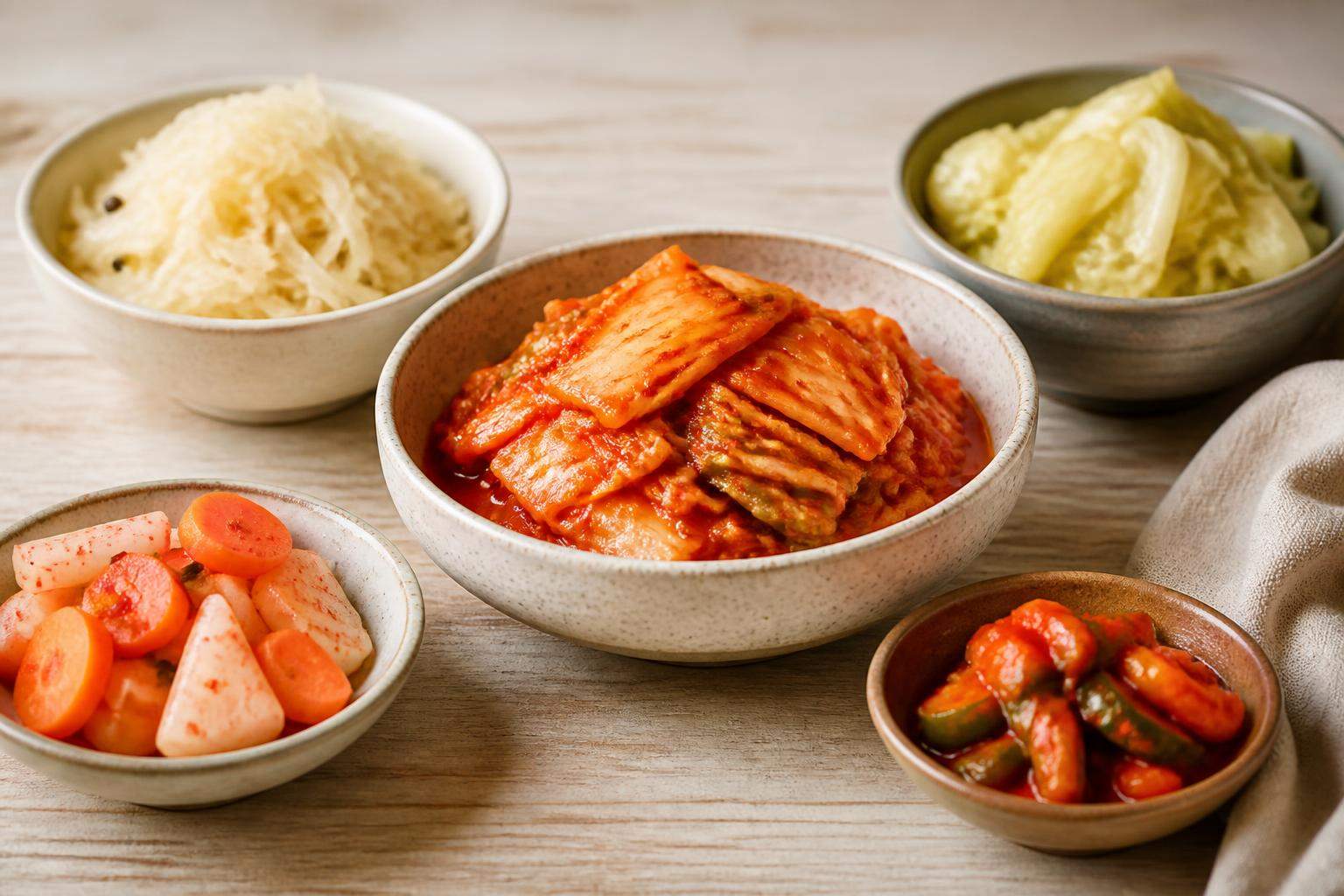
Par quoi remplacer le kimchi dans la majorité des recettes ? La choucroute crue non pasteurisée est la réponse la plus directe. Elle partage le même mécanisme de fermentation lactique et un profil bactérien très similaire.
Selon l’ANSES () [2], les aliments lacto-fermentés comme la choucroute contribuent à la diversité du microbiote intestinal. Une portion de 100 g apporte en moyenne 1 à 10 milliards d’UFC.
- Avantages : disponible partout, prix bas, goût acide proche
- Limite : moins piquante, absence de gochugaru (piment coréen)
- Astuce : ajoutez des flocons de piment et de l’huile de sésame pour vous rapprocher du kimchi
- Ratio de substitution : 1:1 dans toutes les recettes cuites ou crues
Pour explorer d’autres légumes lacto-fermentés aux propriétés similaires, plusieurs options s’offrent à vous selon votre région et vos goûts.
2. Le miso : l’alternative umami par excellence
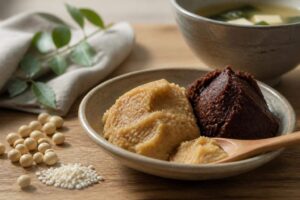
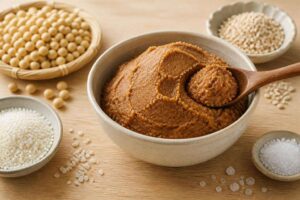
Par quoi remplacer le kimchi quand vous cherchez avant tout la profondeur umami ? Le miso non pasteurisé répond précisément à ce besoin. Cette pâte de soja fermentée japonaise concentre des acides aminés libres et des bactéries lactiques actives.
Une étude publiée dans le British Journal of Nutrition () [3] montre que la consommation régulière de miso améliore la diversité du microbiote chez 68 % des participants en 8 semaines. Le miso blanc (shiro) est le plus doux, le miso rouge (aka) le plus fermenté.
- Utilisez 1 cuillère à soupe de miso dilué pour remplacer 2 cuillères à soupe de kimchi dans les sauces
- Ne chauffez jamais le miso au-dessus de 70°C pour préserver les probiotiques
- Associez-le à du vinaigre de riz pour retrouver l’acidité du kimchi
3. Le tempeh : la densité nutritionnelle maximale
Par quoi remplacer le kimchi dans les plats chauds sans perdre les bénéfices nutritionnels ? Le tempeh, soja fermenté d’origine indonésienne, offre une densité protéique et probiotique remarquable.
Le tempeh contient du Rhizopus oligosporus, un champignon fermentaire qui améliore la biodisponibilité du zinc, du fer et des protéines végétales. Une portion de 100 g apporte 19 g de protéines complètes, selon les données de l’EFSA () [4].
- Idéal dans les woks, les bowls et les sandwichs
- Faites-le mariner dans de la sauce soja, du gingembre et du piment pour imiter le profil aromatique du kimchi
- Ratio : 80-100 g de tempeh pour remplacer une portion de kimchi comme accompagnement protéiné
4. Le kéfir de légumes : probiotiques liquides concentrés
Par quoi remplacer le kimchi sous forme liquide dans les vinaigrettes et les marinades ? Le kéfir de légumes (eau de fermentation de légumes) concentre des bactéries lactiques en suspension dans un liquide acide et légèrement pétillant.
De nombreux lecteurs nous signalent que l’eau de fermentation de leurs bocaux de légumes remplace avantageusement le kimchi dans les sauces de salade et les soupes froides. Cette astuce zéro déchet maximise l’apport probiotique sans coût supplémentaire.
- Utilisez 2 à 3 cuillères à soupe d’eau de lacto-fermentation dans vos vinaigrettes
- Ajoutez-la en fin de cuisson dans les soupes pour préserver les bactéries vivantes
- Combinez-la avec du tahini et du piment pour une sauce umami-probiotique complète
5. Les cornichons lacto-fermentés : l’option la plus accessible
Par quoi remplacer le kimchi en grande surface, sans chercher loin ? Les cornichons lacto-fermentés (à distinguer des cornichons au vinaigre industriel) sont disponibles en magasins bio et contiennent des bactéries vivantes comparables.
Vérifiez l’étiquette : un vrai cornichon lacto-fermenté ne contient que chou, sel et épices — jamais de vinaigre ajouté. Les cornichons au vinaigre sont pasteurisés et ne contiennent aucun probiotique actif.
- Hachez-les finement pour remplacer le kimchi dans les tacos, burgers et bowls
- Leur acidité naturelle imite bien celle du kimchi dans les recettes froides
- Associez-les à de la sauce sriracha pour retrouver le piquant caractéristique
Découvrez également quels sont les aliments probiotiques les plus efficaces pour diversifier vos sources quotidiennes.
Tableau comparatif : par quoi remplacer le kimchi selon votre usage
| Substitut | Probiotiques actifs | Saveur proche du kimchi | Idéal pour | Ratio de substitution |
|---|---|---|---|---|
| Choucroute crue | ⭐⭐⭐⭐⭐ | ⭐⭐⭐⭐ | Toutes recettes | 1:1 |
| Miso non pasteurisé | ⭐⭐⭐⭐ | ⭐⭐⭐ | Sauces, soupes | 1 c.à.s = 2 c.à.s kimchi |
| Tempeh | ⭐⭐⭐ | ⭐⭐ | Plats chauds, bowls | 100 g = 1 portion |
| Cornichons lacto-fermentés | ⭐⭐⭐⭐ | ⭐⭐⭐ | Sandwichs, tacos | 1:1 (haché) |
| Kéfir de légumes (eau) | ⭐⭐⭐⭐⭐ | ⭐⭐ | Vinaigrettes, marinades | 3 c.à.s = 1 portion |
| Pâte de gochujang | ⭐ | ⭐⭐⭐⭐⭐ | Saveur uniquement | 1 c.à.s = 2 c.à.s kimchi |
| Paprika + vinaigre de riz | ❌ | ⭐⭐⭐ | Recettes cuites | 1 c.à.c + 1 c.à.s |
| Brocoli blanchi + tofu | ❌ | ⭐⭐ | Texture uniquement | 1:1 en volume |
6. La pâte de gochujang : le substitut de saveur n°1
Par quoi remplacer le kimchi quand c’est uniquement la saveur piquante et umami qui compte ? La pâte de gochujang reproduit fidèlement le profil aromatique du kimchi sans les légumes ni la texture.
Le gochujang contient du capsaïcine, des sucres naturels issus du riz gluant et des protéines de soja fermenté. C’est le substitut de choix pour les marinades, les sauces de noodles et les plats sautés.
- Diluez 1 cuillère à soupe dans du bouillon ou du yaourt nature pour une sauce rapide
- Associez-le à du vinaigre de riz et de l’ail pour une imitation très proche du kimchi
- Disponible dans les épiceries asiatiques et de plus en plus en grande surface
7. Paprika, piment de Cayenne et flocons de piment : la solution d’urgence
Par quoi remplacer le kimchi quand vous n’avez rien d’autre sous la main ? Le paprika fumé combiné à du vinaigre de cidre et de l’ail en poudre constitue une solution rapide pour les recettes cuites où les probiotiques ne sont de toute façon pas préservés.
Cette combinaison est particulièrement efficace dans les ragoûts, les riz sautés et les soupes. Elle ne reproduit pas les bienfaits probiotiques mais imite la chaleur et la profondeur aromatique du kimchi.
- Mélangez 1 c.à.c de paprika fumé + 1 c.à.c de flocons de piment rouge
- Ajoutez 1 c.à.s de vinaigre de cidre non filtré
- Incorporez 1 gousse d’ail écrasée et 1 c.à.c de sauce soja
- Utilisez ce mélange comme base dans vos recettes chaudes
8. Brocoli blanchi et tofu soyeux : pour la texture
Par quoi remplacer le kimchi dans les recettes végétaliennes où c’est la texture croquante qui prime ? Le brocoli blanchi mélangé à du tofu soyeux écrasé, assaisonné d’huile de sésame et de sauce soja, imite la consistance du kimchi sans la fermentation.
Cette option est recommandée pour les personnes intolérantes aux aliments fermentés ou suivant un régime pauvre en histamine, car les aliments fermentés peuvent aggraver certaines intolérances alimentaires.
- Blanchissez le brocoli 2 minutes à l’eau bouillante pour conserver le croquant
- Écrasez 100 g de tofu soyeux avec 1 c.à.s d’huile de sésame et 1 c.à.s de sauce soja
- Ajoutez des graines de sésame et du piment pour la dimension aromatique
9. Le kombucha : alternative liquide riche en acides organiques
Par quoi remplacer le kimchi dans les marinades et les vinaigrettes ? Le kombucha non pasteurisé apporte l’acidité et les acides organiques caractéristiques des aliments fermentés.
Utilisez du kombucha nature ou au gingembre pour mariner du tofu, du poulet ou des légumes. L’acidité naturelle attendrit les protéines et apporte une dimension fermentée proche de celle du kimchi dans les recettes liquides.
- Remplacez le vinaigre de riz par du kombucha dans vos vinaigrettes asiatiques
- Utilisez-le comme base de marinade pour le poulet ou le porc avant cuisson
- Combinez-le avec du gochujang pour une marinade proche du kimchi
10. Le kéfir de lait : probiotiques et acidité en un seul aliment
Par quoi remplacer le kimchi comme source quotidienne de probiotiques ? Le kéfir de lait, avec ses 30 à 50 souches bactériennes distinctes, dépasse le kimchi en diversité probiotique selon une étude publiée dans le Nutrients () [5].
Il ne remplace pas le kimchi en termes de saveur ou de texture dans les recettes, mais constitue une excellente alternative fonctionnelle pour maintenir les bénéfices intestinaux quotidiens. Consommez 150 à 200 ml par jour pour un effet comparable.
Pour mieux comprendre comment la flore intestinale réagit aux probiotiques, il est utile de savoir que la diversité des souches compte autant que la quantité.
Par quoi remplacer le kimchi selon la recette
Par quoi remplacer le kimchi varie selon le type de plat. Voici les recommandations spécifiques par usage culinaire :
- Riz sauté (kimchi fried rice) : choucroute crue + gochujang + huile de sésame — ratio 1:1
- Soupe (kimchi jjigae) : choucroute + miso rouge + bouillon de légumes épicé
- Pancakes (kimchi jeon) : choucroute finement hachée + flocons de piment + oignons verts
- Tacos et burgers : cornichons lacto-fermentés hachés + sauce sriracha
- Bowls et salades : choucroute crue ou tempeh mariné au gochujang
- Marinades : kombucha au gingembre + piment + ail + sauce soja
Si vous souhaitez explorer d’autres façons d’utiliser le kimchi avant de le remplacer, consultez notre guide sur avec quoi manger du kimchi pour découvrir des associations inattendues.
Par quoi remplacer le kimchi sans gluten ni soja
Par quoi remplacer le kimchi pour les personnes allergiques au gluten ou au soja ? La choucroute crue reste la meilleure option : naturellement sans gluten, sans soja, et riche en probiotiques actifs.
Les personnes cœliaques doivent vérifier que le kimchi du commerce ne contient pas de sauce de poisson avec additifs ou de pâte de soja fermenté. La choucroute artisanale ne contient que chou et sel, ce qui en fait l’alternative la plus sûre.
- Choucroute crue : sans gluten, sans soja, sans allergènes majeurs
- Cornichons lacto-fermentés : sans gluten si préparés sans additifs
- Kéfir de légumes : naturellement exempt de gluten et de soja
- Évitez le miso et le tempeh si vous êtes allergique au soja
Substituts pour les personnes sensibles à l’histamine
Par quoi remplacer le kimchi en cas d’intolérance à l’histamine ? Les aliments fermentés, dont le kimchi, sont naturellement riches en histamine. Les personnes concernées doivent éviter la choucroute, le miso et le kéfir.
Dans ce cas précis, les meilleures alternatives sont les légumes frais assaisonnés d’épices fraîches. Le brocoli blanchi avec de l’ail frais, du citron et du piment frais reproduit la dimension aromatique sans histamine.
- Brocoli + ail frais + jus de citron + piment frais : zéro histamine
- Chou cru assaisonné de vinaigre de pomme fraîchement préparé (consommé immédiatement)
- Carottes râpées + gingembre frais + huile de sésame : texture croquante similaire
L’impact des substituts sur le microbiote intestinal
Par quoi remplacer le kimchi en préservant au maximum les effets sur le microbiote intestinal ? La recherche indique que la diversité des sources probiotiques compte plus que la quantité d’un seul aliment.
Le NCCIH () recommande de varier les sources de probiotiques plutôt que de se concentrer sur un seul aliment fermenté. Combiner choucroute, miso et kéfir sur la semaine produit un effet plus bénéfique qu’une consommation quotidienne exclusive de kimchi.
Pour approfondir ce sujet, notre article sur les aliments probiotiques détaille les sources les plus efficaces classées par densité bactérienne.
- Par quoi remplacer le kimchi en priorité : la choucroute crue non pasteurisée, avec un ratio 1:1 dans toutes les recettes.
- Par quoi remplacer le kimchi pour la saveur umami : le miso non pasteurisé ou la pâte de gochujang.
- Par quoi remplacer le kimchi pour les probiotiques : le kéfir de légumes ou le kéfir de lait offrent la plus grande diversité bactérienne.
- Par quoi remplacer le kimchi sans allergènes : la choucroute artisanale (chou + sel uniquement) est l’option la plus sûre.
- Par quoi remplacer le kimchi en cas d’intolérance à l’histamine : brocoli blanchi + épices fraîches, sans fermentation.
Questions fréquentes sur par quoi remplacer le kimchi
Par quoi remplacer le kimchi dans le riz sauté ?
Par quoi remplacer le kimchi dans le riz sauté ? La choucroute crue finement hachée, mélangée à une cuillère à soupe de gochujang et d’huile de sésame, est le substitut le plus fidèle. Faites-la sauter 2 minutes avant d’ajouter le riz pour développer les arômes.
Peut-on remplacer le kimchi par de la choucroute dans toutes les recettes ?
Oui, la choucroute crue non pasteurisée remplace le kimchi dans la quasi-totalité des recettes avec un ratio 1:1. Ajoutez du piment et de l’huile de sésame pour vous rapprocher du profil aromatique coréen. Évitez la choucroute en conserve pasteurisée, qui ne contient aucun probiotique actif.
Par quoi remplacer le kimchi pour les probiotiques ?
Par quoi remplacer le kimchi pour les probiotiques uniquement ? Le kéfir de lait (150-200 ml/jour) et le kéfir de légumes offrent une diversité bactérienne supérieure au kimchi, avec 30 à 50 souches différentes. Le miso non pasteurisé et la choucroute crue sont également d’excellentes sources.
Le miso peut-il remplacer le kimchi dans une soupe ?
Le miso remplace efficacement le kimchi dans les soupes pour la profondeur umami et les probiotiques. Utilisez 1 cuillère à soupe de miso rouge dilué dans le bouillon chaud (jamais bouillant) pour préserver les bactéries vivantes. Ajoutez du piment pour retrouver le piquant du kimchi.
Par quoi remplacer le kimchi dans un burger ou un taco ?
Les cornichons lacto-fermentés hachés, associés à de la sauce sriracha, remplacent parfaitement le kimchi dans les burgers et tacos. Ils apportent l’acidité croquante et le piquant caractéristiques. Vérifiez que vos cornichons sont bien lacto-fermentés et non au vinaigre industriel.
Quelle est la différence entre kimchi et choucroute sur le plan nutritionnel ?
Le kimchi et la choucroute partagent le même mécanisme de lacto-fermentation. Le kimchi contient en plus du gochugaru (piment), de l’ail, du gingembre et souvent de la sauce de poisson, ce qui lui confère un profil aromatique plus complexe. La choucroute est plus neutre et plus accessible. Les deux offrent des probiotiques comparables.
Par quoi remplacer le kimchi si on est végétalien ?
Par quoi remplacer le kimchi en version végétalienne ? La choucroute crue, le miso de riz (sans soja), le tempeh et les cornichons lacto-fermentés sont tous végétaliens. Vérifiez que le kimchi du commerce ne contient pas de sauce de poisson ou de crevettes fermentées, présentes dans la recette traditionnelle.
Le gochujang remplace-t-il vraiment le kimchi ?
Le gochujang remplace le kimchi uniquement pour la saveur piquante et umami, pas pour les probiotiques ni la texture. C’est le meilleur substitut dans les recettes cuites où les bactéries seraient de toute façon détruites par la chaleur. Pour les recettes froides, préférez la choucroute crue.
Par quoi remplacer le kimchi en cas de régime pauvre en sel ?
Le kimchi et la choucroute sont tous deux riches en sodium. En cas de régime hyposodé, le brocoli blanchi assaisonné de vinaigre de riz, de gingembre frais et de piment constitue la meilleure alternative. Le tempeh non salé est également une option valable pour les plats chauds.
Combien de temps se conserve la choucroute crue en substitut du kimchi ?
La choucroute crue non pasteurisée se conserve 3 à 6 mois au réfrigérateur dans un bocal hermétique immergée dans sa saumure. Une fois ouverte, consommez-la dans les 4 à 6 semaines. Elle continue à fermenter lentement au froid, ce qui peut intensifier son acidité avec le temps.
Par quoi remplacer le kimchi dans la kimchi jjigae (soupe coréenne) ?
Par quoi remplacer le kimchi dans la kimchi jjigae ? Mélangez 200 g de choucroute crue + 2 cuillères à soupe de gochujang + 1 cuillère à soupe de miso rouge dans votre bouillon. Ajoutez du tofu ferme, des champignons shiitake et de l’oignon vert pour une soupe très proche de l’originale.
Le kombucha peut-il remplacer le kimchi comme boisson probiotique ?
Le kombucha ne remplace pas le kimchi comme condiment ou accompagnement, mais il constitue une excellente alternative liquide pour l’apport quotidien en probiotiques et en acides organiques. Consommez 150 à 250 ml de kombucha non pasteurisé par jour pour un effet comparable sur le microbiote intestinal.
Ce qu’il faut retenir
Par quoi remplacer le kimchi dépend de votre objectif : la choucroute crue reste le substitut universel le plus efficace, à la fois pour les probiotiques et la polyvalence culinaire. Par quoi remplacer le kimchi pour la saveur seule ? Le gochujang ou le miso répondent à ce besoin précis sans nécessiter de fermentation.
La clé est de ne pas chercher un substitut parfait unique, mais de combiner plusieurs aliments fermentés sur la semaine pour maximiser la diversité de votre microbiote intestinal. Choucroute le lundi, miso le mercredi, kéfir le vendredi : cette rotation produit des effets supérieurs à la consommation exclusive d’un seul aliment fermenté.
Action concrète : dès cette semaine, achetez un bocal de choucroute crue bio non pasteurisée et intégrez-en 2 cuillères à soupe dans votre prochain repas. C’est le premier pas le plus simple et le plus efficace pour remplacer le kimchi dans votre alimentation quotidienne.
Sources et études
- Microbial Community and Metabolite Profiles of Kimchi — Journal of Microbiology and Biotechnology,
- Les aliments fermentés et le microbiote intestinal — ANSES,
- Fermented soy products and gut microbiota diversity — British Journal of Nutrition,
- Nutritional profiles of fermented plant foods — EFSA,
- Kefir and gut microbiome diversity: a randomized controlled trial — Nutrients,
Cet article est fourni à titre informatif uniquement et ne constitue pas un avis médical. Consultez un professionnel de santé qualifié avant toute utilisation.