Où acheter du kimchi en France : les meilleures adresses
⚠️ Avis médical : Les informations contenues dans cet article sont fournies à titre informatif uniquement et ne remplacent pas l’avis d’un professionnel de santé. Consultez votre médecin ou diététicien avant de modifier votre alimentation de façon significative.
Où acheter du kimchi : vous pouvez trouver du kimchi dans les supermarchés Carrefour et Monoprix, dans les épiceries bio comme Biocoop, dans les épiceries asiatiques et coréennes, ainsi que sur des boutiques en ligne spécialisées comme Koreastore.fr. Une étude publiée dans le Journal of Microbiology and Biotechnology () [1] recense plus de 200 souches de probiotiques actives dans le kimchi traditionnel.
- Supermarchés : Carrefour, Monoprix, Auchan — rayon produits du monde ou frais
- Épiceries bio : Biocoop, La Vie Claire — kimchi lactofermenté non pasteurisé
- Épiceries asiatiques : Tang Frères, K-Mart Paris — kimchi coréen authentique
- Boutiques en ligne : Koreastore.fr, Amazon, iHerb — livraison à domicile
- Marchés locaux : producteurs artisanaux de légumes lactofermentés
1. Où acheter du kimchi en supermarché : ce qui est disponible
Où acheter du kimchi sans chercher loin ? Les grandes surfaces sont votre premier réflexe. Carrefour propose le kimchi fermenté épicé Tanoshi (330 g) dans son rayon produits asiatiques ou épicerie du monde. Monoprix et Auchan référencent également des marques similaires selon les régions.
Ces produits sont souvent pasteurisés, ce qui prolonge leur durée de vie mais réduit la concentration en bactéries lactiques vivantes. Ils conviennent parfaitement à une découverte du goût kimchi.
- Carrefour : Tanoshi Kimchi Fermenté Épicé, 330 g, rayon épicerie du monde
- Monoprix : disponibilité variable selon les magasins
- Auchan : marques asiatiques importées, rayon surgelés ou conserves
- Leclerc : parfois disponible en rayon bio ou produits du monde
- Intermarché : offre limitée, vérifiez en ligne avant de vous déplacer
Conseil pratique : vérifiez l’étiquette. Un kimchi pasteurisé contient peu ou pas de lactobacilles vivants. Si vous cherchez les bienfaits probiotiques documentés, orientez-vous vers les alternatives non pasteurisées.
2. Où acheter du kimchi bio et lactofermenté : Biocoop et La Vie Claire
Où acheter du kimchi avec des probiotiques vivants ? Les épiceries bio sont votre meilleure option. Biocoop distribue le kimchi lactofermenté Nutriform (380 g), préparé à base de chou et de carottes selon la méthode traditionnelle coréenne.
La lactofermentation naturelle préserve les bactéries lactiques actives. Selon une étude publiée dans Food Chemistry () [2], le kimchi non pasteurisé peut contenir jusqu’à 108 UFC/g de bactéries bénéfiques.
- Biocoop : kimchi Nutriform 380 g, rayon conserves de légumes
- La Vie Claire : kimchi bio en pot, disponibilité selon les magasins
- Naturalia : gamme de légumes lactofermentés incluant le kimchi
- Bio c’ Bon : sélection de produits fermentés coréens et européens
Les légumes lactofermentés comme le kimchi sont reconnus pour leur richesse en acide lactique et en enzymes digestives. La Vie Claire et Naturalia proposent souvent des kimchis français artisanaux, produits localement avec du chou de saison.
3. Épiceries asiatiques et coréennes : où acheter du kimchi authentique
Où acheter du kimchi coréen authentique en France ? Les épiceries asiatiques spécialisées offrent la sélection la plus large. À Paris, Tang Frères (13e arrondissement) et K-Mart (Opéra) proposent des kimchis importés directement de Corée du Sud.
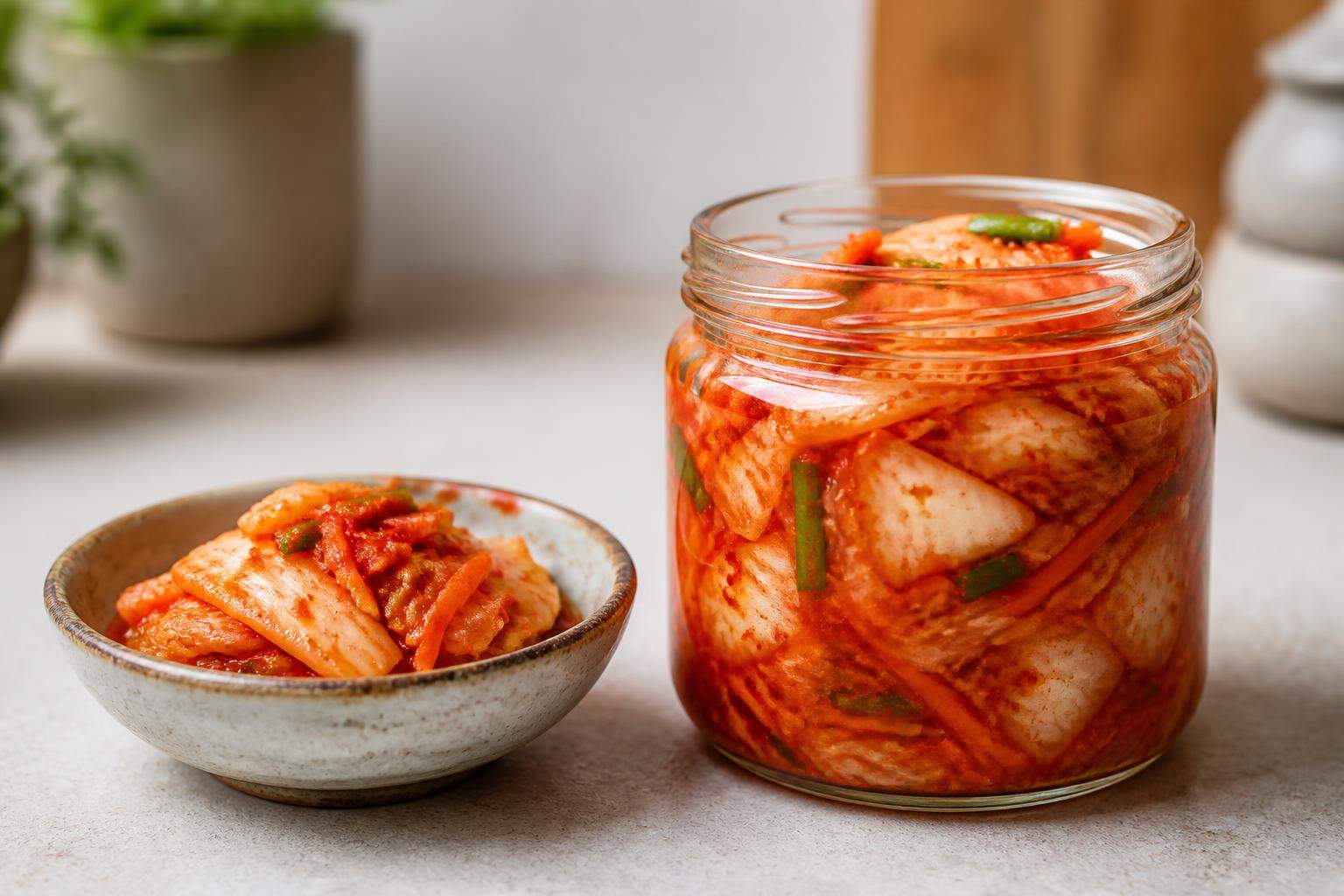
Ces produits sont souvent réfrigérés et non pasteurisés, ce qui garantit une flore microbienne active. Vous y trouverez plusieurs variétés : kimchi de chou napa (baechu-kimchi), kimchi de radis (kkakdugi), ou kimchi de concombre (oi-sobagi).
- Tang Frères (Paris 13e) : large choix de kimchis réfrigérés coréens
- K-Mart Paris (Opéra) : marques coréennes importées, pots de 500 g à 2 kg
- Épiceries coréennes indépendantes : présentes à Lyon, Marseille, Bordeaux
- Marchés asiatiques régionaux : vérifiez les marchés hebdomadaires de votre ville
- Épiceries chinoises de quartier : proposent souvent du kimchi en pot réfrigéré
Qu’est-ce que le kimchi exactement ? C’est un condiment coréen fermenté à base de légumes, de piment (gochugaru), d’ail et de gingembre. Sa préparation artisanale garantit une diversité microbienne supérieure aux versions industrielles.
4. Où acheter du kimchi en ligne : les meilleures boutiques
Où acheter du kimchi depuis chez vous ? Plusieurs boutiques en ligne livrent du kimchi en France en 24 à 72 heures. Koreastore.fr est la référence française pour le kimchi coréen pasteurisé stabilisé, livrable partout en France métropolitaine.
La pasteurisation utilisée par Koreastore stoppe la fermentation active mais garantit une conservation longue durée sans réfrigération pendant le transport. D’autres plateformes proposent du kimchi vivant expédié en colis réfrigéré.
| Boutique | Type de kimchi | Prix indicatif | Livraison | Probiotiques vivants |
|---|---|---|---|---|
| Koreastore.fr | Pasteurisé / stabilisé | 6–12 € / 500 g | France entière | Non (pasteurisé) |
| Amazon.fr | Pasteurisé (marques variées) | 5–15 € / 300–500 g | France entière | Non (pasteurisé) |
| iHerb.com | Pasteurisé (marques US/KR) | 8–18 € / 400 g | France (délai 5–10 j) | Non (pasteurisé) |
| Biocoop.fr | Lactofermenté non pasteurisé | 5–9 € / 380 g | Click & collect | Oui |
| Artisans locaux (Etsy, Leboncoin) | Artisanal vivant | 10–20 € / 500 g | Variable | Oui |
Pour les probiotiques vivants, privilégiez les commandes avec livraison réfrigérée. Vérifiez toujours la date de fabrication : un kimchi lactofermenté se consomme idéalement dans les 3 à 6 mois suivant sa production.
5. Marchés et producteurs artisanaux : où acheter du kimchi local
Où acheter du kimchi produit en France ? Les marchés locaux et les producteurs artisanaux représentent une alternative de plus en plus populaire. De nombreux fermenteurs français proposent du kimchi à base de légumes locaux, souvent bio et de saison.
Ces kimchis français sont généralement non pasteurisés et riches en bactéries lactiques vivantes. Ils se distinguent par leur profil aromatique différent du kimchi coréen traditionnel, avec parfois moins de piment.
- Marchés biologiques hebdomadaires : cherchez les stands de légumes fermentés
- AMAP (Association pour le Maintien d’une Agriculture Paysanne) : certains producteurs proposent du kimchi saisonnier
- Épiceries de quartier zéro déchet : souvent partenaires de fermenteurs locaux
- Réseaux sociaux : des fermenteurs artisanaux vendent en direct sur Instagram et Facebook
Les bienfaits du kimchi documentés par la science incluent un soutien au microbiote intestinal, une action anti-inflammatoire et un apport en vitamines C et K. Ces effets sont maximisés avec un kimchi non pasteurisé.
6. Comment choisir un bon kimchi : pasteurisé vs non pasteurisé
Savoir où acheter du kimchi ne suffit pas : encore faut-il choisir le bon produit. La distinction principale est entre kimchi pasteurisé et kimchi non pasteurisé (kimchi vivant).
Le kimchi pasteurisé est plus pratique à stocker et à transporter. Le kimchi non pasteurisé contient des bactéries lactiques vivantes, notamment Lactobacillus plantarum, Leuconostoc mesenteroides et Lactobacillus brevis, documentées pour leurs effets sur la santé intestinale selon l’ANSES () [3].
- Kimchi pasteurisé : longue conservation, goût stable, peu ou pas de probiotiques vivants
- Kimchi lactofermenté vivant : probiotiques actifs, conservation au réfrigérateur (3–6 mois)
- Kimchi artisanal : diversité microbienne maximale, profil nutritionnel supérieur
- Kimchi industriel : standardisé, accessible, mais souvent avec additifs
Lisez toujours la liste des ingrédients. Un kimchi de qualité contient : chou napa, piment coréen, ail, gingembre, sel marin, sauce de poisson ou pâte de crevettes (ou leur équivalent végétalien). Évitez les produits avec conservateurs artificiels ou vinaigre ajouté.
7. Quel prix pour le kimchi en France : budget et rapport qualité-prix
Où acheter du kimchi au meilleur prix ? Le budget varie selon le type et la source. Un kimchi pasteurisé en supermarché coûte entre 3 et 8 euros pour 300 à 400 g. Un kimchi artisanal non pasteurisé peut atteindre 15 à 20 euros pour 500 g.
De nombreux lecteurs nous signalent que le rapport qualité-prix est nettement meilleur dans les épiceries asiatiques, où des pots de 1 kg de kimchi coréen importé sont disponibles entre 8 et 15 euros.
- Supermarché (pasteurisé) : 3–8 € / 300–400 g
- Épicerie bio (lactofermenté) : 5–10 € / 380 g
- Épicerie asiatique (coréen importé) : 8–15 € / 1 kg
- Boutique en ligne spécialisée : 6–18 € / 500 g + frais de port
- Artisanal local : 10–20 € / 500 g
- Fait maison : 1–3 € / kg (coût des ingrédients uniquement)
8. Faire son kimchi maison : l’alternative économique
Où acheter du kimchi quand vous ne trouvez pas ce qu’il vous faut ? La réponse est parfois dans votre cuisine. Faire son propre kimchi est plus simple qu’il n’y paraît et garantit un produit vivant, sans additifs, au coût le plus bas.
Les ingrédients de base sont disponibles dans tous les supermarchés : chou chinois (napa), sel, ail, gingembre. Le piment coréen (gochugaru) se trouve dans les épiceries asiatiques ou en ligne. La fermentation dure 1 à 5 jours à température ambiante.
La recette complète pour faire du kimchi maison détaille chaque étape, du salage du chou à la mise en pot. Un kimchi maison bien préparé contient une diversité microbienne exceptionnelle, comparable aux meilleures préparations artisanales.
9. Kimchi et probiotiques : ce que dit la science
Où acheter du kimchi avec le plus de probiotiques ? La réponse dépend du procédé de fabrication. Une méta-analyse publiée dans Nutrients () [4] confirme que le kimchi non pasteurisé contient des souches de Lactobacillus spp. associées à une réduction de l’inflammation intestinale et à une amélioration de la diversité du microbiote.
L’EFSA reconnaît les bactéries lactiques issues de la fermentation alimentaire comme GRAS et sans risque pour la population générale en bonne santé [5].
- Lactobacillus plantarum : souche dominante, effets anti-inflammatoires documentés
- Leuconostoc mesenteroides : produit de l’acide lactique et des bactériocines naturelles
- Lactobacillus brevis : contribue à la production de vitamines B
- Weissella confusa : souche spécifique au kimchi, étudiée pour ses effets immunitaires
Les aliments probiotiques les plus efficaces incluent le kimchi, le kéfir, le kombucha et le miso. Le kimchi se distingue par sa richesse en fibres prébiotiques issues du chou, qui nourrissent les bactéries bénéfiques déjà présentes dans votre intestin.
10. Comment conserver le kimchi après achat
Où acheter du kimchi est une chose, bien le conserver en est une autre. Un kimchi non pasteurisé se conserve au réfrigérateur dans un contenant hermétique. La fermentation continue lentement au froid, ce qui intensifie progressivement le goût.
- Réfrigérateur (0–4 °C) : conservation optimale, 3 à 6 mois après ouverture
- Non ouvert au frais : jusqu’à 12 mois pour un kimchi lactofermenté artisanal
- Kimchi pasteurisé non ouvert : selon la date limite indiquée, souvent 12–24 mois
- Congélateur : possible mais déconseillé — détruit les bactéries vivantes
- Température ambiante : à éviter après ouverture — accélère la fermentation et l’acidification
Un kimchi qui dégage une forte odeur acide n’est pas forcément mauvais : c’est le signe d’une fermentation avancée. Goûtez-le. S’il est très acide, utilisez-le en cuisine (soupe kimchi, riz sauté) plutôt qu’en condiment cru.
11. Quelles variétés de kimchi acheter selon vos besoins
Où acheter du kimchi adapté à vos préférences ? Plusieurs variétés existent, chacune avec un profil nutritionnel et gustatif distinct. Le kimchi de chou napa (baechu-kimchi) est le plus courant et le plus facile à trouver en France.
- Baechu-kimchi (chou napa) : le classique, disponible partout, riche en fibres et probiotiques
- Kkakdugi (radis) : texture croquante, plus doux en goût, idéal pour débuter
- Oi-sobagi (concombre) : frais et léger, saisonnier, rare en France
- Kimchi blanc (baek-kimchi) : sans piment, idéal pour les personnes sensibles aux épices
- Kimchi végétalien : sans sauce de poisson ni crevettes, de plus en plus disponible en bio
12. Kimchi et digestion : pourquoi les nutritionnistes le recommandent
Où acheter du kimchi pour améliorer sa digestion ? N’importe quelle source proposant un kimchi non pasteurisé de qualité. Les bactéries lactiques vivantes du kimchi soutiennent la production d’enzymes digestives et renforcent la barrière intestinale.
Une étude publiée dans le Journal of Ethnic Foods () [1] montre que la consommation régulière de kimchi (75 g par jour pendant 4 semaines) améliore significativement la diversité du microbiote intestinal chez les adultes en bonne santé.
Les légumes lactofermentés comme le kimchi apportent également des prébiotiques naturels issus du chou. Cette combinaison probiotiques + prébiotiques est ce que les nutritionnistes appellent un effet symbiotique.
13. Kimchi végétalien : où acheter du kimchi sans produits animaux
Où acheter du kimchi végétalien en France ? La version traditionnelle contient de la sauce de poisson ou de la pâte de crevettes. Mais les alternatives végétaliennes se multiplient dans les épiceries bio et les boutiques en ligne.
- Biocoop et Naturalia : proposent souvent des kimchis végétaliens certifiés bio
- Boutiques en ligne spécialisées : Koreastore propose des versions végétaliens sur demande
- Artisans locaux : la plupart des fermenteurs français proposent des versions vegan
- Fait maison : remplacez la sauce de poisson par de la sauce soja ou du miso
14. Les erreurs à éviter quand vous achetez du kimchi
Où acheter du kimchi sans se tromper ? Évitez ces erreurs fréquentes que font les nouveaux consommateurs. La première est de confondre kimchi pasteurisé et kimchi vivant sur l’étiquette.
- Ne pas lire les ingrédients : certains produits contiennent du vinaigre ajouté (signe d’un kimchi industriel non fermenté)
- Acheter uniquement sur le prix : le kimchi le moins cher est souvent le moins riche en probiotiques
- Ignorer la date de fabrication : un kimchi trop ancien peut être sur-fermenté et très acide
- Conserver à température ambiante après ouverture : accélère la dégradation
- Confondre kimchi et chou sauerkraut : deux produits fermentés différents avec des profils microbiens distincts
- Où acheter du kimchi en supermarché : Carrefour (Tanoshi), Monoprix, Auchan — produits pasteurisés pratiques mais pauvres en probiotiques vivants.
- Où acheter du kimchi bio non pasteurisé : Biocoop (Nutriform 380 g), La Vie Claire, Naturalia — meilleur choix pour les bénéfices probiotiques.
- Où acheter du kimchi coréen authentique : épiceries asiatiques (Tang Frères, K-Mart Paris) et boutiques en ligne comme Koreastore.fr.
- Où acheter du kimchi artisanal vivant : marchés bio locaux, producteurs artisanaux, réseaux sociaux de fermenteurs français.
- Où acheter du kimchi au meilleur rapport qualité-prix : épiceries asiatiques (8–15 € / kg) ou fait maison (1–3 € / kg).
Questions fréquentes sur où acheter du kimchi
Où acheter du kimchi près de chez moi ?
Où acheter du kimchi localement ? Commencez par vérifier les supermarchés de votre quartier (Carrefour, Monoprix, Leclerc) dans le rayon épicerie du monde. Les épiceries bio comme Biocoop et Naturalia en proposent presque systématiquement. Utilisez Google Maps avec la recherche « épicerie asiatique » pour trouver des boutiques spécialisées près de chez vous.
Où acheter du kimchi non pasteurisé en France ?
Où acheter du kimchi vivant avec des probiotiques actifs ? Biocoop est votre meilleure option en grande distribution bio. Les épiceries coréennes et asiatiques proposent souvent du kimchi réfrigéré non pasteurisé. Les fermenteurs artisanaux locaux et les marchés bio sont également d’excellentes sources.
Peut-on acheter du kimchi sur Amazon ?
Oui, Amazon.fr propose plusieurs marques de kimchi, principalement pasteurisé. Les délais de livraison standard (24–48 h) conviennent bien aux produits pasteurisés. Pour du kimchi vivant non pasteurisé, préférez une boutique spécialisée avec livraison réfrigérée.
Où acheter du kimchi coréen authentique en France ?
Où acheter du kimchi coréen importé ? Tang Frères (Paris 13e), K-Mart (Paris Opéra) et les épiceries coréennes indépendantes dans les grandes villes françaises. En ligne, Koreastore.fr est la référence française pour les produits coréens authentiques, avec livraison en France métropolitaine.
Quel est le prix moyen du kimchi en France ?
Le prix d’un kimchi varie entre 3 et 20 euros selon le type et la source. Un kimchi pasteurisé en supermarché coûte 3 à 8 euros pour 300–400 g. Un kimchi artisanal non pasteurisé de qualité coûte 10 à 20 euros pour 500 g. Le meilleur rapport qualité-prix se trouve souvent dans les épiceries asiatiques.
Le kimchi vendu en supermarché contient-il des probiotiques vivants ?
La plupart des kimchis vendus en supermarché sont pasteurisés, ce qui élimine les bactéries vivantes. Pour bénéficier des probiotiques documentés par la recherche scientifique, choisissez un kimchi lactofermenté non pasteurisé, disponible en épicerie bio ou chez les artisans fermenteurs.
Où acheter du kimchi végétalien ?
Les épiceries bio (Biocoop, Naturalia) proposent souvent des kimchis végétaliens sans sauce de poisson ni crevettes. Les fermenteurs artisanaux français produisent majoritairement des versions vegan. En ligne, filtrez les recherches avec « kimchi vegan » ou « kimchi végétalien » pour trouver les bonnes références.
Comment savoir si un kimchi est de bonne qualité ?
Un kimchi de qualité contient des ingrédients simples : chou, sel, piment, ail, gingembre. Évitez les produits avec vinaigre ajouté, conservateurs artificiels ou colorants. Un kimchi non pasteurisé doit être conservé au réfrigérateur et peut légèrement pétiller — signe d’une fermentation active.
Peut-on acheter du kimchi en vrac ?
Oui, certaines épiceries asiatiques et coréennes vendent du kimchi en vrac ou en grands pots (1 à 5 kg). C’est l’option la plus économique pour les consommateurs réguliers. Apportez votre propre contenant hermétique ou demandez un pot avec couvercle.
Où acheter du kimchi à Lyon, Marseille ou Bordeaux ?
Toutes les grandes villes françaises disposent d’épiceries asiatiques proposant du kimchi. À Lyon, le quartier de la Guillotière concentre de nombreuses épiceries asiatiques. À Marseille, le quartier de Belsunce et Noailles. À Bordeaux, cherchez dans le quartier Saint-Michel. Les épiceries bio de ces villes proposent également du kimchi lactofermenté.
Le kimchi maison est-il meilleur que le kimchi acheté ?
D’un point de vue nutritionnel, un kimchi maison bien préparé est souvent supérieur aux versions industrielles pasteurisées. Il contient une diversité microbienne maximale et aucun additif. La préparation prend environ 30 minutes, suivie de 1 à 5 jours de fermentation à température ambiante.
Où acheter du kimchi en dehors des grandes villes ?
Où acheter du kimchi en zone rurale ou dans les petites villes ? Les boutiques en ligne comme Koreastore.fr et Amazon.fr livrent partout en France. Biocoop dispose d’un réseau de plus de 700 magasins en France, y compris dans les villes moyennes. Les marchés bio hebdomadaires sont également une bonne option dans les zones périurbaines.
Ce qu’il faut retenir
Où acheter du kimchi en France ? Vous avez maintenant toutes les options : supermarchés pour la praticité, épiceries bio pour les probiotiques vivants, épiceries asiatiques pour l’authenticité coréenne, et boutiques en ligne pour la commodité. Où acheter du kimchi de qualité optimale ? Privilégiez un kimchi lactofermenté non pasteurisé, disponible chez Biocoop, dans les épiceries coréennes ou directement auprès de fermenteurs artisanaux locaux.
Votre action concrète cette semaine : rendez-vous dans votre Biocoop ou épicerie asiatique la plus proche, comparez deux kimchis (pasteurisé vs non pasteurisé), et commencez par 2 à 3 cuillères à soupe par jour pour habituer votre microbiote. Si vous ne trouvez rien localement, Koreastore.fr livre en 48 heures.
Sources et études
- Health Benefits of Kimchi as a Probiotic Food — Journal of Microbiology and Biotechnology,
- Microbial Community Analysis of Kimchi During Fermentation — Food Chemistry,
- Probiotiques et santé intestinale : évaluation des risques et bénéfices — ANSES,
- Effects of Kimchi Consumption on the Gut Microbiota — Nutrients,
- Scientific Opinion on the Safety of Lactic Acid Bacteria in Fermented Foods — EFSA,
Cet article est fourni à titre informatif uniquement et ne constitue pas un avis médical. Consultez un professionnel de santé qualifié avant toute utilisation.