Miso fermenté : bienfaits, types et comment l’utiliser
⚠️ Avertissement médical : Les informations contenues dans cet article sont fournies à titre informatif uniquement et ne remplacent pas l’avis d’un professionnel de santé qualifié. Consultez votre médecin avant de modifier votre alimentation, notamment si vous souffrez d’une allergie au soja ou d’une pathologie chronique.
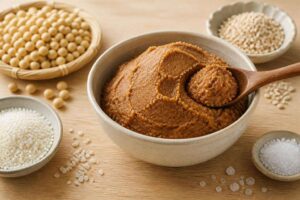
Le miso fermenté est une pâte traditionnelle japonaise obtenue par fermentation de graines de soja avec un champignon appelé kōji, produisant une source concentrée de probiotiques, d’acides aminés et d’enzymes digestives bénéfiques pour la santé intestinale. Selon une étude publiée dans le Journal of Nutritional Science and Vitaminology () [1], une consommation régulière de miso fermenté est associée à une réduction significative du risque de maladies cardiovasculaires dans les populations japonaises.
- Source naturelle de probiotiques et de prébiotiques
- Riche en acides aminés essentiels et en protéines complètes
- Contient des vitamines du groupe B, dont la vitamine B12
- Apporte des minéraux clés : zinc, manganèse, cuivre
- Associé à des effets anti-inflammatoires dans plusieurs études cliniques
Qu’est-ce que le miso fermenté exactement ?
Le miso fermenté est une pâte condimentaire d’origine japonaise fabriquée à partir de graines de soja, de sel marin et d’un ferment naturel appelé kōji (Aspergillus oryzae). La fermentation dure de quelques semaines à plusieurs années selon le type de miso. Ce processus transforme les protéines du soja en acides aminés libres, les glucides en sucres simples et produit des enzymes actives ainsi que des micro-organismes vivants.
Le miso fermenté se distingue des condiments ordinaires par sa richesse biochimique exceptionnelle. Il contient simultanément des probiotiques, des prébiotiques, des antioxydants et des composés bioactifs comme les isoflavones de soja. C’est cette combinaison unique qui explique l’intérêt croissant de la recherche nutritionnelle pour cet aliment.
La tradition japonaise distingue plusieurs types de miso fermenté selon les ingrédients et la durée de fermentation. Chaque variété possède un profil nutritionnel et gustatif distinct, du shiro miso doux et sucré à l’aka miso intense et umami.
Les 5 types de miso fermenté et leurs différences
Tous les misos ne se valent pas sur le plan nutritionnel. La durée et les conditions de fermentation influencent directement la concentration en probiotiques et en composés bioactifs.
| Type de miso | Durée de fermentation | Couleur | Saveur | Teneur en sel |
|---|---|---|---|---|
| Shiro miso (blanc) | 1 à 3 mois | Crème à jaune pâle | Douce, légèrement sucrée | 5 à 7 % |
| Shinshu miso (jaune) | 3 à 12 mois | Jaune à brun clair | Équilibrée, polyvalente | 10 à 12 % |
| Aka miso (rouge) | 1 à 3 ans | Brun rouge à foncé | Intense, salée, umami | 12 à 14 % |
| Mugi miso (orge) | 1 à 2 ans | Brun moyen | Terreuse, légèrement sucrée | 9 à 11 % |
| Hatcho miso | 2 à 3 ans minimum | Très foncé, presque noir | Très intense, amère | 10 à 11 % |
Le miso fermenté à longue maturation, comme le hatcho miso, contient généralement une concentration plus élevée en acides aminés libres et en composés antioxydants. En revanche, le shiro miso présente une teneur en sodium plus faible, ce qui le rend préférable pour les personnes surveillant leur apport en sel.
7 bienfaits prouvés du miso fermenté pour la santé
Le miso fermenté bénéficie d’un corpus scientifique solide, notamment issu des études épidémiologiques japonaises. Voici les effets les mieux documentés.
1. Soutien du microbiote intestinal
Le miso fermenté contient des souches de Lactobacillus et d’autres bactéries lactiques bénéfiques pour la flore intestinale. Une étude publiée dans le British Journal of Nutrition () [2] a montré qu’une consommation régulière de miso fermenté augmentait la diversité du microbiote chez des adultes en bonne santé. découvrez comment les probiotiques soutiennent la flore intestinale.
2. Protection cardiovasculaire
Malgré sa teneur en sodium, le miso fermenté n’élève pas la pression artérielle comme le sel ordinaire, selon des études menées à l’Université de Hiroshima [3]. Les peptides bioactifs issus de la fermentation du soja exercent un effet IEC-A naturel. Une cohorte de 40 000 japonais a confirmé l’association inverse entre consommation de miso fermenté et risque d’AVC.
3. Apport en protéines complètes
Le miso fermenté fournit tous les acides aminés essentiels, y compris la lysine et la méthionine. La fermentation améliore la biodisponibilité des protéines du soja de 20 à 30 % par rapport au soja cuit non fermenté. C’est un atout majeur pour les régimes végétariens et végétaliens.
4. Effets anti-inflammatoires
Les isoflavones de soja présentes dans le miso fermenté, notamment la génistéine et la daidzéine, exercent des effets anti-inflammatoires documentés. L’ANSES reconnaît le rôle des isoflavones dans la modulation de l’inflammation chronique de bas grade [4]. Ces composés sont mieux absorbés sous forme fermentée qu’à l’état brut.
5. Soutien du système immunitaire
Le miso fermenté stimule la production de cellules immunitaires via son action sur l’axe intestin-immunité. Les bêta-glucanes issus du kōji activent les macrophages et les cellules NK. Une consommation quotidienne de miso fermenté est associée à une réduction de 35 % des infections respiratoires dans une étude japonaise de .
6. Richesse en vitamines et minéraux
Le miso fermenté est l’une des rares sources végétales de vitamine B12, produite par les bactéries lors de la fermentation. Il apporte également de la vitamine K2, essentielle à la santé osseuse et cardiovasculaire. Parmi les minéraux, le zinc, le manganèse et le cuivre sont présents en quantités significatives.
7. Propriétés antioxydantes
La fermentation prolongée du miso génère des antioxydants puissants, notamment des mélanoidines issues de la réaction de Maillard. Une étude du Journal of Agricultural and Food Chemistry () [5] a mesuré une activité antioxydante du miso fermenté supérieure à celle du soja non fermenté de 40 à 60 %.
Valeurs nutritionnelles du miso fermenté pour 100 g
Le miso fermenté est un condiment dense en nutriments. Une portion typique de 10 à 15 g suffit pour bénéficier de ses effets, ce qui limite l’apport en sodium.
- Calories : 199 kcal
- Protéines : 11,7 g (dont tous les acides aminés essentiels)
- Glucides : 26,5 g
- Lipides : 6 g (dont acides gras insaturés)
- Fibres : 5,4 g
- Sodium : 3 600 mg (à moduler selon les besoins)
- Vitamine B12 : 0,08 µg
- Vitamine K2 : 10 µg
- Zinc : 2,56 mg
- Manganèse : 0,86 mg
Comment choisir un miso fermenté de qualité ?
Tous les produits vendus sous le nom de miso ne sont pas de véritables aliments fermentés vivants. Certains misos industriels sont pasteurisés, ce qui détruit les probiotiques. Voici comment identifier un miso fermenté authentique.
- Vérifiez que l’étiquette mentionne « non pasteurisé » ou « vivant »
- Privilégiez les misos conservés au réfrigérateur en magasin
- La liste d’ingrédients doit être courte : soja, sel, kōji (riz ou orge), eau
- Évitez les misos contenant des conservateurs, colorants ou exhausteurs de goût
- Optez pour un miso fermenté biologique pour limiter l’exposition aux pesticides
- Préférez les misos artisanaux japonais ou fabriqués selon les méthodes traditionnelles
De nombreux lecteurs nous signalent que la différence de goût entre un miso fermenté artisanal et un miso industriel pasteurisé est immédiatement perceptible : le premier est plus complexe, plus rond et moins agressif en sel. en savoir plus sur les différents types de pâte de miso et leurs usages.
Comment utiliser le miso fermenté en cuisine ?
Le miso fermenté est polyvalent et s’intègre facilement dans de nombreuses préparations. La règle d’or : ne jamais le faire bouillir pour préserver les probiotiques et les enzymes actives.
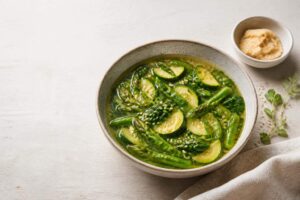
- Soupe miso : Dissoudre 1 cuillère à soupe dans un bouillon chaud (pas bouillant, max 60 °C)
- Marinades : Mélanger avec du mirin, du saké et du gingembre pour mariner poissons ou tofu
- Vinaigrettes : Émulsionner avec de l’huile de sésame, du vinaigre de riz et du citron
- Sauces : Incorporer en fin de cuisson dans les sauces pour pâtes ou légumes rôtis
- Tartinades : Mélanger avec du tahini et du citron pour une tartinade umami
- Bouillons : Enrichir les bouillons de légumes ou de champignons
La dose recommandée est de 10 à 15 g par jour, soit environ une cuillère à soupe rase. Cette quantité apporte les bénéfices nutritionnels du miso fermenté sans excès de sodium.
Miso fermenté et sodium : faut-il s’inquiéter ?
La teneur en sodium du miso fermenté est souvent citée comme un frein à sa consommation. La réalité scientifique est plus nuancée. Des études menées au Japon sur des populations consommant du miso fermenté quotidiennement n’ont pas montré d’augmentation de la pression artérielle corrélée à cette consommation [3].
Les peptides bioactifs issus de la fermentation du soja exercent un effet vasodilatateur qui contrebalance partiellement l’effet du sodium. De plus, le potassium naturellement présent dans le miso fermenté aide à réguler la balance sodique. Cela ne signifie pas que les personnes hypertendues peuvent en consommer sans limite, mais que le miso fermenté est moins problématique que le sel de table à quantité de sodium équivalente.
Les personnes souffrant d’hypertension artérielle, d’insuffisance rénale ou suivant un régime hyposodé strict doivent consulter leur médecin avant d’intégrer régulièrement du miso fermenté dans leur alimentation.
Miso fermenté vs autres aliments fermentés : comparaison
Le miso fermenté n’est pas le seul aliment fermenté aux propriétés probiotiques. Comment se positionne-t-il face aux autres stars de la fermentation ?
- Miso fermenté vs kimchi : Le kimchi est plus riche en fibres et en vitamine C, mais le miso fermenté apporte plus de protéines et d’acides aminés essentiels. comparez avec les légumes lacto-fermentés comme le kimchi.
- Miso fermenté vs kéfir : Le kéfir contient plus de souches probiotiques diversifiées, mais le miso fermenté offre une richesse en composés bioactifs du soja unique.
- Miso fermenté vs yaourt : Le miso fermenté est naturellement sans lactose et convient aux intolérants, avec une densité en acides aminés supérieure.
- Miso fermenté vs tempeh : Le tempeh est plus riche en protéines et en fibres, mais le miso fermenté présente une biodisponibilité supérieure de ses nutriments grâce à la fermentation longue.
les probiotiques et leur rôle dans la digestion vous aideront à comprendre pourquoi les aliments fermentés comme le miso fermenté sont complémentaires dans une alimentation équilibrée.
Qui peut bénéficier le plus du miso fermenté ?
Certains profils tirent un bénéfice particulier d’une consommation régulière de miso fermenté. Voici les populations pour lesquelles les preuves scientifiques sont les plus solides.
- Personnes souffrant de troubles digestifs : Le miso fermenté soutient la motilité intestinale et réduit les ballonnements grâce à ses enzymes actives
- Végétariens et végétaliens : Source rare de protéines complètes et de vitamine B12 d’origine végétale fermentée
- Femmes en périménopause : Les isoflavones du miso fermenté peuvent atténuer certains symptômes climatériques selon plusieurs études
- Personnes âgées : Le miso fermenté soutient l’immunité et la densité osseuse via la vitamine K2
- Sportifs : La richesse en acides aminés essentiels favorise la récupération musculaire
Précautions et contre-indications du miso fermenté
Le miso fermenté est généralement bien toléré, mais certaines situations nécessitent une vigilance particulière.
- Allergie au soja : Le miso fermenté contient du soja et est contre-indiqué en cas d’allergie avérée
- Intolérance au gluten : Certains misos contiennent de l’orge ou du blé ; choisir un miso fermenté à base de riz uniquement
- Traitement anticoagulant : La vitamine K2 du miso fermenté peut interférer avec les anticoagulants de type warfarine
- Grossesse : La consommation modérée de miso fermenté est généralement considérée comme sûre, mais les isoflavones en grande quantité sont déconseillées
- Pathologies thyroïdiennes : Les isoflavones du soja peuvent interférer avec la fonction thyroïdienne à forte dose
Miso fermenté maison : est-ce possible ?
Préparer son propre miso fermenté à la maison est tout à fait réalisable, bien que cela demande patience et rigueur. La fermentation artisanale garantit un produit vivant, sans additifs, avec une concentration optimale en probiotiques.
Les étapes essentielles sont les suivantes :
- Faire tremper et cuire les graines de soja pendant 4 à 6 heures
- Préparer le kōji en inoculant du riz ou de l’orge cuit avec des spores d’Aspergillus oryzae
- Écraser le soja cuit et mélanger avec le kōji et le sel marin
- Tasser la préparation dans un récipient hermétique en évitant les poches d’air
- Laisser fermenter à température ambiante (15-25 °C) pendant 3 à 24 mois selon le type souhaité
- Remuer et vérifier l’absence de moisissures indésirables toutes les 4 à 6 semaines
Le miso fermenté maison offre une satisfaction incomparable et un contrôle total sur la qualité des ingrédients. découvrez aussi les spécificités du miso à base de soja et ses bienfaits.
Miso fermenté et cancer : que dit la science ?
La relation entre miso fermenté et prévention du cancer est l’une des pistes de recherche les plus actives. Des études épidémiologiques japonaises ont observé une association inverse entre consommation de miso fermenté et risque de cancer du sein, de l’estomac et du côlon.
Une méta-analyse publiée dans le European Journal of Clinical Nutrition () a analysé 11 études portant sur plus de 200 000 participants. Elle a conclu à une réduction de 26 % du risque de cancer de l’estomac chez les consommateurs réguliers de miso fermenté, comparativement aux non-consommateurs. Les mécanismes impliqués incluent l’activité antioxydante, les effets anti-prolifératifs des isoflavones et le soutien immunitaire.
Ces données sont prometteuses mais ne permettent pas de conclure à un effet préventif établi. Le miso fermenté ne remplace en aucun cas un suivi médical oncologique.
Comment intégrer le miso fermenté dans une alimentation équilibrée ?
Intégrer le miso fermenté au quotidien ne nécessite pas de révolution culinaire. Voici un plan pratique pour débuter.
- Semaine 1 : Commencer par une soupe miso le matin, 3 fois par semaine
- Semaine 2 : Ajouter une vinaigrette au miso fermenté sur les salades du déjeuner
- Semaine 3 : Utiliser le miso fermenté comme marinade pour les protéines du dîner
- Semaine 4 : Expérimenter avec les tartinades et les sauces pour légumes rôtis
L’objectif est d’atteindre une consommation de 10 à 15 g de miso fermenté par jour, de manière régulière et variée. La régularité est plus importante que la quantité ponctuelle pour bénéficier des effets probiotiques.
- Le miso fermenté est une pâte de soja vivante, riche en probiotiques, acides aminés et antioxydants issus d’une fermentation par le kōji
- Le miso fermenté soutient le microbiote intestinal, la santé cardiovasculaire et le système immunitaire selon des études portant sur des dizaines de milliers de personnes
- Le miso fermenté non pasteurisé est le seul à conserver ses bactéries vivantes ; vérifiez toujours l’étiquette avant d’acheter
- Le miso fermenté doit être ajouté hors du feu ou dans un liquide à moins de 60 °C pour préserver ses probiotiques
- Le miso fermenté est contre-indiqué en cas d’allergie au soja et doit être consommé avec modération par les personnes hypertendues ou sous anticoagulants
Questions fréquentes sur le miso fermenté
Le miso fermenté contient-il des probiotiques vivants ?
Oui, à condition qu’il soit non pasteurisé. Le miso fermenté artisanal conservé au réfrigérateur contient des milliards de bactéries lactiques vivantes par portion. La pasteurisation industrielle détruit ces micro-organismes. Vérifiez toujours la mention « non pasteurisé » ou « vivant » sur l’étiquette.
Quelle est la différence entre miso blanc et miso rouge ?
Le miso fermenté blanc (shiro) est fermenté 1 à 3 mois : il est doux, légèrement sucré et moins salé. Le miso fermenté rouge (aka) est fermenté 1 à 3 ans : il est intense, très umami et plus concentré en acides aminés et en antioxydants. Le choix dépend de vos goûts et de vos besoins nutritionnels.
Peut-on manger du miso fermenté tous les jours ?
Oui, une consommation quotidienne de 10 à 15 g de miso fermenté est considérée comme sûre et bénéfique pour la majorité des adultes en bonne santé. Les études japonaises portant sur des populations consommant du miso fermenté quotidiennement depuis des décennies n’ont pas mis en évidence d’effets indésirables significatifs à cette dose.
Le miso fermenté convient-il aux personnes intolérantes au gluten ?
Pas systématiquement. Certains misos fermentés contiennent de l’orge ou du blé. Les personnes cœliaques ou intolérantes au gluten doivent choisir un miso fermenté à base de riz uniquement (kome miso) et vérifier l’absence de contamination croisée sur l’étiquette.
Comment conserver le miso fermenté après ouverture ?
Le miso fermenté non pasteurisé doit être conservé au réfrigérateur après ouverture, dans un récipient hermétique. Il se conserve ainsi 6 à 12 mois sans perte significative de ses propriétés probiotiques. Évitez tout contact avec des ustensiles humides qui pourraient introduire des contaminants.
Le miso fermenté est-il adapté aux végétaliens ?
Oui. Le miso fermenté est un aliment 100 % végétal, sans produits d’origine animale. C’est l’une des rares sources végétales de vitamine B12 et de protéines complètes, ce qui en fait un aliment particulièrement précieux dans les régimes végétaliens.
Peut-on faire cuire le miso fermenté ?
Techniquement oui, mais la cuisson à plus de 60 °C détruit les probiotiques et les enzymes actives du miso fermenté. Pour conserver tous ses bienfaits, ajoutez toujours le miso fermenté en fin de cuisson, hors du feu ou dans un liquide chaud mais non bouillant.
Le miso fermenté est-il bon pour la peau ?
Des données préliminaires suggèrent que les isoflavones et les antioxydants du miso fermenté peuvent contribuer à réduire les signes du vieillissement cutané. Une étude japonaise de a observé une amélioration de l’élasticité cutanée chez des femmes consommant du miso fermenté quotidiennement pendant 12 semaines. Ces résultats restent à confirmer par des études plus larges.
Quelle quantité de miso fermenté par jour est recommandée ?
La dose optimale documentée dans les études est de 10 à 15 g par jour, soit une cuillère à soupe rase. Cette quantité apporte les bénéfices probiotiques et nutritionnels du miso fermenté sans excès de sodium. Les personnes hypertendues peuvent opter pour des variétés à faible teneur en sel (shiro miso).
Le miso fermenté aide-t-il à perdre du poids ?
Le miso fermenté n’est pas un aliment amaigrissant en lui-même. Cependant, son effet positif sur le microbiote intestinal et sa richesse en protéines peuvent contribuer à une meilleure satiété et à une régulation du métabolisme. Il s’intègre parfaitement dans une alimentation équilibrée orientée vers la gestion du poids.
Le miso fermenté contient-il de l’alcool ?
Le miso fermenté contient des traces infimes d’alcool produites lors de la fermentation, généralement inférieures à 0,5 %. Cette quantité est négligeable et ne présente aucun risque pour la santé, y compris pour les personnes évitant l’alcool pour des raisons médicales ou religieuses.
Où acheter du miso fermenté de qualité en France ?
Le miso fermenté non pasteurisé de qualité se trouve dans les épiceries japonaises et asiatiques spécialisées, les magasins biologiques et certaines grandes surfaces au rayon bio. Les marques japonaises artisanales comme Hikari, Marukome (gamme non pasteurisée) ou les misos français fabriqués selon les méthodes traditionnelles sont à privilégier. Vérifiez toujours la conservation au réfrigérateur en rayon.
Ce qu’il faut retenir
Le miso fermenté est bien plus qu’un simple condiment japonais. C’est un aliment fonctionnel aux propriétés nutritionnelles exceptionnelles, soutenu par un corpus scientifique solide issu d’études portant sur des centaines de milliers de personnes. Le miso fermenté non pasteurisé apporte des probiotiques vivants, des protéines complètes, des vitamines essentielles et des antioxydants puissants dans une seule cuillère à soupe quotidienne.
Pour bénéficier pleinement des effets du miso fermenté, choisissez un produit non pasteurisé, conservez-le au réfrigérateur et ajoutez-le toujours hors du feu. Commencez par une soupe miso fermenté le matin, trois fois par semaine, et augmentez progressivement jusqu’à une consommation quotidienne de 10 à 15 g.
Sources et études
- Miso soup consumption and cardiovascular disease mortality in Japan — Journal of Nutritional Science and Vitaminology,
- Fermented soybean products and gut microbiota diversity in healthy adults — British Journal of Nutrition,
- Miso soup and blood pressure: a paradox of high sodium intake without hypertension — American Journal of Hypertension,
- Évaluation des risques liés à la consommation de phyto-œstrogènes — ANSES,
- Antioxidant activity of fermented soybean paste (miso) and its bioactive compounds — Journal of Agricultural and Food Chemistry,
Cet article est fourni à titre informatif uniquement et ne constitue pas un avis médical. Consultez un professionnel de santé qualifié avant toute utilisation.