Comment faire du kombucha maison ? recette simple en 7 étape
Cet article a une vocation informative et ne remplace pas un avis médical professionnel. Consultez un professionnel de santé avant d’intégrer le kombucha à votre alimentation si vous êtes enceinte, immunodéprimé(e) ou sous traitement médical.
Comment faire du kombucha maison ? La réponse tient en une phrase : il suffit de faire fermenter du thé sucré à l’aide d’un SCOBY (culture symbiotique de bactéries et levures) pendant 7 à 14 jours à température ambiante.
- Une boisson naturellement pétillante, sans additifs ni conservateurs
- Un apport quotidien en probiotiques pour soutenir la flore intestinale
- Un coût de revient très faible comparé au kombucha du commerce
- Une recette personnalisable selon vos thés et arômes préférés
- Un geste zéro déchet, avec un SCOBY qui se reproduit indéfiniment
Comment faire du kombucha maison ? est une question que se posent de plus en plus de Français : la consommation de boissons fermentées artisanales a progressé de 35 % en Europe entre 2020 et 2023 selon les données du marché des aliments fonctionnels. Comment faire du kombucha maison ? devient ainsi un savoir-faire accessible à tous, même sans expérience en fermentation.
Comment faire du kombucha maison ? : les ingrédients indispensables
Avant de se lancer dans la préparation de kombucha artisanal, il faut réunir quelques éléments de base. Comment faire du kombucha maison ? commence toujours par une liste d’ingrédients simples et peu coûteux.
- 1 SCOBY : la mère de kombucha, cœur vivant de la fermentation
- 200 ml de liquide de démarrage : du kombucha déjà fermenté (pH < 3,5)
- 2 litres d’eau filtrée ou de source : évitez l’eau du robinet chlorée
- 6 à 8 g de thé noir ou vert : en vrac ou en sachets, sans arômes ajoutés
- 150 à 200 g de sucre blanc : le sucre cristallisé classique est idéal
Le SCOBY est l’élément central. Vous pouvez en obtenir un auprès d’un brasseur amateur, dans une boutique bio ou le commander en ligne. Sans SCOBY, il est impossible de lancer une fermentation kombucha authentique.
Comment faire du kombucha maison ? : le matériel nécessaire
Comment faire du kombucha maison ? ne nécessite pas d’équipement sophistiqué. Voici l’essentiel :
- Un bocal en verre de 2 à 3 litres (type Le Parfait ou Mason jar)
- Un tissu respirant (gaze, mousseline) et un élastique pour couvrir le bocal
- Une grande casserole pour préparer le thé sucré
- Des bouteilles en verre à fermeture hermétique pour la deuxième fermentation
- Un thermomètre de cuisine (facultatif mais utile)
- Un pH-mètre ou des bandelettes pH (recommandé pour les débutants)
Évitez tout matériel en métal au contact direct du SCOBY : les ions métalliques perturbent la culture. Le verre est le matériau de référence pour brasser du kombucha maison.
Comment faire du kombucha maison ? Étape 1 : préparer le thé sucré
Comment faire du kombucha maison ? débute par la préparation d’un thé sucré refroidi. Portez 500 ml d’eau à ébullition. Infusez votre thé 5 à 10 minutes selon l’intensité souhaitée. Retirez les feuilles ou sachets, puis dissolvez intégralement le sucre dans le thé chaud. Ajoutez ensuite 1,5 litre d’eau froide pour ramener la température à 20-25 °C. Il est crucial que le liquide soit à température ambiante avant d’y ajouter le SCOBY : une température supérieure à 30 °C peut l’endommager irrémédiablement.
La préparation du kombucha fermenté maison repose sur cet équilibre : assez de sucre pour nourrir les levures, assez de tanins pour structurer la boisson.
Comment faire du kombucha maison ? Étape 2 : inoculer avec le SCOBY
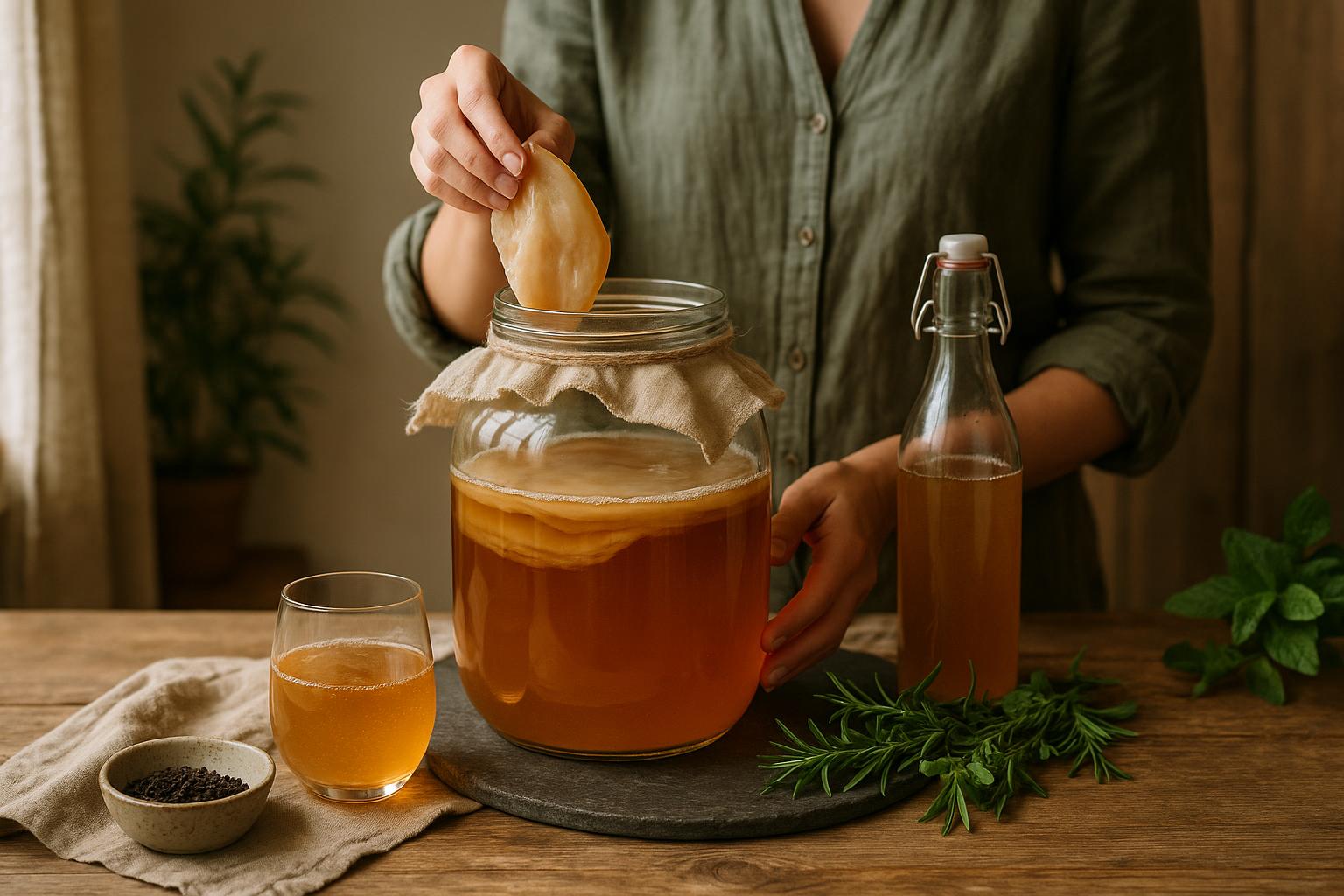
Versez le thé sucré refroidi dans votre bocal en verre propre et stérilisé. Ajoutez les 200 ml de liquide de démarrage (starter liquid) : ce liquide acide protège la préparation contre les contaminations indésirables dès le début de la fermentation. Déposez ensuite délicatement le SCOBY à la surface du liquide avec des mains propres.
Comment faire du kombucha maison ? implique de respecter cette étape scrupuleusement. Le liquide de démarrage abaisse immédiatement le pH du milieu, rendant l’environnement hostile aux bactéries pathogènes et favorable aux micro-organismes bénéfiques du SCOBY.
Comment faire du kombucha maison ? Étape 3 : la première fermentation (F1)
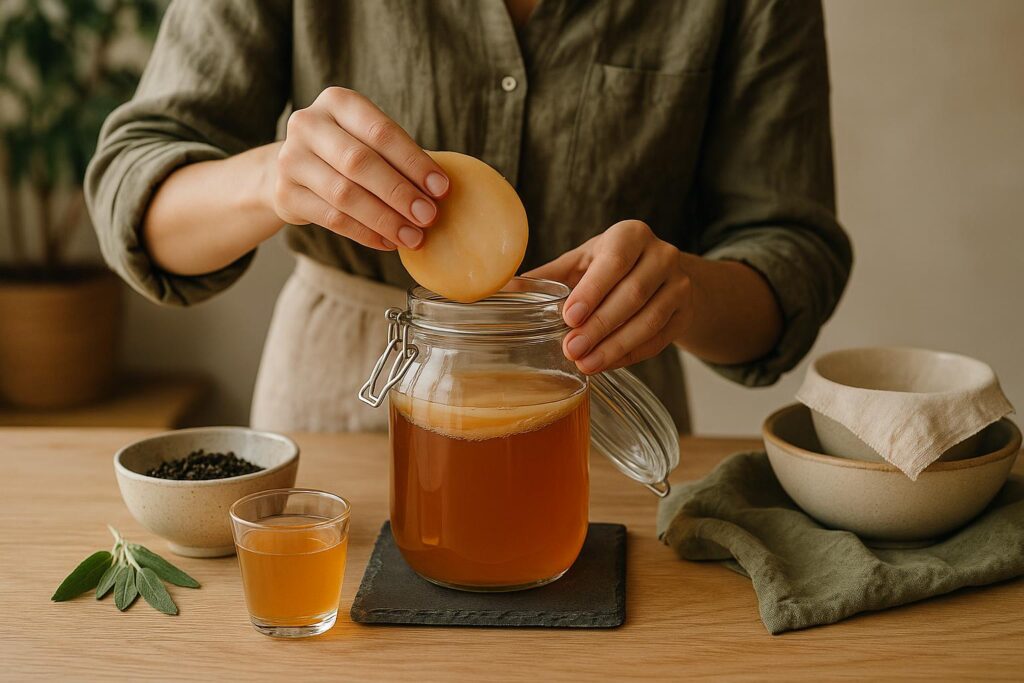
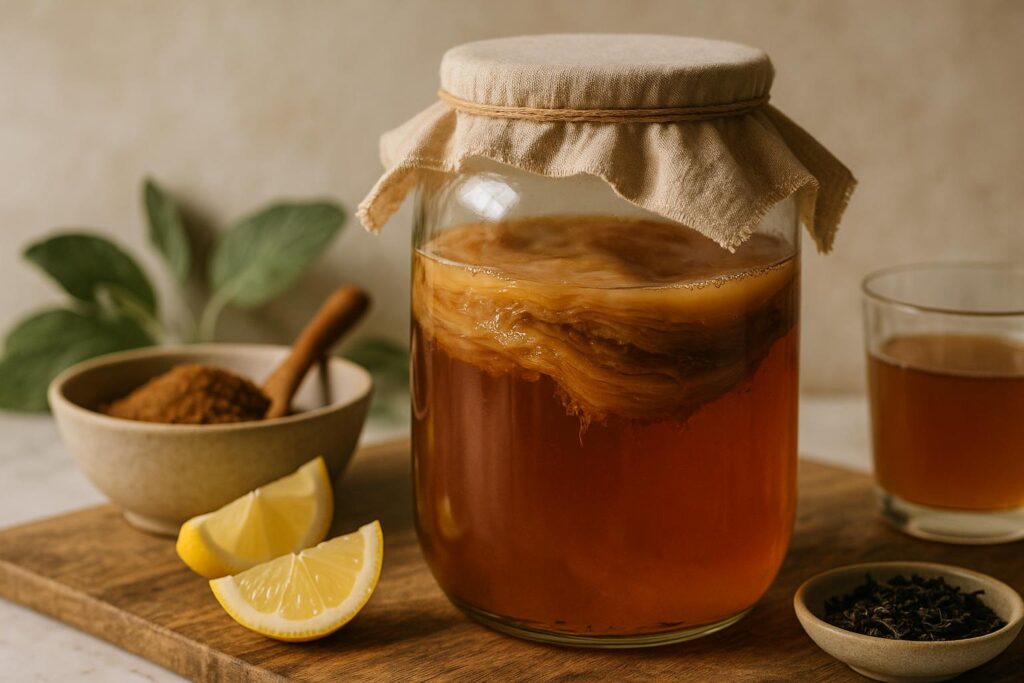
Couvrez le bocal avec votre tissu respirant et fixez-le avec un élastique. Placez le bocal dans un endroit chaud (22 à 27 °C), à l’abri de la lumière directe et des odeurs fortes. La fermentation primaire dure entre 7 et 14 jours selon la température et l’acidité souhaitée.
Comment faire du kombucha maison ? requiert de la patience à cette étape. Goûtez votre préparation à partir du 7e jour avec une paille propre. Si la boisson vous semble trop sucrée, prolongez la fermentation de 2 à 3 jours. Si elle est trop acide, raccourcissez la prochaine fermentation. Un pH entre 2,5 et 3,5 indique une fermentation réussie, selon les données publiées par PubMed (Jayabalan et al., 2014).
Comment faire du kombucha maison ? est reconnu pour ses effets bénéfiques sur la santé intestinale, notamment grâce à la production d’acide acétique, d’acide gluconique et de vitamines du groupe B au cours de cette fermentation.
Comment faire du kombucha maison ? Étape 4 : la deuxième fermentation (F2) pour la pétillance
La deuxième fermentation est l’étape qui donne au kombucha maison sa pétillance caractéristique. Retirez le SCOBY et 200 ml de liquide (votre nouveau starter pour la prochaine fournée). Versez le kombucha dans des bouteilles hermétiques en verre.
Ajoutez à chaque bouteille un aromatisant de votre choix : jus de gingembre frais, purée de fruits rouges, jus de citron, morceaux de mangue ou d’ananas. Ces sucres naturels relancent la fermentation en milieu fermé, produisant du CO2 qui reste piégé dans la bouteille. Fermez hermétiquement et laissez reposer 2 à 4 jours à température ambiante, puis réfrigérez.
En pratique, comment faire du kombucha maison ? permet de créer des saveurs infiniment variées grâce à cette deuxième fermentation. Ouvrez les bouteilles avec précaution : la pression peut être élevée, surtout par temps chaud.
Comment faire du kombucha maison ? : conservation et durée de vie
Une fois réfrigéré, votre kombucha artisanal se conserve 2 à 4 semaines. La fermentation ralentit fortement au froid mais ne s’arrête pas complètement : la boisson continuera de s’acidifier légèrement au fil du temps. Comment faire du kombucha maison ? implique donc de consommer la boisson dans les premières semaines pour profiter de ses arômes optimaux.
Le SCOBY, lui, peut être conservé dans son liquide de démarrage au réfrigérateur pendant plusieurs semaines entre deux brassins. Il peut également être déshydraté pour une conservation longue durée.
Comment faire du kombucha maison ? : les 5 erreurs à éviter absolument
Comment faire du kombucha maison ? est simple, mais quelques erreurs peuvent compromettre votre préparation :
- Utiliser de l’eau chlorée : le chlore inhibe les micro-organismes du SCOBY. Utilisez toujours de l’eau filtrée ou de source.
- Ajouter le SCOBY dans un liquide trop chaud : au-delà de 30 °C, les cultures vivantes sont endommagées.
- Omettre le liquide de démarrage : sans starter acide, le risque de contamination par des moisissures est très élevé.
- Couvrir avec un couvercle hermétique en F1 : le SCOBY a besoin d’oxygène pendant la première fermentation. Utilisez un tissu respirant.
- Utiliser du thé aromatisé ou des huiles essentielles : ces composés peuvent inhiber ou tuer les cultures bactériennes et levurières.
Comment faire du kombucha maison ? reste l’une des solutions les plus accessibles pour intégrer des probiotiques naturels à son alimentation quotidienne, à condition de respecter ces règles fondamentales.
Comment faire du kombucha maison ? : prendre soin de son SCOBY
Le SCOBY est un organisme vivant qui mérite attention. Après chaque brassin, il produit une nouvelle couche (bébé SCOBY) que vous pouvez partager, composter ou conserver dans un hôtel à SCOBY. Un hôtel à SCOBY est simplement un bocal contenant plusieurs SCOBYs dans du liquide de démarrage, conservé à température ambiante ou au réfrigérateur.
Si votre SCOBY présente des taches vertes, noires ou roses, il s’agit de moisissures : jetez l’ensemble (SCOBY et liquide) et recommencez avec un nouveau SCOBY. Des taches brunes ou des filaments brun-rougeâtres sont normaux : ce sont des levures inactives.
La fabrication de kombucha fermenté maison avec un SCOBY bien entretenu peut se perpétuer indéfiniment, rendant cette pratique particulièrement économique et durable.
Comment faire du kombucha maison ? : les bienfaits scientifiquement documentés
Comment faire du kombucha maison ? c’est aussi choisir une boisson aux propriétés étudiées par la recherche. Les études disponibles, dont une revue publiée sur PubMed (Kapp & Sumner, 2019), identifient plusieurs effets potentiels :
- Soutien de la flore intestinale : les probiotiques naturels issus de la fermentation contribuent à l’équilibre du microbiome
- Propriétés antioxydantes : les polyphénols du thé sont préservés et potentialisés par la fermentation
- Effet hépatoprotecteur : des études animales suggèrent un effet protecteur sur le foie, à confirmer chez l’humain
- Activité antimicrobienne : l’acide acétique produit inhibe certaines bactéries pathogènes
- Apport en vitamines B : B1, B6 et B12 sont synthétisées par les micro-organismes du SCOBY
L’ANSES rappelle toutefois que les allégations santé sur les boissons fermentées doivent être interprétées avec prudence, les études cliniques humaines restant encore limitées.
Comment faire du kombucha maison ? : variantes et personnalisation
La préparation de kombucha fait maison offre une liberté créative totale. Voici quelques variantes populaires :
- Kombucha au gingembre-citron : classique et digestif, idéal pour débuter
- Kombucha aux fruits rouges : framboise, mûre ou grenade pour une F2 colorée et antioxydante
- Kombucha au thé vert jasmin : plus délicat, avec des notes florales
- Jun kombucha : variante au miel et au thé vert, fermentée avec un SCOBY spécifique
- Kombucha au rooibos : sans caféine, idéal pour les personnes sensibles
Chaque variante modifie légèrement le profil nutritionnel et le goût. Expérimenter est l’un des grands plaisirs de la fabrication de kombucha artisanal à domicile.
Comment faire du kombucha maison ? : quelle quantité consommer par jour ?
Comment faire du kombucha maison ? est une chose, savoir le consommer correctement en est une autre. Les nutritionnistes recommandent généralement de commencer par 100 à 150 ml par jour pour habituer le système digestif, puis d’augmenter progressivement jusqu’à 250-350 ml par jour maximum.
Le kombucha contient une faible quantité d’alcool (généralement entre 0,5 % et 3 % selon la durée de fermentation) et de caféine résiduelle. Ces éléments justifient une consommation modérée, en particulier pour les femmes enceintes, les enfants et les personnes immunodéprimées, comme le souligne le National Center for Complementary and Integrative Health (NCCIH).
- Comment faire du kombucha maison ? repose sur 5 ingrédients : eau, thé, sucre, SCOBY et liquide de démarrage — rien de plus.
- Comment faire du kombucha maison ? nécessite une première fermentation de 7 à 14 jours à 22-27 °C dans un bocal couvert d’un tissu respirant.
- Comment faire du kombucha maison ? s’enrichit d’une deuxième fermentation en bouteille hermétique pour obtenir la pétillance naturelle souhaitée.
- Comment faire du kombucha maison ? implique d’éviter l’eau chlorée, les températures excessives et les thés aromatisés qui détruisent le SCOBY.
- Comment faire du kombucha maison ? permet de profiter de probiotiques naturels, d’antioxydants et de vitamines B à un coût très faible, tout en maîtrisant chaque ingrédient.
Questions fréquentes sur Comment faire du kombucha maison ?
Combien de temps faut-il pour faire du kombucha maison ?
La première fermentation dure 7 à 14 jours selon la température ambiante et l’acidité souhaitée. La deuxième fermentation pour la pétillance prend 2 à 4 jours supplémentaires. Comptez donc entre 9 et 18 jours au total pour obtenir votre kombucha maison prêt à consommer.
Où trouver un SCOBY pour faire du kombucha maison ?
Vous pouvez obtenir un SCOBY auprès de brasseurs amateurs via des groupes Facebook ou forums dédiés, dans des boutiques bio spécialisées, ou en commandant en ligne. Certains épiceries bio proposent également des SCOBYs déshydratés. Évitez les SCOBYs en mauvais état ou présentant des moisissures visibles.
Peut-on faire du kombucha maison sans SCOBY ?
Non, un SCOBY authentique est indispensable pour réaliser une fermentation kombucha traditionnelle. Certaines méthodes tentent de créer un SCOBY à partir de kombucha du commerce non pasteurisé, mais le résultat est aléatoire et la culture obtenue souvent fragile. Un SCOBY sain reste la voie la plus fiable.
Quel thé utiliser pour faire du kombucha maison ?
Le thé noir est le plus couramment utilisé pour sa richesse en tanins qui nourrissent le SCOBY. Le thé vert convient également et donne un kombucha plus doux. Évitez les thés aromatisés, les tisanes et les thés aux huiles essentielles : ces composés peuvent inhiber ou endommager les cultures vivantes du SCOBY.
Quel sucre utiliser pour la recette de kombucha maison ?
Le sucre blanc cristallisé classique est le plus recommandé pour les débutants car il est entièrement consommé par les levures. Le sucre de canne non raffiné fonctionne aussi. Évitez le miel (sauf pour le Jun kombucha), le sirop d’agave et les édulcorants artificiels qui ne nourrissent pas correctement le SCOBY.
Comment savoir si mon kombucha maison est raté ?
Votre kombucha est raté si vous observez des moisissures colorées (vert, noir, rose) à la surface du SCOBY ou du liquide. Une odeur de vomi, de vernis ou de fromage est également un signal d’alarme. En revanche, une odeur vineuse ou vinaigréeest normale. En cas de doute, jetez et recommencez.
Le kombucha maison contient-il de l’alcool ?
Oui, le kombucha maison contient naturellement entre 0,5 % et 3 % d’alcool selon la durée de fermentation et la quantité de sucre utilisée. Plus la fermentation est longue et riche en sucre, plus le taux d’alcool est élevé. Pour un taux minimal, raccourcissez la fermentation et réfrigérez rapidement après la F2.
Peut-on faire du kombucha maison avec de l’eau du robinet ?
Il est déconseillé d’utiliser de l’eau du robinet non traitée car le chlore qu’elle contient perturbe les micro-organismes du SCOBY et peut inhiber la fermentation. Utilisez de l’eau filtrée (filtre à charbon actif), de l’eau de source ou laissez l’eau du robinet reposer 24 heures à l’air libre pour que le chlore s’évapore.
Comment conserver le SCOBY entre deux brassins ?
Conservez le SCOBY immergé dans 200 à 300 ml de liquide de démarrage acide dans un bocal fermé au réfrigérateur. Il peut ainsi rester dormant plusieurs semaines. Pour une conservation longue durée, déshydratez-le à basse température (35 °C maximum) et conservez-le dans un sachet hermétique à l’abri de la lumière.
Le kombucha maison est-il bon pour la digestion ?
Le kombucha fermenté maison contient des probiotiques naturels, des acides organiques et des enzymes qui peuvent soutenir la digestion et contribuer à l’équilibre du microbiome intestinal. Des études publiées sur PubMed suggèrent des effets bénéfiques, bien que les recherches cliniques humaines restent encore limitées. Consultez un professionnel de santé en cas de troubles digestifs chroniques.
Quelle est la différence entre kombucha et kéfir de fruits ?
Le kombucha est fermenté à partir de thé sucré avec un SCOBY, tandis que le kéfir de fruits utilise des grains de kéfir dans de l’eau sucrée ou du jus de fruit. Les deux sont des boissons probiotiques pétillantes, mais leur profil microbien, leur goût et leur composition nutritionnelle diffèrent sensiblement. Le kombucha est généralement plus acide et plus riche en polyphénols du thé.
Combien coûte la fabrication de kombucha maison ?
Le coût de revient d’un litre de kombucha maison est estimé entre 0,30 € et 0,80 € selon le thé et le sucre utilisés, contre 3 à 6 € pour une bouteille de kombucha bio du commerce. Le SCOBY représente un investissement unique (5 à 15 €) qui se rentabilise dès le deuxième brassin. C’est l’une des boissons fermentées les plus économiques à produire soi-même.
Ce qu’il faut retenir
Comment faire du kombucha maison ? est finalement beaucoup plus simple qu’il n’y paraît. Avec un SCOBY sain, du thé de qualité, du sucre cristallisé et un peu de patience, vous obtenez en moins de deux semaines une boisson vivante, pétillante et riche en probiotiques naturels. La maîtrise de la température, de l’hygiène et du pH sont les trois clés du succès. Chaque brassin vous permet d’affiner votre technique et de personnaliser vos saveurs selon vos envies.
Comment faire du kombucha maison ? c’est aussi adopter une démarche durable, économique et bénéfique pour votre santé digestive. Lancez-vous dès aujourd’hui : votre premier SCOBY vous accompagnera pour des années de brassage artisanal.
Études et sources scientifiques
- Jayabalan R. et al. — A Review on Kombucha Tea — PubMed (2014)
- Kapp J.M. & Sumner W. — Kombucha: a systematic review of the clinical evidence — PubMed (2019)
- National Center for Complementary and Integrative Health — Kombucha Tea (NCCIH)
- ANSES — Boissons fermentées et sécurité alimentaire
- Harvard Health Publishing — Fermented foods for better gut health
Cet article est fourni à titre informatif uniquement et ne constitue pas un avis médical. Consultez un professionnel de santé qualifié avant toute utilisation.