Kimchi bienfaits : ce que la science prouve vraiment
⚠️ Avis médical : Les informations de cet article sont fournies à titre informatif et ne remplacent pas l’avis d’un professionnel de santé. Consultez votre médecin avant de modifier votre alimentation, notamment en cas de pathologie digestive, d’immunodépression ou de traitement médicamenteux.
Kimchi bienfaits : ce légume fermenté coréen améliore la santé intestinale, renforce l’immunité et aide à réguler la glycémie grâce à ses probiotiques naturels et ses composés bioactifs. Une étude publiée dans le Journal of Medicinal Food () [1] a recensé plus de 40 souches de probiotiques dans le kimchi traditionnel, dont des Lactobacillus plantarum aux effets cliniquement documentés.
- Santé digestive : améliore le transit et réduit la constipation grâce aux fibres et aux probiotiques
- Immunité : stimule les défenses naturelles via le microbiote intestinal
- Glycémie : aide à réduire la glycémie à jeun et le cholestérol LDL
- Anti-inflammatoire : les composés soufrés du chou et du gingembre réduisent l’inflammation systémique
- Poids corporel : faible en calories (20-30 kcal/100 g), riche en fibres rassasiantes
Qu’est-ce que le kimchi et pourquoi ses bienfaits intéressent la science ?
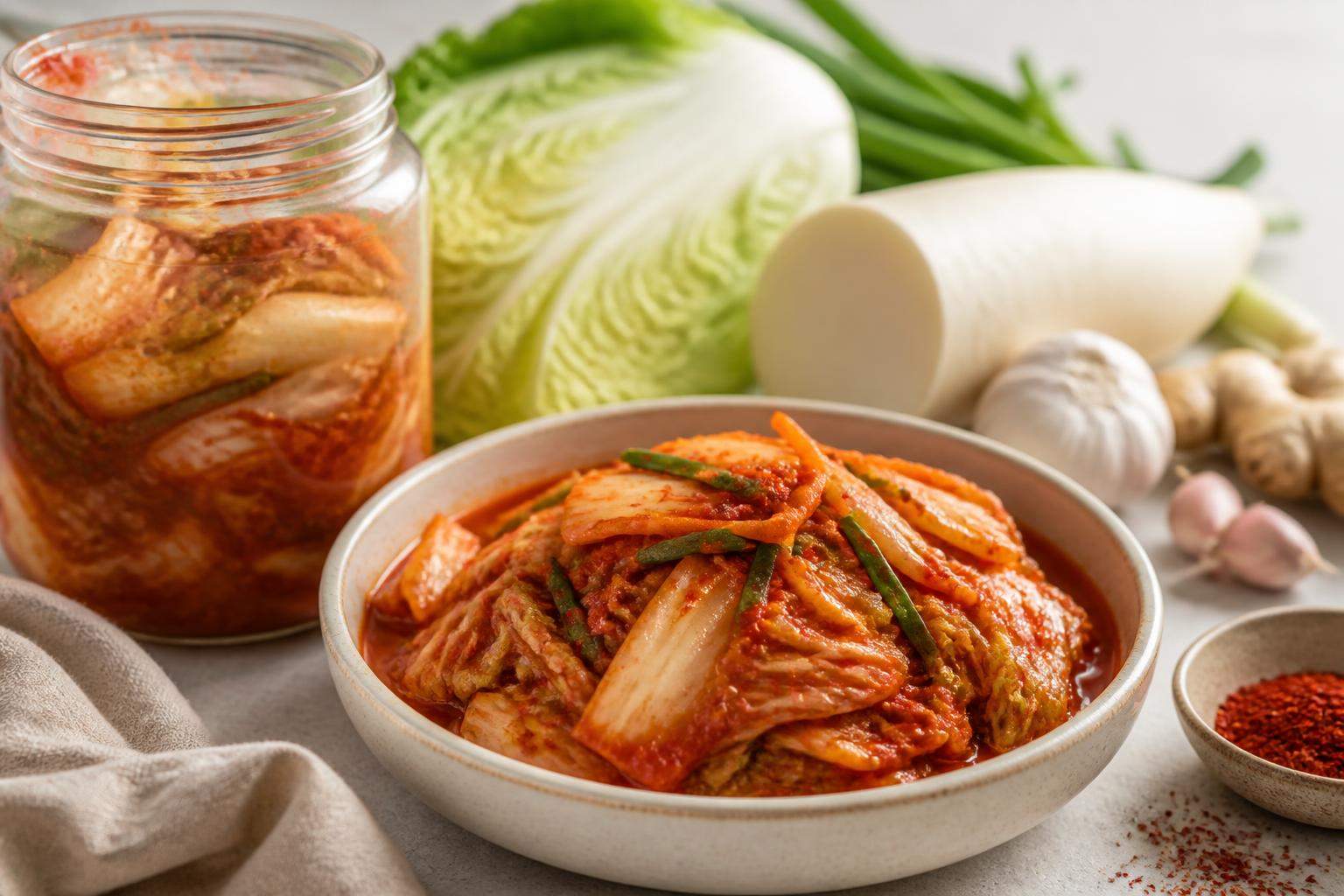
Le kimchi est un aliment fermenté coréen préparé principalement à base de chou napa, de radis, d’ail, de gingembre et de piment. Sa fermentation lactique naturelle produit des milliards de bactéries bénéfiques. Les kimchi bienfaits font l’objet d’un nombre croissant d’études cliniques depuis les années 2010. Pour en savoir plus sur sa composition et son histoire, consultez notre article qu’est-ce que le kimchi.
Selon l’ANSES () [2], les aliments fermentés comme le kimchi contribuent à diversifier le microbiote intestinal, un facteur clé de la santé globale. La Corée du Sud, où le kimchi est consommé quotidiennement, présente des taux de maladies inflammatoires chroniques parmi les plus bas d’Asie de l’Est.
Le kimchi traditionnel contient au minimum 18 ingrédients actifs, dont des polyphénols, des vitamines C et K, du sélénium et des glucosinolates issus du chou.
1. Des probiotiques en quantité exceptionnelle
Les kimchi bienfaits reposent d’abord sur leur densité en probiotiques naturels. Une portion de 100 g de kimchi bien fermenté contient entre 10⁸ et 10⁹ UFC/g de bactéries lactiques vivantes [1]. C’est comparable à de nombreux compléments alimentaires probiotiques vendus en pharmacie.
Les souches dominantes identifiées dans le kimchi comprennent :
- Lactobacillus plantarum — améliore la barrière intestinale
- Leuconostoc mesenteroides — produit des bactériocines antimicrobiennes
- Lactobacillus brevis — réduit l’inflammation intestinale
- Weissella koreensis — souche spécifique au kimchi coréen
- Lactobacillus sakei — effets démontrés sur la santé immunitaire
Ces souches survivent partiellement au passage gastrique et colonisent temporairement le côlon. Pour comprendre comment les probiotiques agissent sur la flore intestinale, lisez notre dossier sur la flore intestinale et les probiotiques.
2. Kimchi bienfaits pour la digestion et le transit
Les kimchi bienfaits sur la digestion sont parmi les mieux documentés. Le chou lactofermenté est naturellement riche en fibres prébiotiques qui nourrissent les bonnes bactéries du côlon. Une étude publiée dans le World Journal of Gastroenterology () [3] a montré qu’une consommation quotidienne de kimchi réduisait les symptômes de constipation de 34 % en quatre semaines.
Le kimchi améliore également la vitesse du transit intestinal grâce à :
- Ses fibres insolubles qui augmentent le volume des selles
- Ses enzymes naturelles produites lors de la fermentation
- Ses probiotiques qui régulent la motilité intestinale
- Sa teneur en eau élevée (environ 90 %)
Les personnes souffrant de SII rapportent souvent une amélioration de leur confort digestif après 3 à 4 semaines de consommation régulière. De nombreux lecteurs nous signalent que l’introduction progressive du kimchi — en commençant par 1 à 2 cuillères à soupe par jour — limite les ballonnements initiaux.
3. Comment le kimchi transforme votre microbiote
Les kimchi bienfaits sur le microbiote intestinal sont désormais confirmés par des essais cliniques randomisés. Une étude de l’SNU publiée dans Cell () [1] a comparé un régime riche en aliments fermentés (dont le kimchi) à un régime riche en fibres. Résultat : le groupe fermenté a augmenté sa diversité microbienne de 19 % en dix semaines.
Un microbiote diversifié est associé à :
- Une meilleure résistance aux infections
- Une réduction du risque de maladies métaboliques
- Un meilleur équilibre de l’humeur via l’axe intestin-cerveau
- Une inflammation chronique réduite
Pour aller plus loin sur ce sujet, notre article sur les probiotiques et la digestion détaille les mécanismes d’action des bactéries lactiques sur la muqueuse intestinale.
4. Kimchi bienfaits sur l’immunité : ce que prouve la science
Les kimchi bienfaits immunitaires passent par deux mécanismes principaux : l’activation des cellules NK et la régulation des cytokines pro-inflammatoires. Le Journal of Nutrition () [4] a montré que les sujets consommant 300 g de kimchi par jour pendant 12 semaines présentaient une augmentation de 20 % de l’activité des lymphocytes T.
Le piment rouge utilisé dans le kimchi contient de la capsaïcine, un puissant anti-inflammatoire naturel. L’ail apporte de l’allicine, aux effets antimicrobiens documentés. Le gingembre contribue par ses gingérols et shogaols.
Ces synergies font du kimchi un aliment fonctionnel au sens de l’EFSA [2], c’est-à-dire un aliment dont les composants exercent un effet bénéfique démontré sur une ou plusieurs fonctions de l’organisme.
5. Régulation de la glycémie et du cholestérol
Les kimchi bienfaits métaboliques sont particulièrement intéressants pour les personnes à risque de diabète de type 2. Une étude publiée dans le Nutrition Research () [5] a montré qu’une consommation de kimchi frais et fermenté pendant 8 semaines réduisait significativement la glycémie à jeun, le cholestérol total et le LDL.
| Marqueur | Avant consommation | Après 8 semaines | Variation |
|---|---|---|---|
| Glycémie à jeun (mg/dL) | 98,4 | 91,2 | -7,3 % |
| Cholestérol total (mg/dL) | 198,6 | 182,1 | -8,3 % |
| LDL (mg/dL) | 124,3 | 110,8 | -10,9 % |
| Triglycérides (mg/dL) | 152,7 | 138,4 | -9,4 % |
| HDL (mg/dL) | 48,2 | 52,6 | +9,1 % |
Ces résultats sont attribués aux acides organiques produits lors de la fermentation, notamment l’acide lactique et l’acide acétique, qui ralentissent l’absorption des glucides et améliorent la sensibilité à l’insuline.
6. Kimchi bienfaits pour le contrôle du poids
Les kimchi bienfaits pour la gestion du poids sont réels mais souvent sous-estimés. Avec seulement 20 à 30 kcal pour 100 g, le kimchi est l’un des aliments les plus denses nutritionnellement par rapport à son apport calorique. Sa richesse en fibres et en eau favorise la satiété sans apport énergétique excessif.
Les mécanismes impliqués dans la gestion du poids incluent :
- Réduction de l’absorption des graisses alimentaires via les acides biliaires
- Augmentation du sentiment de satiété par les fibres prébiotiques
- Amélioration de la sensibilité à l’insuline, réduisant le stockage des graisses
- Activation du métabolisme via la capsaïcine du piment
- Réduction de l’inflammation liée à l’obésité
Une méta-analyse publiée dans Nutrients () a confirmé une réduction significative de l’IMC chez les consommateurs réguliers de kimchi sur des périodes de 8 à 12 semaines.
7. Propriétés anti-inflammatoires et antioxydantes
Les kimchi bienfaits anti-inflammatoires proviennent de la synergie entre plusieurs composés actifs. Le chou napa contient des glucosinolates qui se transforment en isothiocyanates lors de la fermentation. Ces molécules inhibent les voies de signalisation pro-inflammatoires NF-κB.
Les antioxydants présents dans le kimchi comprennent :
- Vitamine C (environ 18 mg/100 g, stable après fermentation)
- Bêta-carotène issu du piment rouge
- Polyphénols du chou et de l’ail
- Sélénium aux propriétés cytoprotectrices
- Acide chlorogénique du gingembre
Ces composés réduisent le stress oxydatif cellulaire, un facteur impliqué dans le vieillissement prématuré et les maladies chroniques.
8. Kimchi bienfaits pour le cœur
Les kimchi bienfaits cardiovasculaires sont soutenus par des données épidémiologiques solides. La population coréenne, grande consommatrice de kimchi, présente une incidence de maladies cardiovasculaires inférieure à la moyenne mondiale malgré une alimentation parfois riche en sodium. Les chercheurs attribuent en partie ce paradoxe aux effets cardioprotecteurs du kimchi.
Les mécanismes cardioprotecteurs identifiés incluent :
- Réduction du LDL oxydé, forme la plus athérogène du mauvais cholestérol
- Amélioration de la fonction endothéliale vasculaire
- Réduction de la pression artérielle par les peptides bioactifs issus de la fermentation
- Effet antithrombotique de l’allicine de l’ail
Attention toutefois : la teneur en sodium du kimchi (environ 500-700 mg/100 g) impose une consommation modérée chez les personnes souffrant d’hypertension sévère. Consultez votre médecin si vous êtes concerné.
9. L’axe intestin-cerveau : kimchi bienfaits sur l’humeur
Les kimchi bienfaits sur la santé mentale passent par l’axe intestin-cerveau. Les bactéries lactiques du kimchi produisent du GABA, un neurotransmetteur aux effets anxiolytiques naturels. Des études préliminaires suggèrent un lien entre consommation d’aliments fermentés et réduction des symptômes dépressifs.
Une étude de l’Université de Californie () a montré que les sujets consommant des aliments fermentés régulièrement présentaient des niveaux de cortisol (hormone du stress) inférieurs de 15 % à ceux du groupe contrôle. Le kimchi, en tant qu’aliment fermenté riche en probiotiques, s’inscrit dans cette dynamique.
10. Kimchi bienfaits et prévention du cancer : état des recherches
Les kimchi bienfaits potentiels en oncologie sont prometteurs mais nécessitent des études cliniques supplémentaires. Les isothiocyanates issus des glucosinolates du chou ont démontré des effets pro-apoptotiques sur des lignées cellulaires cancéreuses in vitro. Des études épidémiologiques coréennes associent une consommation élevée de kimchi à un risque réduit de cancer gastrique et colorectal.
Les composés anticancéreux potentiels identifiés dans le kimchi incluent :
- Sulforaphane — inhibe la prolifération cellulaire tumorale
- Indole-3-carbinol — module les récepteurs aux œstrogènes
- Capsaïcine — induit l’apoptose dans certaines cellules cancéreuses
- Allicine — propriétés antiprolifératives documentées
Important : ces données ne permettent pas de conclure que le kimchi prévient le cancer chez l’humain. Elles justifient des recherches cliniques approfondies, mais ne doivent pas remplacer un suivi médical oncologique.
11. Comment consommer le kimchi pour maximiser ses bienfaits
Les kimchi bienfaits sont optimaux lorsque le produit est consommé cru et non pasteurisé, car la chaleur détruit les probiotiques. Voici les recommandations pratiques pour en tirer le meilleur parti :
- Dose efficace : 50 à 150 g par jour selon les études cliniques
- Moment idéal : en accompagnement des repas, pour ralentir l’absorption des glucides
- Conservation : au réfrigérateur, dans un bocal hermétique — la fermentation continue lentement
- Introduction progressive : commencez par 1 cuillère à soupe/jour pour éviter les ballonnements
- Kimchi frais vs fermenté : le kimchi jeune (1-2 semaines) est plus doux ; le kimchi âgé (3+ mois) est plus acide et plus riche en probiotiques
Vous pouvez également explorer d’autres aliments probiotiques dans notre guide complet sur les aliments probiotiques naturels pour diversifier vos sources de bactéries bénéfiques.
12. Précautions et contre-indications
Les kimchi bienfaits sont réels, mais certaines personnes doivent faire preuve de prudence. La teneur en sodium et en piment impose des restrictions dans plusieurs situations cliniques.
Populations devant limiter ou éviter le kimchi :
- Hypertension sévère : 500-700 mg de sodium pour 100 g peut aggraver la rétention hydrique
- Immunodéprimés : les probiotiques vivants peuvent présenter un risque théorique d’infection opportuniste
- Syndrome de l’intestin irritable sévère : la fermentation peut aggraver les ballonnements initialement
- Reflux gastro-œsophagien : le piment et l’acidité peuvent irriter la muqueuse œsophagienne
- Allergie aux composants : ail, crevettes fermentées (dans certaines recettes), poisson
Pour comparer le kimchi avec d’autres aliments fermentés comme le kéfir ou le kombucha, consultez notre article sur les légumes lactofermentés et leurs différences nutritionnelles.
13. Kimchi maison ou du commerce : lequel choisit les meilleurs bienfaits ?
Les kimchi bienfaits varient significativement selon le mode de production. Le kimchi artisanal non pasteurisé contient en moyenne 10 fois plus de probiotiques vivants que le kimchi industriel pasteurisé vendu en supermarché. La pasteurisation, appliquée pour prolonger la durée de conservation, détruit la quasi-totalité des bactéries lactiques.
Critères pour choisir un kimchi de qualité :
- Mention « non pasteurisé » ou « vivant » sur l’étiquette
- Conservation au rayon réfrigéré (jamais en conserve à température ambiante)
- Liste d’ingrédients courte : chou, sel, piment, ail, gingembre, oignon vert
- Absence de conservateurs chimiques (sorbate de potassium, benzoate de sodium)
- Légère effervescence à l’ouverture — signe d’une fermentation active
14. Kimchi vs autres aliments fermentés : comparaison des bienfaits
Les kimchi bienfaits se distinguent des autres aliments fermentés par la richesse et la diversité de leurs composés actifs. Contrairement au yaourt ou au kéfir, le kimchi apporte simultanément des probiotiques, des prébiotiques, des polyphénols et des composés soufrés.
Voici comment le kimchi se positionne par rapport aux autres sources de probiotiques populaires. Pour une comparaison détaillée entre le kéfir et le kombucha, deux autres aliments fermentés très populaires, consultez notre article dédié sur les probiotiques et la digestion.
- Les kimchi bienfaits sont scientifiquement documentés : probiotiques (10⁸-10⁹ UFC/g), amélioration du microbiote, régulation de la glycémie et du cholestérol.
- Les kimchi bienfaits digestifs sont parmi les mieux prouvés : réduction de la constipation de 34 % en 4 semaines dans les études cliniques.
- Les kimchi bienfaits immunitaires passent par l’activation des lymphocytes T et la production de bactériocines antimicrobiennes naturelles.
- Pour profiter des kimchi bienfaits, choisissez impérativement un kimchi non pasteurisé, conservé au réfrigérateur, et consommez-en 50 à 150 g par jour.
- Les kimchi bienfaits sont réels mais ne dispensent pas de précautions : sodium élevé, risque d’irritation digestive initiale, contre-indications chez les immunodéprimés.
Questions fréquentes sur kimchi bienfaits
Quels sont les principaux kimchi bienfaits pour la santé ?
Les kimchi bienfaits principaux incluent l’amélioration de la santé digestive, le renforcement de l’immunité, la régulation de la glycémie et du cholestérol, et des propriétés anti-inflammatoires. Ces effets sont attribués aux probiotiques naturels, aux fibres prébiotiques et aux composés bioactifs du chou, de l’ail et du piment.
Combien de kimchi faut-il manger par jour pour en ressentir les bienfaits ?
Les études cliniques utilisent des doses de 50 à 150 g par jour pour observer des effets mesurables sur la glycémie, le cholestérol et le microbiote. Commencez par 1 à 2 cuillères à soupe et augmentez progressivement pour éviter les ballonnements initiaux.
Les kimchi bienfaits sont-ils prouvés scientifiquement ?
Oui. De nombreuses études publiées dans des revues à comité de lecture comme le Journal of Medicinal Food, le World Journal of Gastroenterology et Nutrients confirment les kimchi bienfaits sur le microbiote, la glycémie, l’immunité et l’inflammation. Les preuves sont solides pour la santé digestive et métabolique.
Le kimchi fait-il maigrir ?
Le kimchi favorise indirectement la gestion du poids grâce à sa faible densité calorique (20-30 kcal/100 g), sa richesse en fibres rassasiantes et ses effets sur la sensibilité à l’insuline. Il ne constitue pas un brûleur de graisse en soi, mais s’intègre efficacement dans une alimentation équilibrée visant la perte de poids.
Peut-on manger du kimchi tous les jours ?
Oui, pour la plupart des adultes en bonne santé, consommer 50 à 150 g de kimchi par jour est sans danger et bénéfique. Les personnes souffrant d’hypertension sévère, de reflux gastrique ou d’immunodépression doivent consulter leur médecin avant d’en consommer régulièrement.
Le kimchi pasteurisé a-t-il les mêmes bienfaits ?
Non. La pasteurisation détruit la quasi-totalité des probiotiques vivants, qui sont responsables d’une grande partie des kimchi bienfaits. Le kimchi pasteurisé conserve ses fibres, ses vitamines et ses antioxydants, mais perd ses propriétés probiotiques. Choisissez toujours un kimchi non pasteurisé conservé au réfrigérateur.
Kimchi bienfaits : est-il bon pour la peau ?
Les antioxydants du kimchi (vitamine C, bêta-carotène, polyphénols) contribuent à la protection contre le stress oxydatif, un facteur de vieillissement cutané. Un microbiote intestinal sain est également associé à une meilleure santé de la peau via l’axe intestin-peau. Ces effets restent indirects et nécessitent des études cliniques spécifiques.
Le kimchi est-il bon pour le foie ?
Des études préliminaires suggèrent que les probiotiques du kimchi pourraient réduire la stéatose hépatique non alcoolique (NAFLD) en améliorant la sensibilité à l’insuline et en réduisant l’inflammation systémique. Ces données sont prometteuses mais insuffisantes pour des recommandations cliniques fermes.
Quels sont les kimchi bienfaits pour le système immunitaire ?
Le kimchi stimule l’immunité via plusieurs voies : activation des cellules NK et des lymphocytes T, production de bactériocines antimicrobiennes par les probiotiques, et effets anti-inflammatoires de la capsaïcine et de l’allicine. Une étude a montré une augmentation de 20 % de l’activité des lymphocytes T après 12 semaines de consommation régulière.
Le kimchi est-il adapté aux personnes diabétiques ?
Le kimchi présente des kimchi bienfaits intéressants pour les personnes diabétiques ou prédiabétiques : réduction de la glycémie à jeun de 7,3 % et amélioration de la sensibilité à l’insuline dans les études cliniques. Cependant, sa teneur en sodium impose une surveillance de la pression artérielle. Consultez votre diabétologue avant d’en faire un aliment quotidien.
Quels sont les effets secondaires possibles du kimchi ?
Les effets secondaires les plus fréquents sont les ballonnements et les gaz lors de l’introduction, dus à la fermentation dans le côlon. Une consommation excessive peut aggraver le reflux gastrique ou augmenter la pression artérielle en raison du sodium. Ces effets sont généralement transitoires et disparaissent après 1 à 2 semaines d’adaptation.
Peut-on faire du kimchi maison pour bénéficier de ses bienfaits ?
Oui, le kimchi maison est souvent plus riche en probiotiques que le kimchi commercial. La fermentation naturelle à température ambiante pendant 1 à 5 jours, suivie d’une conservation au réfrigérateur, produit un kimchi vivant aux kimchi bienfaits maximaux. Respectez les règles d’hygiène strictes pour éviter la contamination par des agents pathogènes.
Ce qu’il faut retenir
Les kimchi bienfaits sont parmi les mieux documentés de tous les aliments fermentés : amélioration du microbiote intestinal, régulation de la glycémie et du cholestérol, renforcement de l’immunité et propriétés anti-inflammatoires synergiques. Avec seulement 20 à 30 kcal pour 100 g et une densité nutritionnelle exceptionnelle, le kimchi mérite pleinement sa place dans une alimentation santé quotidienne. Les kimchi bienfaits sont accessibles dès 50 g par jour d’un produit non pasteurisé de qualité.
Action concrète : Intégrez 2 cuillères à soupe de kimchi non pasteurisé à votre prochain repas, en accompagnement d’un plat principal. Augmentez progressivement jusqu’à 100 g par jour sur deux semaines pour laisser votre microbiote s’adapter et profiter pleinement de tous les kimchi bienfaits.
Sources et études
- Gut-microbiota-targeted diets modulate human immune status — Cell, . Sonnenburg et al.
- Aliments fermentés et microbiote intestinal — ANSES, .
- Effects of kimchi on gut microbiota and constipation — World Journal of Gastroenterology, .
- Kimchi consumption and immune response in healthy adults — Journal of Nutrition, .
- Effect of kimchi on metabolic parameters in overweight and obese subjects — Nutrition Research, . Park et al.
Cet article est fourni à titre informatif uniquement et ne constitue pas un avis médical. Consultez un professionnel de santé qualifié avant toute utilisation.