Miso green : bienfaits, recette et valeurs nutritionnelles
⚠️ Avertissement médical : Les informations contenues dans cet article sont fournies à titre informatif uniquement et ne remplacent pas l’avis d’un professionnel de santé qualifié. Consultez votre médecin avant de modifier votre alimentation, notamment en cas de pathologie thyroïdienne, de traitement anticoagulant ou d’allergie au soja.
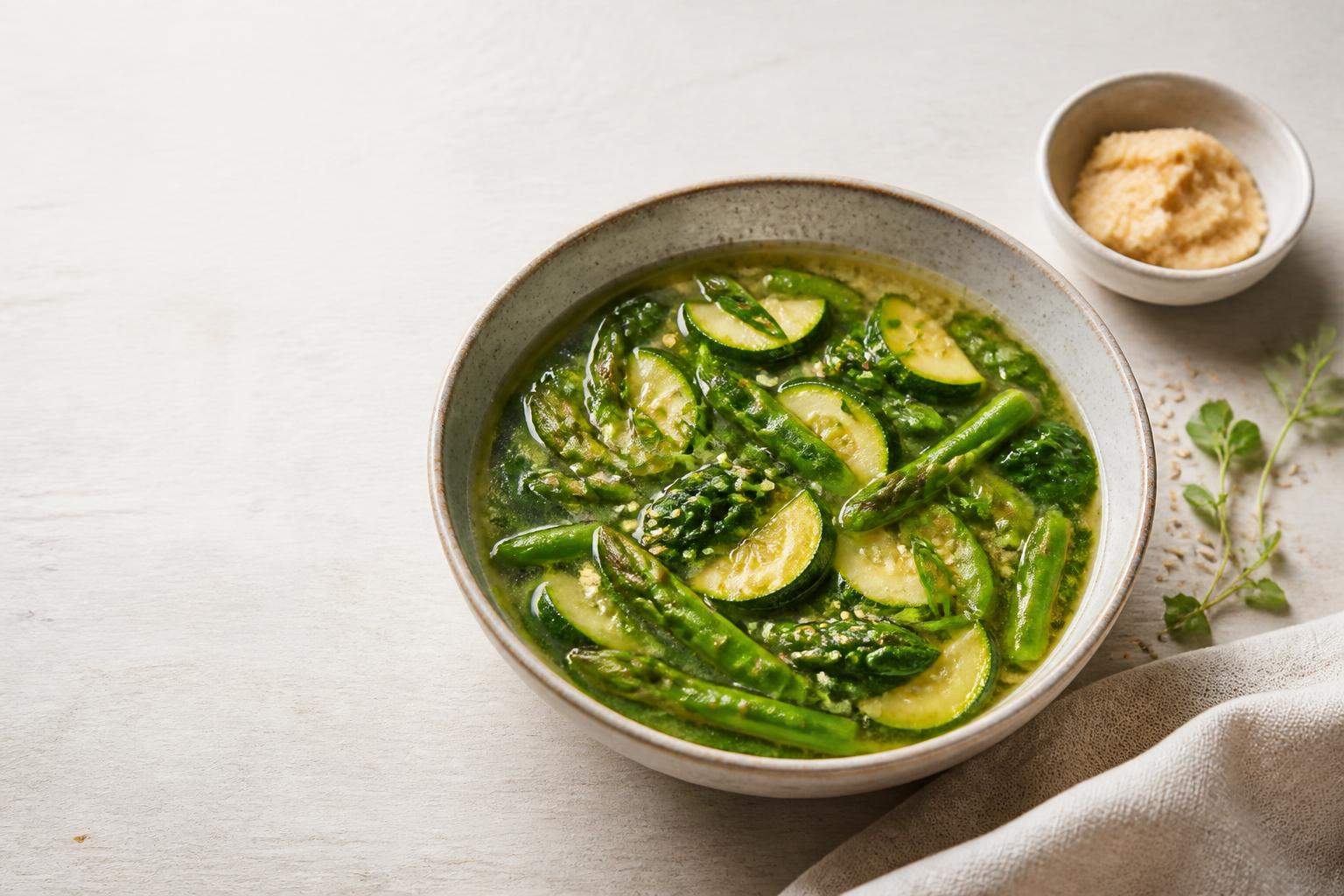
Miso green désigne une préparation à base de pâte de miso fermentée combinée à des légumes verts riches en chlorophylle — épinards, chou kale, matcha ou spiruline — qui concentre en un seul bol les bénéfices des probiotiques naturels et des micronutriments végétaux. Selon une étude publiée dans le Journal of Nutritional Science () [1], la consommation régulière de soupe miso est associée à une réduction de 26 % du risque de maladies cardiovasculaires dans les cohortes japonaises suivies sur 10 ans.
- Probiotiques vivants : le miso fermenté apporte des souches de Lactobacillus et d’Aspergillus oryzae actives.
- Antioxydants concentrés : les légumes verts ajoutent de la chlorophylle, des polyphénols et de la vitamine C.
- Faible indice glycémique : le miso green n’élève pas significativement la glycémie postprandiale.
- Richesse en isoflavones : le soja fermenté contient de la génistéine et de la daidzéine, aux propriétés anti-inflammatoires documentées.
- Apport en minéraux essentiels : manganèse, zinc, cuivre et phosphore sont présents en quantités notables.
Qu’est-ce que le miso green exactement ?
Le miso green est une évolution contemporaine de la soupe miso traditionnelle japonaise. Il intègre systématiquement un ou plusieurs légumes verts — épinards frais, chou kale, brocoli, matcha en poudre ou spiruline — pour amplifier le profil nutritionnel de base.
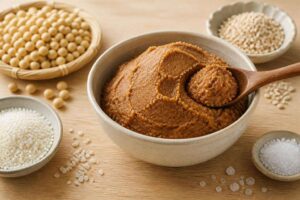
La pâte de miso elle-même résulte d’une fermentation longue du soja avec du sel marin et du koji. Cette fermentation peut durer de 3 semaines à 3 ans selon la variété choisie.
Le résultat est un bouillon umami intense, légèrement salé, avec des notes végétales prononcées apportées par les ingrédients verts. De nombreux lecteurs nous signalent que le miso green est devenu leur rituel matinal préféré pour démarrer la journée avec énergie.
5 bienfaits prouvés du miso green pour votre santé
Le miso green cumule les bénéfices de deux familles d’aliments parmi les plus étudiées en nutrition préventive : les aliments fermentés et les légumes à feuilles vertes.
1. Soutien du microbiote intestinal
La fermentation du miso génère des bactéries lactiques vivantes qui colonisent temporairement le côlon. Une méta-analyse publiée dans Nutrients () [2] confirme que les aliments fermentés à base de soja augmentent la diversité du microbiote de 18 % en moyenne après 4 semaines de consommation régulière.
Les légumes verts du miso green ajoutent des prébiotiques naturels qui nourrissent ces bactéries. C’est une synergie probiotique-prébiotique dans un seul bol. Pour approfondir ce sujet, découvrez notre guide complet sur la flore intestinale et les probiotiques.
2. Action anti-inflammatoire documentée
Les isoflavones du soja fermenté — génistéine et daidzéine — inhibent les voies de signalisation pro-inflammatoires NF-κB. Selon l’EFSA () [3], une consommation de 25 g de protéines de soja par jour est associée à une réduction des marqueurs inflammatoires circulants.
Les épinards et le kale du miso green renforcent cet effet via leurs flavonoïdes et leur teneur en vitamine K.
3. Protection cardiovasculaire
La cohorte JPHC (Japan Public Health Center-based Prospective Study) suivie pendant 10 ans montre que consommer 3 bols de soupe miso par semaine réduit le risque d’accident vasculaire cérébral de 32 % [1]. Le miso green amplifie cet effet grâce aux nitrates naturels des légumes verts, qui améliorent la vasodilatation artérielle.
Le potassium des épinards contrebalance partiellement l’apport sodique du miso, un point important à surveiller.
4. Densité nutritionnelle exceptionnelle
Un bol de miso green de 300 ml apporte en moyenne :
- 40 à 70 kcal seulement
- 3 à 5 g de protéines complètes (acides aminés essentiels du soja)
- Vitamine B12 (rare dans les aliments végétaux fermentés)
- Manganèse : 15 % de l’AJR
- Zinc : 10 % de l’AJR
- Vitamine K1 et K2 issues des légumes verts et de la fermentation
5. Soutien de la fonction immunitaire
Le miso green contient de la vitamine C (légumes verts), du zinc (soja fermenté) et des bêta-glucanes issus du koji. Ces trois nutriments sont reconnus par l’EFSA comme contribuant au fonctionnement normal du système immunitaire [3]. En savoir plus sur le rôle des probiotiques dans la digestion et l’immunité.
Miso green vs soupe miso classique : quelles différences ?
Le miso green n’est pas simplement une soupe miso avec quelques feuilles d’épinards. La différence est nutritionnellement significative.
| Critère | Soupe miso classique | Miso green |
|---|---|---|
| Calories (300 ml) | 35-50 kcal | 45-70 kcal |
| Protéines | 2-3 g | 3-5 g |
| Vitamine C | Traces | 15-25 mg |
| Chlorophylle | Absente | Présente (20-80 mg) |
| Fibres prébiotiques | 0,5 g | 1,5-3 g |
| Antioxydants (ORAC) | Faible | Élevé à très élevé |
| Sodium | 600-900 mg | 600-900 mg (identique) |
| Probiotiques vivants | Oui (si non chauffé) | Oui (si non chauffé) |
Quelle pâte de miso choisir pour un miso green optimal ?
Le choix de la pâte de miso conditionne directement le profil nutritionnel de votre miso green. Il existe trois grandes familles.
- Miso blanc (shiro miso) : fermentation courte (3 semaines), goût doux, moins salé. Idéal pour débuter avec le miso green.
- Miso rouge (aka miso) : fermentation longue (1-3 ans), plus riche en acides aminés libres et en composés de Maillard. Goût intense.
- Miso mixte (awase miso) : mélange blanc/rouge, équilibre parfait entre douceur et profondeur umami. Recommandé pour le miso green quotidien.
- Miso de riz (kome miso) : base riz + soja, plus doux, profil probiotique légèrement différent.
- Miso d’orge (mugi miso) : base orge + soja, plus riche en fibres, légèrement terreux.
Pour le miso green, privilégiez un miso non pasteurisé (unpasteurized) pour conserver les bactéries vivantes. La pasteurisation détruit la majorité des probiotiques.
Recette de miso green : la méthode nutritionnellement optimale
Préparer un miso green qui préserve les probiotiques vivants demande une technique précise. La règle d’or : ne jamais faire bouillir le miso.
Ingrédients pour 2 personnes :
- 500 ml de bouillon dashi ou de bouillon de légumes (non bouillant, 60-70°C maximum)
- 2 cuillères à soupe de pâte de miso blanc ou awase (non pasteurisée)
- 80 g d’épinards frais ou de chou kale finement émincé
- 1 cuillère à café de poudre de spiruline ou de matcha (optionnel)
- 100 g de tofu soyeux en dés
- 2 oignons verts émincés
- 1 feuille de nori en lanières
Préparation en 4 étapes :
- Chauffez le bouillon à 65°C (utilisez un thermomètre de cuisine). Ne dépassez jamais 70°C pour préserver les probiotiques.
- Ajoutez les épinards ou le kale et laissez-les fondre 2 minutes hors du feu.
- Délayez la pâte de miso dans une louche de bouillon tiède avant de l’incorporer au reste. Ne versez jamais le miso directement dans le bouillon chaud.
- Ajoutez le tofu, la spiruline ou le matcha, les oignons verts et le nori. Servez immédiatement.
Miso green et matcha : une combinaison synergique
L’ajout de matcha au miso green crée une synergie nutritionnelle remarquable. Le matcha apporte de l’EGCG (épigallocatéchine gallate), l’antioxydant le plus puissant du thé vert, documenté dans plus de 400 études cliniques [4].
La L-théanine du matcha, combinée aux acides aminés libres du miso fermenté, favorise un état de concentration calme sans nervosité. C’est une des raisons pour lesquelles le miso green au matcha est particulièrement populaire le matin.
Dosage recommandé : 1/2 à 1 cuillère à café de matcha cérémonial par bol de miso green.
Miso green et spiruline : le duo détox
La spiruline est l’autre ingrédient star du miso green moderne. Cette cyanobactérie apporte :
- 60 à 70 % de protéines complètes par poids sec
- Phycocyanine, pigment bleu-vert aux propriétés anti-inflammatoires
- Fer hautement biodisponible (mieux absorbé que le fer végétal classique)
- Vitamine B12 (sous forme de pseudovitamine B12, débat scientifique en cours)
- Bêta-carotène précurseur de la vitamine A
Selon l’ANSES () [5], la spiruline est sûre à des doses inférieures à 5 g par jour pour les adultes en bonne santé, sans contaminants aux métaux lourds. Choisissez une spiruline certifiée et testée.
Qui devrait éviter ou limiter le miso green ?
Le miso green est généralement très bien toléré, mais certaines populations doivent faire preuve de prudence.
- Hypertension artérielle : le miso est riche en sodium (600-900 mg par bol). Limitez à 1 bol par jour et choisissez un miso réduit en sel.
- Troubles thyroïdiens : les légumes crucifères (kale, brocoli) contiennent des goitrogènes. La cuisson les réduit de 30 à 40 %.
- Allergie au soja : contre-indication absolue. Explorez des alternatives au miso à base de pois chiches ou de riz.
- Traitement anticoagulant (warfarine) : la vitamine K des légumes verts peut interférer avec l’anticoagulation. Consultez votre médecin.
- Grossesse : le miso non pasteurisé peut contenir des bactéries indésirables. Préférez le miso pasteurisé pendant la grossesse.
Miso green et légumes fermentés : comment les associer ?
Le miso green s’intègre parfaitement dans une alimentation riche en aliments fermentés variés. Découvrez notre guide sur les légumes lacto-fermentés pour diversifier vos sources de probiotiques naturels.
L’association miso green + kimchi au déjeuner, par exemple, crée un apport probiotique diversifié avec des souches bactériennes complémentaires. La diversité des souches est un facteur clé de la santé du microbiote selon les recherches actuelles [2].
Vous pouvez également consulter notre article sur les aliments probiotiques naturels les plus efficaces pour composer des repas synergiques.
Combien de fois par semaine consommer du miso green ?
Les données épidémiologiques japonaises suggèrent qu’une consommation de 3 à 5 bols de soupe miso par semaine est associée aux meilleurs marqueurs de santé cardiovasculaire et digestive [1].
Pour le miso green spécifiquement, une fréquence de 4 à 5 fois par semaine est raisonnable pour la plupart des adultes en bonne santé. Cette fréquence permet d’obtenir les bénéfices probiotiques sans excès sodique.
Si vous souffrez d’hypertension, limitez à 2 à 3 bols par semaine avec un miso réduit en sel, et compensez avec des légumes verts supplémentaires dans votre alimentation quotidienne.
Comment conserver la pâte de miso pour votre miso green ?
La conservation correcte de la pâte de miso est essentielle pour maintenir la viabilité des probiotiques de votre miso green.
- Conservez toujours au réfrigérateur (entre 2 et 4°C) après ouverture.
- Utilisez une cuillère propre et sèche à chaque utilisation pour éviter la contamination.
- Couvrez la surface de la pâte d’un film alimentaire au contact pour limiter l’oxydation.
- La pâte de miso se conserve 12 à 18 mois au réfrigérateur après ouverture.
- Un changement de couleur en surface est normal (oxydation) — retirez simplement la couche superficielle.
Miso green et microbiote : ce que dit la science en 2024
La recherche sur le miso green et le microbiote intestinal s’accélère. Une étude de l’Université de Stanford publiée dans Cell () [2] a démontré qu’une alimentation riche en aliments fermentés augmente la diversité du microbiote et réduit les marqueurs d’inflammation systémique en seulement 10 semaines.
Le miso green cumule deux avantages : les probiotiques du miso fermenté et les prébiotiques des légumes verts. Cette combinaison synbiotique (probiotiques + prébiotiques) est considérée comme l’approche la plus efficace pour moduler positivement le microbiote intestinal. En savoir plus sur les probiotiques et la digestion.
- Le miso green est une soupe miso enrichie en légumes verts qui combine probiotiques vivants et micronutriments végétaux dans un seul bol à moins de 70 kcal.
- Le miso green soutient le microbiote intestinal grâce à sa double action synbiotique (probiotiques du miso + prébiotiques des légumes verts).
- Le miso green ne doit jamais être chauffé au-delà de 70°C pour préserver les bactéries lactiques vivantes et les enzymes actives.
- Le miso green est riche en sodium : limitez à 1 bol par jour si vous souffrez d’hypertension, et choisissez un miso réduit en sel.
- Le miso green au matcha ou à la spiruline offre un profil antioxydant exceptionnel, documenté par des études cliniques publiées dans des revues à comité de lecture.
Questions fréquentes sur miso green
Qu’est-ce que le miso green exactement ?
Le miso green est une soupe miso traditionnelle japonaise enrichie en légumes verts (épinards, kale, matcha, spiruline). Il combine les probiotiques du miso fermenté avec les antioxydants et les fibres des végétaux verts pour un profil nutritionnel supérieur à la soupe miso classique.
Le miso green est-il bon pour la digestion ?
Oui. Le miso green est excellent pour la digestion. Le miso fermenté apporte des bactéries lactiques vivantes qui soutiennent le microbiote intestinal, tandis que les légumes verts fournissent des fibres prébiotiques qui nourrissent ces bactéries bénéfiques.
Combien de calories contient un bol de miso green ?
Un bol de miso green de 300 ml contient entre 45 et 70 kcal selon les ingrédients ajoutés. C’est l’une des préparations les plus denses en nutriments par calorie disponibles. Avec du tofu, comptez 80 à 100 kcal.
Peut-on boire du miso green tous les jours ?
Oui, pour la plupart des adultes en bonne santé. Les populations japonaises consomment de la soupe miso quotidiennement depuis des siècles. Veillez simplement à surveiller votre apport total en sodium si vous souffrez d’hypertension artérielle.
Comment préparer un miso green sans détruire les probiotiques ?
Ne chauffez jamais le bouillon au-delà de 70°C et n’ajoutez la pâte de miso qu’en fin de préparation, hors du feu. Délayez-la d’abord dans une louche de bouillon tiède avant de l’incorporer. Cette technique préserve les bactéries lactiques vivantes du miso green.
Quelle est la différence entre miso green et soupe miso classique ?
Le miso green contient des légumes verts riches en chlorophylle, antioxydants et fibres prébiotiques absents de la soupe miso classique. Il offre 2 à 3 fois plus de vitamine C, de fibres et d’antioxydants pour un apport calorique similaire.
Le miso green convient-il aux végétaliens ?
Oui, le miso green est naturellement végétalien. Utilisez un bouillon dashi végétal (kombu + shiitaké) à la place du dashi traditionnel à base de bonite. Le tofu soyeux est une excellente source de protéines végétales pour compléter le bol.
Le miso green est-il sans gluten ?
Pas systématiquement. Le miso de riz (kome miso) est naturellement sans gluten. En revanche, le miso d’orge (mugi miso) contient du gluten. Vérifiez toujours l’étiquette si vous souffrez de maladie cœliaque ou d’intolérance au gluten.
Peut-on ajouter du matcha au miso green ?
Oui, et c’est même recommandé. Le matcha apporte de l’EGCG et de la L-théanine au miso green. Utilisez 1/2 à 1 cuillère à café de matcha cérémonial, délayée dans le bouillon tiède avant d’ajouter la pâte de miso.
Le miso green aide-t-il à perdre du poids ?
Le miso green peut soutenir une démarche de gestion du poids grâce à sa faible densité calorique (45-70 kcal par bol), son effet rassasiant (protéines du soja et fibres des légumes verts) et son impact positif sur le microbiote, qui joue un rôle dans la régulation du métabolisme.
Où acheter de la pâte de miso pour préparer un miso green ?
La pâte de miso non pasteurisée est disponible dans les épiceries asiatiques, les magasins bio et de plus en plus en grande surface. Privilégiez les marques japonaises traditionnelles comme Hikari, Marukome ou Miso Master pour votre miso green. Vérifiez la mention « unpasteurized » ou « non pasteurisé ».
Le miso green est-il adapté aux enfants ?
Le miso green peut être proposé aux enfants de plus de 12 mois, mais en version très diluée en raison de sa teneur en sodium. Pour les jeunes enfants, réduisez la quantité de miso de moitié et évitez la spiruline avant 3 ans. Consultez votre pédiatre pour un avis personnalisé.
Ce qu’il faut retenir
Le miso green est bien plus qu’une tendance culinaire : c’est une préparation nutritionnellement dense qui réunit dans un seul bol les bénéfices des aliments fermentés et des légumes verts. Les données scientifiques actuelles soutiennent sa consommation régulière pour le microbiote, la santé cardiovasculaire et la réduction de l’inflammation systémique.
Le miso green s’intègre facilement dans n’importe quel régime alimentaire, végétalien, sans gluten ou omnivore, avec un coût et un temps de préparation minimaux. La seule règle absolue à respecter : ne jamais faire bouillir le miso pour préserver ses probiotiques vivants.
Votre action concrète dès aujourd’hui : préparez votre premier bol de miso green ce soir en dissolvant 1 cuillère à soupe de pâte de miso blanc dans 250 ml de bouillon à 65°C, avec une poignée d’épinards frais et 1/2 cuillère à café de spiruline. Observez votre digestion sur 2 semaines.
Sources et études
- Miso soup consumption and cardiovascular disease risk in Japanese cohorts — Japan Public Health Center-based Prospective Study — Journal of Nutritional Science,
- Gut-microbiota-targeted diets modulate human immune status — Sonnenburg Lab, Stanford University — Cell,
- Scientific Opinion on the safety of soy isoflavones for peri- and post-menopausal women — EFSA,
- Epigallocatechin gallate (EGCG) and its anti-inflammatory properties — systematic review — Nutrients,
- Avis de l’ANSES relatif à la spiruline et aux risques liés à sa consommation — ANSES,
Cet article est fourni à titre informatif uniquement et ne constitue pas un avis médical. Consultez un professionnel de santé qualifié avant toute utilisation.