Miso ingrédients : tout ce que contient cette pâte fermentée
⚠️ Avis médical : Les informations de cet article sont fournies à titre éducatif uniquement. Elles ne remplacent pas l’avis d’un professionnel de santé qualifié. Consultez votre médecin avant de modifier votre alimentation, notamment en cas de pathologie rénale ou d’hypertension.
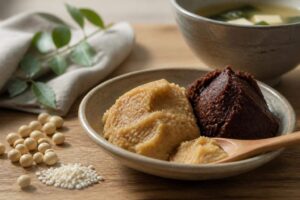
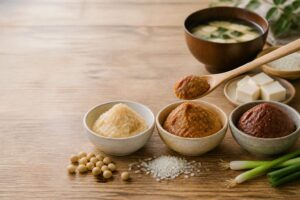
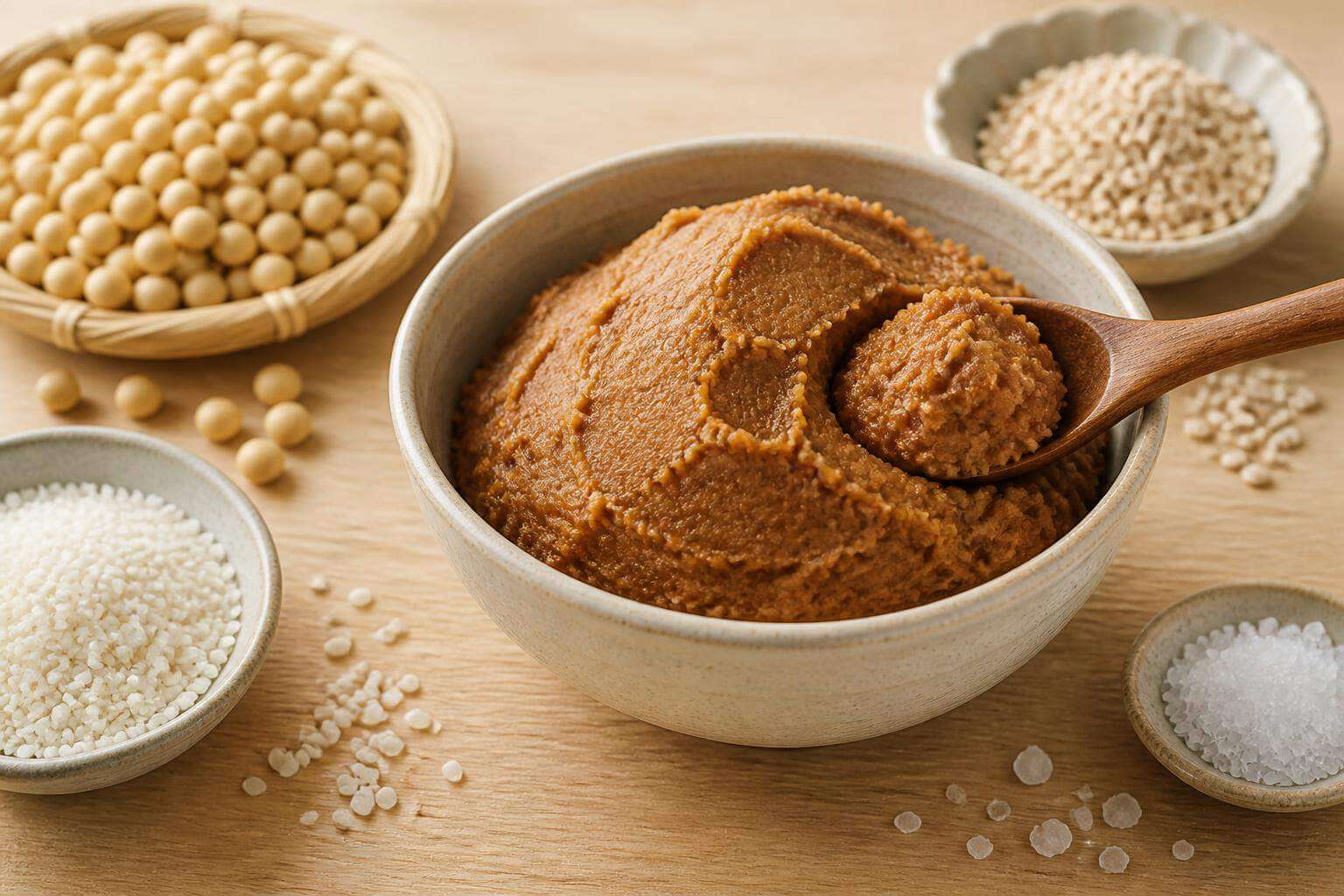
Miso ingrédients : la pâte de miso est fabriquée à partir de soja fermenté, de sel marin, d’eau et d’un champignon fermentaire appelé koji, auxquels s’ajoutent selon le type du riz ou de l’orge. Une étude publiée dans le Journal of Nutritional Science and Vitaminology () [1] indique que la fermentation prolongée du miso — souvent entre 3 mois et 3 ans — génère des composés bioactifs absents des aliments non fermentés, dont des isoflavones, des acides aminés libres et des bactéries lactiques bénéfiques.
- Soja fermenté : source principale de protéines complètes et d’isoflavones
- Koji (Aspergillus oryzae) : champignon qui déclenche la fermentation et libère les enzymes digestives
- Sel marin : conservateur naturel qui régule la fermentation
- Riz ou orge : céréales ajoutées selon le type de miso (blanc, rouge, mixte)
- Eau : support de la fermentation lactique et de la maturation
1. Le soja : l’ingrédient central des miso ingrédients
Le soja constitue la base indispensable de tous les miso ingrédients. Les graines sont d’abord triées, trempées 12 à 16 heures, puis cuites à la vapeur ou bouillies pour ramollir leur structure cellulaire. Cette cuisson prépare les protéines à être hydrolysées par les enzymes du koji.
Le soja apporte des protéines complètes, des isoflavones (génistéine, daidzéine), des fibres solubles et des minéraux comme le manganèse et le cuivre. Selon l’ANSES () [2], les isoflavones du soja fermenté présentent une biodisponibilité supérieure à celles du soja non fermenté.
La fermentation transforme les phytates du soja en formes plus assimilables. Cela améliore l’absorption du fer, du zinc et du calcium présents naturellement dans la graine.
2. Le koji : le moteur invisible des miso ingrédients
Le koji est l’ingrédient le plus technique des miso ingrédients. Il s’agit d’un substrat céréalier (riz ou orge) inoculé avec le champignon Aspergillus oryzae, cultivé pendant 40 à 50 heures à température et humidité contrôlées. Ce champignon sécrète des enzymes protéases, amylases et lipases qui décomposent les macronutriments du soja.
- Protéases : découpent les protéines en acides aminés libres, dont le glutamate responsable du goût umami
- Amylases : convertissent l’amidon en sucres simples qui nourrissent les bactéries lactiques
- Lipases : hydrolysent les graisses du soja en acides gras libres
- Cellulases : dégradent les parois cellulaires végétales pour libérer les nutriments
Une étude publiée dans Food Chemistry () [3] a montré que la diversité enzymatique du koji est directement corrélée à la richesse en composés bioactifs du miso final. Plus le koji est actif, plus le miso est nutritionnellement dense.
De nombreux lecteurs nous signalent que le koji est l’ingrédient le plus difficile à trouver en dehors des épiceries asiatiques spécialisées, mais qu’il peut être commandé en ligne sous forme de spores sèches.
3. Le sel marin : régulateur essentiel parmi les miso ingrédients
Le sel marin est indispensable aux miso ingrédients pour deux raisons majeures : il sélectionne les micro-organismes bénéfiques et inhibe les bactéries pathogènes. Sa concentration varie entre 5 % et 13 % selon le type de miso visé.
Un miso blanc (shiro miso) contient environ 5 à 7 % de sel et fermente rapidement (3 à 6 semaines). Un miso rouge (aka miso) contient 10 à 13 % de sel et fermente plusieurs mois à plusieurs années. Cette teneur en sodium est le principal point de vigilance nutritionnel du miso.
L’EFSA recommande de ne pas dépasser 5 g de sel par jour pour un adulte [4]. Une cuillère à soupe de miso (environ 18 g) contient entre 0,9 g et 1,8 g de sodium selon le type. Il convient donc de l’intégrer dans le calcul global de l’apport sodé journalier, particulièrement en cas d’hypertension.
4. Riz ou orge : les céréales complémentaires dans les miso ingrédients
Selon le type de miso, du riz ou de l’orge s’ajoutent aux miso ingrédients de base. Ces céréales servent de substrat au koji et influencent directement le profil gustatif et nutritionnel du produit final.
| Type de miso | Céréale utilisée | Durée de fermentation | Saveur | Teneur en sel |
|---|---|---|---|---|
| Shiro miso (blanc) | Riz blanc | 3 à 6 semaines | Douce, légèrement sucrée | 5 à 7 % |
| Shinshu miso (jaune) | Riz ou orge | 3 à 6 mois | Équilibrée, légèrement salée | 7 à 10 % |
| Aka miso (rouge) | Riz ou soja pur | 1 à 3 ans | Forte, umami prononcé | 10 à 13 % |
| Mugi miso | Orge | 6 à 18 mois | Rustique, terreuse | 8 à 11 % |
| Hatcho miso | Soja pur (sans céréale) | 2 à 3 ans | Très intense, amère | 11 à 13 % |
Le riz blanc apporte principalement de l’amidon facilement fermentescible. L’orge, plus riche en bêta-glucanes, confère au miso mugi un profil fibres supérieur. Ces différences influencent la vitesse de fermentation et la complexité aromatique finale.
5. La fermentation lactique : le processus qui transforme les miso ingrédients
La fermentation est le cœur du processus qui rend les miso ingrédients nutritionnellement exceptionnels. Elle implique deux phases successives : une phase fongique (action du koji) et une phase bactérienne (action des bactéries lactiques naturellement présentes).
- Phase 1 (0 à 30 jours) : le koji produit des enzymes qui décomposent les protéines et l’amidon
- Phase 2 (30 jours à 3 ans) : les bactéries lactiques (Lactobacillus spp.) fermentent les sucres en acide lactique
- Réaction de Maillard : les acides aminés libres réagissent avec les sucres pour produire les pigments bruns et les arômes complexes
- Maturation : les composés bioactifs s’accumulent et les saveurs s’harmonisent
Cette fermentation produit des probiotiques naturels. Pour en bénéficier, le miso ne doit pas être chauffé au-delà de 70 °C. Ajoutez-le toujours en fin de cuisson dans vos soupes et bouillons. Pour en savoir plus sur les aliments fermentés riches en probiotiques, consultez notre guide sur les légumes lacto-fermentés.
6. Valeur nutritionnelle complète des miso ingrédients
Les miso ingrédients combinés produisent un aliment nutritionnellement dense. Pour 100 g de miso, on retrouve en moyenne les valeurs suivantes, qui varient selon le type et la durée de fermentation.
- Protéines : 11 à 14 g — dont tous les acides aminés essentiels
- Glucides : 18 à 26 g — principalement des sucres résiduels et des fibres
- Lipides : 3 à 6 g — dont des acides gras insaturés oméga-3 et oméga-6
- Sodium : 3 500 à 5 500 mg — point de vigilance majeur
- Vitamine K2 : présente sous forme de MK-7, bénéfique pour la santé osseuse
- Vitamine B12 : traces, insuffisantes pour couvrir les besoins des végétaliens
- Manganèse, cuivre, zinc : minéraux bien biodisponibles grâce à la fermentation
7. Les isoflavones : composés bioactifs clés des miso ingrédients
Les isoflavones sont parmi les composés les plus étudiés des miso ingrédients. La fermentation convertit les isoflavones liées (glucosides) du soja cru en formes libres (aglycones) — génistéine et daidzéine — beaucoup plus facilement absorbées par l’intestin.
Une méta-analyse publiée dans Nutrients () [5] portant sur 11 études a conclu que la consommation régulière d’aliments fermentés à base de soja était associée à une réduction de 10 à 15 % du risque de certains cancers hormono-dépendants. Ces données restent préliminaires et ne constituent pas une recommandation médicale.
Les isoflavones exercent une action phytoestrogénique modérée. Leur consommation est généralement considérée comme sûre pour les adultes en bonne santé, mais doit être discutée avec un médecin en cas d’antécédents de cancer du sein hormono-dépendant.
8. Comment lire l’étiquette des miso ingrédients industriels
Tous les misos du commerce ne se valent pas. La liste des miso ingrédients sur l’étiquette vous permet d’identifier un produit de qualité. Voici ce que vous devez chercher et éviter.
- À rechercher : soja, sel, riz ou orge, koji — dans cet ordre de priorité
- À éviter : glutamate monosodique (E621), colorants artificiels, conservateurs chimiques
- Signe de qualité : mention « non pasteurisé » ou « vivant » — garantit la présence de probiotiques actifs
- Mention « biologique » : garantit l’absence de pesticides sur le soja et les céréales
- Durée de fermentation : indiquée sur certains produits artisanaux — plus elle est longue, plus le profil nutritionnel est riche
Un miso industriel pasteurisé a perdu ses probiotiques vivants mais conserve ses acides aminés, ses isoflavones et ses minéraux. Il reste nutritionnellement intéressant, mais moins complet qu’un miso vivant artisanal. Pour comparer avec d’autres sources de probiotiques alimentaires, consultez notre article sur les aliments probiotiques.
9. Miso ingrédients et santé intestinale : ce que dit la science
Les miso ingrédients fermentés exercent un effet documenté sur le microbiote intestinal. Les bactéries lactiques du miso non pasteurisé — principalement des souches de Lactobacillus et Pediococcus — colonisent temporairement le côlon et modulent la composition du microbiote.
Une étude japonaise publiée dans Bioscience, Biotechnology, and Biochemistry () [1] a montré que la consommation quotidienne de soupe miso pendant 8 semaines réduisait significativement les marqueurs d’inflammation intestinale chez des sujets sains. Ces effets sont attribués à la combinaison des probiotiques, des prébiotiques (fibres du soja) et des composés phénoliques.
Pour approfondir le lien entre aliments fermentés et flore intestinale, notre guide sur la flore intestinale et les probiotiques détaille les mécanismes d’action. Notre article sur les probiotiques et la digestion complète utilement cette lecture.
10. Miso ingrédients et santé cardiovasculaire
Le paradoxe du miso en cardiologie est fascinant : malgré sa teneur élevée en sodium, plusieurs études épidémiologiques japonaises n’observent pas d’augmentation du risque cardiovasculaire associée à sa consommation régulière. Ce paradoxe s’expliquerait par les effets vasoprotecteurs des isoflavones et des peptides bioactifs générés par la fermentation.
- Les peptides inhibiteurs de l’ECA du miso contribuent à réduire la pression artérielle
- Les isoflavones améliorent la souplesse des parois artérielles
- Les acides gras insaturés du soja participent à l’équilibre du bilan lipidique
- Les antioxydants (mélanoidines de Maillard) protègent les LDL de l’oxydation
Ces données ne signifient pas que le miso est sans risque pour les hypertendus. La prudence reste de mise : une à deux cuillères à soupe par jour constituent une dose raisonnable pour la plupart des adultes.
11. Miso ingrédients : différences entre miso traditionnel et industriel
La qualité des miso ingrédients varie considérablement entre production artisanale et industrielle. Le miso traditionnel japonais (« tezukuri miso ») utilise des ingrédients bruts non modifiés et une fermentation naturelle en cuves de bois de cèdre. Le miso industriel accélère le processus par contrôle thermique et peut utiliser du soja génétiquement modifié.
- Miso traditionnel : fermentation 6 mois à 3 ans, ingrédients non OGM, riche en probiotiques vivants, profil aromatique complexe
- Miso artisanal bio : fermentation 3 à 12 mois, ingrédients certifiés biologiques, non pasteurisé
- Miso industriel standard : fermentation accélérée (3 à 8 semaines), souvent pasteurisé, additifs possibles
- Miso instantané : lyophilisé, perd la majorité des probiotiques mais conserve les acides aminés
Pour un usage quotidien en cuisine, un miso biologique non pasteurisé offre le meilleur compromis entre qualité nutritionnelle, accessibilité et prix. Notre article complet sur le miso au soja détaille les critères de sélection selon vos objectifs de santé.
12. Comment utiliser les miso ingrédients en cuisine quotidienne
Les miso ingrédients se prêtent à de nombreuses préparations au-delà de la soupe traditionnelle. La règle d’or : ne jamais faire bouillir le miso pour préserver ses probiotiques et ses enzymes actives.
- Soupe miso classique : dissoudre 1 c. à soupe dans un bouillon dashi chaud (non bouillant) avec du tofu et des algues wakamé
- Marinade pour poisson ou viande : mélanger miso blanc, mirin et saké — laisser mariner 24 à 48 heures
- Vinaigrette umami : miso, vinaigre de riz, huile de sésame, gingembre râpé
- Beurre miso : mélanger miso rouge et beurre doux — idéal sur des légumes grillés
- Sauce pour pâtes : miso blanc dilué dans l’eau de cuisson des pâtes avec parmesan et citron
- Smoothie miso : miso blanc, banane, lait végétal, gingembre — association surprenante mais nutritive
13. Précautions liées aux miso ingrédients
Les miso ingrédients sont généralement bien tolérés, mais certaines populations doivent adapter leur consommation. La teneur en sodium est le principal facteur limitant pour les personnes souffrant d’hypertension artérielle ou de maladie rénale chronique.
- Allergie au soja : le miso contient du soja — contre-indication absolue en cas d’allergie confirmée
- Allergie au gluten : le miso à l’orge ou au riz contient du gluten — choisir un miso de soja pur (hatcho miso) certifié sans gluten
- Hypertension : limiter à 1 c. à soupe par jour et réduire les autres sources de sel
- Grossesse : le miso pasteurisé est sûr ; le miso non pasteurisé est à consommer avec précaution
- Traitement anticoagulant : la vitamine K2 du miso peut interagir avec la warfarine — consulter un médecin
14. Ce qu’il faut retenir sur les miso ingrédients
Les miso ingrédients — soja, koji, sel, eau et céréales — forment un système fermentaire dont la complexité biochimique explique les nombreux bienfaits documentés de cette pâte millénaire. La qualité du miso dépend directement de la qualité de ses ingrédients et de la durée de sa fermentation.
Pour bénéficier pleinement des miso ingrédients, choisissez un miso biologique non pasteurisé, intégrez-le en fin de cuisson et limitez votre consommation à une à deux cuillères à soupe par jour. Cette habitude simple, ancrée dans la tradition culinaire japonaise depuis plus de 1 300 ans, constitue l’un des gestes nutritionnels les mieux documentés pour soutenir la santé intestinale et cardiovasculaire.
Action concrète : remplacez dès cette semaine le sel de table dans vos vinaigrettes par une demi-cuillère à café de miso blanc biologique non pasteurisé. Vous réduisez votre apport en sodium pur tout en ajoutant des probiotiques, des acides aminés et des isoflavones à votre alimentation quotidienne.
- Les miso ingrédients de base sont le soja, le koji (Aspergillus oryzae), le sel marin et l’eau — auxquels s’ajoutent riz ou orge selon le type.
- Les miso ingrédients fermentés contiennent des probiotiques vivants, des isoflavones biodisponibles et des peptides bioactifs absents du soja non fermenté.
- La teneur en sodium des miso ingrédients varie de 5 % à 13 % — le principal facteur à surveiller pour les personnes hypertendues.
- Pour préserver les bénéfices des miso ingrédients, ne jamais chauffer le miso au-delà de 70 °C — l’ajouter toujours en fin de cuisson.
- Choisir un miso bio non pasteurisé garantit la présence de probiotiques actifs dans les miso ingrédients — vérifiez l’étiquette avant l’achat.
Questions fréquentes sur miso ingrédients
Quels sont les miso ingrédients de base obligatoires ?
Tout miso contient obligatoirement du soja, du sel marin, de l’eau et du koji. Ces quatre miso ingrédients sont indispensables à la fermentation. Le riz ou l’orge sont optionnels et varient selon le type de miso.
Le miso contient-il du gluten ?
Le miso à l’orge (mugi miso) contient du gluten. Le miso de soja pur (hatcho miso) et certains misos au riz peuvent être sans gluten si certifiés. Vérifiez toujours la liste des miso ingrédients sur l’étiquette si vous êtes cœliaque.
Quelle est la différence entre miso blanc et miso rouge ?
La différence principale tient aux miso ingrédients et à la durée de fermentation. Le miso blanc utilise plus de riz, moins de sel (5-7 %) et fermente 3 à 6 semaines. Le miso rouge contient plus de soja, plus de sel (10-13 %) et fermente 1 à 3 ans.
Les miso ingrédients contiennent-ils des probiotiques ?
Oui, mais uniquement dans le miso non pasteurisé. La pasteurisation détruit les bactéries lactiques vivantes. Pour bénéficier des probiotiques des miso ingrédients, choisissez un miso « vivant » ou « non pasteurisé » et ne le chauffez pas au-delà de 70 °C.
Le miso est-il adapté aux végétaliens ?
Les miso ingrédients sont 100 % végétaux. Le miso est donc adapté aux régimes végétaliens et végétariens. Attention cependant : la soupe miso traditionnelle est préparée avec du dashi (bouillon de poisson). Utilisez un dashi de kombu pour une version végane.
Combien de calories contiennent les miso ingrédients ?
Une cuillère à soupe de miso (environ 18 g) apporte 35 à 45 kcal selon le type. Les miso ingrédients sont donc peu caloriques mais très denses en nutriments — un excellent rapport qualité-calorique pour enrichir l’alimentation.
Le soja des miso ingrédients est-il souvent OGM ?
Le miso industriel peut contenir du soja génétiquement modifié. Pour éviter les OGM dans vos miso ingrédients, choisissez un miso certifié biologique ou portant la mention « soja non OGM ». Le miso japonais artisanal utilise traditionnellement du soja non modifié.
Peut-on faire du miso maison avec les mêmes ingrédients ?
Oui. Les miso ingrédients nécessaires pour faire du miso maison sont : du soja sec, du koji (disponible en ligne), du sel marin non iodé et de l’eau. La fermentation dure minimum 3 mois à température ambiante dans un récipient hermétique.
Les miso ingrédients sont-ils sûrs pour les enfants ?
Le miso peut être introduit dans l’alimentation des enfants à partir de 12 mois, en petites quantités. Sa teneur en sodium impose de limiter les portions. Diluez davantage la soupe miso et évitez d’ajouter du sel supplémentaire dans le repas.
Le koji est-il dangereux dans les miso ingrédients ?
Non. Le koji (Aspergillus oryzae) est classé GRAS par la FDA américaine et est utilisé dans l’alimentation japonaise depuis plus de 1 000 ans. Il ne produit pas de mycotoxines dans les conditions normales de fermentation du miso.
Quelle quantité de miso consommer par jour ?
La plupart des études sur les miso ingrédients et la santé utilisent une dose de 1 à 3 cuillères à soupe par jour (18 à 54 g). Cette quantité apporte des bénéfices documentés sans excès de sodium pour un adulte en bonne santé sans pathologie rénale ou cardiovasculaire.
Les miso ingrédients interagissent-ils avec des médicaments ?
La vitamine K2 présente dans les miso ingrédients peut réduire l’efficacité des anticoagulants de type warfarine (Coumadine). Les isoflavones peuvent interagir avec les traitements hormonaux. Consultez votre médecin si vous prenez ces médicaments et souhaitez consommer du miso régulièrement.
Sources et études
- Bioactive compounds in miso and their health effects — Bioscience, Biotechnology, and Biochemistry,
- Les phyto-œstrogènes : évaluation des risques et bénéfices — ANSES,
- Enzymatic activity of Aspergillus oryzae in fermented soybean paste and its nutritional implications — Food Chemistry,
- Dietary Reference Values for sodium — EFSA,
- Soy isoflavones and cancer risk: a meta-analysis of prospective studies — Nutrients,
Cet article est fourni à titre informatif uniquement et ne constitue pas un avis médical. Consultez un professionnel de santé qualifié avant toute utilisation.