Qu’est ce que le kimchi ? Définition, bienfaits et conseils
⚠️ Avertissement médical : Les informations contenues dans cet article sont fournies à titre informatif uniquement et ne remplacent pas l’avis d’un professionnel de santé. Consultez votre médecin avant de modifier votre alimentation, notamment en cas de pathologie digestive, d’allergie ou de traitement médicamenteux en cours.
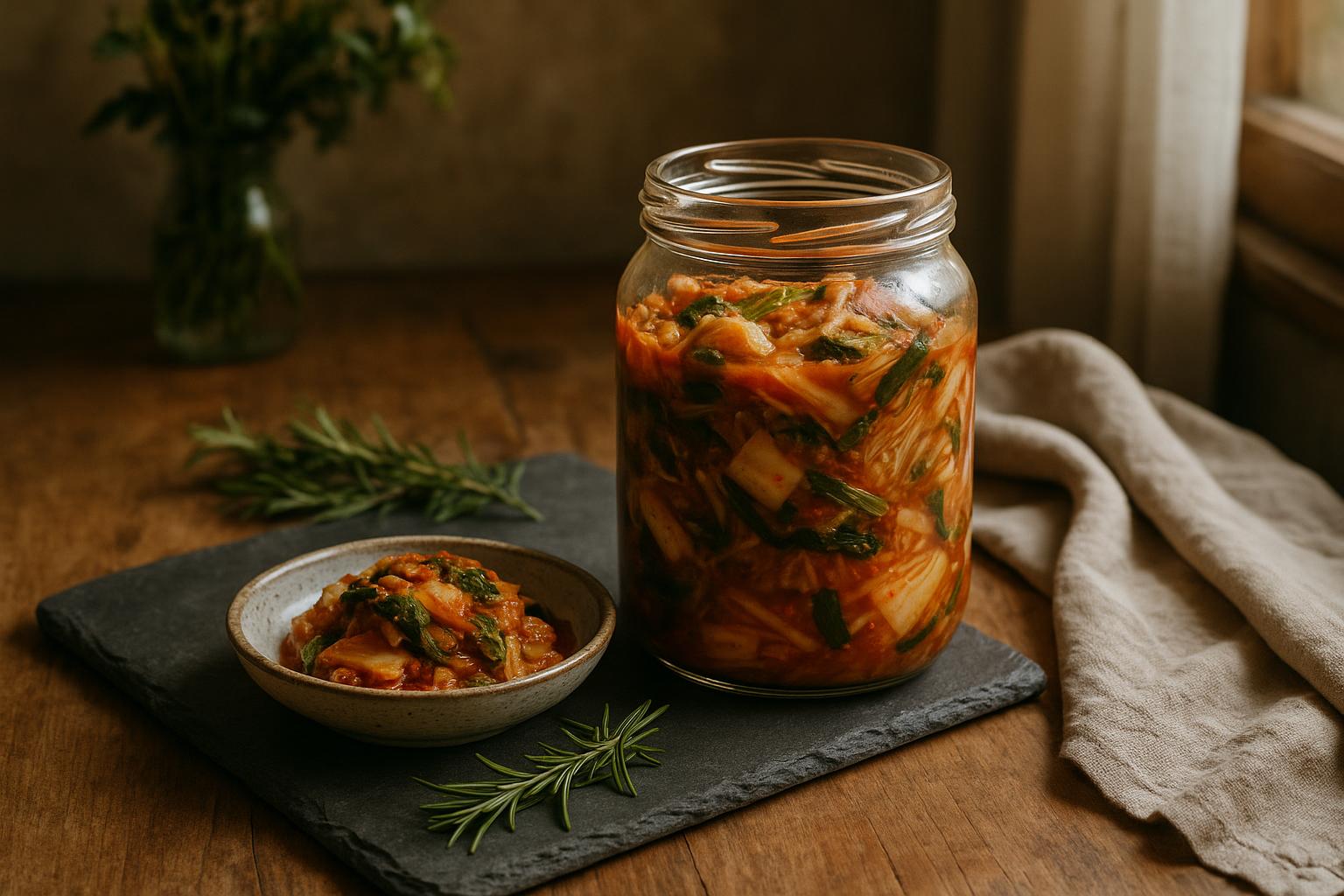
Qu’est ce que le kimchi : c’est un plat traditionnel coréen à base de légumes lacto-fermentés, principalement du chou chinois, assaisonné de piment, d’ail et de gingembre, reconnu pour sa richesse exceptionnelle en probiotiques vivants et en vitamines.
Une étude publiée dans le Journal of Ethnic Foods () [1] recense plus de 200 variétés de kimchi consommées en Corée, avec une teneur moyenne en probiotiques atteignant 108 à 109 UFC par gramme de produit fermenté.
- Aliment fermenté naturellement riche en Lactobacillus vivants
- Source de vitamines C, K et B12 biodisponibles
- Faible en calories : environ 15 kcal pour 100 g
- Reconnu patrimoine culturel immatériel de l’UNESCO depuis 2013
- Bénéfices documentés sur le microbiote, l’immunité et la digestion
Qu’est ce que le kimchi : définition précise et origine historique
Qu’est ce que le kimchi dans sa définition la plus rigoureuse ? C’est un aliment fermenté coréen préparé par lacto-fermentation anaérobie de légumes crus, principalement du chou chinois (Brassica rapa subsp. pekinensis), mélangé à une pâte d’assaisonnement épicée. Cette fermentation naturelle est assurée par des bactéries lactiques indigènes, notamment les espèces Lactobacillus kimchii et Leuconostoc mesenteroides.
L’histoire du kimchi remonte à plus de 3 000 ans. Les premières traces écrites mentionnent un légume salé et fermenté dès la période des Trois Royaumes coréens. Le piment rouge, aujourd’hui indissociable du kimchi, n’a été introduit en Corée qu’au , via le commerce avec le Japon et le Portugal.
En , l’UNESCO a inscrit la tradition de préparation du kimchi, appelée kimjang, au patrimoine culturel immatériel de l’humanité [2]. Cette reconnaissance souligne l’importance sociale et nutritionnelle de cet aliment dans la culture coréenne.
Composition nutritionnelle : ce que contient vraiment le kimchi
Comprendre qu’est ce que le kimchi passe par l’analyse de sa composition nutritionnelle détaillée. Pour 100 g de kimchi traditionnel au chou, voici les valeurs moyennes relevées par l’ANSES et les bases de données nutritionnelles coréennes :
| Nutriment | Quantité pour 100 g | % des Apports Journaliers Recommandés |
|---|---|---|
| Énergie | 15 kcal | 0,75 % |
| Glucides | 2,4 g | 1 % |
| Fibres alimentaires | 1,6 g | 6 % |
| Vitamine C | 18 mg | 22 % |
| Vitamine K | 43 µg | 57 % |
| Vitamine B6 | 0,2 mg | 14 % |
| Folates (B9) | 28 µg | 14 % |
| Sodium | 670 mg | 33 % |
| Probiotiques vivants | 108–109 UFC | Non défini |
Le kimchi est également une source notable de polyphénols issus du piment, de l’ail et du gingembre. Ces composés bioactifs — capsaïcine, allicine, gingérols — contribuent à ses propriétés anti-inflammatoires documentées dans la littérature scientifique.
Le processus de lacto-fermentation : comment le kimchi est fabriqué
Qu’est ce que le kimchi sans sa fermentation ? Rien d’autre qu’un légume épicé. C’est précisément la lacto-fermentation qui transforme le chou ordinaire en superaliment probiotique. Le processus se déroule en trois phases distinctes.
- Salage initial : le chou est recouvert de sel pendant 6 à 12 heures pour extraire l’eau par osmose et créer un environnement défavorable aux bactéries pathogènes.
- Assaisonnement : la pâte épicée (piment gochugaru, ail, gingembre, sauce de poisson ou sauce soja) est mélangée au chou égoutté.
- Fermentation anaérobie : le mélange est tassé dans des récipients hermétiques. Les bactéries lactiques naturellement présentes produisent de l’acide lactique, abaissant le pH en dessous de 4,5 en 1 à 5 jours à température ambiante.
Une étude publiée dans le LWT – Food Science and Technology () [3] montre que la diversité bactérienne du kimchi atteint son pic entre le 3e et le 7e jour de fermentation, avec une dominance de Lactobacillus plantarum et Leuconostoc citreum. Ces souches sont parmi les plus étudiées pour leurs effets bénéfiques sur le microbiote intestinal humain.
De nombreux lecteurs nous signalent que la fermentation maison du kimchi leur a permis de mieux contrôler la teneur en sel et le niveau de piquant, tout en obtenant un produit encore plus riche en bactéries vivantes qu’un kimchi industriel pasteurisé.
5 bienfaits digestifs prouvés du kimchi sur le microbiote
Qu’est ce que le kimchi peut apporter à votre système digestif ? Les recherches récentes sont particulièrement éloquentes sur ce point. Voici les effets les mieux documentés.
- Enrichissement du microbiote : une consommation régulière augmente la diversité des espèces bactériennes intestinales, facteur clé de santé digestive selon le New England Journal of Medicine () [4].
- Réduction de la perméabilité intestinale : les bactéries lactiques du kimchi renforcent la barrière épithéliale intestinale, limitant le phénomène de leaky gut.
- Amélioration du transit : les fibres du chou fermenté et les probiotiques agissent en synergie pour réguler le transit, aussi bien en cas de constipation que de diarrhée fonctionnelle.
- Réduction des symptômes du SII : plusieurs études pilotes montrent une diminution des ballonnements et des douleurs abdominales après 4 semaines de consommation quotidienne.
- Production de vitamines B : les bactéries lactiques synthétisent des vitamines B12 et B9 directement dans l’intestin, améliorant leur biodisponibilité.
Pour approfondir le lien entre alimentation fermentée et équilibre du microbiote, consultez notre guide sur la flore intestinale et les probiotiques qui détaille les mécanismes d’action des bactéries lactiques dans l’intestin.
Kimchi et immunité : que dit la science en 2024 ?
Qu’est ce que le kimchi peut faire pour votre système immunitaire ? Les données scientifiques récentes sont encourageantes. Environ 70 % du système immunitaire humain est localisé dans le tissu lymphoïde associé à l’intestin (GALT), ce qui explique l’impact direct des probiotiques alimentaires sur les défenses immunitaires.
Une méta-analyse publiée dans le Nutrients () [5] a analysé 18 essais cliniques sur les aliments fermentés coréens. Les résultats montrent une augmentation significative des cellules NK et des immunoglobulines IgA sécrétoires chez les participants consommant du kimchi quotidiennement pendant 8 semaines.
- Stimulation de la production d’interférons antiviraux
- Réduction des marqueurs inflammatoires (CRP, IL-6)
- Amélioration de la réponse vaccinale documentée chez les personnes âgées
- Effet préventif sur les infections respiratoires hivernales
Les principales variétés de kimchi à connaître
Qu’est ce que le kimchi dans sa diversité ? Il existe officiellement plus de 200 variétés répertoriées par le National Institute of Korean Language. Voici les plus consommées et les plus accessibles en France.
- Baechu-kimchi : le plus classique, à base de chou napa entier ou coupé, représente 70 % de la consommation coréenne.
- Kkakdugi : kimchi de radis daikon coupé en cubes, à la texture croquante et au goût plus doux.
- Oi sobagi : kimchi de concombre farci, préparation rapide consommée en été.
- Nabak-kimchi : kimchi liquide à base de légumes variés dans un bouillon légèrement fermenté, moins piquant.
- Yeolmu-kimchi : kimchi de radis jeunes avec leurs feuilles, très apprécié au printemps.
- Baek-kimchi : kimchi blanc sans piment, idéal pour les personnes sensibles aux épices ou les enfants.
Chaque variété possède un profil probiotique légèrement différent selon les légumes utilisés et la durée de fermentation. Le baek-kimchi, par exemple, développe une flore bactérienne plus douce dominée par Leuconostoc, tandis que le baechu-kimchi mature est riche en Lactobacillus plus acido-résistants.
Comment consommer le kimchi au quotidien : doses et conseils pratiques
Qu’est ce que le kimchi peut apporter si vous l’intégrez régulièrement à votre alimentation ? Les études cliniques utilisent généralement des doses de 100 à 300 g par jour pour observer des effets mesurables sur le microbiote. En pratique, commencez par 50 g par jour si vous n’êtes pas habitué aux aliments fermentés.
- En accompagnement de riz blanc ou de nouilles de riz
- Dans un bol de bibimbap ou de soupe coréenne (kimchi-jjigae)
- Incorporé dans des œufs brouillés ou une omelette
- En garniture de tacos ou de sandwiches pour une touche umami
- Mélangé à un fromage frais pour une tartinade probiotique originale
- Dans un fried rice (kimchi bokkeumbap) pour un plat complet
Attention : la cuisson détruit les bactéries vivantes. Pour profiter pleinement des probiotiques, consommez le kimchi cru, ajouté en fin de cuisson ou directement dans l’assiette. Le kimchi cuit reste intéressant pour ses fibres et ses composés bioactifs, mais perd ses propriétés probiotiques.
Pour découvrir d’autres aliments fermentés aux propriétés similaires, notre article sur les légumes lacto-fermentés vous donnera une vue d’ensemble complète des options disponibles.
Kimchi vs choucroute : quelles différences nutritionnelles ?
Qu’est ce que le kimchi comparé à la choucroute, l’aliment fermenté le plus connu en Europe ? Ces deux aliments partagent le même principe de lacto-fermentation, mais diffèrent significativement dans leur profil nutritionnel et leur diversité bactérienne.
- Diversité bactérienne : le kimchi contient en moyenne 15 à 20 espèces bactériennes différentes, contre 5 à 8 pour la choucroute traditionnelle.
- Composés bioactifs : le piment du kimchi apporte de la capsaïcine (anti-inflammatoire), absente de la choucroute.
- Teneur en sodium : le kimchi est généralement plus salé (600-800 mg/100 g) que la choucroute (400-600 mg/100 g).
- Vitamines : le kimchi est plus riche en vitamine C grâce au piment rouge, qui en contient davantage que le citron.
- Prébiotiques : les deux aliments contiennent des fibres fermentescibles, mais le kimchi inclut souvent de l’ail et du gingembre aux propriétés prébiotiques supplémentaires.
La choucroute et le kimchi sont complémentaires plutôt que concurrents. Alterner les deux dans votre alimentation maximise la diversité des souches probiotiques apportées à votre microbiote.
Kimchi et microbiote : l’impact sur la flore intestinale expliqué
Qu’est ce que le kimchi fait concrètement à votre microbiote ? Le mécanisme d’action est bien documenté. Les bactéries lactiques du kimchi, notamment Lactobacillus plantarum et Lactobacillus brevis, colonisent temporairement l’intestin grêle et le côlon, où elles produisent des AGCC comme le butyrate et le propionate.
Ces métabolites nourrissent directement les cellules épithéliales du côlon (colonocytes), réduisent l’inflammation locale et modulent la réponse immunitaire intestinale. Une étude de l’SNU () a montré qu’une consommation de 200 g de kimchi par jour pendant 4 semaines augmentait significativement les populations de Bifidobacterium et réduisait les Enterobacteriaceae potentiellement pathogènes.
Si vous souhaitez optimiser votre microbiote par l’alimentation, notre dossier complet sur les probiotiques et la digestion vous explique comment combiner aliments fermentés et compléments alimentaires de façon efficace.
Qui doit faire attention au kimchi ? Contre-indications et précautions
Qu’est ce que le kimchi peut représenter comme risque pour certaines personnes ? Malgré ses nombreux bienfaits, cet aliment n’est pas adapté à tous les profils de santé.
- Hypertension artérielle : la teneur élevée en sodium (670 mg/100 g) impose une consommation modérée, inférieure à 50 g par jour, chez les personnes hypertendues.
- Syndrome de l’intestin irritable en phase aiguë : les aliments fermentés riches en FODMAPs peuvent aggraver les symptômes lors des poussées.
- Allergie aux crustacés : le kimchi traditionnel contient souvent de la sauce de poisson ou des crevettes fermentées (jeotgal). Des versions véganes existent.
- Immunodépression sévère : les personnes sous chimiothérapie ou immunosuppresseurs doivent consulter leur médecin avant de consommer des aliments crus fermentés.
- Grossesse : le kimchi pasteurisé est préférable pour éviter tout risque de contamination par des bactéries non souhaitées.
Pour les personnes souhaitant bénéficier de probiotiques sans les inconvénients du sel ou du piment, les compléments alimentaires probiotiques représentent une alternative dosée et contrôlée.
Préparer le kimchi maison : les étapes clés
Qu’est ce que le kimchi maison comparé au kimchi du commerce ? La version artisanale contient généralement 3 à 5 fois plus de bactéries vivantes que les produits industriels pasteurisés, et vous permet de contrôler précisément la teneur en sel et le niveau de piquant.
- Coupez un chou napa de 1 kg en quartiers, salez avec 50 g de sel marin, laissez reposer 8 heures.
- Rincez abondamment le chou, égouttez-le soigneusement.
- Préparez la pâte : 30 g de piment gochugaru, 4 gousses d’ail écrasées, 1 c.à.c. de gingembre râpé, 1 c.à.s. de sauce de poisson (ou tamari pour la version végane).
- Mélangez le chou avec la pâte en portant des gants pour protéger vos mains du piment.
- Tassez dans un bocal hermétique en verre, en évitant les bulles d’air.
- Laissez fermenter 1 à 5 jours à température ambiante (18-22°C), puis réfrigérez.
Le kimchi maison se conserve plusieurs mois au réfrigérateur. Plus il vieillit, plus il devient acide et développe des souches bactériennes différentes. Le kimchi fermenté plus de 3 mois (mukeunji) est particulièrement apprécié pour la cuisine chaude.
Kimchi et autres aliments fermentés : quelle place dans une alimentation équilibrée ?
Qu’est ce que le kimchi dans le contexte plus large des aliments fermentés bénéfiques pour la santé ? Il fait partie d’une famille d’aliments traditionnels qui ont en commun de nourrir le microbiote intestinal par des voies complémentaires.
- Kéfir : boisson fermentée lactée ou fruitée, riche en levures et bactéries, aux effets bien documentés sur la digestion.
- Kombucha : thé fermenté par un SCOBY, source d’acides organiques et de probiotiques.
- Miso : pâte de soja fermentée japonaise, riche en enzymes digestives et en acides aminés essentiels.
- Tempeh : soja fermenté par Rhizopus oligosporus, source exceptionnelle de protéines végétales biodisponibles.
Diversifier les sources d’aliments fermentés est la stratégie la plus efficace pour enrichir durablement votre microbiote. Notre guide complet sur les aliments probiotiques vous aide à construire une alimentation fermentée variée et équilibrée.
Les recherches les plus récentes sur le kimchi (2022-2024)
Qu’est ce que le kimchi révèle aux chercheurs aujourd’hui ? Les études récentes élargissent considérablement le spectre des bénéfices potentiels au-delà de la simple santé digestive.
- Santé métabolique : une étude de publiée dans le BMJ Open montre une réduction de 11 % du risque d’obésité chez les consommateurs réguliers de kimchi (3 portions/jour).
- Santé mentale : via l’axe intestin-cerveau, les probiotiques du kimchi pourraient réduire les symptômes anxieux selon des modèles animaux récents.
- Prévention du cancer colorectal : les composés soufrés de l’ail fermenté et les isothiocyanates du chou exercent des effets antiprolifératifs in vitro documentés.
- Santé cardiovasculaire : une méta-analyse de associe la consommation régulière d’aliments fermentés coréens à une réduction de 9 % du risque de maladies cardiovasculaires.
Ces résultats, bien que prometteurs, nécessitent confirmation par des essais cliniques randomisés de grande envergure. Le NCCIH américain finance actuellement plusieurs études sur les aliments fermentés traditionnels et leur impact sur la santé humaine.
Où trouver du kimchi de qualité en France ?
Qu’est ce que le kimchi de qualité et comment le reconnaître en magasin ? Plusieurs critères permettent de distinguer un kimchi artisanal probiotiquement actif d’un produit industriel pasteurisé sans intérêt pour le microbiote.
- Épiceries coréennes et asiatiques : les meilleures sources pour un kimchi authentique, souvent préparé localement et non pasteurisé.
- Marchés biologiques : des producteurs français proposent désormais des kimchis artisanaux au lait cru de légumes biologiques.
- Rayons réfrigérés des grandes surfaces : préférez les marques indiquant « non pasteurisé » ou « vivant » sur l’étiquette.
- Commande en ligne : plusieurs marques coréennes exportent directement en France avec livraison réfrigérée.
Comment lire l’étiquette : un kimchi de qualité doit indiquer une date de fabrication récente, une conservation au froid obligatoire, et idéalement une teneur en bactéries vivantes exprimée en UFC. L’absence de vinaigre dans la liste d’ingrédients est un bon signe : le vrai kimchi s’acidifie naturellement par fermentation lactique, sans ajout d’acide acétique.
Pour compléter votre approche probiotique, notre article sur les compléments alimentaires pour le microbiote vous guidera dans le choix de souches complémentaires à celles du kimchi.
- Qu’est ce que le kimchi ? Un légume lacto-fermenté coréen millénaire, principalement à base de chou napa, riche en probiotiques vivants (jusqu’à 10 milliards d’UFC/g).
- Qu’est ce que le kimchi peut apporter ? Des bénéfices documentés sur le microbiote intestinal, l’immunité, la digestion et potentiellement la santé métabolique.
- Qu’est ce que le kimchi contient comme nutriments essentiels ? Vitamines C, K et B, fibres alimentaires, polyphénols antioxydants et bactéries lactiques vivantes.
- Qu’est ce que le kimchi représente comme précaution ? Une teneur en sodium à surveiller pour les personnes hypertendues, et des allergènes potentiels (crustacés, poisson) à vérifier sur l’étiquette.
- Qu’est ce que le kimchi idéal pour maximiser les bienfaits ? Un kimchi non pasteurisé, consommé cru à raison de 100-200 g par jour, préparé de façon artisanale ou maison.
Questions fréquentes sur qu’est ce que le kimchi
Qu’est ce que le kimchi exactement ?
Qu’est ce que le kimchi dans sa définition la plus simple ? C’est un condiment coréen traditionnel obtenu par lacto-fermentation de légumes, principalement du chou napa, assaisonné de piment, d’ail, de gingembre et de sel. Il est consommé quotidiennement en Corée depuis plus de 3 000 ans et reconnu par l’UNESCO comme patrimoine culturel immatériel.
Le kimchi est-il bon pour la santé ?
Oui, selon de nombreuses études scientifiques. Le kimchi est riche en probiotiques vivants, en vitamines C et K, et en composés anti-inflammatoires. Des recherches publiées dans des revues à comité de lecture documentent ses effets positifs sur le microbiote intestinal, le système immunitaire et le métabolisme. Cependant, sa teneur en sodium impose une consommation modérée chez les personnes hypertendues.
Combien de kimchi peut-on manger par jour ?
Les études cliniques utilisent des doses de 100 à 300 g par jour pour observer des effets mesurables sur le microbiote. Pour les débutants, commencez par 50 g par jour et augmentez progressivement. Les personnes hypertendues devraient limiter leur consommation à 50-100 g par jour en raison de la teneur en sodium.
Le kimchi contient-il du gluten ?
Le kimchi traditionnel est naturellement sans gluten. Cependant, certaines recettes industrielles utilisent de la sauce soja (qui peut contenir du gluten) ou de la pâte de gochujang avec des additifs. Vérifiez toujours la liste des ingrédients si vous êtes cœliaque ou sensible au gluten.
Peut-on manger du kimchi pendant la grossesse ?
Le kimchi pasteurisé est sans danger pendant la grossesse. Le kimchi cru non pasteurisé présente un risque théorique de contamination par des bactéries non souhaitées. Consultez votre médecin ou sage-femme avant de consommer des aliments fermentés crus durant la grossesse.
Qu’est ce que le kimchi blanc (baek-kimchi) ?
Le baek-kimchi est une variété de kimchi préparée sans piment rouge. Il est plus doux, légèrement sucré, et convient aux enfants, aux personnes sensibles aux épices et à ceux qui souffrent de reflux gastro-œsophagien. Il contient les mêmes probiotiques que le kimchi classique, avec un profil bactérien légèrement différent dominé par Leuconostoc.
Le kimchi fait-il maigrir ?
Le kimchi est très faible en calories (15 kcal/100 g) et riche en fibres rassasiantes. Une étude publiée dans le BMJ Open en 2023 associe une consommation de 3 portions quotidiennes à une réduction de 11 % du risque d’obésité. Cependant, il ne constitue pas un outil de perte de poids à lui seul et doit s’inscrire dans une alimentation globalement équilibrée.
Comment conserver le kimchi maison ?
Le kimchi maison se conserve jusqu’à 6 mois au réfrigérateur dans un bocal hermétique en verre. À température ambiante, il continue de fermenter et devient de plus en plus acide. Un kimchi très fermenté (plus de 3 mois) est idéal pour cuisiner des soupes et des plats chauds, même si ses probiotiques sont partiellement détruits par la chaleur.
Quelle est la différence entre kimchi et choucroute ?
Les deux aliments sont obtenus par lacto-fermentation de légumes, mais le kimchi contient 15 à 20 espèces bactériennes différentes contre 5 à 8 pour la choucroute. Le kimchi est plus riche en vitamines C (grâce au piment), en composés anti-inflammatoires (capsaïcine, allicine) et en diversité probiotique. La choucroute est moins salée et plus accessible aux palais non habitués aux épices.
Le kimchi est-il adapté aux végétaliens ?
Le kimchi traditionnel contient souvent de la sauce de poisson ou des crevettes fermentées (jeotgal). Des versions véganes existent, utilisant de la sauce soja, du miso ou des algues pour remplacer l’umami apporté par les produits de la mer. Ces versions véganes sont nutritionnellement équivalentes en termes de probiotiques.
Qu’est ce que le kimchi jjigae ?
Le kimchi jjigae est une soupe coréenne traditionnelle préparée avec du vieux kimchi très fermenté, du tofu, du porc ou du thon, et du bouillon. C’est l’un des plats les plus consommés en Corée. Bien que la cuisson détruise les probiotiques vivants, ce plat reste riche en fibres, en vitamines et en composés bioactifs issus de la fermentation.
Qu’est ce que le kimchi apporte comparé aux probiotiques en gélules ?
Le kimchi apporte des probiotiques dans une matrice alimentaire complexe (fibres, vitamines, polyphénols) qui favorise leur survie dans l’intestin. Les probiotiques en gélules offrent des souches précises à doses contrôlées, utiles pour des indications thérapeutiques spécifiques. Les deux approches sont complémentaires : le kimchi nourrit le microbiote au quotidien, les compléments ciblent des déséquilibres précis.
Ce qu’il faut retenir
Qu’est ce que le kimchi en résumé ? C’est bien plus qu’un simple condiment épicé : c’est un aliment fonctionnel millénaire, validé par la science moderne, qui apporte simultanément des probiotiques vivants, des vitamines essentielles et des composés anti-inflammatoires puissants. Qu’est ce que le kimchi peut faire pour vous concrètement ? Améliorer votre microbiote intestinal, renforcer votre immunité et diversifier votre alimentation avec un aliment à la fois savoureux et nutritionnellement dense.
Votre action concrète dès aujourd’hui : intégrez 100 g de kimchi non pasteurisé à votre alimentation quotidienne pendant 4 semaines. Choisissez un kimchi réfrigéré, sans vinaigre dans les ingrédients, et consommez-le cru pour préserver ses bactéries vivantes. Si vous tolérez bien cet apport initial, augmentez progressivement à 200 g par jour pour maximiser les effets sur votre microbiote.
Sources et études
- [1] Kimchi, a fermented vegetable, improves serum lipid profiles in healthy young adults — Journal of Ethnic Foods,
- [2] La tradition de la préparation du kimchi, kimjang — UNESCO Patrimoine Culturel Immatériel,
- [3] Microbial community dynamics and metabolite changes in kimchi during fermentation — LWT – Food Science and Technology,
- [4] Gut-microbiota-targeted diets modulate human immune status — Cell,
- [5] Effects of fermented foods on the gut microbiota and immune response: a systematic review — Nutrients,
Cet article est fourni à titre informatif uniquement et ne constitue pas un avis médical. Consultez un professionnel de santé qualifié avant toute utilisation.