Qu’est-ce que le kombucha ? tout savoir en 5 points clés
Cet article a une vocation informative et ne remplace pas un avis médical professionnel. Consultez un professionnel de santé avant de modifier votre alimentation.
Qu’est-ce que le kombucha : c’est une boisson fermentée légèrement pétillante, obtenue par la fermentation du thé sucré grâce à une culture symbiotique de bactéries et de levures appelée SCOBY. Qu’est-ce que le kombucha — une question que des millions de Français se posent depuis que cette boisson ancestrale a envahi les rayons bio et les grandes surfaces. Qu’est-ce que le kombucha exactement, que contient-il, et pourquoi tant d’engouement ? Voici le guide complet, factuel et sans compromis.
- ✅ Qu’est-ce que le kombucha : une boisson fermentée riche en probiotiques naturels bénéfiques pour le microbiote intestinal
- ✅ Source d’acides organiques, de vitamines B et d’antioxydants issus du thé
- ✅ Consommé depuis plus de 2 000 ans en Asie orientale — surnommé « l’élixir de l’immortalité »
- ✅ Faiblement alcoolisé (<0,5%) et naturellement acidulé
- ✅ Alternative sérieuse aux sodas sucrés : 5 fois moins de sucre qu’une boisson gazeuse classique
Selon une étude Nielsen (2023), le marché mondial du kombucha dépasse les 3 milliards de dollars avec une croissance annuelle de 25 %. Qu’est-ce que le kombucha représente aujourd’hui l’une des tendances les plus solides de la nutrition fonctionnelle.
Qu’est-ce que le kombucha ? Définition et origines
Qu’est-ce que le kombucha à la base ? C’est une préparation ancestrale née en Chine vers 220 avant J.-C., sous la dynastie Tsin, où elle était surnommée « l’élixir de l’immortalité » ou « thé de longue vie ». Son nom viendrait du japonais : « kombu » (algue) et « cha » (thé). La boisson s’est ensuite répandue en Russie, en Europe de l’Est, puis dans le monde entier au cours du XXe siècle.
Qu’est-ce que le kombucha techniquement ? Le thé fermenté est préparé en immergeant un SCOBY dans du thé sucré. Pendant 7 à 14 jours, les micro-organismes transforment le sucre en acides organiques, en gaz carbonique et en une petite quantité d’alcool (généralement inférieure à 0,5%). Le résultat est une boisson légèrement effervescente, au goût acidulé et fruité.
Qu’est-ce que le kombucha qui le distingue des sodas industriels ? L’absence totale de colorants artificiels, sa richesse en composés bioactifs naturels, et sa teneur en sucre résiduel de seulement 3 à 8g/100ml — contre 10 à 12g/100ml pour les sodas classiques.
Qu’est-ce que le kombucha ? Le rôle central du SCOBY
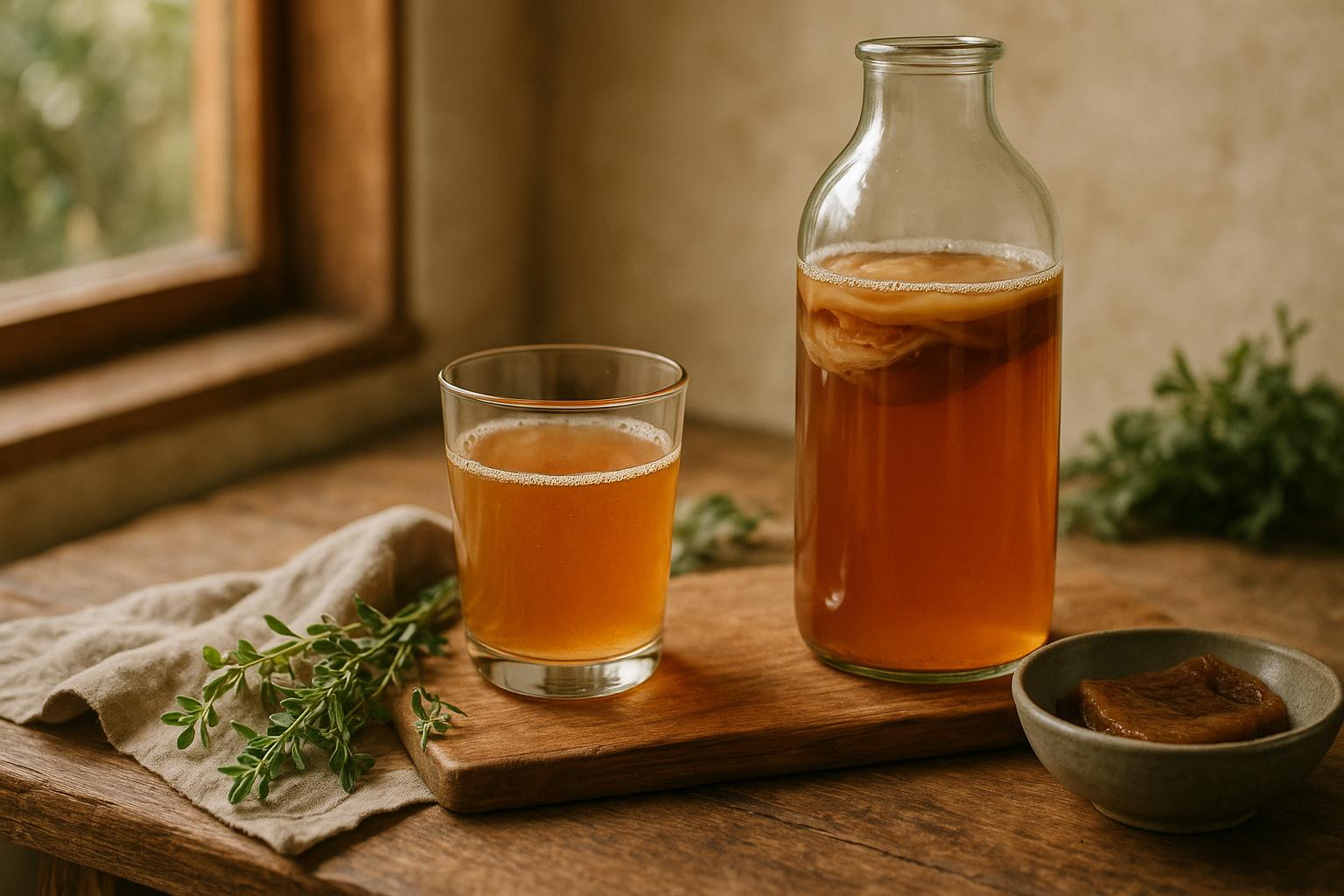
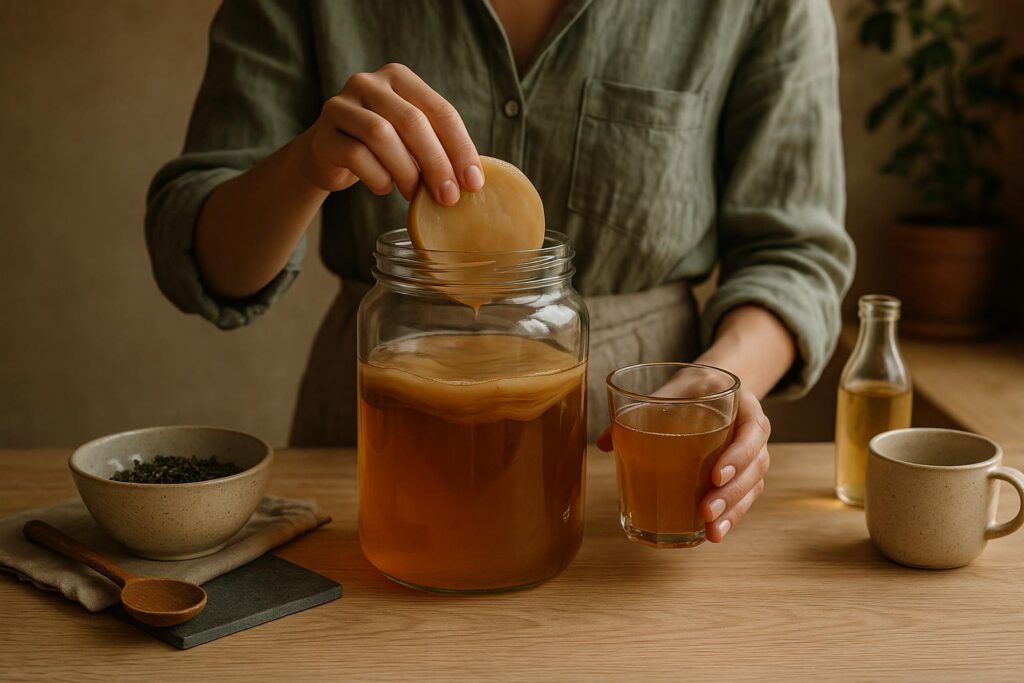
Le SCOBY est l’élément fondateur du kombucha. Il s’agit d’une masse gélatineuse, souvent comparée à une méduse, constituée de cellulose bactérienne. À l’intérieur vivent en symbiose des bactéries acétiques et lactiques ainsi que des levures sauvages.
Ces micro-organismes travaillent ensemble pour transformer le thé sucré en kombucha :
- Les levures décomposent d’abord le saccharose en glucose et fructose, puis produisent de l’éthanol
- Les bactéries convertissent ensuite cet éthanol en acide acétique — ce qui donne à la boisson son goût acidulé caractéristique
- Des acides organiques supplémentaires (gluconique, glucuronique, lactique) se forment progressivement
Le SCOBY se reproduit à chaque fermentation en formant un « bébé SCOBY » en surface. On peut ainsi partager la culture, la conserver ou l’utiliser pour démarrer une nouvelle fournée.
Qu’est-ce que le kombucha ? Sa composition nutritionnelle détaillée
Qu’est-ce que le kombucha apporte concrètement ? Voici la composition d’une portion standard de 240 ml :
| Composant | Quantité (240ml) | Rôle principal |
|---|---|---|
| Acide acétique | Variable | Antimicrobien, régulation pH |
| Acide glucuronique | Variable | Détoxification hépatique |
| Acide lactique | Variable | Équilibre microbiote |
| Vitamines B1, B2, B6, B12 | Traces à modéré | Énergie cellulaire, système nerveux |
| Polyphénols (antioxydants) | Selon le thé | Protection cellulaire, anti-âge |
| Probiotiques vivants | 5–10 souches | Microbiote, immunité |
| Sucres résiduels | 7–19g | Énergie (vs 25–30g pour les sodas) |
| Caféine résiduelle | ~15mg | Léger effet énergisant |
| Alcool | <0,5% | Produit naturel de fermentation |
| Minéraux traces | Zinc, Mn, Fe | Oligo-éléments essentiels |
La concentration exacte varie selon le type de thé utilisé, la durée de fermentation, la température et la souche de SCOBY. Un kombucha fermenté 7 jours sera plus doux ; fermenté 14 jours, plus acide et plus riche en acides organiques.
Qu’est-ce que le kombucha selon le type de thé ? Ce que la concurrence ne dit pas
Qu’est-ce que le kombucha change radicalement selon le thé utilisé — et c’est un point que la plupart des articles ignorent :
- Thé noir : le plus courant. Profil probiotique le plus étudié, goût prononcé légèrement vinaigré, caféine modérée (~15mg/240ml). Idéal pour débuter.
- Thé vert : plus riche en EGCG (épigallocatéchine gallate), un antioxydant puissant. Goût plus doux, herbacé. Privilégié par les personnes cherchant un effet anti-inflammatoire renforcé.
- Thé blanc : le plus délicat, le plus riche en antioxydants, le moins transformé. Fermentation plus douce, goût floral. Idéal pour les palais sensibles.
- Jun kombucha : variante au thé vert et au miel (non végan). Profil gustatif plus fin, fermentation plus rapide.
- Thé rooibos : sans caféine, riche en minéraux. Option idéale pour les personnes sensibles à la caféine ou souhaitant consommer du kombucha en soirée.
Qu’est-ce que le kombucha optimal pour vous ? Si vous cherchez les antioxydants maximum : thé vert ou blanc. Si vous débutez : thé noir. Si vous évitez la caféine : rooibos.
Qu’est-ce que le kombucha ? Ses bienfaits scientifiquement documentés
Qu’est-ce que le kombucha apporte à la santé ? Voici les effets les mieux documentés par la littérature scientifique :
1. Soutien du microbiote intestinal
Qu’est-ce que le kombucha fait pour le microbiote ? Il apporte des probiotiques vivants qui colonisent le côlon et renforcent l’équilibre de la flore intestinale. Une étude publiée sur PubMed (2021) a montré que la consommation régulière de boissons fermentées améliore la diversité microbienne intestinale — facteur clé de la santé globale.
2. Propriétés antioxydantes
Les polyphénols du thé sont partiellement préservés après fermentation. Ces antioxydants neutralisent les radicaux libres responsables du vieillissement cellulaire et des maladies chroniques. La fermentation augmente même la biodisponibilité de certains polyphénols — un avantage absent dans le thé non fermenté.
3. Effet hépatoprotecteur potentiel
Des études sur modèles animaux suggèrent que l’acide glucuronique contenu dans le kombucha soutient les fonctions hépatiques en facilitant l’élimination des toxines. Des recherches humaines restent nécessaires pour confirmer cet effet.
4. Activité antimicrobienne
L’acide acétique et les bactériocines produits lors de la fermentation exercent une action inhibitrice sur certains pathogènes comme E. coli, Salmonella et Candida albicans, selon plusieurs études in vitro.
5. Régulation de la glycémie
Une publication de Harvard Health évoque le potentiel du kombucha pour ralentir l’absorption des glucides et modérer les pics glycémiques post-prandiaux, notamment chez les personnes à risque de diabète de type 2.
6. Énergie et vitalité
Qu’est-ce que le kombucha apporte en termes d’énergie ? Ses vitamines B (B1, B2, B6, B12) sont directement impliquées dans la production d’énergie cellulaire et le bon fonctionnement du système nerveux. La légère caféine résiduelle (~15mg/240ml) procure un effet énergisant doux, sans les pics de la caféine du café.
Qu’est-ce que le kombucha fait pour la peau ? L’axe intestin-peau expliqué
Ce que la concurrence ne détaille pas : qu’est-ce que le kombucha apporte à la peau via l’axe intestin-peau — l’un des domaines de recherche les plus actifs en dermatologie fonctionnelle.
Le microbiote intestinal et le microbiote cutané communiquent en permanence via le système immunitaire et le système nerveux. Un déséquilibre intestinal (dysbiose) se manifeste souvent par des problèmes cutanés : acné, rougeurs, eczéma, teint terne. En rééquilibrant le microbiote intestinal, le kombucha agit indirectement mais réellement sur la qualité de la peau :
- Réduction de l’inflammation systémique — principal déclencheur de l’acné inflammatoire
- Amélioration de l’absorption des nutriments essentiels à la peau (zinc, vitamine C, oméga-3)
- Les polyphénols antioxydants du thé protègent les fibroblastes contre le stress oxydatif — facteur de vieillissement cutané prématuré
- L’acide glucuronique soutient l’élimination des toxines qui s’accumulent dans la peau
Les résultats sur la peau sont généralement perceptibles après 4 à 8 semaines de consommation régulière de 200–300ml par jour.
Qu’est-ce que le kombucha pour les sportifs ?
Qu’est-ce que le kombucha apporte aux personnes qui pratiquent une activité physique régulière ? C’est un autre angle que la concurrence ignore totalement :
- Avant l’effort : la légère caféine (~15mg/240ml) offre un pré-workout naturel doux, sans perturbation du sommeil si consommé en matinée
- Après l’effort : les polyphénols antioxydants neutralisent les radicaux libres produits lors d’un effort intense — réduisant les dommages oxydatifs musculaires
- Récupération : les vitamines B1, B2 et B6 soutiennent le métabolisme énergétique et la récupération musculaire
- Hydratation : alternative aux boissons de récupération sucrées — le kombucha hydrate tout en apportant des électrolytes naturels
Le kombucha après le sport est aujourd’hui recommandé par de nombreux nutritionnistes spécialisés en performance. Pour les sportifs, la combinaison kombucha (antioxydants post-effort) + kefir de lait (protéines + probiotiques le matin) est optimale. Découvrez notre comparatif kombucha ou kefir pour choisir selon votre profil.
Qu’est-ce que le kombucha ? Comment est-il fabriqué ?
La fabrication du kombucha suit toujours le même protocole de base :
- Préparation du thé : faire infuser du thé noir ou vert dans de l’eau bouillante pendant 10 minutes
- Ajout du sucre : dissoudre 80 à 100g de sucre par litre de thé
- Refroidissement : laisser refroidir à température ambiante (en dessous de 30°C)
- Inoculation : ajouter le SCOBY et 10% de kombucha de la fournée précédente (liquide starter)
- Fermentation primaire : couvrir d’un tissu respirant et laisser fermenter 7 à 14 jours à 20–25°C
- Mise en bouteille : filtrer et embouteiller pour une fermentation secondaire optionnelle (gazéification + arômes)
Le coût de revient du kombucha maison est de 0,30 à 0,50 €/litre — contre 4 à 8 €/bouteille de 330ml en commerce. Sur un an, la différence est considérable.
Qu’est-ce que le kombucha ? Les différentes variétés disponibles
Qu’est-ce que le kombucha dans ses différentes formes ?
- Kombucha classique au thé noir : le plus courant, au goût prononcé et légèrement vinaigré
- Kombucha au thé vert : plus doux, plus riche en catéchines, légèrement herbacé
- Jun kombucha : variante fermentée avec du miel et du thé vert, plus délicat — non végan
- Kombucha aromatisé : infusé avec des fruits, du gingembre, de la lavande lors de la fermentation secondaire
- Kombucha pasteurisé : version industrielle stabilisée — moins riche en probiotiques vivants, à éviter
- Kombucha cru (raw) : non pasteurisé, contient le maximum de micro-organismes actifs — à privilégier
Pour bénéficier des effets probiotiques, qu’est-ce que le kombucha idéal ? Toujours non pasteurisé, conservé au réfrigérateur, avec une légère turbidité naturelle au fond de la bouteille.
Qu’est-ce que le kombucha ? Le protocole de cure optimal semaine par semaine
Qu’est-ce que le kombucha comme cure ? La concurrence ne donne jamais de protocole précis. Voici celui que les nutritionnistes en alimentation fermentée recommandent :
- Semaine 1 : 100ml par jour après le repas de midi — laisser le microbiote s’adapter
- Semaine 2 : 150–200ml par jour, en deux prises (midi et après-midi)
- Semaine 3 : 200–300ml par jour selon tolérance — c’est la dose d’entretien idéale
- Semaine 4 et au-delà : 300ml par jour en cure de 8 semaines minimum pour des effets profonds sur le microbiote
Si vous constatez des ballonnements lors des premières consommations, c’est normal : le microbiote s’adapte. Réduisez la dose et augmentez plus progressivement.
Qu’est-ce que le kombucha ? Comment et quand le consommer ?
Qu’est-ce que le kombucha consommé au bon moment ? La boisson se prend froide, de préférence :
- Avant ou pendant le repas pour stimuler la production de sucs digestifs
- Après un effort sportif pour les antioxydants anti-radicaux libres
- En milieu de journée pour profiter de la légère caféine sans perturber le sommeil
- Évitez le soir si vous êtes sensible à la caféine — préférez le kefir de fruits sans caféine le soir
Qu’est-ce que le kombucha comme substitut aux sodas ? C’est l’une de ses applications les plus immédiates et les plus impactantes : remplacer une canette de soda (35g de sucre, 0 probiotique, 0 antioxydant) par 330ml de kombucha (8–10g de sucre, probiotiques vivants, antioxydants du thé).
Précautions et contre-indications à connaître
Malgré ses nombreux atouts, qu’est-ce que le kombucha peut poser des problèmes dans certains cas :
- Femmes enceintes et allaitantes : déconseillé — alcool résiduel et absence d’études cliniques suffisantes
- Personnes immunodéprimées : risque d’infection par des micro-organismes non maîtrisés, notamment dans les préparations maison
- Personnes atteintes de candidiase : les levures présentes peuvent aggraver certains cas — consultez votre médecin
- Personnes sensibles à la caféine : le thé de base contient de la caféine, même après fermentation (~15mg/240ml)
- Diabétiques sous traitement : la teneur en sucres résiduels varie selon les marques — lisez les étiquettes
- Reflux gastrique (RGO) actif : le kombucha est acide (pH 2,5–3,5) et gazeux — déconseillé en phase de crise. Préférez le kefir de lait. Voir notre guide sur le kéfir et le reflux gastrique.
- Personnes sous anticoagulants : les acides organiques peuvent interagir avec certains médicaments
L’ANSES recommande une consommation modérée et déconseille le kombucha maison aux populations vulnérables en raison du risque de contamination si les règles d’hygiène ne sont pas strictement respectées.
Qu’est-ce que le kombucha ? Sa place sur le marché français
En France, le marché du kombucha a explosé entre 2018 et 2024. On trouve aujourd’hui qu’est-ce que le kombucha dans les grandes surfaces, les magasins bio, les épiceries fines et en ligne.
Le prix moyen d’une bouteille de 330ml se situe entre 3 et 5 euros pour les versions premium non pasteurisées. Les versions maison reviennent à environ 0,30 à 0,50 euro par litre — soit une économie de plus de 90%. Les projections indiquent que la France deviendra l’un des cinq premiers marchés européens du kombucha d’ici 2027.
Qu’est-ce que le kombucha ? Comment bien le choisir en magasin ?
Face à la multiplication des références, qu’est-ce que le kombucha de qualité ? Les 5 critères à vérifier :
- Non pasteurisé : la mention « raw » ou « vivant » garantit la présence de probiotiques actifs
- Teneur en sucre : moins de 5g de sucre pour 100ml est un bon indicateur de fermentation complète
- Liste d’ingrédients courte : thé, eau, sucre, SCOBY — évitez les arômes artificiels et conservateurs
- Conservation au frais : un kombucha vivant doit impérativement être réfrigéré
- Teneur en alcool : inférieure à 0,5% pour les versions standards
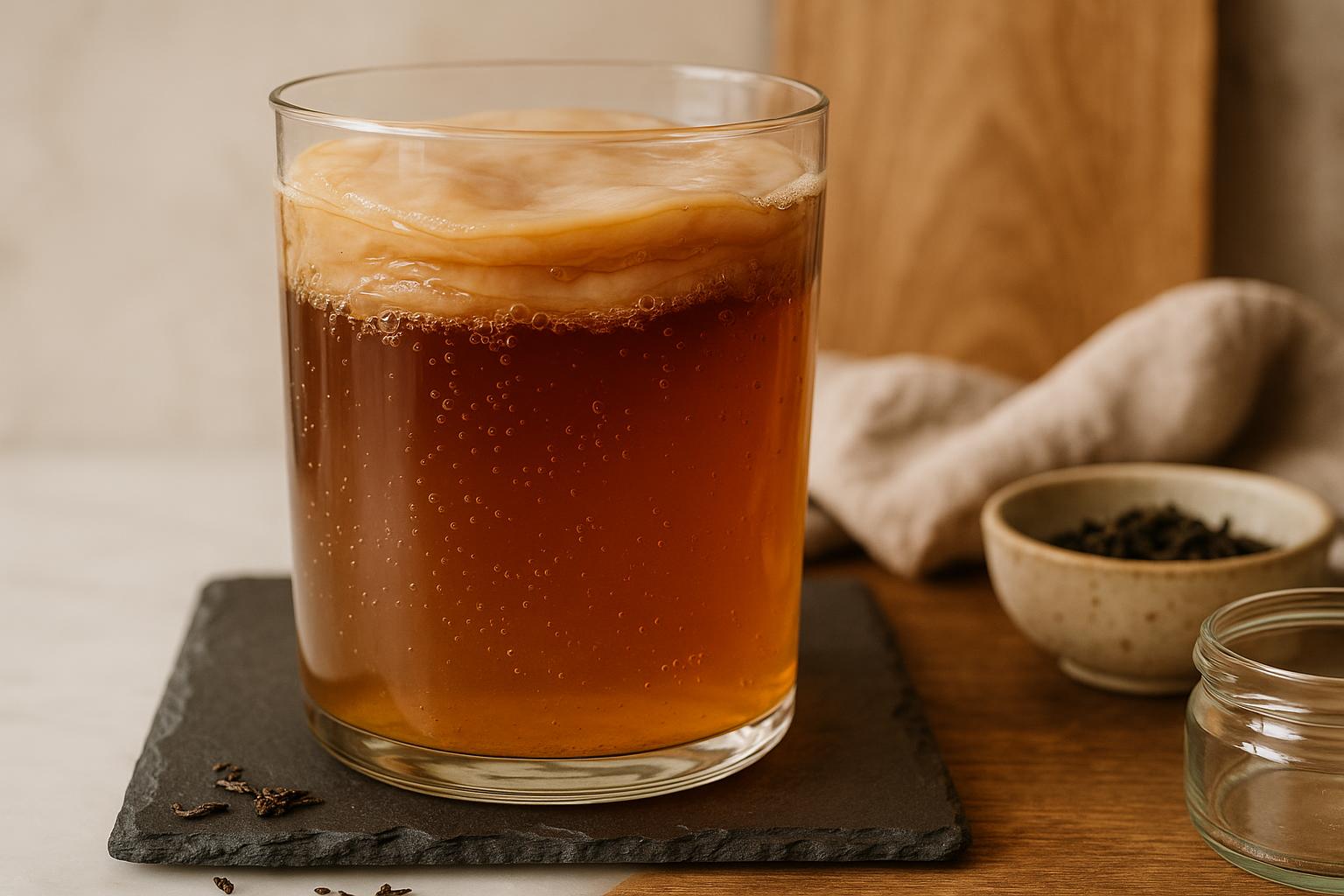
Un bon kombucha du commerce doit sentir légèrement le vinaigre et présenter un léger trouble naturel au fond — signe de vivacité microbienne. Évitez les versions trop claires et inodores.
Qu’est-ce que le kombucha vs le kéfir : les vraies différences
Qu’est-ce que le kombucha comparé au kéfir ? Les différences clés :
- Base : le kombucha utilise du thé ; le kéfir utilise du lait ou de l’eau sucrée
- Probiotiques : 5–10 souches pour le kombucha vs 40–60 souches pour le kéfir — le kéfir domine largement
- Antioxydants : élevés dans le kombucha (polyphénols du thé) ; faibles dans le kéfir — le kombucha domine
- Caféine : présente dans le kombucha (~15mg/240ml), absente dans le kéfir
- Calcium : élevé dans le kéfir de lait (300mg/250ml), absent dans le kombucha
- Temps de fermentation : 7–30 jours pour le kombucha vs 24–48h pour le kéfir
Les deux boissons sont complémentaires. La stratégie optimale : kombucha pour les antioxydants et l’énergie, kéfir pour les probiotiques et le calcium. Découvrez notre guide complet kombucha ou kefir : lequel choisir.
- Qu’est-ce que le kombucha : une boisson fermentée à base de thé sucré et de SCOBY, riche en probiotiques, acides organiques et antioxydants — originaire de Chine il y a plus de 2 000 ans
- Qu’est-ce que le kombucha apporte : soutien du microbiote intestinal, effet antioxydant, soutien hépatique potentiel, régulation glycémique, énergie via les vitamines B
- Qu’est-ce que le kombucha de qualité : non pasteurisé, légèrement trouble, conservé au frais, moins de 5g de sucre/100ml
- Qu’est-ce que le kombucha en cure : 100ml/jour en semaine 1, puis augmenter progressivement jusqu’à 200–300ml/jour pendant 8 semaines minimum
- Qu’est-ce que le kombucha pour qui : adultes en bonne santé, sportifs, personnes cherchant une alternative aux sodas — déconseillé aux femmes enceintes et personnes immunodéprimées
Questions fréquentes sur qu’est-ce que le kombucha
Le kombucha est-il alcoolisé ?
Oui, mais très faiblement. Qu’est-ce que le kombucha produit naturellement de l’éthanol lors de la fermentation, mais la teneur reste généralement inférieure à 0,5% dans les versions commerciales standard. Vérifiez toujours l’étiquette si vous êtes sensible à l’alcool.
Peut-on boire du kombucha tous les jours ?
Oui, une consommation quotidienne modérée de 150 à 300ml est généralement bien tolérée par les adultes en bonne santé. Commencez par de petites quantités pour habituer votre microbiote. Une consommation excessive peut provoquer des troubles digestifs ou une acidité excessive.
Le kombucha fait-il maigrir ?
Qu’est-ce que le kombucha comme aide minceur ? Il n’est pas un produit amincissant, mais il peut soutenir une démarche de perte de poids en remplaçant les sodas sucrés, en améliorant la digestion et en modulant la glycémie. Il doit s’inscrire dans une alimentation équilibrée.
Qu’est-ce que le kombucha apporte pour la peau ?
Grâce à ses antioxydants et à son soutien du microbiote intestinal, qu’est-ce que le kombucha peut indirectement améliorer l’éclat de la peau via l’axe intestin-peau. Un microbiote équilibré réduit l’inflammation systémique souvent associée à l’acné et aux rougeurs. Des résultats visibles demandent 4 à 8 semaines de consommation régulière.
Le kombucha contient-il du gluten ?
Non, qu’est-ce que le kombucha traditionnel à base de thé, d’eau, de sucre et de SCOBY est naturellement sans gluten. Vérifiez néanmoins les versions aromatisées. Les personnes cœliaques peuvent généralement le consommer sans problème.
Comment conserver le kombucha maison ?
Le kombucha maison se conserve au réfrigérateur dans des bouteilles hermétiques en verre pendant 1 à 3 mois. Le froid ralentit la fermentation sans la stopper. Plus il vieillit, plus il devient acide. Le SCOBY se conserve séparément dans du kombucha starter.
Le kombucha est-il bon pour le foie ?
Des études sur modèles animaux suggèrent un effet hépatoprotecteur lié à l’acide glucuronique. Ces résultats sont prometteurs mais non confirmés par des essais cliniques humains de grande envergure. En cas de pathologie hépatique, consultez votre médecin avant consommation.
Peut-on donner du kombucha à un enfant ?
La prudence s’impose. La teneur en alcool, l’acidité élevée et la caféine déconseillent qu’est-ce que le kombucha aux enfants de moins de 12 ans. Pour les enfants, préférez le kéfir de fruits — sans caféine ni alcool significatif. Voir notre guide sur kombucha ou kefir pour les enfants.
Quelle est la différence entre kombucha du commerce et kombucha maison ?
Le kombucha du commerce est souvent pasteurisé — ce qui détruit une partie des probiotiques. Le kombucha maison, non pasteurisé, est plus riche en micro-organismes vivants. Qu’est-ce que le kombucha idéal ? Le maison, à condition de respecter des règles d’hygiène strictes.
Le kombucha est-il adapté aux végans ?
Oui, qu’est-ce que le kombucha classique à base de thé est 100% vegan. Aucun ingrédient d’origine animale n’entre dans sa composition standard. Seul le Jun kombucha (au miel) est non végan.
Qu’est-ce que le kombucha apporte en cas de fatigue chronique ?
Qu’est-ce que le kombucha contre la fatigue ? Ses vitamines B (B1, B2, B6, B12) sont directement impliquées dans la production d’énergie cellulaire. Certains consommateurs rapportent une amélioration de leur niveau d’énergie après plusieurs semaines de consommation régulière. Ces effets ne remplacent pas un bilan médical en cas de fatigue persistante.
Le kombucha est-il halal ?
Qu’est-ce que le kombucha dans le cadre d’un régime halal ? Le kombucha est généralement considéré halal car l’alcool est produit de manière naturelle par la fermentation et n’est pas toxique pour l’organisme dans ces quantités. Cependant, les avis divergent entre les autorités religieuses — consultez un imam ou une autorité compétente si vous avez un doute.
Qu’est-ce que le kombucha apporte de différent par rapport au yaourt ?
Qu’est-ce que le kombucha vs yaourt ? Le kombucha est sans lactose, contient des antioxydants du thé et des acides organiques absents du yaourt. Le yaourt est plus riche en protéines et en calcium. Les deux sont complémentaires dans une alimentation fermentée variée.
Qu’est-ce que le kombucha peut apporter aux sportifs spécifiquement ?
Qu’est-ce que le kombucha pour les sportifs ? Avant l’effort, sa caféine légère offre un boost naturel. Après l’effort, ses polyphénols antioxydants neutralisent les radicaux libres produits lors d’un effort intense. Ses vitamines B soutiennent la récupération musculaire. C’est l’une des meilleures boissons de récupération naturelles disponibles.
Ce qu’il faut retenir
Qu’est-ce que le kombucha ? C’est bien plus qu’une simple boisson tendance. Qu’est-ce que le kombucha — c’est un aliment fermenté vivant, riche en probiotiques, en acides organiques et en antioxydants, dont les bienfaits pour la santé digestive, immunitaire et énergétique sont de mieux en mieux documentés par la science.
Qu’est-ce que le kombucha reste l’une des solutions les plus complètes pour soutenir naturellement son microbiote, à condition de le choisir non pasteurisé, de le consommer avec modération selon le protocole progressif, et d’adapter sa consommation à son état de santé.
Pour aller plus loin, comparez avec son alter ego : kombucha ou kefir — lequel choisir selon votre profil. Et si vous souhaitez maximiser l’apport en probiotiques, découvrez les bienfaits du kéfir pour la santé.
Études et sources scientifiques
- Jayabalan R. et al. (2014). A Review on Kombucha Tea — PubMed
- Kapp J.M. et al. (2019). Kombucha : a systematic review of the empirical evidence — PubMed
- Wastyk et al. (2021) — Gut-microbiota-targeted diets modulate human immune status. Cell
- Harvard Health Publishing — Is kombucha good for you?
- National Center for Complementary and Integrative Health (NCCIH) — Kombucha Tea
- ANSES — Avis et recommandations sur le kombucha
Cet article est fourni à titre informatif uniquement et ne constitue pas un avis médical. Consultez un professionnel de santé qualifié avant toute utilisation.