À quoi sert le scoby de kombucha ? 7 rôles essentiels
Cet article a une vocation informative et ne remplace pas un avis médical professionnel. Consultez un professionnel de santé avant de modifier votre alimentation.
À quoi sert le scoby de kombucha ? : il s’agit de la culture symbiotique de bactéries et de levures qui transforme le thé sucré en kombucha, une boisson fermentée riche en probiotiques, en acides organiques et en composés bioactifs bénéfiques pour l’organisme.
- Fermente le thé sucré pour produire du kombucha
- Génère des probiotiques favorables à la flore intestinale
- Produit des acides organiques aux propriétés antimicrobiennes
- Synthétise des vitamines du groupe B et de la vitamine C
- Se reproduit pour permettre des fermentations successives
À quoi sert le scoby de kombucha ? Cette question revient régulièrement chez les amateurs de boissons fermentées artisanales. À quoi sert le scoby de kombucha ? La réponse est multiple : il est à la fois l’agent de fermentation, le producteur de composés santé et le garant de la qualité de votre boisson. Selon plusieurs études publiées sur PubMed, le kombucha contient plus de 200 composés bioactifs issus directement de l’activité du scoby.
À quoi sert le scoby de kombucha ? Définition et composition
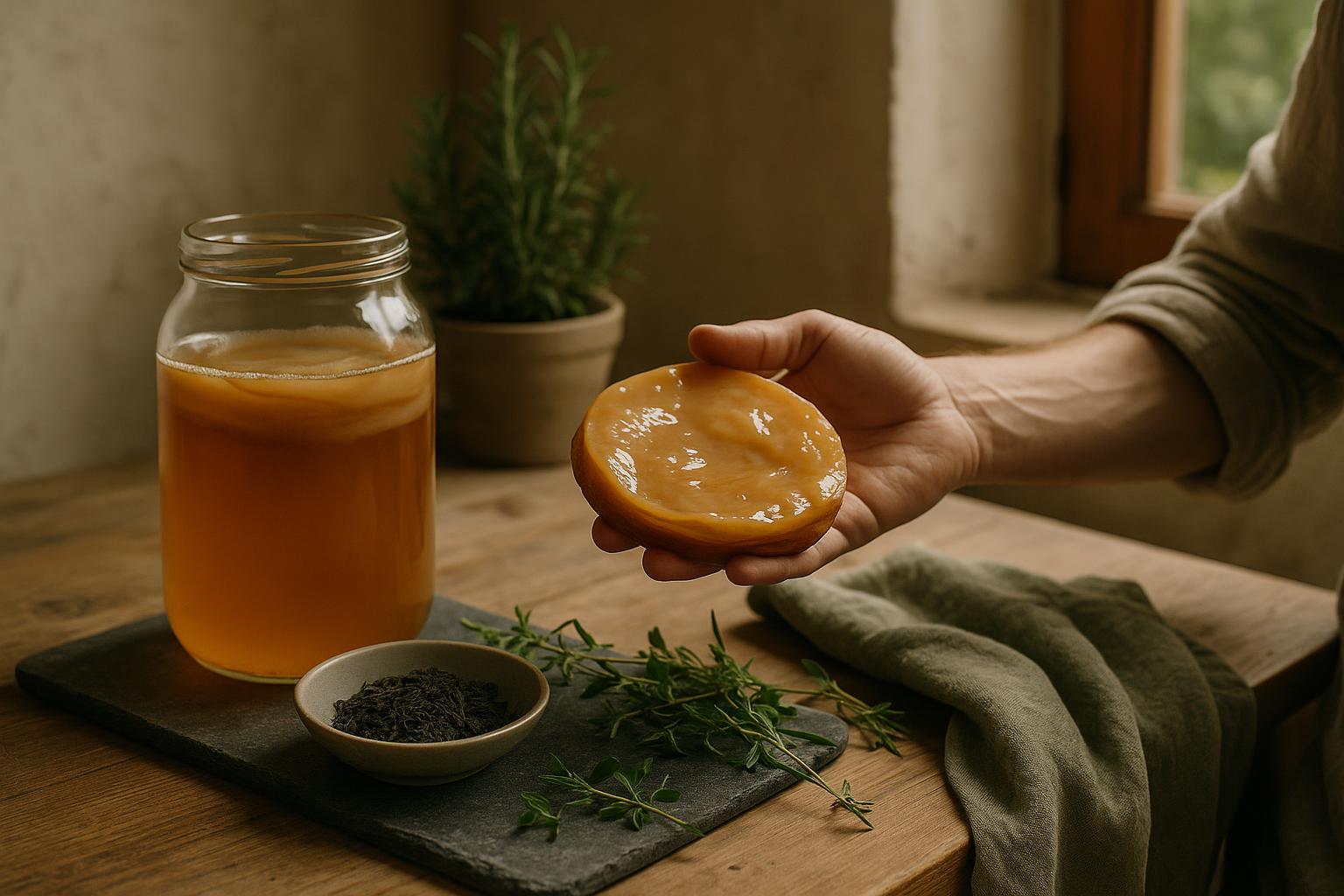
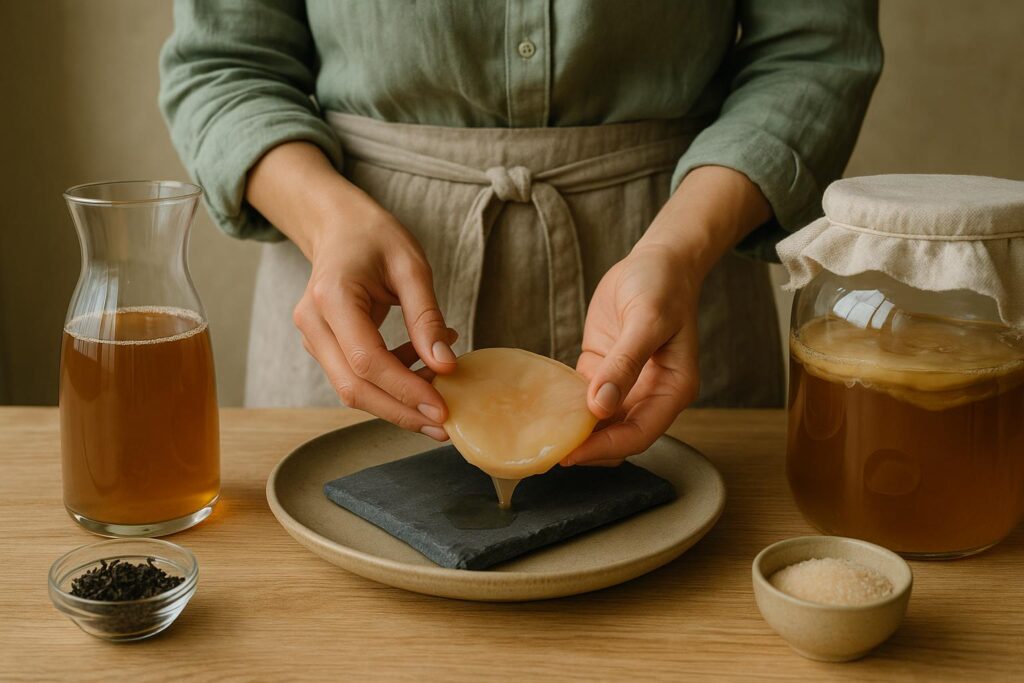
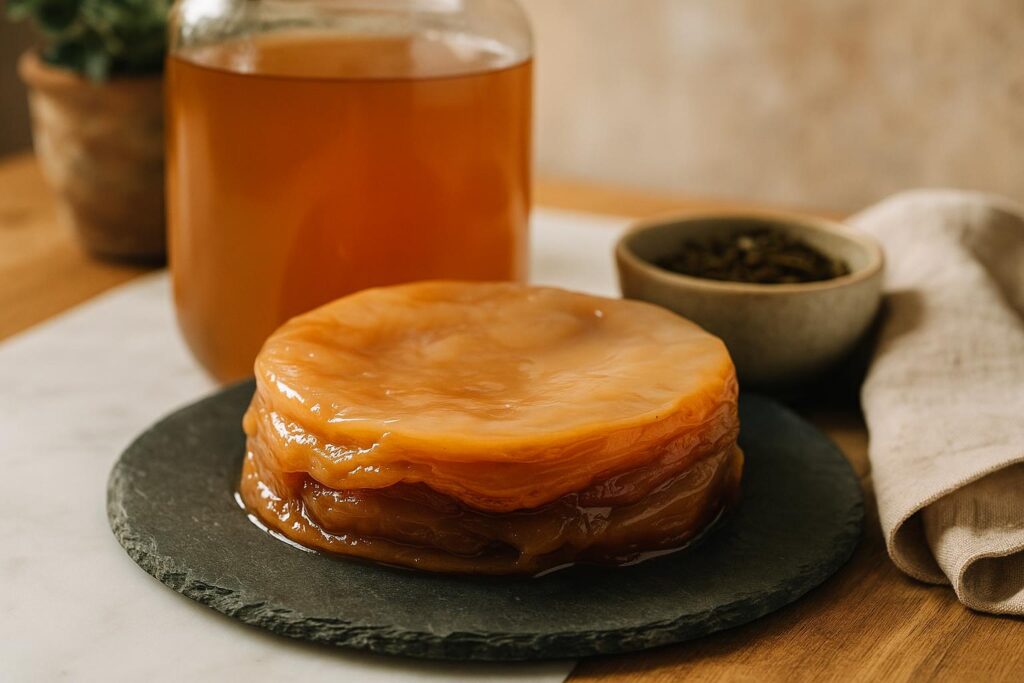
Le scoby — acronyme de Symbiotic Culture Of Bacteria and Yeast — est une matrice gélatineuse d’apparence translucide ou légèrement dorée. Il se présente sous la forme d’un disque épais qui flotte à la surface du liquide en fermentation. Sa texture rappelle celle d’un champignon, ce qui lui a valu le surnom populaire de « champignon de kombucha », bien qu’il ne s’agisse pas d’un champignon au sens mycologique du terme.
À quoi sert le scoby de kombucha ? Sur le plan structurel, il est composé d’une matrice de cellulose bactérienne dans laquelle vivent en symbiose des bactéries acétiques (Acetobacter, Gluconobacter) et des levures (Zygosaccharomyces, Brettanomyces). Cette association unique est ce qui lui confère toute sa puissance fermentaire. La cellulose sert de support physique, tandis que les micro-organismes effectuent le travail de transformation biochimique.
La composition précise du scoby varie selon l’origine géographique, la qualité du thé utilisé, la température de fermentation et les générations successives de culture. C’est pourquoi chaque scoby est unique et produit un kombucha au profil aromatique et nutritionnel légèrement différent.
À quoi sert le scoby de kombucha ? Son rôle central dans la fermentation
Le rôle principal du scoby est de déclencher et de conduire la fermentation. Lorsqu’il est plongé dans un thé sucré refroidi accompagné d’un peu de kombucha déjà fermenté (le « starter »), il met en route deux processus biochimiques simultanés et complémentaires.
Les levures présentes dans le scoby consomment d’abord le saccharose et le transforment en glucose et fructose, puis en alcool éthylique et en dioxyde de carbone. Ensuite, les bactéries acétiques récupèrent cet alcool et l’oxydent en acide acétique. Ce mécanisme est identique à celui de la production de vinaigre, mais il est ici contrôlé et partiel, ce qui donne au kombucha son goût légèrement acidulé et pétillant.
À quoi sert le scoby de kombucha ? Il sert précisément à orchestrer cette double fermentation de façon autonome et stable, sans nécessiter d’ajout de levures ou de bactéries extérieures à chaque cycle. C’est ce qui en fait un outil de fermentation domestique particulièrement accessible et fiable.
À quoi sert le scoby de kombucha ? La production de probiotiques
L’une des fonctions les plus valorisées du scoby est sa capacité à générer des probiotiques vivants. Ces micro-organismes bénéfiques se retrouvent en suspension dans le liquide fermenté et contribuent à l’équilibre du microbiote intestinal lorsqu’ils sont ingérés.
Les souches bactériennes les plus fréquemment identifiées dans le kombucha produit par le scoby appartiennent aux genres Lactobacillus, Acetobacter et Gluconobacter. Ces bactéries sont reconnues pour leur capacité à résister partiellement à l’acidité gastrique et à atteindre le côlon, où elles exercent leurs effets bénéfiques.
À quoi sert le scoby de kombucha ? Il sert à produire en continu ces populations microbiennes vivantes, ce qui fait du kombucha une source naturelle de probiotiques comparable — selon certaines études — aux yaourts fermentés ou au kéfir. Une revue publiée sur PubMed a recensé plusieurs dizaines de souches microbiennes actives dans les cultures de kombucha issues de scobys traditionnels.
Le scoby de kombucha et la synthèse d’acides organiques bénéfiques
Au-delà des probiotiques, le scoby produit une large gamme d’acides organiques qui jouent un rôle important dans les propriétés nutritionnelles et antimicrobiennes du kombucha. Les principaux acides identifiés sont :
- Acide acétique : propriétés antibactériennes, régulation de la glycémie
- Acide gluconique : soutien hépatique, détoxification légère
- Acide glucuronique : conjugaison des toxines dans le foie
- Acide lactique : équilibre du pH intestinal
- Acide malique : énergie cellulaire, cycle de Krebs
À quoi sert le scoby de kombucha ? Il sert notamment à synthétiser ces acides organiques qui confèrent au kombucha ses vertus digestives et détoxifiantes. L’acide glucuronique en particulier est étudié pour son rôle dans la conjugaison hépatique des substances indésirables, bien que les concentrations dans le kombucha restent variables selon les méthodes de fermentation.
À quoi sert le scoby de kombucha ? La production de vitamines
Le scoby de kombucha est également un producteur de vitamines. Durant la fermentation, les micro-organismes synthétisent plusieurs micronutriments essentiels qui enrichissent la boisson finale.
Les vitamines les plus documentées dans le kombucha produit par le scoby sont les vitamines du groupe B : B1 (thiamine), B2 (riboflavine), B3 (niacine), B6 (pyridoxine) et B12 (cobalamine). Cette dernière est particulièrement intéressante pour les personnes suivant un régime végétalien, même si les teneurs restent modestes et variables.
La vitamine C est également présente, issue de l’oxydation de certains précurseurs lors de la fermentation acétique. À quoi sert le scoby de kombucha ? Il sert aussi à enrichir naturellement la boisson en micronutriments que le thé seul ne contient pas, grâce à l’activité métabolique de ses micro-organismes.
À quoi sert le scoby de kombucha ? Sa capacité à se reproduire
L’une des caractéristiques les plus remarquables du scoby est sa capacité à se reproduire à chaque fermentation. À chaque cycle, une nouvelle couche de cellulose bactérienne se forme à la surface du liquide, créant un « bébé scoby » ou « hôtel à scoby ».
Ce mécanisme de reproduction permet :
- De lancer de nouvelles fermentations en parallèle
- De partager le scoby avec d’autres personnes
- De conserver un scoby de réserve en cas de contamination
- De maintenir une culture active sur plusieurs années
- De réduire les coûts liés à l’achat de nouveaux scobys
À quoi sert le scoby de kombucha ? Il sert aussi de ressource renouvelable autonome. Un scoby bien entretenu peut produire du kombucha indéfiniment, ce qui en fait un investissement unique pour les amateurs de fermentation maison.
Le scoby de kombucha comme bouclier antimicrobien
Le scoby joue un rôle protecteur essentiel durant la fermentation. L’acidité qu’il génère — le pH du kombucha descend rapidement entre 2,5 et 3,5 — crée un environnement hostile aux micro-organismes pathogènes. Cette acidification naturelle protège la boisson contre les contaminations par des bactéries indésirables ou des moisissures.
La couche physique de cellulose que forme le scoby à la surface du liquide constitue également une barrière mécanique contre les contaminants aériens. C’est pourquoi il est recommandé de toujours laisser le scoby flotter à la surface et de couvrir le récipient d’un tissu respirant.
À quoi sert le scoby de kombucha ? Il sert aussi de système de défense naturel pour la boisson en fermentation, rendant la production de kombucha maison relativement sûre lorsque les règles d’hygiène de base sont respectées. Des recherches disponibles sur le site du NCCIH confirment que le profil acide du kombucha limite significativement la prolifération de pathogènes courants.
À quoi sert le scoby de kombucha ? Ses bienfaits pour la santé digestive
La consommation régulière de kombucha produit par un scoby actif est associée à plusieurs bénéfices digestifs documentés. Les probiotiques, les acides organiques et les enzymes présents dans la boisson agissent de concert pour soutenir la santé du tractus gastro-intestinal.
Les effets les plus fréquemment rapportés incluent une amélioration du transit intestinal, une réduction des ballonnements, un renforcement de la barrière intestinale et une meilleure tolérance à certains aliments. Ces effets sont attribués à la modulation du microbiote intestinal par les probiotiques issus du scoby.
Une revue de littérature publiée dans Comprehensive Reviews in Food Science and Food Safety et référencée sur PubMed a conclu que le kombucha présentait un potentiel prébiotique et probiotique significatif, bien que des études cliniques à grande échelle soient encore nécessaires pour quantifier précisément ces effets chez l’humain.
Le scoby de kombucha et les propriétés antioxydantes
Le thé utilisé comme base du kombucha est naturellement riche en polyphénols et en catéchines, des antioxydants puissants. Durant la fermentation conduite par le scoby, ces composés sont partiellement transformés et leur biodisponibilité peut être améliorée.
Des études ont montré que le kombucha fermenté présente une activité antioxydante supérieure à celle du thé non fermenté dans certaines conditions. Cette augmentation est attribuée à la production de nouveaux composés phénoliques par les micro-organismes du scoby, ainsi qu’à la libération de polyphénols liés par l’action enzymatique.
À quoi sert le scoby de kombucha ? Il sert aussi à potentialiser les propriétés antioxydantes du thé, faisant du kombucha une boisson doublement intéressante sur le plan nutritionnel. Des informations complémentaires sur les antioxydants et la santé sont disponibles sur Harvard Health Publishing.
Comment conserver son scoby de kombucha correctement ?
Pour que le scoby continue à remplir toutes ses fonctions, sa conservation est primordiale. Un scoby mal entretenu perd progressivement sa vitalité et produit un kombucha de moins bonne qualité.
Les règles de conservation essentielles sont les suivantes :
- Température idéale : entre 20 et 30°C, à l’abri des variations brutales
- Pause longue durée : placer le scoby dans un « hôtel à scoby » avec du kombucha et du sucre, au réfrigérateur
- Éviter le contact direct avec le métal : utiliser des ustensiles en bois, verre ou plastique alimentaire
- Surveiller les signes de contamination : moisissures vertes ou noires indiquent qu’il faut jeter le scoby
- Renouveler le starter : toujours conserver 10 à 20 % de kombucha précédent pour acidifier le nouveau brassage
À quoi sert le scoby de kombucha ? Il ne peut remplir son rôle que s’il est maintenu dans des conditions optimales. Un scoby sain se reconnaît à sa couleur beige à brun clair, à sa texture ferme et à l’absence totale de moisissures.
À quoi sert le scoby de kombucha ? Usages alternatifs insoupçonnés
Au-delà de la production de kombucha, le scoby trouve des applications inattendues que la communauté des fermenteurs explore de plus en plus.
Les usages alternatifs documentés incluent :
- Alimentation animale : les vieux scobys peuvent être donnés aux poules ou aux chiens comme complément probiotique
- Compostage : le scoby est riche en matière organique et se dégrade facilement
- Soins de la peau : certains utilisateurs appliquent du kombucha dilué sur la peau pour ses propriétés légèrement exfoliantes
- Cuir végétal : des chercheurs et designers explorent la cellulose bactérienne du scoby comme matériau textile durable
- Fermentation d’autres boissons : certains expérimentateurs utilisent le scoby pour fermenter des jus de fruits ou des tisanes
Ces usages témoignent de la polyvalence remarquable du scoby, bien au-delà de sa fonction première de producteur de kombucha. Des travaux de recherche sur la cellulose bactérienne produite par les scobys sont accessibles via l’EFSA et diverses publications scientifiques européennes.
- À quoi sert le scoby de kombucha ? Il sert avant tout à déclencher et conduire la double fermentation alcoolique et acétique du thé sucré pour produire du kombucha.
- À quoi sert le scoby de kombucha ? Il génère des probiotiques vivants, des acides organiques et des vitamines du groupe B qui enrichissent la boisson finale.
- À quoi sert le scoby de kombucha ? Il protège la boisson contre les contaminations grâce à l’acidification rapide du milieu et à sa couche de cellulose protectrice.
- À quoi sert le scoby de kombucha ? Il se reproduit à chaque fermentation, permettant des cycles de production continus et un partage facile entre brasseurs amateurs.
- À quoi sert le scoby de kombucha ? Il potentialise les propriétés antioxydantes du thé et peut trouver des usages alternatifs comme le compostage ou l’alimentation animale.
Questions fréquentes sur À quoi sert le scoby de kombucha ?
Le scoby de kombucha est-il comestible ?
Oui, le scoby de kombucha est comestible. Certaines personnes le consomment directement, le déshydratent pour en faire des chips ou l’incorporent dans des recettes. Il est riche en cellulose bactérienne et contient des probiotiques vivants. Son goût est légèrement acidulé et sa texture gélatineuse peut surprendre, mais il ne présente aucun danger pour la santé.
Combien de temps un scoby peut-il vivre ?
Un scoby bien entretenu peut vivre indéfiniment. Des cultures transmises de génération en génération existent depuis plusieurs décennies. La clé est de le nourrir régulièrement avec du thé sucré, de maintenir une température stable entre 20 et 30°C et de le protéger des contaminations. Un scoby inactif au réfrigérateur peut survivre plusieurs mois sans fermentation active.
Peut-on faire du kombucha sans scoby ?
Il est théoriquement possible de démarrer une fermentation à partir d’une bouteille de kombucha non pasteurisé du commerce, qui contient encore des micro-organismes vivants. Cependant, le résultat est moins prévisible et le processus plus lent. Un scoby mature reste le moyen le plus fiable et le plus rapide pour produire un kombucha de qualité constante.
Pourquoi le scoby de kombucha flotte-t-il ?
Le scoby flotte grâce à la cellulose bactérienne qui le compose et aux bulles de CO2 piégées dans sa structure. Sa position en surface est fonctionnelle : elle lui permet d’accéder à l’oxygène nécessaire aux bactéries acétiques tout en restant en contact avec le liquide sucré que consomment les levures. Un scoby qui coule n’est pas forcément défaillant.
Comment savoir si un scoby de kombucha est mort ou contaminé ?
Un scoby contaminé présente des moisissures visibles à sa surface, généralement de couleur verte, noire ou rose. Ces moisissures ne doivent pas être confondues avec les taches brunes naturelles dues aux dépôts de thé. Si vous observez des moisissures, jetez immédiatement le scoby et le liquide. Un scoby sain est beige à brun clair, sans odeur de moisi.
À quoi sert le scoby de kombucha dans la deuxième fermentation ?
À quoi sert le scoby de kombucha lors de la deuxième fermentation ? En réalité, il n’y participe généralement pas. La deuxième fermentation se fait en bouteille fermée, sans scoby, pour développer la carbonatation et les arômes. Le scoby reste dans le bocal principal pour démarrer un nouveau cycle. C’est le kombucha résiduel et les levures en suspension qui conduisent cette seconde étape.
Quelle est la différence entre un scoby de kombucha et un scoby de kéfir ?
Le scoby de kombucha est une matrice de cellulose bactérienne plate et gélatineuse. Le scoby de kéfir (grains de kéfir) se présente sous forme de petits grains blancs ou translucides. Les deux sont des cultures symbiotiques de bactéries et de levures, mais leurs compositions microbiennes, leurs substrats et leurs produits finaux sont différents. Le kéfir fermente du lait ou de l’eau sucrée, pas du thé.
Combien de temps faut-il pour que le scoby produise du kombucha ?
La durée de fermentation varie entre 7 et 30 jours selon la température, la taille du scoby, la quantité de starter et le goût recherché. À 22-25°C, une fermentation standard dure 10 à 14 jours. Plus la température est élevée, plus la fermentation est rapide. Le goût final doit être légèrement acidulé, ni trop sucré ni trop vinaigré.
Le scoby de kombucha contient-il de l’alcool ?
Le scoby lui-même ne contient pas d’alcool, mais le kombucha qu’il produit en contient de faibles quantités, généralement entre 0,5 % et 3 % vol. selon la durée de fermentation. Ce taux reste inférieur à celui de la bière dans la plupart des cas. Les personnes sensibles à l’alcool, les femmes enceintes et les enfants doivent en tenir compte avant de consommer du kombucha maison.
Peut-on utiliser n’importe quel thé avec le scoby de kombucha ?
Le scoby fonctionne mieux avec du thé noir ou du thé vert, qui contiennent les tanins et les nutriments nécessaires à la survie des micro-organismes. Il est déconseillé d’utiliser des thés aromatisés avec des huiles essentielles ou des thés contenant des additifs, car ces substances peuvent inhiber ou tuer les cultures. Les tisanes à base de plantes seules ne sont pas recommandées pour les premières fermentations.
Le scoby de kombucha est-il adapté aux personnes intolérantes au gluten ?
Oui, le kombucha produit par le scoby est naturellement sans gluten. Le thé, le sucre et l’eau utilisés comme substrats ne contiennent pas de gluten. Cependant, il convient de vérifier qu’aucun ingrédient aromatisant ajouté lors de la deuxième fermentation ne contient de traces de gluten. Les personnes cœliaques peuvent généralement consommer du kombucha sans problème.
Où trouver un scoby de kombucha pour démarrer sa production ?
Un scoby de kombucha peut être obtenu auprès d’un brasseur amateur qui en a en surplus, dans des groupes de partage en ligne, dans certaines boutiques bio ou épiceries spécialisées, ou via des sites de vente en ligne dédiés à la fermentation. Il est également possible de démarrer une culture à partir d’un kombucha non pasteurisé du commerce, bien que ce processus soit plus long et moins fiable.
À quoi sert le scoby de kombucha ? Cette question résume à elle seule l’intérêt croissant pour les boissons fermentées artisanales. Le scoby est bien plus qu’un simple ingrédient : il est le cœur vivant du kombucha, responsable de sa transformation, de ses propriétés nutritionnelles et de sa sécurité microbiologique. À quoi sert le scoby de kombucha ? Il sert à produire une boisson fermentée unique, riche en probiotiques, en acides organiques et en vitamines, que des millions de personnes dans le monde consomment pour soutenir leur santé digestive et leur bien-être général. Que vous soyez débutant ou brasseur confirmé, comprendre le rôle du scoby est la première étape indispensable pour produire un kombucha de qualité, cycle après cycle, en toute confiance.
Études et sources scientifiques
- PubMed — Revues scientifiques sur la composition et les propriétés du kombucha
- NCCIH (National Center for Complementary and Integrative Health) — Données sur le kombucha et la santé
- Harvard Health Publishing — Antioxydants, probiotiques et santé digestive
- EFSA — Autorité européenne de sécurité des aliments : cellulose bactérienne et aliments fermentés
- ANSES — Agence nationale de sécurité sanitaire de l’alimentation : boissons fermentées et sécurité
Cet article est fourni à titre informatif uniquement et ne constitue pas un avis médical. Consultez un professionnel de santé qualifié avant toute utilisation.