Qui ne peut pas consommer du kombucha ? 7 cas essentiels
Cet article a une vocation informative et ne remplace pas un avis médical professionnel. Consultez votre médecin avant d’introduire le kombucha dans votre alimentation si vous avez un doute sur votre état de santé.
Qui ne peut pas consommer du kombucha ? : les femmes enceintes, les enfants de moins de 4 ans, les personnes immunodéprimées, les diabétiques non équilibrés, les personnes souffrant de maladies rénales graves, les individus allergiques aux levures ou à l’alcool, et ceux qui suivent certains traitements médicamenteux doivent éviter ou limiter strictement cette boisson fermentée.
- Le kombucha contient de l’alcool résiduel (0,5 à 3 %), incompatible avec certains profils
- Sa teneur en sucres résiduels peut déstabiliser la glycémie des diabétiques
- Les bactéries vivantes qu’il renferme présentent un risque pour les immunodéprimés
- Sa forte acidité peut aggraver les reflux gastriques et les ulcères
- Certains médicaments interagissent avec les composés du kombucha
Qui ne peut pas consommer du kombucha ? est une question que se posent de plus en plus de consommateurs : en France, la consommation de boissons fermentées a progressé de 40 % en cinq ans, mais tous les profils ne sont pas égaux face à cette boisson. Qui ne peut pas consommer du kombucha ? concerne en réalité plusieurs millions de personnes en France, qu’il s’agisse de femmes enceintes, de personnes sous immunosuppresseurs ou de patients atteints de pathologies chroniques.
Qui ne peut pas consommer du kombucha ? Le cas des femmes enceintes
La grossesse est l’une des contre-indications les plus documentées au kombucha. Qui ne peut pas consommer du kombucha ? : en premier lieu, les femmes enceintes, et ce pour plusieurs raisons cumulées.
Le kombucha contient de l’alcool résiduel, même en faible quantité (entre 0,5 % et 3 % selon la durée de fermentation). Or, aucun seuil d’alcool n’est considéré comme sûr pendant la grossesse selon l’Organisation Mondiale de la Santé. Cette exposition, même minime, peut affecter le développement fœtal.
Par ailleurs, le kombucha est une boisson vivante contenant des bactéries et des levures actives. Pendant la grossesse, le système immunitaire est naturellement modifié pour tolérer le fœtus, ce qui rend la femme enceinte plus vulnérable aux infections d’origine alimentaire. Une contamination bactérienne accidentelle — possible lors d’une fermentation maison — pourrait avoir des conséquences graves.
Enfin, la forte acidité du kombucha peut accentuer les nausées et les reflux gastriques, déjà fréquents pendant la grossesse. Pour en savoir plus sur la consommation pendant l’allaitement, consultez notre article dédié : boire du kombucha pendant l’allaitement : 5 règles essentielles.
Qui ne peut pas consommer du kombucha ? Les enfants de moins de 4 ans
Les pédiatres sont unanimes : qui ne peut pas consommer du kombucha ? Les jeunes enfants, et particulièrement les moins de 4 ans, figurent parmi les profils les plus vulnérables.
Plusieurs facteurs expliquent cette contre-indication :
- L’alcool résiduel : même à 0,5 %, l’alcool est beaucoup plus toxique pour un organisme en développement que pour un adulte. Le foie d’un enfant ne métabolise pas l’alcool de la même façon.
- La caféine : le kombucha est préparé à base de thé, qui contient naturellement de la caféine. Cette substance est déconseillée chez les enfants, car elle peut provoquer agitation, troubles du sommeil et palpitations.
- L’acidité : le pH très bas du kombucha (entre 2,5 et 3,5) peut irriter la muqueuse gastrique encore fragile des jeunes enfants.
- Les bactéries vivantes : le système immunitaire des enfants en bas âge est encore en maturation, ce qui les rend plus sensibles aux micro-organismes présents dans les boissons fermentées.
Entre 4 et 12 ans, une consommation très occasionnelle et en petite quantité (quelques millilitres) peut être envisagée, mais uniquement avec l’accord d’un pédiatre. Pour les adolescents, les mêmes précautions que pour les adultes s’appliquent, en tenant compte du poids corporel.
Qui ne peut pas consommer du kombucha ? Les personnes immunodéprimées
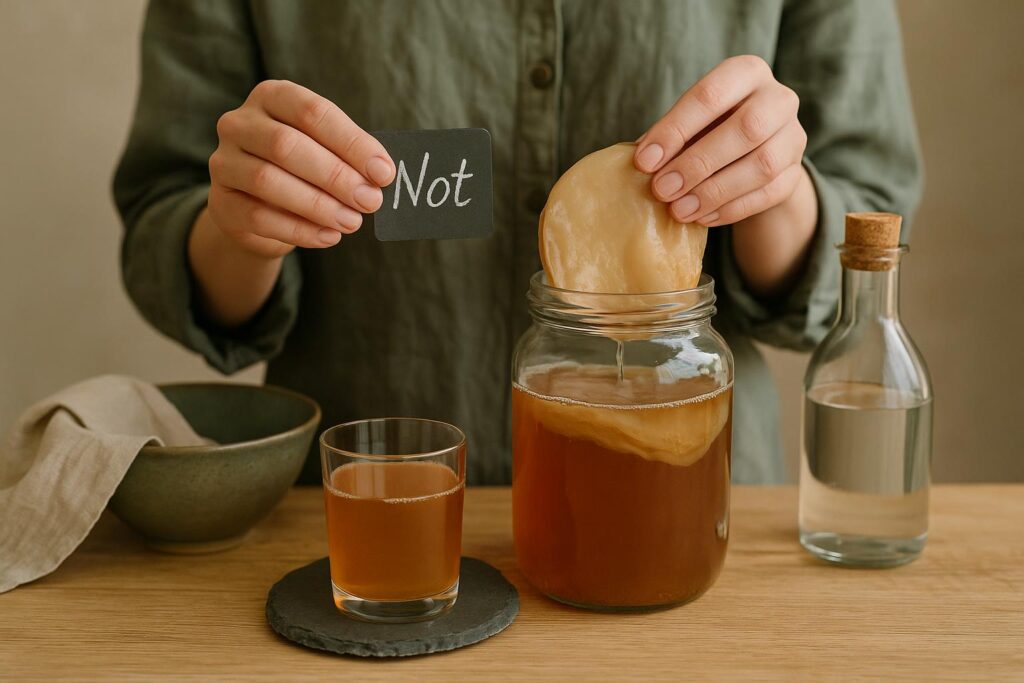
Qui ne peut pas consommer du kombucha ? Les personnes dont le système immunitaire est affaibli constituent un groupe à risque majeur. Sont concernés :
- Les patients sous chimiothérapie ou radiothérapie
- Les personnes séropositives (VIH/SIDA)
- Les greffés d’organes sous immunosuppresseurs
- Les patients atteints de lupus ou d’autres maladies auto-immunes traitées
- Les personnes sous corticoïdes au long cours
Le kombucha est une boisson fermentée contenant des micro-organismes vivants — bactéries et levures — qui sont inoffensifs pour un individu en bonne santé. En revanche, chez une personne immunodéprimée, ces mêmes micro-organismes peuvent provoquer des infections opportunistes graves. Des cas de septicémie liés à la consommation de kombucha ont été rapportés dans la littérature médicale chez des patients immunodéprimés, comme le signale le National Center for Complementary and Integrative Health (NCCIH).
De plus, la fermentation maison augmente le risque de contamination par des agents pathogènes (moisissures, bactéries indésirables), ce qui rend la boisson encore plus risquée pour ces profils. Même le kombucha commercial pasteurisé n’est pas totalement exempt de risques pour les immunodéprimés.
Qui ne peut pas consommer du kombucha ? Les personnes diabétiques
Le diabète est une autre situation dans laquelle qui ne peut pas consommer du kombucha ? mérite une réponse nuancée mais prudente.
Le kombucha contient des sucres résiduels issus de la fermentation. La quantité varie selon la durée de fermentation et la recette, mais elle oscille généralement entre 2 et 10 grammes pour 100 ml. Pour un diabétique de type 1 ou un diabétique de type 2 dont la glycémie est mal équilibrée, cette charge glycémique peut perturber significativement le contrôle de la glycémie.
Certaines études préliminaires, comme celle publiée sur PubMed, suggèrent que le kombucha pourrait avoir un effet hypoglycémiant modéré. Mais cet effet est imprévisible et variable selon les individus et les préparations. Pour un diabétique sous insuline ou sous antidiabétiques oraux, une hypoglycémie imprévue peut être dangereuse.
Les diabétiques qui souhaitent consommer du kombucha doivent impérativement :
- Consulter leur diabétologue au préalable
- Choisir un kombucha fermenté longtemps (moins de sucres résiduels)
- Surveiller leur glycémie avant et après la consommation
- Ne pas dépasser 100 ml par prise
Pour mieux comprendre quelle quantité de kombucha boire par jour en toute sécurité, consultez notre guide dédié.
Qui ne peut pas consommer du kombucha ? Les insuffisants rénaux
Qui ne peut pas consommer du kombucha ? Les personnes souffrant d’insuffisance rénale chronique ou aiguë doivent absolument éviter cette boisson.
Le kombucha contient des acides organiques — acide glucuronique, acide acétique, acide lactique — qui sont éliminés par les reins. Chez une personne dont la fonction rénale est altérée, l’accumulation de ces acides peut provoquer une acidose métabolique, une complication grave pouvant engager le pronostic vital.
Des cas d’acidose lactique sévère liés à la consommation de kombucha chez des patients insuffisants rénaux ont été documentés dans la littérature médicale internationale. L’Autorité Européenne de Sécurité des Aliments (EFSA) recommande la prudence pour toutes les boissons fermentées riches en acides organiques chez les personnes atteintes de pathologies rénales.
Par ailleurs, la teneur en potassium du kombucha peut être problématique pour les insuffisants rénaux qui doivent surveiller leur apport en électrolytes.
Qui ne peut pas consommer du kombucha ? Les personnes avec des troubles digestifs sévères

Le kombucha est souvent présenté comme bénéfique pour la digestion, mais qui ne peut pas consommer du kombucha ? inclut également les personnes souffrant de certains troubles gastro-intestinaux sévères.
Les profils concernés :
- Ulcères gastroduodénaux actifs : l’acidité du kombucha (pH 2,5-3,5) peut aggraver les lésions de la muqueuse gastrique et provoquer des douleurs intenses.
- Reflux gastro-œsophagien (RGO) sévère : la boisson fermentée peut exacerber les remontées acides chez les personnes déjà sensibles.
- Syndrome de l’intestin irritable (SII) en phase aiguë : les FODMAP et les acides organiques du kombucha peuvent déclencher des ballonnements, des douleurs et des diarrhées.
- SIBO (prolifération bactérienne de l’intestin grêle) : apporter des bactéries et des levures supplémentaires en cas de SIBO peut aggraver la situation.
- Maladie de Crohn ou rectocolite hémorragique en poussée : la consommation de probiotiques non contrôlés peut être déconseillée en phase inflammatoire active.
Pour les personnes atteintes de ces pathologies en dehors des phases aiguës, une consommation très modérée peut parfois être envisagée après avis médical.
Qui ne peut pas consommer du kombucha ? Les personnes allergiques ou intolérantes
Qui ne peut pas consommer du kombucha ? Les personnes présentant des allergies ou des intolérances spécifiques doivent être particulièrement vigilantes.
Allergie aux levures : le kombucha contient des levures actives (Saccharomyces cerevisiae et d’autres espèces). Une allergie aux levures peut provoquer des réactions allant de l’urticaire aux troubles digestifs, voire des réactions anaphylactiques dans les cas les plus graves.
Intolérance à l’alcool : certaines personnes présentent un déficit en aldéhyde déshydrogénase (ALDH2), enzyme nécessaire à la métabolisation de l’alcool. Même les faibles quantités d’alcool présentes dans le kombucha peuvent provoquer des rougeurs, des palpitations et des maux de tête chez ces individus. Pour en savoir plus sur la teneur en alcool, lisez notre article : quel pourcentage d’alcool contient le kombucha.
Intolérance à l’histamine : le kombucha est une boisson fermentée naturellement riche en histamine. Les personnes souffrant d’intolérance à l’histamine peuvent ressentir des maux de tête, des démangeaisons, des troubles digestifs et des réactions cutanées après consommation.
Intolérance à la caféine : préparé à base de thé noir ou vert, le kombucha contient de la caféine (10 à 25 mg pour 100 ml). Les personnes hypersensibles à la caféine, les cardiaques ou ceux souffrant d’anxiété chronique doivent en tenir compte.
Qui ne peut pas consommer du kombucha ? Les personnes sous certains traitements médicamenteux
Qui ne peut pas consommer du kombucha ? Les interactions médicamenteuses constituent un risque souvent méconnu mais réel.
Plusieurs classes de médicaments sont concernées :
- Antifongiques (fluconazole, itraconazole) : les levures du kombucha peuvent interférer avec l’efficacité de ces traitements.
- Antibiotiques : la consommation de kombucha pendant une antibiothérapie peut réduire l’efficacité du traitement ou provoquer des interactions avec certaines molécules.
- Anticoagulants (warfarine, héparine) : la vitamine K et certains composés du kombucha peuvent modifier l’INR et déséquilibrer le traitement anticoagulant.
- Médicaments à marge thérapeutique étroite : le kombucha peut modifier l’absorption intestinale de certains médicaments en raison de son acidité et de ses effets sur le microbiote.
- Disulfirame (Antabuse) : utilisé dans le traitement de l’alcoolisme, ce médicament réagit même aux faibles quantités d’alcool, comme celles présentes dans le kombucha.
Si vous prenez un traitement au long cours, consultez systématiquement votre médecin ou votre pharmacien avant de consommer du kombucha.
Qui ne peut pas consommer du kombucha ? Les personnes atteintes de maladies hépatiques
Le foie joue un rôle central dans la métabolisation de l’alcool et des acides organiques présents dans le kombucha. Qui ne peut pas consommer du kombucha ? Les personnes souffrant de pathologies hépatiques doivent figurer sur cette liste.
Les maladies concernées :
- Cirrhose hépatique : le foie cirrotique ne peut pas métaboliser correctement l’alcool résiduel du kombucha, même en faible quantité.
- Hépatite virale active (B ou C) : la consommation d’alcool, même minime, est contre-indiquée pendant le traitement des hépatites virales.
- Stéatose hépatique non alcoolique (NAFLD) : bien que certaines études suggèrent un effet bénéfique potentiel du kombucha sur le foie gras, les preuves restent insuffisantes pour recommander sa consommation sans avis médical.
Des cas d’hépatotoxicité liés à une consommation excessive de kombucha ont été rapportés, notamment chez des personnes présentant une vulnérabilité hépatique préexistante, comme le signale Harvard Health Publishing.
Précautions générales : qui doit modérer sa consommation de kombucha ?
Au-delà des contre-indications absolues, certains profils doivent simplement modérer leur consommation plutôt que de l’éviter totalement.
Les personnes âgées de plus de 70 ans : le vieillissement s’accompagne d’une diminution de la fonction rénale et hépatique, ainsi que d’une plus grande sensibilité aux micro-organismes. Une consommation modérée (100 à 150 ml par jour maximum) est conseillée.
Les personnes souffrant d’hypertension artérielle : certains kombucha commerciaux contiennent des quantités non négligeables de sodium. Vérifiez l’étiquette et préférez les versions faibles en sel.
Les personnes en convalescence : après une chirurgie, une infection grave ou une hospitalisation, le système immunitaire est temporairement affaibli. Attendez la guérison complète avant de reprendre la consommation de boissons fermentées.
Les personnes souffrant de migraines chroniques : la tyramine et l’histamine présentes dans le kombucha peuvent déclencher des crises migraineuses chez les personnes sensibles.
Pour mieux comprendre quand boire du kombucha et dans quelles conditions, consultez notre guide complet sur les moments idéaux de consommation.
Kombucha maison : des risques supplémentaires pour certains profils
Le kombucha fait maison présente des risques spécifiques qui aggravent encore les contre-indications listées précédemment. Qui ne peut pas consommer du kombucha ? : cette question se pose avec encore plus d’acuité pour la version artisanale.
Les risques supplémentaires du kombucha maison :
- Contamination par des moisissures : une fermentation mal maîtrisée peut laisser se développer des moisissures productrices de mycotoxines, dangereuses pour tous mais surtout pour les profils vulnérables.
- Teneur en alcool variable et imprévisible : selon la température, la durée de fermentation et la souche de levures, la teneur en alcool peut dépasser 3 %, voire 5 % dans certains cas.
- pH insuffisamment acide : si le kombucha n’est pas assez fermenté, son pH peut ne pas être assez bas pour inhiber la croissance de bactéries pathogènes comme Escherichia coli ou Salmonella.
- Contamination par le plomb : des cas d’intoxication au plomb ont été signalés lors de la fermentation dans des récipients en céramique émaillée au plomb.
Pour toutes ces raisons, les profils à risque (femmes enceintes, immunodéprimés, enfants, personnes âgées) doivent éviter le kombucha maison, même si le kombucha commercial reste acceptable sous conditions médicales.
Alternatives au kombucha pour les profils à risque
Si vous faites partie des profils pour lesquels qui ne peut pas consommer du kombucha ? s’applique, il existe des alternatives pour profiter de certains bénéfices des boissons fermentées sans les risques associés.
- Kéfir de lait pasteurisé : moins acide et sans alcool significatif, il peut convenir à certains profils sous contrôle médical.
- Eau gazeuse infusée aux herbes : sans fermentation, sans alcool, sans risque bactérien.
- Jus de légumes lacto-fermentés pasteurisés : la pasteurisation élimine les micro-organismes vivants tout en conservant certains composés bénéfiques.
- Tisanes digestives : camomille, fenouil, gingembre — des alternatives naturelles sans contre-indication majeure.
- Probiotiques pharmaceutiques : pour les personnes qui souhaitent soutenir leur microbiote sans les risques du kombucha, des probiotiques cliniquement testés et dosés avec précision représentent une alternative plus sûre.
- Qui ne peut pas consommer du kombucha ? : les femmes enceintes et allaitantes doivent éviter cette boisson en raison de l’alcool résiduel et des bactéries vivantes qu’elle contient.
- Qui ne peut pas consommer du kombucha ? : les enfants de moins de 4 ans sont particulièrement vulnérables à l’alcool, à la caféine et à l’acidité du kombucha.
- Qui ne peut pas consommer du kombucha ? : les personnes immunodéprimées (chimiothérapie, VIH, greffés) risquent des infections graves liées aux micro-organismes vivants de la boisson.
- Qui ne peut pas consommer du kombucha ? : les diabétiques, les insuffisants rénaux et les personnes atteintes de maladies hépatiques doivent consulter un médecin avant toute consommation.
- Qui ne peut pas consommer du kombucha ? : les personnes allergiques aux levures, intolérantes à l’histamine ou à l’alcool, et celles sous certains traitements médicamenteux doivent éviter ou limiter strictement cette boisson.
Questions fréquentes sur Qui ne peut pas consommer du kombucha ?
Le kombucha est-il dangereux pour tout le monde ?
Non. Pour un adulte en bonne santé, le kombucha est généralement bien toléré en quantités modérées (150 à 300 ml par jour). Les risques concernent principalement des profils spécifiques : femmes enceintes, enfants, immunodéprimés, personnes atteintes de maladies chroniques ou sous certains traitements. Pour les autres, une consommation raisonnée ne présente pas de danger avéré.
Une femme enceinte peut-elle boire du kombucha pasteurisé ?
Même pasteurisé, le kombucha reste déconseillé pendant la grossesse. La pasteurisation élimine les bactéries vivantes, mais ne supprime pas totalement l’alcool résiduel ni l’acidité. Par précaution, la majorité des professionnels de santé recommandent d’éviter toute forme de kombucha pendant la grossesse et l’allaitement.
À partir de quel âge peut-on donner du kombucha à un enfant ?
La plupart des experts déconseillent le kombucha avant 4 ans. Entre 4 et 12 ans, une consommation très occasionnelle et en très petite quantité (quelques millilitres) peut être envisagée avec l’accord d’un pédiatre. L’alcool résiduel, la caféine et l’acidité sont les principales préoccupations pour les jeunes enfants.
Le kombucha peut-il aggraver un reflux gastrique ?
Oui. Le kombucha a un pH très acide (entre 2,5 et 3,5), comparable à celui du jus de citron. Pour les personnes souffrant de reflux gastro-œsophagien (RGO), d’ulcères gastriques ou de gastrite, cette acidité peut aggraver les symptômes et provoquer des brûlures d’estomac. Une consommation est déconseillée en phase aiguë.
Le kombucha contient-il vraiment de l’alcool ?
Oui. Le kombucha contient de l’alcool résiduel issu de la fermentation des sucres par les levures. La teneur varie entre 0,5 % et 3 % pour les versions artisanales, et peut dépasser ce seuil en cas de fermentation prolongée. Les versions commerciales sont généralement limitées à moins de 0,5 % pour être classées comme boissons sans alcool dans la plupart des pays.
Les personnes sous antibiotiques peuvent-elles boire du kombucha ?
Il est préférable d’éviter le kombucha pendant une antibiothérapie. Les antibiotiques ciblent les bactéries, y compris celles du kombucha, ce qui peut réduire l’efficacité de la boisson. De plus, certains antibiotiques interagissent avec les composés fermentés. Attendez la fin du traitement et respectez un délai de 48 à 72 heures avant de reprendre.
Le kombucha est-il contre-indiqué en cas de candidose ?
Oui, dans la majorité des cas. Le kombucha contient des levures actives, dont certaines espèces proches de Candida. En cas de candidose diagnostiquée, la consommation de kombucha peut théoriquement alimenter la prolifération fongique. Consultez votre médecin ou votre naturopathe avant d’en consommer si vous êtes sujet aux infections à Candida.
Peut-on boire du kombucha en cas de maladie de Crohn ?
La réponse varie selon l’état du patient. En phase de poussée inflammatoire, le kombucha est déconseillé : son acidité et ses micro-organismes peuvent aggraver l’inflammation intestinale. En phase de rémission, certains patients tolèrent de petites quantités, mais cela doit toujours être discuté avec le gastro-entérologue traitant.
Le kombucha est-il dangereux pour les personnes âgées ?
Pas nécessairement, mais des précautions s’imposent. Avec l’âge, les fonctions rénale et hépatique diminuent, et le système immunitaire s’affaiblit. Les personnes de plus de 70 ans doivent limiter leur consommation à 100-150 ml par jour maximum, éviter le kombucha maison et consulter leur médecin si elles prennent des médicaments au long cours.
Le kombucha peut-il provoquer une intoxication alimentaire ?
Oui, dans des cas rares mais documentés. Le kombucha maison mal préparé peut être contaminé par des moisissures ou des bactéries pathogènes. Les symptômes d’une intoxication incluent nausées, vomissements, diarrhées et douleurs abdominales. Les profils vulnérables (immunodéprimés, femmes enceintes, enfants) sont les plus exposés à ces risques.
Combien de kombucha peut-on boire par jour sans risque ?
Pour un adulte en bonne santé, la quantité recommandée est de 150 à 300 ml par jour, idéalement en dehors des repas. Au-delà, les effets indésirables (acidité, ballonnements, apport en alcool) augmentent. Les personnes débutantes devraient commencer par 50 à 100 ml par jour pour tester leur tolérance digestive.
Existe-t-il un kombucha sans alcool adapté aux profils à risque ?
Certains fabricants proposent des versions de kombucha désalcoolisées ou pasteurisées. La pasteurisation élimine les micro-organismes vivants, ce qui réduit certains risques mais supprime aussi les probiotiques. Ces versions restent déconseillées pour les femmes enceintes et les immunodéprimés, mais peuvent être envisagées pour d’autres profils sous contrôle médical.
Ce qu’il faut retenir avant de consommer du kombucha
Qui ne peut pas consommer du kombucha ? La réponse est claire : les femmes enceintes, les enfants de moins de 4 ans, les personnes immunodéprimées, les diabétiques non équilibrés, les insuffisants rénaux, les personnes atteintes de maladies hépatiques graves, les individus allergiques aux levures ou à l’histamine, et ceux qui suivent certains traitements médicamenteux doivent éviter ou limiter strictement cette boisson fermentée. Pour tous les autres, le kombucha reste une boisson intéressante à condition d’en respecter les quantités recommandées. Qui ne peut pas consommer du kombucha ? est une question qui mérite toujours une réponse personnalisée : en cas de doute, consultez votre médecin avant d’intégrer cette boisson à votre alimentation quotidienne.
Études et sources scientifiques
- Jayabalan R. et al. (2014). A Review on Kombucha Tea — PubMed
- National Center for Complementary and Integrative Health — Kombucha Tea
- Harvard Health Publishing — Is kombucha good for you?
- Organisation Mondiale de la Santé — Alcool et santé
- Autorité Européenne de Sécurité des Aliments (EFSA) — Sécurité alimentaire
Cet article est fourni à titre informatif uniquement et ne constitue pas un avis médical. Consultez un professionnel de santé qualifié avant toute utilisation.