Comment faire du kefir de fruit : recette simple et efficace en 7 étapes
Cet article a une vocation informative et ne remplace pas un avis médical professionnel. Consultez un professionnel de santé avant toute utilisation, notamment en cas de grossesse, traitement médicamenteux ou pathologie chronique.
Comment faire du kefir de fruit : mélangez des grains de kefir, de l’eau, du sucre et des fruits séchés, puis laissez fermenter 24 à 48 heures à température ambiante.
- Une boisson naturellement pétillante et riche en probiotiques
- Une fermentation simple, réalisable sans matériel spécialisé
- Un coût très faible comparé aux probiotiques en capsules
- Une recette personnalisable selon les fruits et le niveau de sucre souhaité
- Un procédé reproductible à l’infini grâce aux grains vivants
Savoir comment faire du kefir de fruit permet de produire chez soi une boisson fermentée contenant des milliards de bactéries lactiques et de levures bénéfiques. Selon une étude publiée sur PubMed / NCBI, les boissons fermentées à base de kefir contiennent entre 10⁷ et 10⁹ UFC par millilitre, soit une concentration probiotique comparable aux meilleurs compléments du marché.
Qu’est-ce que le kefir de fruit et pourquoi apprendre comment faire du kefir de fruit ?
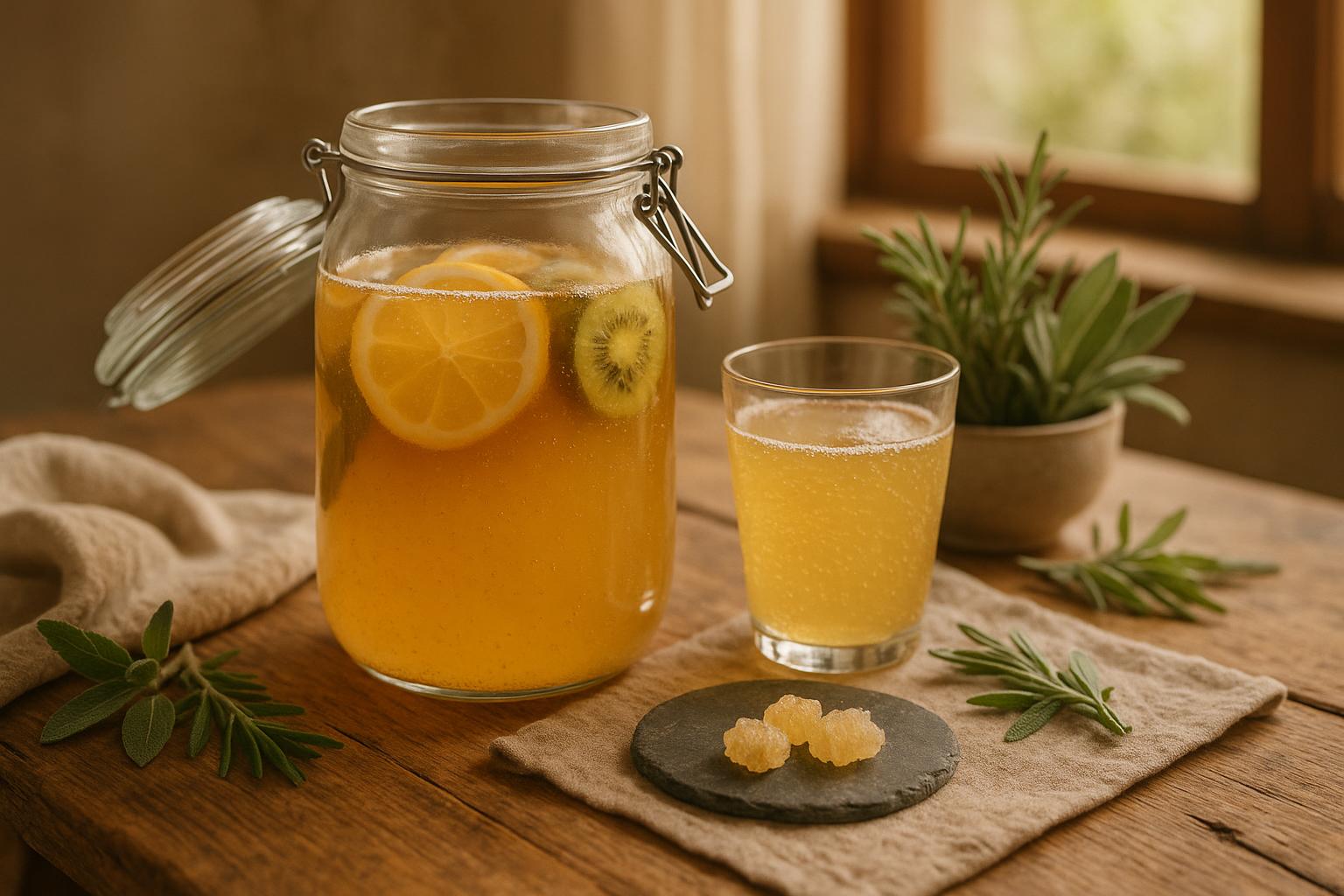
Le kefir de fruit, aussi appelé kefir d’eau, est une boisson fermentée obtenue à partir de grains de kefir plongés dans une solution sucrée enrichie de fruits. Ces grains sont des colonies symbiotiques de bactéries lactiques et de levures, emprisonnées dans une matrice polysaccharidique translucide.
Comment faire du kefir de fruit est reconnu pour ses effets positifs sur la flore intestinale, l’immunité et la digestion. Contrairement au kefir de lait, la version à base d’eau est naturellement sans lactose, ce qui la rend accessible aux personnes intolérantes ou veganes.
Les grains de kefir : le cœur vivant de la recette
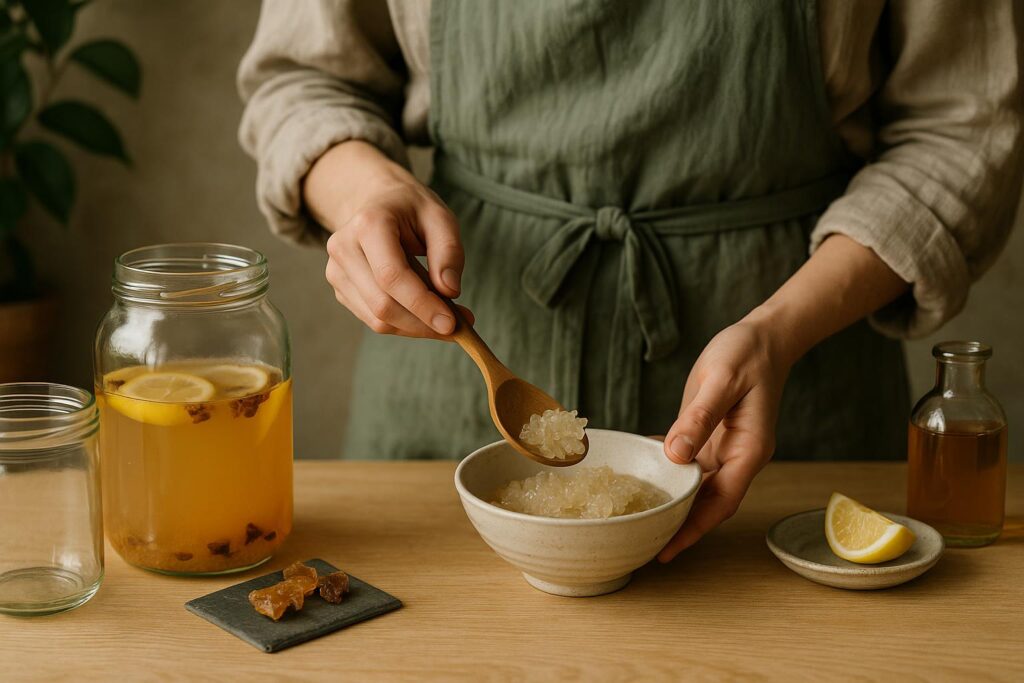
Les grains de kefir sont des organismes vivants. Bien entretenus, ils se multiplient à chaque fermentation. On les obtient auprès d’associations de partage, de pharmacies spécialisées ou en ligne. Leur aspect rappelle de petits cristaux gélatineux translucides.
- Bactéries dominantes : Lactobacillus, Leuconostoc, Acetobacter
- Levures associées : Saccharomyces cerevisiae, Candida kefyr
- Production naturelle d’acide lactique, CO₂ et traces d’alcool (< 0,5 %)
- Grains réutilisables indéfiniment si correctement rincés entre chaque cycle
En pratique, comment faire du kefir de fruit permet de maintenir ces grains actifs tout en produisant une boisson savoureuse à moindre coût. Un seul lot de grains suffit pour des années de production.
Les ingrédients essentiels pour comment faire du kefir de fruit maison
La réussite de comment faire du kefir de fruit repose sur la qualité et la proportion des ingrédients. Voici ce dont vous avez besoin pour 1,5 litre de kefir de fruit.
| Ingrédient | Quantité pour 1,5 L | Rôle |
|---|---|---|
| Grains de kefir | 30 à 45 g | Ferments vivants |
| Eau (robinet ou filtrée) | 1,5 litre | Base de la boisson |
| Sucre blond ou rapadura | 60 g (4 c. à soupe) | Nourriture des grains |
| Fruits séchés (figues, abricots, dattes) | 2 à 3 pièces | Minéraux et arômes |
| Citron bio (tranches) | 2 à 3 rondelles | Acidité et conservation |
Le meilleur comment faire du kefir de fruit est celui qui respecte ces proportions. Trop de sucre ralentit la fermentation ; trop peu affame les grains et produit une boisson plate et sans caractère.
Comment faire du kefir de fruit reste l’une des solutions les plus économiques pour intégrer des probiotiques au quotidien : moins de 0,20 € par litre produit contre 2 à 4 € pour les boissons probiotiques commerciales.
Comment faire du kefir de fruit : les 7 étapes détaillées
Voici le protocole complet pour comment faire du kefir de fruit à la maison, testé et validé pour une fermentation réussie dès le premier essai.
Étape 1 : Préparer le matériel
Utilisez un bocal en verre d’au moins 2 litres, une cuillère en bois (jamais en métal), une passoire en plastique ou en nylon, et un carré de tissu ou une étamine pour couvrir le bocal sans l’étancher complètement.
Étape 2 : Dissoudre le sucre
Versez 1,5 litre d’eau dans le bocal. Ajoutez 60 g de sucre blond. Mélangez avec la cuillère en bois jusqu’à dissolution complète. Le sucre est indispensable : les grains s’en nourrissent pour produire l’acidité et le gaz carbonique.
Étape 3 : Ajouter les grains de kefir
Rincez délicatement les grains à l’eau froide (jamais chaude). Ajoutez 30 à 45 g de grains dans le bocal sucré. Comment faire du kefir de fruit correctement implique de ne jamais utiliser d’ustensiles métalliques au contact direct des grains.
Étape 4 : Ajouter les fruits et le citron
Déposez 2 figues séchées (ou abricots, dattes) et 2 rondelles de citron bio non traité. Ces éléments apportent des minéraux essentiels à l’activité des grains et enrichissent le profil aromatique de la boisson.
Étape 5 : Couvrir et placer à température ambiante
Couvrez le bocal avec un tissu maintenu par un élastique. Ne fermez jamais hermétiquement à cette étape : le CO₂ produit doit pouvoir s’échapper. Placez à 20–25 °C, à l’abri de la lumière directe.
Étape 6 : Fermenter 24 à 48 heures
Concrètement, comment faire du kefir de fruit agit sur le sucre par fermentation lactique et alcoolique légère. En été (25 °C+), 24 heures suffisent. En hiver (18–20 °C), comptez 48 heures. Goûtez régulièrement : la boisson doit être légèrement acidulée, pétillante et peu sucrée.
Étape 7 : Filtrer, embouteiller et conserver
Filtrez le kefir à travers la passoire pour récupérer les grains. Embouteillez la boisson dans des bouteilles à fermeture hermétique (type limonade). Conservez au réfrigérateur jusqu’à 7 jours. Les grains récupérés sont rincés et prêts pour un nouveau cycle.
Pour aller plus loin sur la fabrication maison, consultez notre article détaillé sur comment faire son kefir soi-même, qui couvre également le kefir de lait et les variantes avancées.
Les bienfaits prouvés de comment faire du kefir de fruit régulièrement
Comment faire du kefir de fruit et le consommer régulièrement apporte des bénéfices documentés sur la santé digestive, immunitaire et métabolique. Ces effets sont attribués à la richesse en micro-organismes vivants et en acides organiques.
Santé digestive et microbiote
Les bactéries lactiques présentes dans le kefir de fruit colonisent temporairement l’intestin et modulent la composition du microbiote. Une méta-analyse disponible sur PubMed / NCBI confirme l’effet positif des ferments lactiques sur les troubles fonctionnels intestinaux, notamment les ballonnements et l’irrégularité du transit.
Soutien immunitaire
Environ 70 % du système immunitaire est localisé dans l’intestin. En pratique, comment faire du kefir de fruit permet de renforcer la barrière intestinale et de stimuler la production d’immunoglobulines IgA, première ligne de défense muqueuse. L’Organisation Mondiale de la Santé reconnaît l’intérêt des aliments fermentés dans le maintien d’une alimentation équilibrée.
Apport en vitamines B et en minéraux
La fermentation enrichit naturellement la boisson en vitamines B2, B9 et B12 synthétisées par les bactéries. Les fruits séchés ajoutés apportent du potassium, du magnésium et du fer biodisponible.
- Amélioration du transit en 2 à 4 semaines de consommation régulière
- Réduction des ballonnements post-prandiaux
- Effet légèrement détoxifiant grâce aux acides organiques
- Hydratation optimisée par les électrolytes naturels
- Alternative sans lactose aux probiotiques laitiers
Comment faire du kefir de fruit : les erreurs fréquentes à éviter
Même avec une recette simple, certaines erreurs compromettent la qualité du kefir de fruit. Voici les pièges les plus courants identifiés par les fermenteurs expérimentés.
| Erreur | Conséquence | Solution |
|---|---|---|
| Utiliser des ustensiles métalliques | Oxydation, mort partielle des grains | Bois, plastique ou silicone uniquement |
| Fermer hermétiquement dès le départ | Surpression, risque d’explosion du bocal | Couvrir avec un tissu en 1ère fermentation |
| Température trop basse (< 18 °C) | Fermentation lente, boisson trop sucrée | Placer près d’une source de chaleur douce |
| Oublier les fruits séchés | Manque de minéraux, grains moins actifs | Toujours ajouter figues ou abricots secs |
| Ne pas rincer les grains entre cycles | Accumulation d’acidité, grains fragilisés | Rinçage doux à l’eau froide après chaque lot |
La deuxième fermentation : comment faire du kefir de fruit pétillant
La deuxième fermentation est l’étape secrète pour obtenir un kefir de fruit vraiment pétillant et aromatisé. Comment faire du kefir de fruit avec une belle effervescence passe obligatoirement par cette phase.
Protocole de la 2F (deuxième fermentation)
Après avoir filtré les grains, versez le kefir dans des bouteilles à fermeture hermétique (type Grolsch ou bouteilles de limonade en verre). Ajoutez un aromatisant de votre choix : jus de citron, gingembre frais râpé, fruits frais mixés, lavande, menthe. Fermez hermétiquement et laissez reposer 12 à 24 heures à température ambiante.
- Le CO₂ résiduel se dissout dans la boisson fermée : effervescence garantie
- Les arômes se développent et s’intensifient
- L’acidité s’équilibre avec les notes fruitées ajoutées
- Le taux d’alcool reste inférieur à 0,5 % si la 2F ne dépasse pas 24 h
Comment faire du kefir de fruit reste l’une des solutions les plus accessibles pour produire une boisson fermentée maison de qualité professionnelle. Ouvrez les bouteilles avec précaution au-dessus d’un évier lors de la 2F.
Comment conserver les grains de kefir entre deux préparations
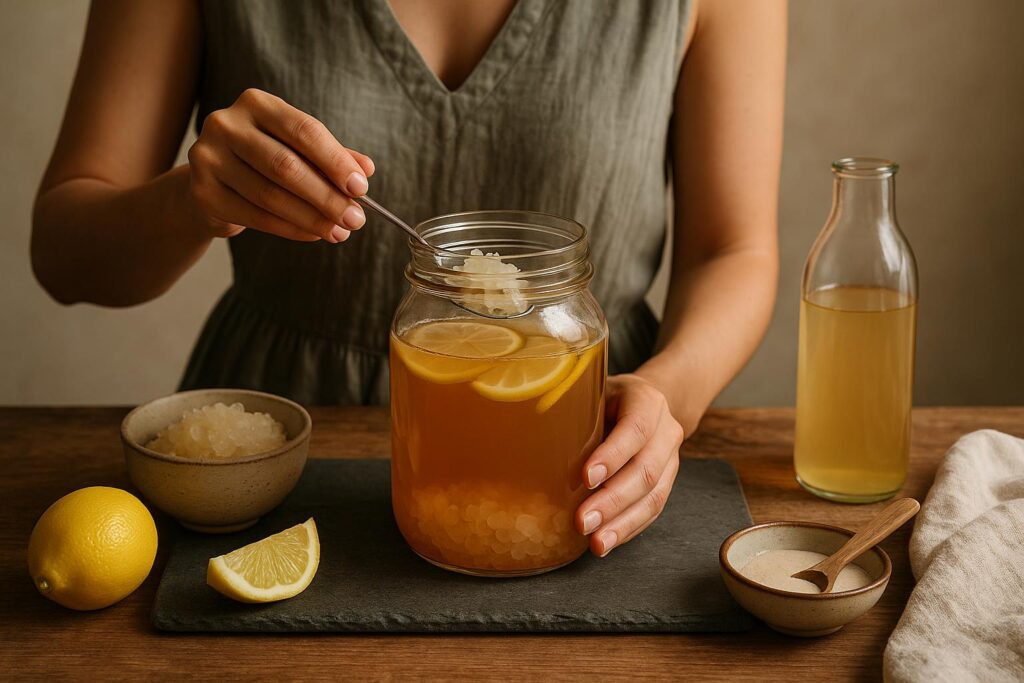
Connaître comment faire du kefir de fruit implique aussi de savoir entretenir ses grains sur le long terme. Des grains bien conservés restent actifs des années.
Conservation courte durée (moins de 7 jours)
Rincez les grains, placez-les dans un bocal avec de l’eau sucrée (1 cuillère à café de sucre par verre d’eau). Fermez et réfrigérez. Les grains entrent en dormance légère et restent utilisables sans phase de réveil prolongée.
Conservation longue durée (plusieurs semaines)
Étalez les grains sur du papier absorbant. Laissez sécher 24 à 48 heures à température ambiante. Conservez dans un sachet hermétique au réfrigérateur ou au congélateur. Pour les réactiver, effectuez 2 à 3 cycles de fermentation avant consommation.
En pratique, comment faire du kefir de fruit permet de ne jamais manquer de ferments : les grains se multiplient à chaque cycle et peuvent être partagés avec l’entourage ou donnés via des réseaux d’échange communautaires.
Comment faire du kefir de fruit : variantes et recettes créatives
Une fois la recette de base maîtrisée, comment faire du kefir de fruit ouvre la porte à d’infinies variations aromatiques selon les saisons et les goûts.
Kefir de fruit au gingembre et citron vert
Remplacez le citron jaune par du citron vert et ajoutez 2 cm de gingembre frais râpé en deuxième fermentation. Résultat : une boisson tonique et digestive, idéale avant les repas.
Kefir de fruit aux fruits rouges
Ajoutez 100 g de framboises ou myrtilles fraîches en deuxième fermentation. La couleur devient rosée, le goût légèrement sucré et acidulé. Riche en antioxydants selon les données de Harvard Health Publishing.
Kefir de fruit à la lavande et au miel
En deuxième fermentation, ajoutez une cuillère à café de miel cru et 4 fleurs de lavande séchées. Une boisson apaisante, parfaite en soirée pour favoriser la détente.
Comment faire du kefir de fruit en toute sécurité : précautions et contre-indications
Comment faire du kefir de fruit est généralement sûr pour la majorité des adultes en bonne santé. Cependant, certaines situations nécessitent des précautions particulières.
- Grossesse et allaitement : consultez votre médecin avant consommation régulière, en raison des traces d’alcool et de la présence de micro-organismes vivants.
- Immunodépression : les personnes sous immunosuppresseurs ou atteintes de pathologies graves doivent éviter les boissons fermentées non pasteurisées.
- Enfants de moins de 3 ans : déconseillé sans avis médical préalable.
- Syndrome de l’intestin irritable sévère : commencez par de petites quantités (50 ml/jour) et augmentez progressivement.
- Interactions médicamenteuses : les probiotiques peuvent interagir avec certains antibiotiques ; respectez un délai de 2 heures entre les deux.
Le NIH / NCCIH rappelle que les probiotiques sont généralement bien tolérés mais que des effets transitoires (gaz, ballonnements) peuvent survenir en début de consommation.
Combien consommer et comment intégrer le kefir de fruit au quotidien
Comment faire du kefir de fruit est une chose ; savoir le consommer intelligemment en est une autre. La posologie recommandée varie selon la tolérance individuelle.
Quantités recommandées
- Débutants : 100 à 150 ml par jour pendant les 2 premières semaines
- Consommateurs réguliers : 200 à 300 ml par jour, de préférence le matin à jeun ou avant les repas
- Usage thérapeutique ciblé : jusqu’à 500 ml par jour, en fractionnant en 2 à 3 prises
Comment faire du kefir de fruit est reconnu pour ses effets progressifs : les premiers bénéfices digestifs se ressentent généralement après 10 à 15 jours de consommation quotidienne. La constance prime sur la quantité.
Questions fréquentes sur la réussite de comment faire du kefir de fruit
Pourquoi mes grains ne fermentent-ils pas ?
Des grains inactifs signalent généralement une température trop basse, une eau trop chlorée ou des grains en dormance après conservation. Effectuez un cycle de réveil avec de l’eau sucrée à 22–24 °C pendant 48 heures avant de relancer une production normale.
Peut-on utiliser du sucre blanc pour comment faire du kefir de fruit ?
Oui, le sucre blanc fonctionne. Le sucre blond, le rapadura ou le sucre de coco sont cependant préférables car ils contiennent des traces de minéraux utiles à l’activité des grains. Évitez les édulcorants artificiels : les grains ne peuvent pas les métaboliser.
Pour approfondir les techniques de fermentation maison, notre guide sur comment faire son kefir soi-même détaille également les variantes laitières et les astuces avancées de fermenteurs expérimentés.
Comment faire du kefir de fruit sans grains : est-ce possible ?
Certains se demandent si comment faire du kefir de fruit est réalisable sans grains vivants. La réponse est nuancée.
Des starters lyophilisés (poudres de ferments) existent en pharmacie et permettent de produire une boisson fermentée similaire. Cependant, ces préparations ne se multiplient pas et nécessitent un nouveau sachet à chaque production. La diversité microbienne est aussi moins riche qu’avec des grains vivants.
Comment faire du kefir de fruit avec de vrais grains vivants reste la méthode la plus efficace, la plus économique et la plus riche en micro-organismes bénéfiques. Les grains vivants sont la seule option pour une production durable et autonome.
- Comment faire du kefir de fruit : mélangez grains de kefir, eau, sucre, fruits séchés et citron, puis fermentez 24 à 48 heures à température ambiante.
- Respectez les proportions (30–45 g de grains pour 1,5 L d’eau et 60 g de sucre) pour garantir une fermentation active et une boisson équilibrée.
- Comment faire du kefir de fruit avec une deuxième fermentation permet d’obtenir une boisson naturellement pétillante et aromatisée selon vos goûts.
- Comment faire du kefir de fruit en toute sécurité implique d’éviter les ustensiles métalliques, de ne pas fermer hermétiquement en première fermentation et de rincer les grains entre chaque cycle.
- Comment faire du kefir de fruit régulièrement et le consommer à raison de 150 à 300 ml par jour apporte des bénéfices digestifs et immunitaires documentés après 10 à 15 jours de pratique.
Questions fréquentes sur comment faire du kefir de fruit
Comment faire du kefir de fruit pour la première fois sans expérience ?
Commencez par la recette de base : 1,5 L d’eau, 60 g de sucre blond, 30 g de grains, 2 figues séchées et 2 rondelles de citron. Couvrez d’un tissu, attendez 48 heures à 20–22 °C. Goûtez : si la boisson est légèrement acidulée et peu sucrée, la fermentation a réussi. Filtrez et réfrigérez.
Combien de temps faut-il pour comment faire du kefir de fruit ?
La préparation prend 10 minutes. La fermentation dure 24 à 48 heures selon la température. Une deuxième fermentation optionnelle ajoute 12 à 24 heures. Au total, comptez 2 à 3 jours entre la préparation et la dégustation d’un kefir de fruit pétillant et prêt à consommer.
Comment faire du kefir de fruit avec des grains congelés ?
Décongelez les grains lentement au réfrigérateur pendant 12 heures, puis à température ambiante 2 heures. Effectuez 2 à 3 cycles de fermentation de réveil en jetant le liquide produit. Au troisième cycle, les grains retrouvent leur pleine activité et la boisson est consommable normalement.
Comment faire du kefir de fruit est-il dangereux ?
Non, pour la majorité des adultes en bonne santé. Des effets transitoires (gaz, légères nausées) peuvent survenir en début de consommation. Les personnes immunodéprimées, enceintes ou sous traitement médical doivent consulter un professionnel de santé avant d’intégrer cette boisson à leur alimentation quotidienne.
Comment faire du kefir de fruit sans sucre ?
C’est impossible : le sucre est la nourriture indispensable des grains de kefir. Sans sucre, les micro-organismes meurent et aucune fermentation ne se produit. Rassurez-vous : après 48 heures, les grains consomment la quasi-totalité du sucre ajouté. La boisson finale contient très peu de sucre résiduel.
Quelle eau utiliser pour comment faire du kefir de fruit ?
L’eau du robinet convient si vous la laissez reposer 30 minutes pour dissiper le chlore. L’eau de source légèrement minéralisée est idéale. Évitez l’eau osmosée ou ultra-purifiée, pauvre en minéraux, qui ralentit l’activité des grains. L’eau gazeuse est déconseillée en première fermentation.
Comment faire du kefir de fruit plus pétillant ?
La deuxième fermentation en bouteille hermétique est la clé. Après filtrage, embouteillez le kefir avec un aromatisant (gingembre, jus de fruits), fermez hermétiquement et laissez 12 à 24 heures à température ambiante. Le CO₂ résiduel se dissout sous pression et crée une effervescence naturelle intense.
Comment faire du kefir de fruit moins acide ?
Réduisez le temps de fermentation à 24 heures maximum. Utilisez une eau légèrement plus froide (18–19 °C). Ajoutez une datte supplémentaire pour équilibrer l’acidité avec une note sucrée naturelle. En deuxième fermentation, les fruits frais adoucissent également le profil gustatif de la boisson.
Comment faire du kefir de fruit convient-il aux enfants ?
Déconseillé aux enfants de moins de 3 ans sans avis médical. Pour les enfants de 3 à 12 ans, commencez par 50 ml par jour dilués dans de l’eau ou du jus de fruit. La boisson contient des traces d’alcool inférieures à 0,5 %, ce qui reste très faible mais mérite une vigilance chez les plus jeunes.
Comment faire du kefir de fruit aide-t-il à perdre du poids ?
Indirectement, oui. La boisson est très peu calorique (20 à 40 kcal par verre), favorise la satiété et améliore le microbiote intestinal, dont l’équilibre est lié à la gestion du poids selon plusieurs études. Elle ne constitue pas un traitement amaigrissant mais s’intègre utilement dans une alimentation équilibrée.
Comment faire du kefir de fruit sans figues séchées ?
Les figues peuvent être remplacées par des abricots secs, des dattes, des raisins secs ou des pruneaux. L’essentiel est d’utiliser des fruits séchés sans additifs ni huile de conservation. Ces fruits apportent les minéraux nécessaires à l’activité optimale des grains de kefir.
Comment faire du kefir de fruit se conserve-t-il longtemps ?
La boisson filtrée se conserve 5 à 7 jours au réfrigérateur dans des bouteilles hermétiques. Au-delà, l’acidité augmente et le goût devient trop vinaigreux. Les grains récupérés se conservent jusqu’à 7 jours au réfrigérateur dans de l’eau sucrée, ou plusieurs mois au congélateur après séchage.
Maîtriser comment faire du kefir de fruit à la maison, c’est accéder à une boisson vivante, économique et personnalisable, aux bénéfices probiotiques documentés. Avec des grains de qualité, de l’eau, du sucre et quelques fruits séchés, vous produisez en moins de 48 heures une alternative naturelle aux sodas industriels.
Études et sources scientifiques
- Études sur les propriétés probiotiques des boissons fermentées à base de kefir — PubMed / NCBI
- Recommandations sur les aliments fermentés — Organisation Mondiale de la Santé
- Bénéfices des probiotiques et des aliments fermentés — Harvard Health Publishing
- Données sur la sécurité et l’efficacité des probiotiques — NIH / NCCIH
- Évaluation scientifique des allégations de santé relatives aux micro-organismes fermentants — EFSA
Cet article est fourni à titre informatif uniquement et ne constitue pas un avis médical. Consultez un professionnel de santé qualifié avant toute utilisation.