What percentage of alcohol does kombucha contain? 5 truths
This article is for informational purposes only and does not replace professional medical advice. If you have any doubts about your alcohol consumption or your health, consult a doctor.
What percentage of alcohol does kombucha contain? The short answer: between 0.5% and 3% ABV for most commercially available kombuchas, with significant variations depending on the fermentation method and recipe. What percentage of alcohol does kombucha contain? This question often comes up among health-conscious consumers or those who avoid alcohol for medical, religious, or athletic reasons.
- Standard commercial kombucha typically contains less than 0.5% alcohol.
- Homemade kombucha can exceed 2 to 3% depending on the fermentation time.
- The ethanol content increases with heat and fermentation time.
- Some "hard" kombuchas are intentionally produced with 4-8% alcohol.
- European regulations require specific labeling above 1.2% vol.
According to several studies published on PubMed, kombucha fermentation naturally produces ethanol as a byproduct of the yeast activity present in the SCOBY. What percentage of alcohol does kombucha contain? The answer depends on many factors, which this article details point by point, with supporting scientific data.
What percentage of alcohol does kombucha contain? The fermentation process explained
Kombucha is produced by fermenting sweetened tea using a SCOBY (Symbiotic Culture Of Bacteria and Yeast). This consortium of microorganisms transforms the sugar into several compounds: organic acids, CO2, and ethanol. It is precisely this ethanol production that determines the alcohol percentage of the kombucha at the end of the process.
strains Brettanomyces, Zygosaccharomyces , and Saccharomyces —metabolize glucose and fructose into ethanol and carbon dioxide. Simultaneously, acetic acid bacteria oxidize some of this ethanol to acetic acid, naturally reducing the final alcohol content. This dual mechanism keeps the alcohol content of kombucha relatively low under normal fermentation conditions.
The duration of the first fermentation plays a key role. The longer it is, the more time the yeast has to produce ethanol. A 7-day fermentation at 24°C will result in a different alcohol content than a 14-day fermentation at 28°C. Understanding the alcohol percentage of kombucha therefore requires mastering these variables from the outset.
What percentage of alcohol does commercially available kombucha contain?
Kombucha sold in supermarkets or organic stores is subject to strict controls. In Europe, a beverage with an alcohol content of less than 1.2% ABV is not subject to regulations governing alcoholic beverages. The vast majority of commercial brands therefore target an ABV below 0.5%, often even below 0.3%.
Analyses of store-bought kombucha—including a study by the Canadian Centre for Emerging Substances (CCES)—have shown that some products can exceed the 0.5% alcohol content indicated on the label, particularly after prolonged storage at room temperature. Continued fermentation in the bottle (secondary fermentation) can significantly increase the ethanol content.
kombucha contain commercially available
- Pasteurized kombucha : 0.1 to 0.3% vol. (fermentation stopped)
- Unpasteurized (live) kombucha : 0.3 to 0.8% vol., sometimes more depending on storage
- "Hard" kombucha : 4 to 8% vol. (volumeally alcoholic products)
To learn more about the basics of this drink, see our article "What is kombucha and how is it made?".
What percentage of alcohol does homemade kombucha contain?
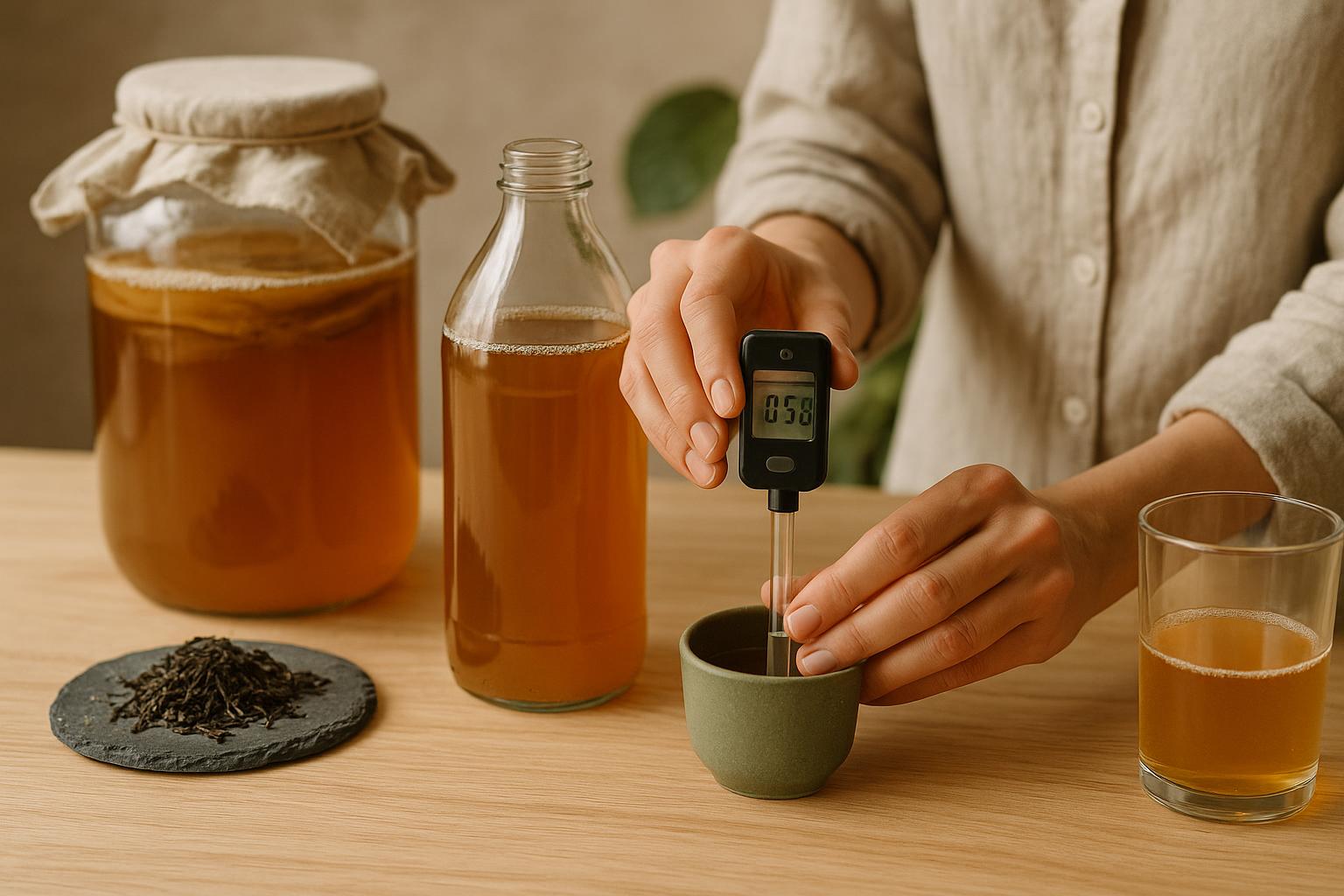
Homemade kombucha is significantly less predictable than commercially produced kombucha. Without precise measuring equipment (refractometer, alcoholmeter), it's difficult to know exactly what percentage of alcohol the kombucha you make at home contains.
Factors that increase the alcohol content in homemade kombucha:
- High temperature : above 26-28 °C, yeasts are more active and produce more ethanol.
- Long fermentation : beyond 10-14 days, the rate can reach 1.5 to 3%.
- Excess sugar : more available substrate means more ethanol production.
- Young or unbalanced SCOBY : fewer acetic bacteria to oxidize the alcohol produced.
- Second fermentation in a closed bottle : carbonation is accompanied by a slight increase in alcohol content.
Homebrewers report alcohol levels as high as 2.5% to 3.5% ABV after a prolonged second fermentation with the addition of sweet fruits. What percentage of alcohol does homemade kombucha contain ? The realistic range is between 0.5% and 3%, but it can exceed this threshold under extreme conditions.
To master your recipe, discover our complete guide: how to make homemade kombucha step by step.
What percentage of alcohol does kombucha contain? The 5 key factors that influence its content
The ethanol content of kombucha is not a fixed value. It fluctuates depending on several specific parameters. Here are the 5 main factors that determine the alcohol percentage in your glass of kombucha:
1. Fermentation temperature
Between 20°C and 30°C, the yeast is active. The higher the temperature, the faster the ethanol production. At 28°C, the level can be twice as high as at 20°C for the same fermentation time. Temperature control is therefore essential to manage the alcohol content of your kombucha.
2. Fermentation time
Fermentation time is the factor most directly correlated to alcohol content. A short fermentation (5-7 days) produces less ethanol. A long fermentation (14-21 days) can increase this content by a factor of 3 or 4. Most recipes recommend 7 to 10 days to stay below the 1% threshold.
3. The amount of sugar added
Sugar is the substrate for yeast. The more you add, the more ethanol they produce. The standard dose is 60 to 80 g per liter. Above 100 g/L, the risk of exceeding 1% alcohol increases significantly, even with a short fermentation.
4. The composition of the SCOBY
A SCOBY rich in acetic acid bacteria (such as Acetobacter and Gluconobacter) oxidizes more ethanol to acetic acid, thus reducing the final alcohol content. An unbalanced SCOBY, with a predominance of yeast, will produce a higher-alcohol kombucha. To understand the role of the SCOBY, read our article on the 7 essential roles of the kombucha SCOBY.
5. The second fermentation
The second fermentation in an airtight bottle (for carbonation) slightly increases the alcohol content. If you add fresh fruit or sweetened juice, the increase can be more pronounced. This is a step to monitor closely if you want to maintain a low ethanol level in your kombucha.
What percentage of alcohol does kombucha contain according to European regulations?
In Europe, the regulations are clear: any beverage with an alcohol content exceeding 1.2% ABV is considered alcoholic and must be labeled accordingly. Below this threshold, kombucha can be sold as a non-alcoholic beverage.
In France, ANSES (the French Agency for Food, Environmental and Occupational Health & Safety) recommends caution for vulnerable populations: pregnant women, children, and people undergoing medical treatment. Even a level of 0.5% can be problematic in some cases.
What percentage of alcohol does kombucha contain according to regulatory limits?
- Less than 0.5% vol.: a beverage considered "non-alcoholic" in most countries
- 0.5% to 1.2% vol.: regulatory grey area, often not labeled as alcoholic
- More than 1.2% vol.: alcohol labelling requirement in Europe
- More than 1.2% vol. in France: tax on alcoholic beverages applicable
The EFSA (European Food Safety Authority) has published opinions on fermented drinks and their ethanol content, stressing the need for transparent labelling for consumers.
What percentage of alcohol does kombucha contain? Can you get drunk from it?
The question often comes up: can you feel the effects of alcohol when drinking kombucha? For a standard commercial kombucha at 0.3-0.5% ABV, the answer is no under normal consumption conditions. You would have to ingest astronomical quantities to reach a measurable blood alcohol level.
For comparison, some naturally fermented fruit juices contain up to 0.3% alcohol, and sliced bread can contain up to 0.1%. How does kombucha compare to a light beer? A light beer has an alcohol content of approximately 2.5 to 3%, which is 5 to 10 times higher than a standard kombucha.
However, consuming 500 ml of homemade kombucha at 2-3% ABV could produce a measurable effect in sensitive individuals, particularly those who do not usually consume alcohol. Caution is advised.
What percentage of alcohol does kombucha contain? Risks for sensitive populations
Even in small doses, the ethanol in kombucha can be problematic for some people. What percentage of alcohol does kombucha contain , and what are the associated risks?
- Pregnant women : no alcohol level is considered safe during pregnancy. Unpasteurized kombucha is not recommended, even at 0.5%.
- Children : their immature liver metabolizes alcohol differently. Homemade kombucha should be avoided.
- People recovering from alcoholism : even small doses can trigger cravings or reactions.
- People taking medication : some medications (metronidazole, disulfiram, some antibiotics) interact with ethanol even at low concentrations.
- Drivers : at 0.5% vol., a liter of kombucha consumed quickly can produce a blood alcohol level of around 0.1 to 0.2 g/L depending on body weight.
To find out when it is safe to consume your kombucha during the day, see our article on the best times to drink kombucha.
How can you measure the alcohol percentage in homemade kombucha?
If you brew your own kombucha at home and want to know precisely what percentage of alcohol the kombucha you produce contains, several methods exist:
The refractometer
The refractometer measures the density of the liquid before and after fermentation. The difference in density allows you to estimate the amount of sugar converted into alcohol. This is the most accessible method for homebrewers, with an accuracy of ±0.3% vol.
The alcoholometer or ebulliometer
The ebulliometer is more precise but more expensive. It directly measures the boiling point of the liquid, which varies according to its alcohol content. Used by professional breweries, it gives reliable results to within ±0.1% vol.
Laboratory analysis
For maximum accuracy, sending a sample to an accredited laboratory remains the most reliable solution. Some artisanal kombucha brands have their batches analyzed regularly to guarantee regulatory compliance.
What percentage of alcohol does kombucha contain? How can it be reduced?
If you want to produce kombucha with the lowest possible alcohol content, here are the recommended practices to control the alcohol percentage of the kombucha you make:
- Shorten the fermentation : stop at 5-7 days rather than 14.
- Ferment at a low temperature : 18-20 °C rather than 26-28 °C.
- Reduce the amount of sugar : 50 g/L instead of 80-100 g/L.
- Use a mature and balanced SCOBY : rich in acetic bacteria.
- Avoid prolonged second fermentation : 24-48h maximum in a closed bottle.
- Pasteurize the finished product : stops any residual fermentation.
What percentage of alcohol does the kombucha produced in this way contain? By applying these recommendations, you can keep the level below 0.3% vol. in the vast majority of cases.
What percentage of alcohol does kombucha contain compared to other fermented beverages?
To better contextualize the alcohol percentage in kombucha, here is a comparison with other common fermented beverages:
- Commercial kombucha : 0.1 to 0.5% vol.
- Homemade kombucha : 0.5 to 3% vol.
- Milk kefir : 0.5 to 2% vol.
- Water kefir : 0.5 to 1% vol.
- Non-alcoholic beer : 0.1 to 0.5% vol.
- Light beer : 2.5 to 3% vol.
- Standard beer : 4.5 to 6% vol.
- Wine : 11 to 15% vol.
- Cider : 2 to 8% vol.
This comparison shows that the alcohol percentage in commercially produced kombucha is comparable to that of non-alcoholic beer. The main difference lies in the variability of homemade kombucha, which can approach the level of a light beer if fermentation is not controlled.
- What percentage of alcohol does commercial kombucha contain ? Generally less than 0.5% vol., often between 0.1 and 0.3%, which classifies it as a non-alcoholic beverage according to European regulations.
- What percentage of alcohol does homemade kombucha contain ? Between 0.5% and 3% vol. depending on the fermentation time, temperature and amount of sugar used — regular monitoring is essential.
- What percentage of alcohol does kombucha contain after the second fermentation? The level can increase by an additional 0.2 to 0.5% during carbonation in a sealed bottle, especially with the addition of sweet fruits.
- What percentage of alcohol does kombucha contain according to regulations? Above 1.2% vol., alcohol labeling is mandatory in Europe; "hard" kombuchas can reach 4 to 8% vol.
- What percentage of alcohol does kombucha contain that is relevant for sensitive populations? Even at 0.5%, unpasteurized kombucha is not recommended for pregnant women, children, and people undergoing certain medical treatments.
Frequently asked questions about kombucha: What percentage of alcohol does it contain?
What is the average alcohol content of kombucha?
Commercial kombucha typically contains between 0.1% and 0.5% alcohol by volume. Homemade kombucha can reach 1% to 3% depending on the fermentation conditions. "Hard" kombuchas are intentionally produced at 4-8% alcohol by volume and are clearly labeled as alcoholic beverages.
Can kombucha make you drunk?
A standard commercial kombucha at 0.3-0.5% ABV cannot cause intoxication under normal consumption conditions. You would have to drink several liters in a very short time. However, a poorly controlled homemade kombucha at 2-3% ABV can produce mild effects in sensitive individuals or those who never consume alcohol.
Is kombucha halal or suitable for people who avoid alcohol?
This is a sensitive issue. Some Islamic religious opinions consider any product containing even trace amounts of ethanol problematic. Others tolerate beverages below 0.5%. It is advisable to consult a qualified religious authority and choose a pasteurized kombucha with the lowest possible certified alcohol content.
How can I find out what percentage of alcohol the kombucha I buy contains?
Read the label: reputable brands indicate the alcohol content. If it's not mentioned, the product likely contains less than 0.5% alcohol. For homemade kombucha, use a refractometer or ebulliometer to accurately measure the ethanol content before consumption.
Does the alcohol content of kombucha increase over time?
Yes, if the kombucha is unpasteurized. Live (unpasteurized) kombucha continues to ferment slowly in the bottle, even in the refrigerator. Over several weeks, the alcohol content can increase by an additional 0.1 to 0.3%. Keep it refrigerated and consume it within 30 days of opening.
What percentage of alcohol does Synergy or GT's kombucha contain?
GT's Synergy brand kombuchas are unpasteurized and live. Their alcohol content is generally less than 0.5% ABV according to the official label. However, independent analyses have sometimes found slightly higher levels, particularly in bottles stored at room temperature.
Can a child drink kombucha?
Caution is advised. Even at 0.3-0.5% alcohol, unpasteurized kombucha is not recommended for children under 12. Their immature liver metabolizes alcohol differently. If you wish to give kombucha to a child, choose a pasteurized product with a certified alcohol content of less than 0.1% ABV.
Can a pregnant woman drink kombucha?
No, unpasteurized kombucha is not recommended during pregnancy for two reasons: the presence of ethanol, even in small amounts, and the microbiological risk associated with live bacteria. Pasteurized kombucha can be considered occasionally, but only after consulting a doctor. The safety of the mother and baby is paramount.
What percentage of alcohol does homemade kombucha contain after 14 days of fermentation?
After 14 days of fermentation at 22-24°C with 80g of sugar per liter, homemade kombucha can have an alcohol content between 1.5% and 2.5% ABV. This percentage varies depending on the SCOBY used, the exact temperature, and the amount of sugar. A refractometer measurement is strongly recommended before consumption.
Is hard kombucha different from regular kombucha?
Yes, hard kombucha is produced with the deliberate intention of increasing the alcohol content, often by adding extra yeast, more sugar, or extending the fermentation. It typically has an alcohol content between 4% and 8% ABV, about the same as a standard beer. It is clearly labeled as an alcoholic beverage and is prohibited for minors.
Is it safe to drive after drinking kombucha?
For a standard commercial kombucha with an alcohol content of 0.3-0.5%, moderate consumption (1 to 2 glasses) should not produce a measurable blood alcohol level in a normal-weight adult. However, for homemade kombucha with an alcohol content of 2-3%, caution is advised. If in doubt, wait at least one hour after consumption before driving.
What percentage of alcohol does pasteurized vs. unpasteurized kombucha contain?
Pasteurized kombucha has its fermentation stopped: the alcohol content is permanently fixed at the time of pasteurization, generally between 0.1% and 0.3% ABV. Unpasteurized kombucha continues to ferment slightly, and its alcohol content can fluctuate between 0.3% and 0.8% ABV, or even higher depending on storage conditions.
Kombucha and alcohol: what you need to know
What percentage of alcohol does kombucha contain? The answer is clear: between 0.1% and 0.5% ABV for commercial products, and up to 3% ABV for uncontrolled homemade kombucha. This ethanol content is naturally produced by the yeast in the SCOBY during fermentation and partially reduced by acetic acid bacteria. For sensitive populations—pregnant women, children, and people undergoing treatment—vigilance is still advised even at low concentrations. By controlling the temperature, fermentation time, and amount of sugar, it is possible to produce kombucha with a minimal alcohol content. What percentage of alcohol does the kombucha you choose contain? Always read the label and favor brands that are transparent about their production process.
Studies and scientific sources
- Jayabalan R. et al. (2014) — A Review on Kombucha Tea: Microbiology, Composition, Fermentation, Beneficial Effects, Toxicity, and Tea Fungus — PubMed
- Chakravorty S. et al. (2016) — Kombucha tea fermentation: Microbial and biochemical dynamics — PubMed
- ANSES — Fermented beverages and food safety — French Agency for Food, Environmental and Occupational Health & Safety
- EFSA (2012) — Scientific Opinion on the safety of kombucha — European Food Safety Authority
- NCCIH — Kombucha Tea: What You Need To Know — National Center for Complementary and Integrative Health
This article is provided for informational purposes only and does not constitute medical advice. Consult a qualified healthcare professional before use.