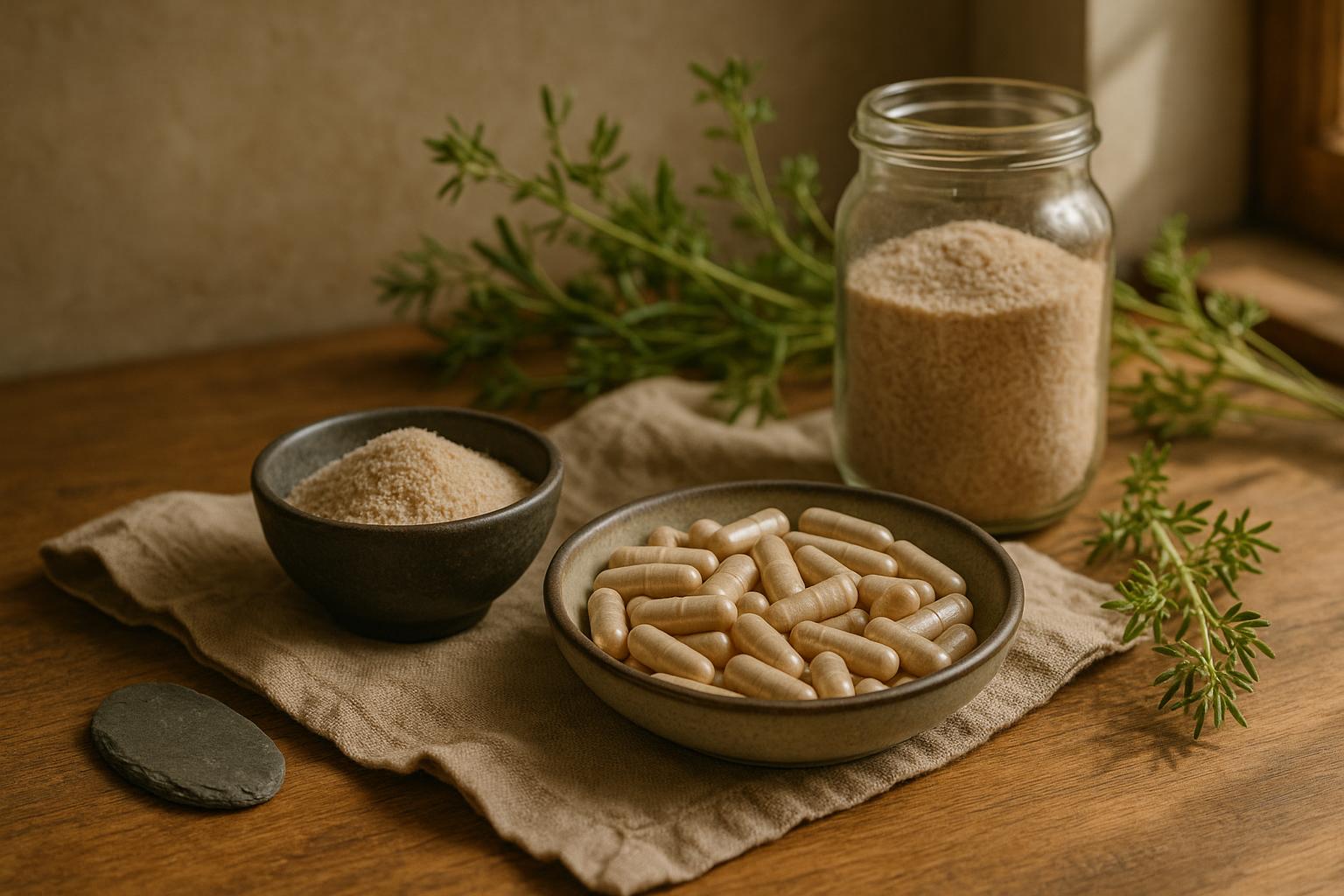
Psyllium capsules or powder: knowing how to choose
⚠️ Medical advice: The information in this article is for informational purposes only and is not a substitute for professional medical advice. Consult your doctor or pharmacist before starting any supplementation, especially if you are taking medication or have a digestive condition.
Psyllium capsules or powder : both forms contain the same active mucilage, but their convenience, dosage, and speed of action differ depending on your lifestyle. A study published in the American Journal of Clinical Nutrition () confirms that a daily dose of 10 to 15 g of psyllium fiber significantly reduces LDL cholesterol and improves bowel movements, according to PubMed [1]. Here's what you need to know before choosing.
- Psyllium powder acts faster thanks to immediate contact with water.
- Psyllium capsules are more convenient when traveling and have no taste or texture.
- The effective dose is the same: 5 to 10 g of active fiber per day.
- Blond psyllium (Plantago ovata) is the most scientifically studied variety.
- Both forms must absolutely be taken with a large glass of water.
1. Psyllium capsule or powder: what is the fundamental difference?
Psyllium capsules and powder both come from the same plant: Plantago ovata, also known as ispaghula. The only difference lies in the dosage form, that is, how the soluble fiber is packaged and ingested. The psyllium husks—the outer covering of the seed—are ground to obtain the powder, or encapsulated to produce capsules.
The active mucilaginous fiber is identical in both cases. It absorbs water in the intestine to form a viscous gel that facilitates intestinal transit. The biochemical composition does not change depending on the form chosen.
What changes: the release speed, ease of use, cost per dose, and versatility in cooking. These four criteria will guide your choice between psyllium capsules and powder.
2. Psyllium powder: advantages and disadvantages
Psyllium powder is the most common and best-documented form in clinical studies. It partially dissolves in water and quickly forms a thick gel. This immediate contact with liquid accelerates its effect on intestinal transit.
- Advantages: fast action, versatile in cooking (bread, smoothie, yogurt), lower cost per gram of fiber, easy to measure with a spoon.
- Disadvantages: gelatinous texture sometimes off-putting, slightly earthy taste, requires an immediate glass of water, not very practical when traveling.
Psyllium powder is particularly recommended for those who cook gluten-free. It partially replaces gluten in bread dough. To learn more about its culinary uses, see our guide to using psyllium powder in cooking, which offers detailed practical tips.
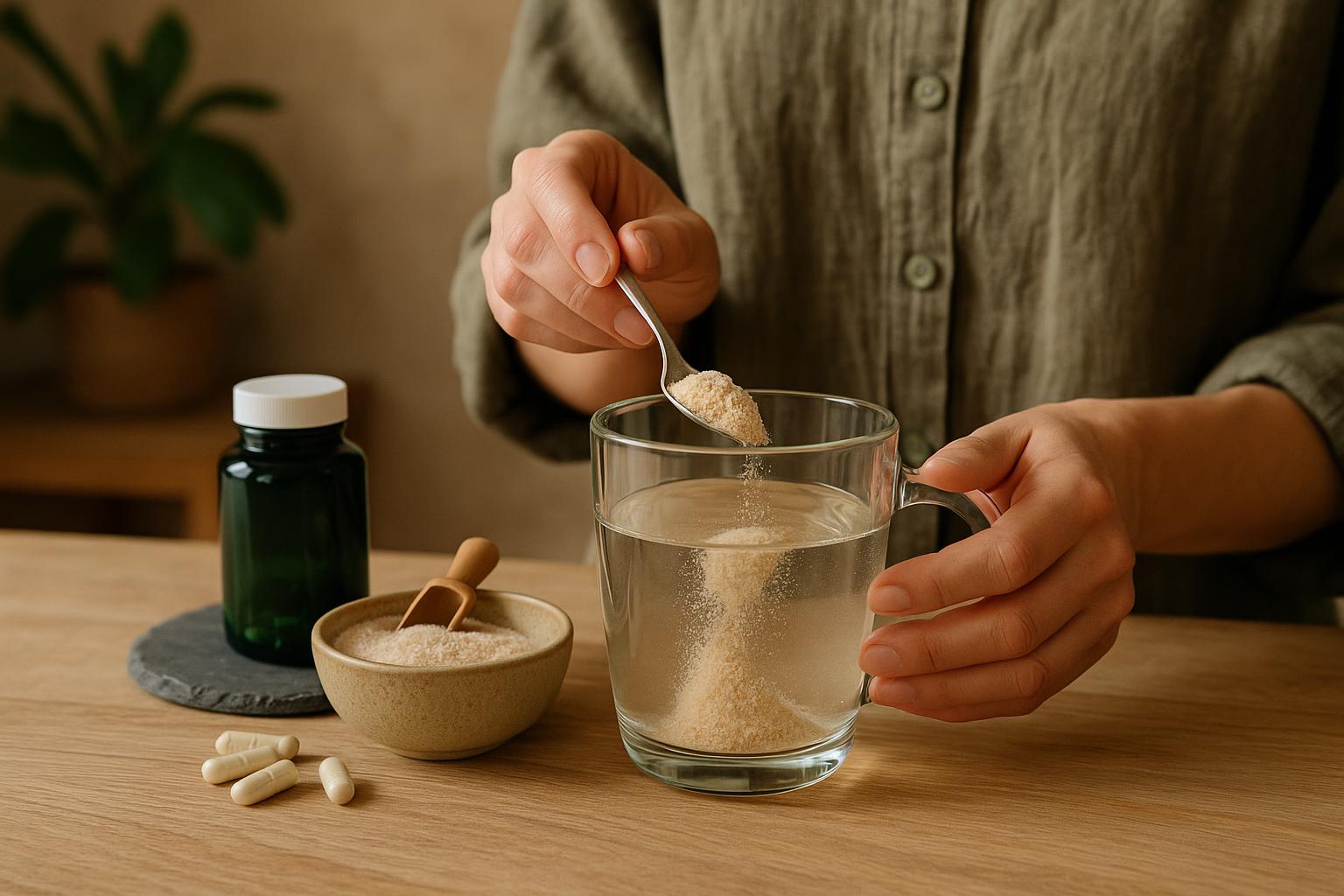
3. Psyllium capsules: for whom and why?
Psyllium capsules typically contain 200 to 500 mg of husk powder per capsule. To reach an effective dose of 5 g of fiber, you often need to swallow 6 to 10 capsules per day, depending on the product's dosage. This is the main drawback of this form.
- Advantages: tasteless, textureless, easy to transport, precise dosage, ideal for people sensitive to tastes.
- Disadvantages: high number of capsules per day, higher cost per gram of fiber, less versatile in cooking.
Psyllium capsules are particularly suitable for people who travel often, seniors who have difficulty with thick textures, and those who wish to incorporate psyllium into their dietary supplement routine without changing their eating habits.
According toANSES (), psyllium is well tolerated in all forms, provided that the progressive dose and hydration are respected according to ANSES [2].
4. Comparative dosage: psyllium capsule or powder, how much to take?
The effective dosage of psyllium capsules or powder depends on the amount of active fiber absorbed, not the volume of the form. A level teaspoon of psyllium powder provides approximately 3 to 5 grams of soluble fiber. Capsules containing 500 mg provide 0.5 grams of fiber each.
| Criteria | Psyllium powder | Psyllium capsules |
|---|---|---|
| Recommended daily dose | 1 to 3 teaspoons (5-10 g) | 6 to 12 capsules of 500 mg |
| Speed of action | Fast (immediate freezing) | Slightly delayed (capsule dissolution) |
| Average cost per dose | 0.10 to 0.25 € | €0.30 to €0.60 |
| Practicality when traveling | Weak | Excellent |
| Culinary use | Yes (bread, smoothie) | No |
| Hydration is essential | Yes (250 ml minimum) | Yes (250 ml minimum) |
Regardless of the form you choose, always start with a low dose and gradually increase it over two weeks. This helps prevent bloating and intestinal cramps, which are common at the beginning of supplementation. To learn how to safely take psyllium daily, consult our dedicated guide.
5. Comparative effectiveness on intestinal transit
In terms of effectiveness, psyllium capsules or powder produce equivalent effects at an equal dose of active fiber. A meta-analysis published in the Journal of the Academy of Nutrition and Dietetics () confirms that 10 g of psyllium per day significantly improves stool frequency and consistency in cases of chronic constipation, according to PubMed [3].
Psyllium powder offers a slight advantage in cases of acute constipation: the gel forms more quickly in the intestine. Capsules require the gelatin or vegetable cellulose capsule to dissolve first, which slightly delays their effect by 15 to 30 minutes.
For diarrhea, both forms are equally effective. Mucilaginous fiber absorbs excess water in the colon and normalizes stool consistency. It is one of the few fibers that works in both directions of intestinal transit.
6. Psyllium capsules or powder for cholesterol and blood sugar
The cardiovascular and metabolic benefits of psyllium are well documented. In , EFSA validated the following health claim: 10 g of psyllium husks per day contributes to maintaining normal blood cholesterol levels according to EFSA [4] .
- Psyllium gel traps bile acids in the intestine and reduces their reabsorption.
- The liver compensates by converting more LDL cholesterol into bile acids.
- LDL cholesterol decreases by an average of 5 to 10% after 8 weeks of supplementation.
- The glycemic index of meals decreases due to the slowing of carbohydrate absorption.
These effects are identical with psyllium capsules or powder, provided you reach a dose of 10g of active fiber per day. To discover all the health benefits, the advantages of psyllium are detailed in our comprehensive article.
7. How to take psyllium depending on the chosen form?
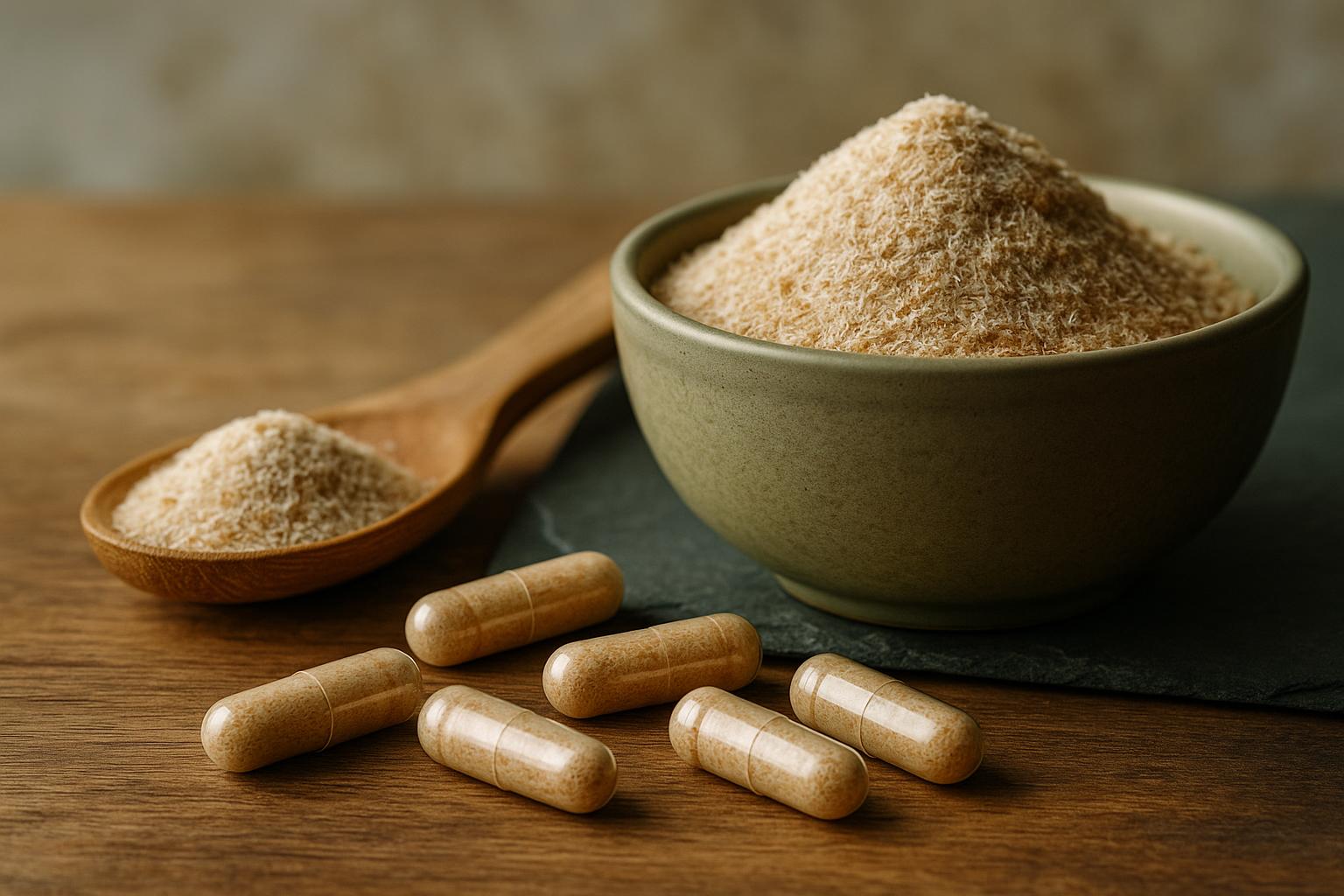
The number one rule for psyllium capsules or powder is the same: always drink at least 250 ml of water immediately after taking it. Without sufficient hydration, psyllium can form a blockage in the esophagus or intestines, which is dangerous.
For psyllium powder:
- Pour 1 teaspoon (3-5 g) into a large glass of cold or lukewarm water.
- Mix quickly and drink immediately before gel forms.
- Drink a second glass of water within the next few minutes.
- Ideally, take it 30 minutes before meals for an appetite-suppressant effect.
For psyllium capsules:
- Swallow 3 to 6 capsules depending on the product dosage (read the label).
- Serve with a large glass of water (minimum 250 ml).
- Do not take while lying down or just before sleeping.
- Leave at least 2 hours between taking the medication.
Many readers report that dividing the dose into two daily intakes (morning and evening) improves digestive tolerance and reduces initial bloating. For a complete protocol, see our step-by-step guide on how to take psyllium for constipation
8. Psyllium capsules or powder: which to choose depending on your goal?
The choice between psyllium capsules or powder depends primarily on your health goals and lifestyle. Here's a quick guide to help you decide.
- Chronic constipation: opt for powder for faster action and flexible dosage.
- High cholesterol: both forms are equivalent at an equal dose of 10 g/day.
- Weight loss: the powder mixed with water before meals creates a more pronounced satiating effect.
- Type 2 diabetes: the powder taken with meals slows down carbohydrate absorption better.
- Whether for travel or simple routine: capsules are more convenient and require no preparation.
- Gluten-free cooking: only the powder can be incorporated into bread and pastry recipes.
- Elderly people or those sensitive to texture: capsules avoid the uncomfortable gelatinous texture.
9. Blond psyllium or brown psyllium: an additional difference
Before choosing between psyllium capsules or powder, it's also important to distinguish between blond and brown psyllium. Blond psyllium (Plantago ovata) contains 70% mucilage, compared to 40% for brown psyllium (Plantago psyllium). It is therefore twice as concentrated in active fibers.
Scientific studies focus almost exclusively on blond psyllium. This is the form recommended by the NCCIH for therapeutic uses according to the NCCIH [5]. Always check the label of your product, whether it is in capsule or powder form.
To understand the specifics of blond psyllium, what blond psyllium is used for, we answer all your questions about this variety.
10. Precautions and contraindications common to both forms
Psyllium capsules or powder share the same precautions for use. These soluble fibers are generally well tolerated, but certain situations require particular attention.
- Drug interactions: Psyllium may reduce the absorption of certain medications (metformin, lithium, digoxin). Always leave 2 hours between doses.
- Allergy: rare but possible, especially in people allergic to grasses.
- Intestinal obstruction: contraindicated in cases of known stenosis or intestinal obstruction.
- Difficulty swallowing: the capsules may be dangerous for people with severe swallowing difficulties.
- Pregnancy and breastfeeding: consult your doctor before taking any supplements.
The most common side effects at the start of supplementation are bloating, gas, and abdominal cramps. These usually disappear after 7 to 14 days of gradual adjustment.
11. Quality and labels: how to choose a good product?
The quality of psyllium capsules or powder varies considerably between brands. To ensure the effectiveness of your supplement, check these criteria before purchasing.
- Mucilage index: greater than 160 for pharmaceutical grade blond psyllium.
- Organic certification: AB label or European equivalent to avoid pesticide residues.
- Fiber content: at least 70% soluble fiber on the nutrition label.
- Origin: India (Gujarat) produces 80% of the world's top-quality psyllium.
- Vegetable capsules: prefer HPMC capsules for vegetarians and vegans.
12. Psyllium capsule or powder and gut microbiota
Psyllium also acts as a prebiotic. The soluble fiber in psyllium nourishes the bifidobacteria and lactobacilli present in the colon. A study published in the British Journal of Nutrition () shows that 10 g of psyllium per day significantly increases the diversity of the gut microbiota after 4 weeks.
This prebiotic effect is identical with psyllium capsules or powder. It complements the gel's mechanical action on intestinal transit by promoting a healthy gut environment in the long term. The partial fermentation of mucilage in the colon produces SCFAs that are beneficial for the intestinal lining.
13. How long before I see results?
With psyllium capsules or powder, the first effects on bowel movements generally appear within 12 to 72 hours. Benefits on cholesterol and blood sugar require 4 to 8 weeks of regular supplementation at an effective dose.
- Intestinal transit: 12 to 72 hours (constipation or diarrhea).
- LDL cholesterol: 4 to 8 weeks at 10 g/day.
- Postprandial blood glucose: from the first dose if taken with a meal.
- Feeling of fullness: immediate if taken 30 minutes before the meal.
- Gut microbiota: 3 to 4 weeks of regular supplementation.
14. Key takeaways
Psyllium capsules or powder: both forms are effective with the same dose of active fiber. Choose the powder if you're looking for fast action, lower cost, or culinary use. Opt for capsules if you prioritize convenience, a smooth texture, and easy dosing on the go.
In all cases, adhere to the gradual increase of 3 to 10 grams of fiber per day and drink at least 250 ml of water with each dose. This is the essential rule for getting the most benefit from psyllium capsules or powder without the risk of adverse effects.
Practical advice: Start with half a teaspoon of powder (or 3 capsules) in the morning with a large glass of water for 7 days, then double the dose if well tolerated. Reassess after 4 weeks with your doctor or pharmacist.
- Psyllium capsules or powder contain the same active mucilaginous fibers derived from Plantago ovata.
- Psyllium powder works faster and costs less per dose than psyllium capsules.
- Psyllium capsules are ideal for people on the go or sensitive to the gelatinous texture.
- Psyllium capsules or powder absolutely require a minimum of 250 ml of water with each dose to avoid any risk of obstruction.
- The effectiveness of psyllium capsules or powder is equivalent at equal doses: 10 g of fiber per day for cardiovascular benefits validated by theEFSA.
Frequently asked questions about psyllium capsules or powder
What is the difference between psyllium capsules and powder?
The only difference between psyllium capsules and powder is the dosage form. Both contain the same blond psyllium husks and the same active mucilaginous fibers. The powder acts slightly faster because the gel forms immediately upon contact with water. Capsules are more convenient but require swallowing several per day to reach the effective dose.
How many psyllium capsules should I take per day?
The number of psyllium capsules depends on the product's dosage. For 500 mg capsules, you generally need 6 to 12 capsules per day to reach 3 to 6 g of active fiber. Some products recommend 3 to 6 capsules of 220 mg capsules. Always read the label and start with the minimum dose for 7 to 14 days.
Is psyllium powder more effective than capsules?
No, psyllium capsules and powder are equally effective at the same dose of active fiber. Psyllium powder has a slight advantage in terms of speed of action because the mucilaginous gel forms immediately in the stomach. But in the long term, the benefits for intestinal transit, cholesterol, and blood sugar are identical in both forms.
Can you take psyllium capsules or powder every day?
Yes, psyllium capsules or powder can be taken daily over the long term. The EFSA has approved its regular use at 10g per day to maintain normal cholesterol levels. There is no risk of addiction or habituation. However, start gradually and stay well-hydrated throughout the day.
How can I take psyllium powder without it thickening too quickly?
Pour the psyllium powder into a large glass of cold water and drink immediately, stirring well. The cold water slightly slows the formation of the mucilaginous gel. You can also mix the powder into a smoothie, yogurt, or applesauce. Avoid preparing the mixture in advance, as the gel thickens considerably within minutes.
Is psyllium in capsule or powder form suitable for vegetarians?
Psyllium powder is naturally vegetarian and vegan. For psyllium capsules, check the capsule composition: capsules made with bovine or porcine gelatin are not suitable for vegetarians. Choose capsules made with HPMC (plant-based cellulose) or pullulan, clearly labeled as plant-based on the packaging.
Can psyllium capsules or powder be used for weight loss?
Psyllium capsules or powder can support weight loss thanks to their satiating effect. The mucilaginous gel slows gastric emptying and prolongs the feeling of fullness. The powder, taken 30 minutes before meals, is more effective for this purpose. However, psyllium is not a fat burner; it should be used as part of a comprehensive dietary rebalancing program.
Is psyllium in capsule or powder form safe during pregnancy?
Psyllium is generally considered safe during pregnancy for treating constipation, but it is essential to consult your doctor or midwife before taking it. Psyllium capsules or powder are not absorbed into the bloodstream and remain in the digestive tract. However, its interaction with certain prenatal supplements requires individualized medical advice.
How long before you see the effects of psyllium?
The effects of psyllium capsules or powder on intestinal transit appear within 12 to 72 hours. Benefits on LDL cholesterol require 4 to 8 weeks of regular supplementation with 10g of fiber per day. The effect on postprandial blood sugar is almost immediate after the first dose if psyllium is consumed with a meal.
Can psyllium capsules or powder interact with medications?
Yes, psyllium capsules or powder can reduce the absorption of certain medications by forming a gel that traps them in the intestine. These medications include metformin, digoxin, lithium, blood thinners, and some antidepressants. Always leave at least two hours between taking psyllium before or after your other medications.
Which brand of psyllium capsules or powder should I choose?
To choose a good psyllium capsule or powder, check the mucilage index (above 160), organic certification, soluble fiber content (minimum 70%), and product origin (Gujarat, India). Brands that clearly display this information on the label are generally more reliable. Avoid products without indicating the active fiber content.
Does psyllium in capsule or powder form help with irritable bowel syndrome?
Psyllium, in capsule or powder form, is one of the best-tolerated fibers for irritable bowel syndrome (IBS). Unlike insoluble fibers, psyllium mucilage does not ferment excessively in the colon and does not cause excess gas. Several clinical studies show a reduction in abdominal pain and improved bowel movements in IBS patients after four weeks.
Sources and studies
- Psyllium fiber improves glycemic control proportional to loss of glycemic control: a meta-analysis of data in euglycemic subjects — American Journal of Clinical Nutrition,
- ANSES opinion on food supplements based on dietary fiber — ANSES,
- Dietary fiber and bowel transit time: a meta-analysis of randomized controlled trials — Journal of the Academy of Nutrition and Dietetics,
- Scientific Opinion on the substantiation of health claims related to psyllium seed husk — EFSA,
- Psyllium: Uses, Side Effects, and More — NCCIH,
This article is provided for informational purposes only and does not constitute medical advice. Consult a qualified healthcare professional before use.