
How to tell if kefir grains are still good: 5 signs
This article is for informational purposes only and does not replace professional medical advice. Consult a healthcare professional before making any changes to your diet.
How to know if kefir grains are still good : simply observe their texture, color, smell and fermentation activity to determine if they are still alive and effective.
- Firm, translucent grains indicate good microbial vitality
- A slightly acidic and lactic smell is a sign of healthy fermentation
- A visible multiplication of the grains confirms their biological activity
- Kefir that bubbles and foams after 24 to 48 hours indicates active microorganisms
- The absence of colored mold or putrid odor guarantees their safety
Knowing how to tell if kefir grains are still good is essential for any home fermentation enthusiast. According to a study published on PubMed, healthy kefir grains contain between 10 and 100 billion microorganisms per gram. Knowing how to tell if your kefir grains are still good helps you avoid consuming a potentially spoiled product and allows you to fully benefit from its probiotic properties.
How to tell if kefir grains are still good by their texture
Texture is the first indicator to examine. Healthy kefir grains are firm to the touch, slightly gelatinous, and resemble small cauliflower florets or puffed-up grains of rice. This compact structure testifies to the integrity of the polysaccharide matrix that houses the lactic acid bacteria and yeasts.
When wondering how to tell if your kefir grains are still good, gently squeeze a grain between your fingers. It should offer slight resistance without crushing. If it immediately disintegrates or sticks excessively to your fingers, it's a sign of advanced spoilage.
A slimy, viscous texture, unlike the light, natural gelatin, often indicates unwanted bacterial contamination. Grains that become very small and fragment abnormally have generally undergone significant stress: unsuitable temperature, lack of nutrients, or the presence of chlorine in the water used. In this case, a recovery period in filtered water can sometimes revive them.
The color of the grains: a key visual indicator to know if they are still good
Healthy kefir grains range in color from milky white to slightly translucent or yellowish, depending on their diet. However, determining if kefir grains are still good becomes crucial as soon as pink, orange, green, or black spots appear.
These unusual discolorations almost always indicate the presence of mold or pathogenic bacteria. This type of contamination renders the grains unusable and potentially dangerous. Never attempt to rinse the mold off the grains to salvage them; discard them immediately.
A slight, even yellowing can be normal if you use full-fat milk. But a bright yellow or orange discoloration in some areas warrants attention.
For fruit kefir, the kefir grains are naturally translucent to slightly yellowish. Any sudden cloudiness or unusual pink or brown coloration should raise a red flag. To understand best practices for starting out: how to make fruit kefir step by step.
How to tell if kefir grains are still good by their smell
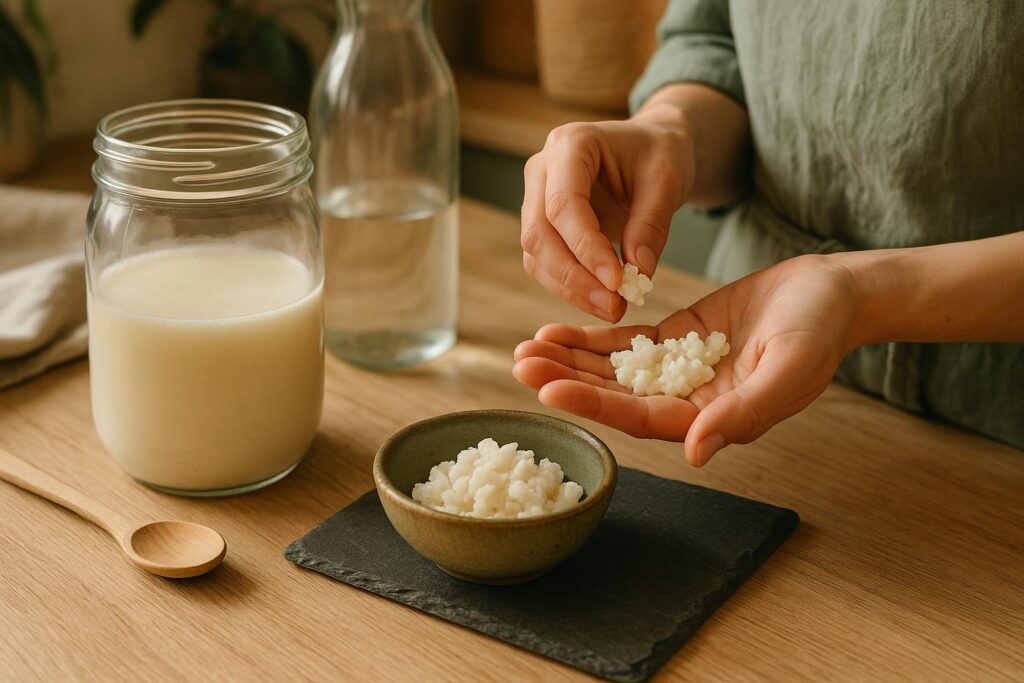
The sense of smell is a powerful and immediate diagnostic tool. Active kefir grains give off a characteristic odor: slightly acidic, lactic, sometimes slightly yeasty. This odor is pleasant, or at least neutral.
How can you tell if your kefir grains are still good by their smell? It's simple: if you detect a putrid, very strong cheesy, rotten, sulfurous, or excessively alcoholic odor, it's a warning sign. A slight alcoholic smell is normal in fruit kefir, as the yeasts naturally produce ethanol. But if this smell becomes dominant and pungent, the kefir grains are already experiencing an imbalance.
Always rinse your grains in filtered (chlorine-free) water before smelling them for a more accurate assessment. According to ANSES recommendations,tap water must be dechlorinated before any food use involving live cultures.
Fermentation activity: how to tell if kefir grains are still good by observing the bubbles
A live kefir grain ferments. That's its primary function. To find out if kefir grains are still good, place a small amount of grains in fresh milk or sweetened water and observe what happens after 24 hours at room temperature (between 18 and 24°C).
Active grains will cause the liquid to acidify, produce slight effervescence (CO2 bubbles), and gradually thicken the milk. If nothing happens after 48 hours, your grains are probably dormant or too weak to ferment properly.
Fermentation is the ultimate test. A grain that doesn't ferment is useless, even if it looks perfectly fine. Always test for activity after prolonged refrigeration or after shipping. Several reactivation cycles may be necessary before the grains regain their full effectiveness.
To learn more about good preparation practices: how to make your own kefir: a complete 7-step method.
How to tell if kefir grains are still good: multiplication as proof of life
Healthy kefir grains grow and multiply. This is one of the most reliable signs of their vitality. If your grains have remained the same size for several weeks, it's an indicator that something is wrong.
How can you tell if your kefir grains are still good by their growth? Weigh your grains before and after a week of regular fermentation. Healthy grains generally double in volume in one to two weeks under optimal conditions.
Factors that inhibit multiplication include: temperatures that are too low (below 15°C), a lack of sugar or lactose, excessively chlorinated water, contamination, or a pH that is too acidic (fermentation that is too long). Identifying the cause often allows the grains to be revived without being discarded.
How to tell if kefir grains are still good: quick diagnostic chart
This concise chart, which the competition never offers — allows you to diagnose the condition of your grains in 30 seconds:
| Sign observed | Diagnosis | Action |
|---|---|---|
| Firm, gelatinous, translucent white, tangy odor, active bubbles | ✅ Healthy Grains | Continue as normal |
| No bubbles after 48 hours, liquid remains sweet | ⚠️ Dormancy or weakness | Reactivation 5–7 days |
| Excessively slimy texture, strong cheese odor | ⚠️ Flora imbalance | Rinse, change the water, test for 3 days |
| Very small, fragmented, not very active | ⚠️ Nutritional stress | Change the water (to filtered), increase the sugar |
| Green, black, pink, orange spots | ❌ Mold | Dispose of immediately |
| A putrid odor, of sulfur, of rot | ❌ Contamination | Dispose of immediately |
| Liquid texture, without consistency | ❌ Dead grains | Throw away, start again |
| Zero activity after 10 days of reactivation | ❌ Unrecoverable grains | Throw away, obtain new grains |
How to tell if kefir grains are still good after long storage
Storage is a critical step. Grains kept in the refrigerator in milk or sweetened water can remain dormant for several weeks, or even several months. But how can you tell if the kefir grains are still good after this resting period?
The first step is to gently rinse them with filtered water. Examine their texture and color. If they appear visually intact, start a test fermentation cycle. The first one or two cycles may produce less active kefir: this is normal, the grains are gradually becoming active.
Dried or frozen grains require gradual rehydration. Place them in fresh milk or sweetened water at room temperature and change the liquid every 24 hours for three to five days. If no fermentation is visible after a full week, the grains are likely dead.
According to data published on the NCCIH, probiotic cultures can lose their viability if exposed to extreme temperatures or unsuitable storage conditions.
Detecting contamination: how to tell if kefir grains are still good in the face of mold

Mold contamination is the most feared scenario. It usually manifests as colored spots (green, black, pink, orange) on the grains or the surface of the kefir. How can you tell if your kefir grains are still good in the face of this risk? The rule is simple: any visible mold = discard the grains.
Mold can produce mycotoxins that are harmful to health. It is impossible to guarantee that rinsing the grains will completely eliminate these toxins. Thoroughly clean the pot and all utensils before starting again with new grains.
To prevent contamination: always use clean utensils, avoid metal, cover your jar with a breathable fabric and maintain impeccable hygiene.
How to tell if fruit kefir grains are still good: specifics
Fruit kefir grains (tibicos) have their own characteristics. How can you tell if the kefir grains are still good in this particular case? Healthy tibicos are translucent, slightly gelatinous, and resemble small sugar crystals. They should not be opaque, soft, or fragmented.
Active fruit kefir produces a slightly sparkling, tangy, and fruity drink in 24 to 48 hours. If your preparation remains flat and sweet after 48 hours, your grains are not fermenting properly.
Tibicos are often more resilient than milk kefir grains, but they can be weakened by excessive acidity, a lack of minerals, or overly purified water. Adding a dried fig or a clean eggshell to the jar can help rebalance the medium.
The importance of water and sugar for keeping kefir grains good
The quality of the water and sugar used directly influences the health of the grains. determine if kefir grains are still good . Grains weakened by chlorinated water or refined sugar low in minerals may appear unhealthy when they simply need a better substrate.
Always use filtered water, spring water, or tap water that has been left to stand for an hour to remove chlorine. For sugar, unrefined cane sugar or whole cane sugar provides beneficial trace minerals.
A change of water or sugar can sometimes be enough to revive grains that seemed to be dying. Before concluding that your grains are a lost cause, try these simple adjustments for a full week.
How to tell if kefir grains are still good using a pH test
pH is an objective tool for assessing the activity of your grains. Properly fermented milk kefir has a pH between 3.5 and 4.5. Active fruit kefir typically reaches a pH between 3.0 and 4.0 after 24 to 48 hours of fermentation.
How can you tell if your kefir grains are still good using this method? Use pH test strips available at pharmacies. If your kefir's pH doesn't drop below 5.0 after 48 hours, your grains aren't fermenting sufficiently—a clear sign of microbial weakness.
A pH that is too low (below 3.0) indicates excessive fermentation, which can stress the grains. Research published on PubMed confirms that the acidity profile of kefir is directly correlated with the diversity and vitality of its microbial community.
How to revive kefir grains that seem to have gone bad
Before throwing away your grains, try a reactivation procedure. How do you know if kefir grains are still good after reactivation? Follow these steps: rinse the grains with filtered water, place them in a volume of milk or sweetened water two to three times greater than their usual volume, and let them ferment at room temperature for 24 hours.
Repeat this process for five to seven consecutive days without consuming the kefir produced. This period of "intensive feeding" allows the grains to replenish their microbial population. If no improvement is visible after a full week, the grains are probably too damaged to be salvaged.
To understand all the steps of a successful fermentation from the start: how to make your own kefir in 5 simple steps.
How to tell if kefir grains are still good or if they need to be thrown away
Some signs are unmistakable. Discard your grains immediately if you observe: colored molds (green, black, pink), a putrid or rotten smell, a completely liquid and inconsistent texture, or a total absence of fermentation after ten days of intensive reactivation.
How can you tell if your kefir grains are still good in borderline cases? Trust your instincts. If something seems off, it's best to start over with fresh grains. Finding new grains is often easy: check out our guide on where to find kefir: 7 places to buy it easily. And for grains specifically: where to buy kefir grains: a complete guide.
- To determine if kefir grains are still good, start with the texture: firm and slightly gelatinous grains are healthy, soft or slimy grains are suspect.
- How to tell if kefir grains are still good by smell: a tangy, milky smell is normal, a putrid or sulfurous smell indicates contamination
- Multiplication and fermentation activity (bubbles, acidification, pH <5) are the most reliable evidence
- Any visible colored mold definitively answers the question: the grains are no longer good and must be thrown away immediately
- How to tell if kefir grains are still good after storage: test with a complete fermentation cycle and measure the pH of the kefir produced
Frequently asked questions about how to tell if kefir grains are still good
Can kefir grains die?
Yes, kefir grains can die if the living conditions of the microorganisms are not met. Prolonged exposure to extreme temperatures, contamination by chemicals such as chlorine, or a lack of nutrients for too long can kill the cultures. Dead grains will no longer ferment and must be replaced.
How can I tell if kefir grains are still good after freezing?
After thawing, rinse the grains with filtered water and run several test fermentation cycles. The first few cycles may be inactive. If, after five to seven days of regular feeding, no fermentation is visible and the pH does not drop below 5.0, the grains have not survived freezing.
Are kefir grains that are too small still good?
Very small grains can indicate nutritional stress or overly chlorinated water. They are not necessarily dead. Change the water, increase the amount of sugar or lactose, and observe their progress over a week. If they begin to grow and ferment again, they can be saved.
Does a slightly alcoholic smell mean the grains are bad?
Not necessarily. A slight alcoholic odor is normal in fruit kefir. However, if the alcoholic smell is very strong and dominant, it indicates an imbalance in the kefir grains. Reduce the fermentation time and check the temperature.
Is it safe to consume kefir grains that appear to be of questionable quality?
No. If you have any doubt about the condition of your grains, do not consume the kefir produced. Contaminated grains can transmit pathogenic bacteria or mycotoxins to the fermented liquid. The rule is simple: when in doubt, throw it away.
How to store kefir grains so they stay good for a long time?
Store milk kefir grains in fresh milk in the refrigerator, changing the milk weekly. For water kefir grains, store them in sweetened water in the refrigerator. For long-term storage, air-dry them or freeze them in an airtight bag with a little powdered milk.
Can kefir grains become slimy without it being bad?
A slightly gelatinous texture is normal. However, excessive viscosity and stickiness, unlike natural gelatin, often indicate contamination by bacteria that produce undesirable exopolysaccharides. If this stickiness is accompanied by a bad odor or a lack of fermentation, the grains are spoiled.
How long do kefir grains stay good in the refrigerator?
In fresh milk or regularly changed sweetened water, kefir grains can remain viable in the refrigerator for two to four weeks without active fermentation. Even minimal weekly feeding will maintain their vitality for several months.
Are yellow kefir grains still good?
A slight, even yellowing can be normal, especially with whole milk that is high in fat. However, a bright yellow, orange, or yellowing localized to certain areas is suspicious. Observe the changes over 24 to 48 hours and simultaneously check the smell and fermentation activity.
How can I tell if kefir grains are still good if I receive them by mail?
Grains received by mail may be dormant or slightly stressed. Gently rinse them, examine their texture and color, then immediately start a reactivation cycle. Change the liquid every 24 hours for five days before consuming the resulting kefir.
Does kefir that doesn't bubble indicate damaged grains?
Not always. Low effervescence can be due to a temperature that is too low, a lack of sugar, or a fermentation that is too short. Wait 48 hours at room temperature before drawing any conclusions. If, after 48 hours at 20–22°C, no bubbles are visible and the liquid remains sweet and not acidic, your grains lack microbial activity.
Do milk and fruit kefir grains degrade in the same way?
Both types share common signs of spoilage: abnormal texture, unpleasant odor, lack of fermentation, and mold. Fruit kefir grains are generally more resistant to temperature fluctuations. Milk kefir grains are more susceptible to contamination and require stricter hygiene.
Key takeaways
Knowing how to tell if kefir grains are still good is an essential skill for any home fermenter. The indicators are clear and accessible: firm texture, natural color, tangy aroma, active fermentation, and regular multiplication. These five criteria, assessed together, give you a reliable picture of the health of your grains.
Never ignore a warning sign. Apply the reactivation methods described before discarding your grains, but know when it's time to start over. To fully enjoy the benefits of kefir once your grains are revived: the health benefits of kefir: 9 proven effects.
Studies and scientific sources
This article is provided for informational purposes only and does not constitute medical advice. Consult a qualified healthcare professional before use.